Subdomain Takeover at Landing.udemy.com
A subdomain of the target pointed via a DNS CNAME record to an Unbounce-hosted page that was no longer claimed, so anyone could register that page name on Unbounce and serve their own content on the target's domain. An attacker could then host convincing HTML or JavaScript there for phishing or cross-site scripting against users who trust the domain.
 Originally disclosed on HackerOne
- Fixed in 3 days
- Paid in 3 days
- Disclosed after 33 days
Target: Landing.udemy.com
###Details:
The target subdomain points to unbounce.com service, via a DNS CNAME record. As a result of this, an attacker could potentially initiate a subdomain takeover by registering the subdomain on unbounce.com.
Additionally,
Unbounce is a custom 404-page hosting service, therefore leveraging its functionality an attacker can host custom HTML/Javascript webpage on the domain which will look very legitimate to the end-user and can be used to conduct large-scale phishing/XSS attacks.
###Proof of Concept:
CNAME Record:
Cname: unbouncepages.com Name: landing.udemy.com Type: CNAME Class: IN TTL: 300
I did not proceed with the takeover, Contacting the support and confirming from them was more sensible.
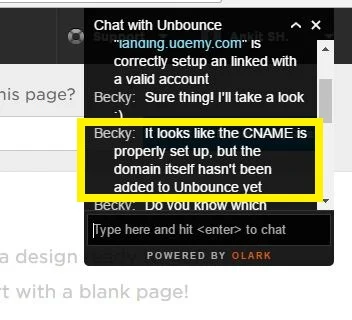
###Remediation:
Remove the CNAME entry or claim the domain by signing up on unbounce.com
~Regards
Not written yet. The AI write-up for this report has not been written yet. The Original tab links to the source.
How it worked
Root cause
Likely a dangling DNS CNAME record pointing to an Unbounce page that was never claimed or had been released, leaving the name free for anyone to register.
Impact
An attacker could host custom HTML or JavaScript on the trusted domain, which could be used for large-scale phishing or cross-site scripting; the reporter did not actually perform the takeover.
What the attacker needed
DNS CNAME points to Unbounce; Unbounce page name is unclaimed
The fix
The CNAME entry should be removed, or the domain should be claimed by signing up on the hosting service.
How it was found
- Look up the DNS records for the target subdomain and note the CNAME pointing to the Unbounce service.
- Check whether the referenced Unbounce page is unclaimed, which would allow anyone to register it.
- Stop before completing the takeover and instead contact the company's support to confirm the issue.
Explained by bugbounty.wiki with AI from the original and checked against quotes from it; it can still be wrong. Read the original before relying on a detail.
Not written yet. The AI write-up for this report has not been written yet. The Original tab links to the source.
A DNS record is like an address book entry that tells browsers where a name such as landing.example.com actually lives. Here that entry pointed at a third-party page-hosting service, and nobody at the company had claimed the page name there, so a stranger could claim it and put their own content on the company's own web address. Visitors would see the trusted domain name and might not notice the page was controlled by someone else.
What is Subdomain takeover?
A company's DNS still points at a cloud service it no longer uses, so anyone can claim it and serve content on the company's domain.





