Privilege Escalation vulnerability in steam's Remote Play feature leads to arbitrary kernel-mode driver installation
Steam verifies its installed files only at startup, but installs two kernel-mode drivers later, the first time Remote Play streaming is used. An attacker who can modify those driver files after Steam starts could therefore get an arbitrary kernel-mode driver installed.
 Originally disclosed on HackerOne
- Triaged in 11 days
- Fixed in 4 months
- Paid in 4 months
- Disclosed after 17 months
Tested on Windows 10 x64
- On Steam starting, it will check all installed files' Integrity, and re-download the modified file(s). This step makes every single file in Steam installation folder is exactly its original self.
- Before the first time Steam stream to SteamLink (Remote Play feature), it makes SteamServices to install 2 kernel-mode drivers:
SteamStreamingMicrophoneandSteamStreamingSpeakersinC:\Program Files (x86)\Steam\drivers\Windows10\x64.
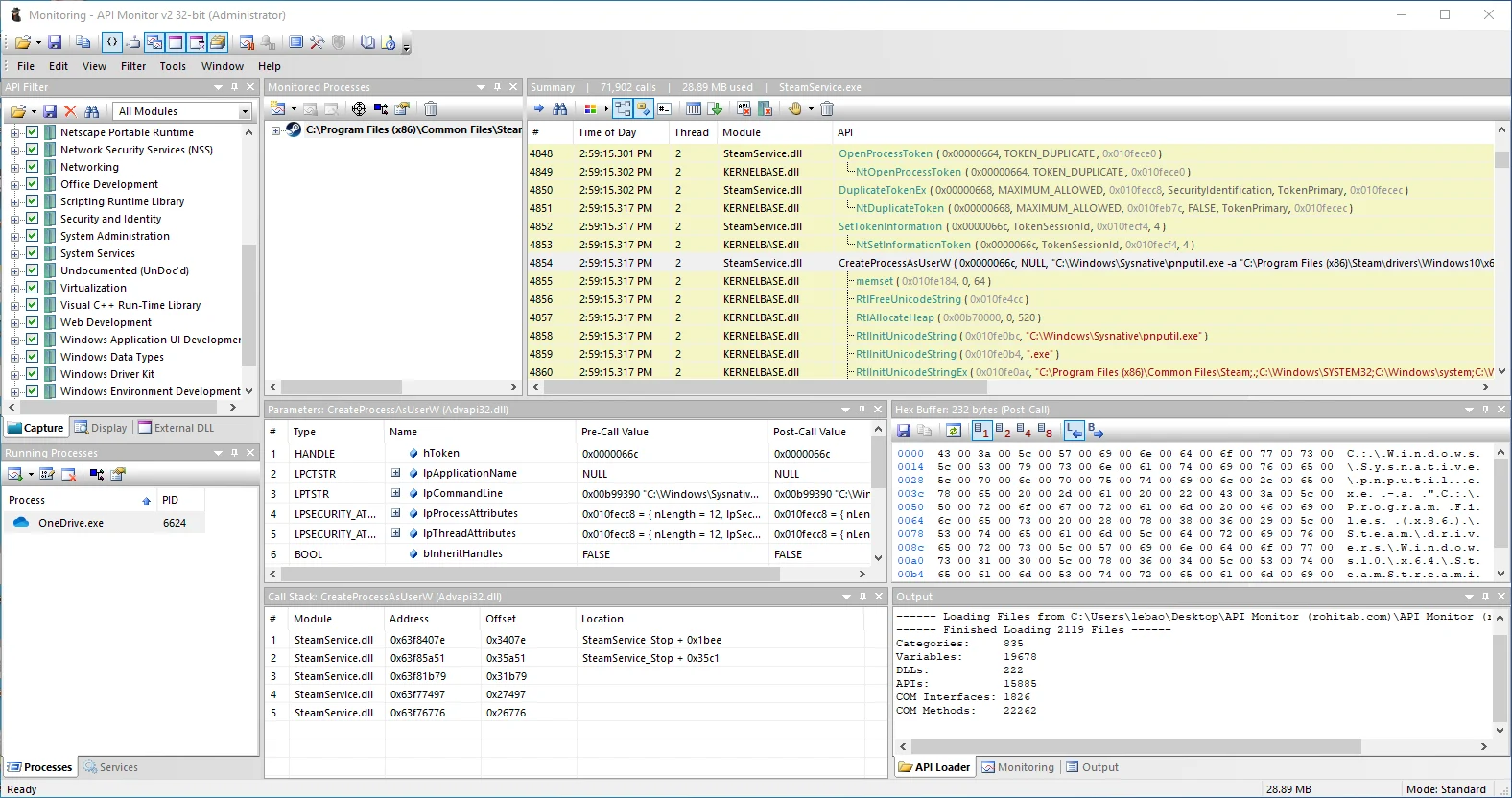
- From 2 points above, we can assume that if
SteamStreamingMicrophoneorSteamStreamingSpeakerswas modified after steam starting and before being installed (the first time streaming), the "modified" driver will be installed instead of the original one. This means an arbitrary kernel-mode driver can be installed from Steam. SteamStreamingMicrophone.sysandSteamStreamingSpeakers.sys██████
My fake driver: (Attachment on the original report: fake_driver.zip)
PoC Video:
Impact
Installing kernel-mode driver, which can lead to run code in kernel-mode,...
Not written yet. The AI write-up for this report has not been written yet. The Original tab links to the source.
How it worked
Root cause
Likely a time-of-check to time-of-use gap: integrity is verified at startup, but the driver files are installed later without being re-verified.
Impact
An attacker could get an arbitrary kernel-mode driver installed, which could lead to code running in kernel mode; the text does not show this being exploited end to end.
What the attacker needed
Ability to write to Steam's drivers folder; Steam started but not yet streamed; first Remote Play stream to a Steam Link
How it was found
- Start Steam so it performs its integrity check of installed files.
- Modify one of the two streaming driver files in the Steam drivers folder before any streaming has happened.
- Use Remote Play to stream to a Steam Link device for the first time, which triggers installation of the modified driver.
Explained by bugbounty.wiki with AI from the original and checked against quotes from it; it can still be wrong. Read the original before relying on a detail.
Not written yet. The AI write-up for this report has not been written yet. The Original tab links to the source.
Steam checks that its files are genuine when it opens, then trusts them afterwards. Two special driver files, which run with the deepest level of access on Windows, are only installed the first time you stream to another device. If someone swaps those files in the gap between the check and the install, Steam will install the swapped version without checking it again.
What is Access control?
A user can do something their role should not allow: reach an admin function, act on a feature they have not paid for, or skip a permission check. IDOR is the special case where the object belongs to someone else.

