Application XSS filter function Bypass may allow Multiple stored XSS
The application used a greedy regular-expression filter that stripped everything between '<' and '>' to block cross-site scripting. The author found a way to slip tags past that filter, so payloads could be stored in the database and would execute wherever output was not properly encoded.
 Originally disclosed on HackerOne
- Fixed in 39 days
- Paid in 2.0 years
- Disclosed after 5 months
Hi,
As i analysed the application behavior and the security structure, i found out that the application is using "Greedy XSS Regex filter" against XSS and removes any the whole string from '<' to '>'. So i tried some basic bypass which allowed me to insert tags and other characters into the string.
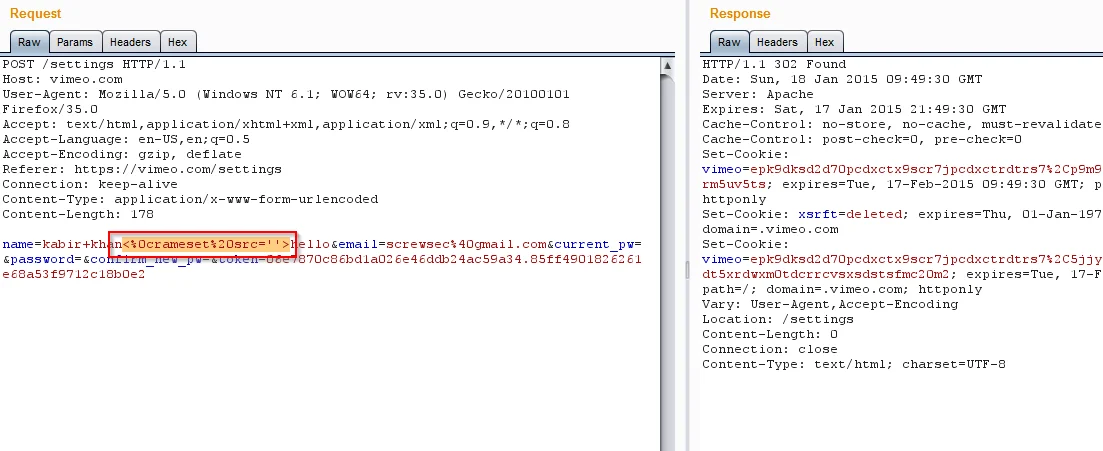
Here is the the payload: <%0crameset%20src=''>
Now if we see the whole application is using same filter against XSS which makes this bypass to be universally working on nearly all the input fields, which means we can say an attacker can successfully bypass and enter XSS payload in database but when the string prints in the frontend there is another filter, which encode all html entities before printing.
Nice but now enough as many of the inputs could in the below condition will end up with a successful XSS exploitation.
- Input under javascript.
- Any string not properly encoded before printing.
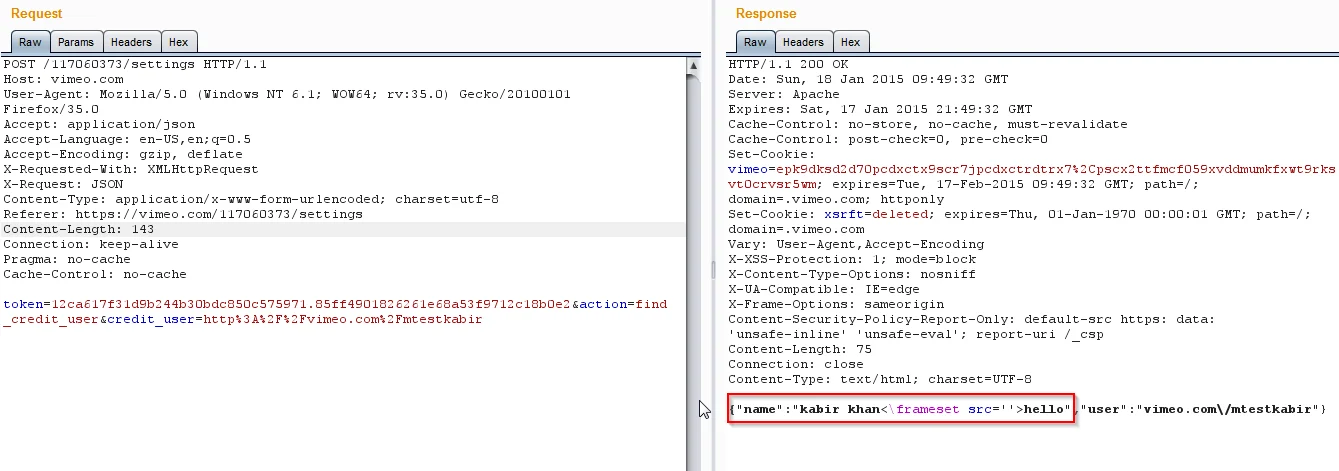
- JSON output with HTML headers.
I have already reported some issues in vimeo where input injected directly into javascript and do not need any html characters, another issue of JSON output with HTML headers.
Below you can see both reports: https://hackerone.com/reports/43934 https://hackerone.com/reports/44215
In the first screenshot you can see profile update request where i updates my profile and injected those HTML characters, in second screenshot you can see it injected in the response as stored XSS.
Attachments
Not written yet. The AI write-up for this report has not been written yet. The Original tab links to the source.
How it worked
Root cause
Likely the input filter relied on a greedy regular expression that removed text between '<' and '>' rather than properly parsing and encoding the input, so malformed or unusual tag syntax slipped through.
Impact
An attacker could store XSS payloads across nearly all input fields, and they would execute where output is placed inside JavaScript, is not properly encoded, or is returned as JSON with HTML headers.
What the attacker needed
Ability to submit input to the application; output rendered without proper encoding
How it was found
- Observe that the application strips everything between '<' and '>' as its XSS defence.
- Craft a tag that survives the greedy filter and still forms valid markup.
- Submit it through a profile update request so it is stored.
- View the response and confirm the payload is stored, executing where output is not encoded.
Explained by bugbounty.wiki with AI from the original and checked against quotes from it; it can still be wrong. Read the original before relying on a detail.
Not written yet. The AI write-up for this report has not been written yet. The Original tab links to the source.
A cross-site scripting (XSS) flaw lets an attacker put their own code into a page that other people view, so the code runs in those visitors' browsers. The site tried to block this by deleting anything between angle brackets, which are the characters that start and end HTML tags. The author found a way to sneak a tag past that deletion, so the malicious code could be saved and later shown to users.
What is XSS?
Script an attacker supplies runs in another user's browser, on the target's origin, with that user's session.




