Vine User’s Private information disclosure
An API endpoint returned full profile data for any user when given their numeric user ID, without checking that the requester was that user. An attacker could change the ID and read other users' private details, including email, phone number and IP address.
 Published on medium.com
This is Prial Islam a security researcher from Bangladesh . This is a old finding of mine adding into my blog .
The full write-up lives on its author's site
It belongs to its author, so we link to it rather than copy it. The other two tabs are our own rewrites, checked against it.
Context
Vine was a short-form video service, and this write-up concerns an API endpoint on vine.co that returns a user's profile record. The researcher first assumed the endpoint was meant to return the logged-in user's own profile data, as many sites have such endpoints. The researcher found that the same endpoint would return the full profile record of any user whose numeric identifier was supplied, not just the caller's own.
The report describes the issue as a critical IDOR (insecure direct object reference) leading to information disclosure. The researcher reported it to the Twitter Security team through their HackerOne bug bounty programme and was rewarded 7,560 USD. Vine published a statement about the vulnerability on the Vine blog, and HackerOne mentioned it in the Zero Daily newsletter of 11 July 2017.
Setup
No special tooling, accounts or versions are described. The researcher was testing Vine domains and noticed the endpoint while looking at responses. The only precondition is knowledge of a target user's numeric user ID, which the report says can be collected for any chosen user.
Finding it
The researcher noticed an endpoint whose response returned all information for their own account. At first this looked normal, since many sites have an endpoint that shows the logged-in user's information. The next thought was to try to exploit it through CORS in case the policy was misconfigured, but the CORS policy was in place, so that route was closed.
The turning point was changing the user ID value to a random number. The response then contained another user's information. By changing the user ID value, the researcher could retrieve all information for any Vine user.
The vulnerable endpoint is:
https://vine.co/api/users/profiles/<User Id>
Exploitation
Step 1: Choose a target and collect the user ID
Pick any user whose information you want, and collect that user's numeric user ID.
Step 2: Request the profile endpoint with that ID
Place the user ID in the endpoint and visit it. The response comes back in the body.
The <User Id> segment is the only variable. Substituting a different numeric ID returns a different user's record, with no ownership check tying the request to the caller.
Step 3: Read the response
The response body is a JSON object with a data member holding the profile record. The report shows the following response, with values removed by Twitter security because they belong to other users:
{"code": "", "data": {"followerCount": 16271364, "includePromoted": 1, "captchaSucceeded": 0, "recordComment": null, "locale": "iUS", "shareUrl": "https://vine.co/████████", "hiddenPhoneNumber": 0, "notPorn": 0, "userId": █████████, "private": 0, "likeCount": null, "commentCount": null, "platforms": ["android", "ios"], "postCount": null, "profileBackground": "0x33ccbf", "suspended": null, "hiddenFacebook": 0, "verifiedEmail": 0, "explicitContent": 0, "dmcaStrikeCount": 0, "flaggedCount": 7579, "verified": 1, "loopCount": 6132344784, "avatarUrl": "http://v.cdn.vine.co/r/avatars/████████████████████████████████████████.jpg?versionId=[redacted]", "authoredPostCount": 598, "review_result_illegal_review": 0, "review_result_ok": 0, "review": null, "suspendedBy": null, "twitterId": ████████, "phoneNumber": "██████████", "location": "Los Angeles California", "notifyActivity": 1, "facebookConnected": 1, "explicitContentAdmin": 0, "statsTags": null, "hiddenEmail": 0, "unflaggable": 0, "username": "████████", "modified": "2017–01–29T01:24:00.000000", "userIdStr": "████████", "twitterIdStr": "████████", "vanityUrls": ["kingbach"], "remixDisabled": 0, "deleted": null, "categories": null, "released": 0, "loopVelocity": null, "strikeCounts": [{"count": 0, "strikeType": "SEVERE_POLICY_VIOLATION"}, {"count": 0, "strikeType": "DMCA"}, {"count": 0, "strikeType": "SENSITIVE"}, {"count": 0, "strikeType": "POSSIBLY_ILLEGAL"}, {"count": 0, "strikeType": "GRAPHIC_NON_VIOLATING"}, {"count": 0, "strikeType": "ESC"}], "uploadHD": 1, "verifiedPhoneNumber": 1, "hiddenTwitter": 0, "vineVerified": 1, "notifyMessages": 1, "needsPhoneVerification": 0, "repostCount": null, "twitterScreenname": "██████", "secondaryColor": "0x33ccbf", "twitterVerified": 1, "captchaRequired": 0, "edition": null, "acceptsOutOfNetworkConversations": 1, "disableAddressBook": 1, "description": "Instagram/Twitter/Shots/SnapChat- @███ For booking go to the library", "escStrikeCount": 0, "review_result_explicit": 0, "notificationsLastViewed": "2016–04–26T21:03:35.000000", "email": "████████", "hideFromPopular": 0, "admin": 0, "contentReview": 0, "created": "2013–04–13T19:30:31.000000", "review_result_illegal_confirmed": 0, "followingCount": null, "lastLogin": "2016–12–13T23:29:40.000000", "escUser": 0, "ipAddress": "██████", "twitterConnected": 1}, "success": true, "error": ""}
The record mixes public profile fields with account-internal data. The fields the researcher singles out as private are:
"platforms": ["android", "ios"]
"flaggedCount": 7579
"twitterId": "█████████"
"phoneNumber": "█████"
"location": "Los Angeles California"
"modified": "2017–01–29T01:24:00.000000"
"notificationsLastViewed": "2016–04–26T21:03:35.000000"
"email": "█████████"
"created": "2013–04–13T19:30:31.000000"
"lastLogin": "2016–12–13T23:29:40.000000"
"ipAddress": "█████"
Beyond those, the response also carries moderation and account-state fields such as strikeCounts, dmcaStrikeCount, escStrikeCount, review_result_* flags, suspended, suspendedBy, admin, contentReview, unflaggable, hideFromPopular, verifiedEmail, verifiedPhoneNumber, needsPhoneVerification, twitterConnected, facebookConnected, disableAddressBook and acceptsOutOfNetworkConversations. The email address, phone number and IP address are disclosed directly in the body.
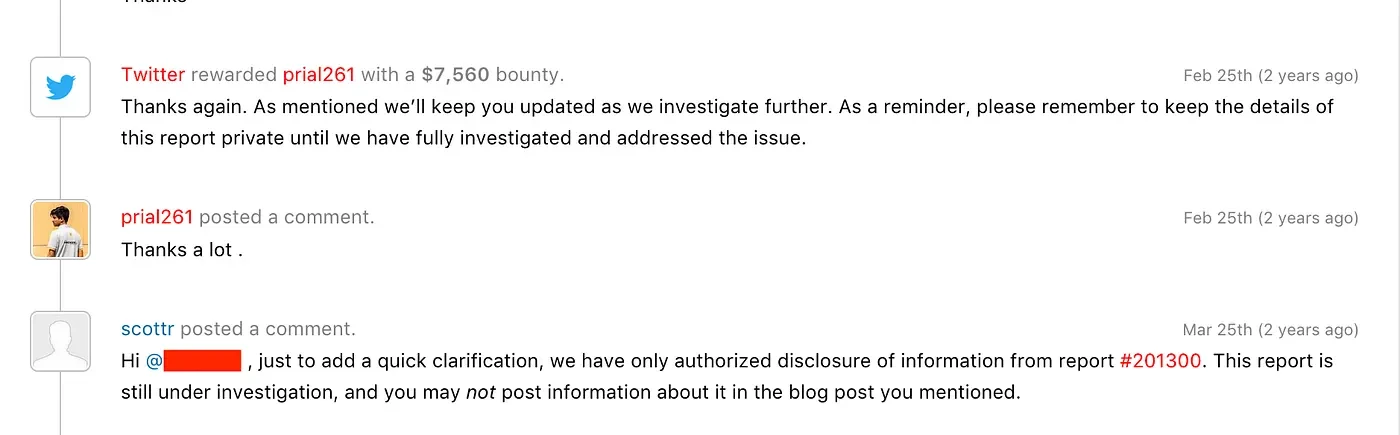
The image shows the reward and the blog post permission.
Root cause
The endpoint takes the user ID from the URL path and uses it to look up the profile record, but it does not check that the requested ID belongs to the authenticated caller. The numeric user ID is the only thing that selects which record is returned, so a caller can substitute another user's ID and read that record. The CORS policy was correctly configured, which is why the cross-origin route was not available, but CORS is a browser-side control and does nothing to stop a direct request to the endpoint. The report does not describe the server-side code, so the exact implementation mistake is not shown; the behaviour is consistent with a missing authorisation check on the object lookup.
Impact
An attacker who supplies another user's ID can retrieve that user's sensitive information, including IP address, email address and phone number, along with login timestamps, platform usage and moderation state. The researcher notes that an attacker could use this information for malicious attacks on any Vine user and could dump all user information. Because Vine users could log in with their Twitter account, the researcher states the issue also affects Twitter users. The report does not quantify how many records could be dumped or describe any rate limiting.
Fix
The report does not describe the fix that was applied.
Variants to test
- Numeric ID substitution on profile endpoints. Take an endpoint that returns the current user's record, replace the ID with another user's ID, and check whether the response contains that user's private fields. A positive result is a full record for a user other than the caller.
- Sequential enumeration. Walk IDs upward or downward from a known valid ID and look for records that return successfully. A positive result is a run of valid records for users you do not own.
- String versus numeric identifiers. Try the same substitution with usernames, vanity URLs or UUIDs where the endpoint accepts them. A positive result is the same disclosure through a different identifier form.
- CORS as a red herring. Confirm the CORS policy separately, then test the endpoint directly with a tool rather than a browser. A positive result is disclosure even when CORS is correctly locked down, since CORS does not protect server-side object access.
- Linked-account fields. Look for fields that reference other services, such as Twitter or Facebook IDs and connection flags, in the leaked record. A positive result is cross-service identifiers that widen the impact beyond the original platform.
What happened, in plain words
Vine was a service where people posted very short videos that played on a loop. Like most websites, it had a behind-the-scenes part that its own pages used to fetch information: a small web address that answers with data instead of a web page. That kind of address is called an API endpoint. Think of it as a serving hatch at a restaurant: the dining room (the website you see) does not cook anything itself, it asks the kitchen (the API) for a dish, and the kitchen passes it through the hatch.
The researcher first assumed this hatch was meant to hand back the profile details of the person who was logged in. The researcher, Prial Islam, found that this hatch did not check who was asking. If you changed one number in the address, the kitchen handed you somebody else's dish: the full profile record of a completely different Vine user, including their email address, phone number and IP address.
This kind of mistake has a name: IDOR, short for Insecure Direct Object Reference. The everyday comparison is a hotel. Your room key opens room 214. If the hotel's system simply trusts whatever room number you write on a slip of paper, you can write 215 and be let into a stranger's room. The room number is the "direct object reference": a plain identifier for a thing, used without checking that you are allowed to have that thing.
The researcher reported it to the Twitter Security team through their bug bounty programme on HackerOne. A bug bounty programme is a scheme where a company pays people who find security problems and report them privately instead of abusing them. The Twitter Security team paid 7,560 USD for the report. Vine published a statement about the vulnerability on the Vine blog, and HackerOne mentioned it in the Zero Daily newsletter of 11 July 2017.
Background you need first
A few ideas come up again and again below, so here they are from zero.
Website versus API. When you open a page in your browser, you get a page made of text and pictures meant for human eyes. An API endpoint is a different address on the same site that returns raw data, usually in a format called JSON, meant for a program to read. JSON is just a way of writing labelled values: curly braces group things together, and each entry is a name in quotes, a colon, and a value. {"colour": "blue"} says the field called colour has the value blue. It is like a form with labelled boxes.
User ID. Every account on a site needs an internal name that never changes, even if the person changes their public username. That internal name is often a plain number, called a user ID. It is not secret in the sense of a password; it is just an identifier, like a customer number on a loyalty card.
Authentication versus authorisation. Authentication is proving who you are, like showing your passport at a desk. Authorisation is the separate question of what you are allowed to do once you are in, like the desk checking whether your ticket is for the front row or the back row. Many security bugs are not failures of authentication (the site knows who you are) but failures of authorisation (the site forgets to check what you may see).
CORS. Browsers have a rule that stops a page on one website from quietly reading data from another website using your logged-in session. CORS (Cross-Origin Resource Sharing) is the mechanism a site uses to say, deliberately, which other sites may read its data. It is a browser-side guard: it constrains what a web page in a browser can do. It does nothing about a request sent directly to the server by a program, because there is no browser involved to enforce it.
Bug bounty. A programme, usually run on a platform such as HackerOne, where a company invites researchers to test its systems and pays for valid reports. The payment is called a bounty.
The vulnerable endpoint
The address at the centre of the report is:
https://vine.co/api/users/profiles/<User Id>
Line by line:
https://is the secure version of the web protocol; the padlock part.vine.cois the site's domain, the equivalent of a street address./api/signals that this is a data endpoint rather than a normal page./users/profiles/is the path, the part that says which shelf in the building you want: user profiles.<User Id>is a placeholder. It is not literal text; it is where a real number goes. The angle brackets are a convention meaning "put the value here".
So the whole address means: "give me the profile record for the user whose ID is whatever number I put at the end".
How it was found
The researcher was testing Vine's domains, looking for anything interesting, and noticed this endpoint because its response contained all the information for their own account. At first this seemed normal: plenty of sites have an endpoint that shows the logged-in user their own details, because the page needs that data to draw your profile.
The first idea was to attack it through CORS, in case the cross-origin policy had been set up wrongly. If CORS were misconfigured, a page on another site could read the data. But the CORS policy was in place, so that route was closed. This is worth pausing on: the researcher did not stop there. CORS being correct only means browsers are constrained; it says nothing about whether the server checks who is asking.
The turning point was simple. The researcher changed the user ID value in the address to a random number. The response came back containing another user's information. By changing the user ID, the researcher could retrieve all information for any Vine user.
Reproducing it
Step 1: Choose a target and collect the user ID
Pick any user whose information you want, and collect that user's numeric user ID. The report does not explain how the ID is obtained; it simply states that it can be collected for any chosen user.
Step 2: Put the ID in the endpoint and visit it
Place the user ID in the endpoint and visit it. The response comes back in the body, meaning the main content of the reply rather than headers or status information.
Line by line:
GETis the request method. It is the everyday "please give me this" verb of the web; opening a page in your browser is a GET.https://vine.co/api/users/profiles/is the fixed part of the address, the same for every user.<User Id>is the only variable. Substituting a different number returns a different user's record.
The key point is that nothing in the request ties it to the caller. There is no check that the ID in the address belongs to the person making the request. The server takes the number from the address, looks up that record, and returns it.
Step 3: Read the response
The response body is a JSON object. At the top level it has a code field, a data field holding the profile record, a success field and an error field. The report shows the following response, with values removed by Twitter security because they belong to other users:
{"code": "", "data": {"followerCount": 16271364, "includePromoted": 1, "captchaSucceeded": 0, "recordComment": null, "locale": "iUS", "shareUrl": "https://vine.co/████████", "hiddenPhoneNumber": 0, "notPorn": 0, "userId": █████████, "private": 0, "likeCount": null, "commentCount": null, "platforms": ["android", "ios"], "postCount": null, "profileBackground": "0x33ccbf", "suspended": null, "hiddenFacebook": 0, "verifiedEmail": 0, "explicitContent": 0, "dmcaStrikeCount": 0, "flaggedCount": 7579, "verified": 1, "loopCount": 6132344784, "avatarUrl": "http://v.cdn.vine.co/r/avatars/████████████████████████████████████████.jpg?versionId=[redacted]", "authoredPostCount": 598, "review_result_illegal_review": 0, "review_result_ok": 0, "review": null, "suspendedBy": null, "twitterId": ████████, "phoneNumber": "██████████", "location": "Los Angeles California", "notifyActivity": 1, "facebookConnected": 1, "explicitContentAdmin": 0, "statsTags": null, "hiddenEmail": 0, "unflaggable": 0, "username": "████████", "modified": "2017–01–29T01:24:00.000000", "userIdStr": "████████", "twitterIdStr": "████████", "vanityUrls": ["kingbach"], "remixDisabled": 0, "deleted": null, "categories": null, "released": 0, "loopVelocity": null, "strikeCounts": [{"count": 0, "strikeType": "SEVERE_POLICY_VIOLATION"}, {"count": 0, "strikeType": "DMCA"}, {"count": 0, "strikeType": "SENSITIVE"}, {"count": 0, "strikeType": "POSSIBLY_ILLEGAL"}, {"count": 0, "strikeType": "GRAPHIC_NON_VIOLATING"}, {"count": 0, "strikeType": "ESC"}], "uploadHD": 1, "verifiedPhoneNumber": 1, "hiddenTwitter": 0, "vineVerified": 1, "notifyMessages": 1, "needsPhoneVerification": 0, "repostCount": null, "twitterScreenname": "██████", "secondaryColor": "0x33ccbf", "twitterVerified": 1, "captchaRequired": 0, "edition": null, "acceptsOutOfNetworkConversations": 1, "disableAddressBook": 1, "description": "Instagram/Twitter/Shots/SnapChat- @███ For booking go to the library", "escStrikeCount": 0, "review_result_explicit": 0, "notificationsLastViewed": "2016–04–26T21:03:35.000000", "email": "████████", "hideFromPopular": 0, "admin": 0, "contentReview": 0, "created": "2013–04–13T19:30:31.000000", "review_result_illegal_confirmed": 0, "followingCount": null, "lastLogin": "2016–12–13T23:29:40.000000", "escUser": 0, "ipAddress": "██████", "twitterConnected": 1}, "success": true, "error": ""}
How to read this without any programming knowledge:
- The outer braces hold four things:
code,data,successanderror.successistrue, so the request worked. - Everything inside
datais the profile record. Each entry is a label and a value, separated by a colon. nullmeans "no value here".0and1are used as yes/no switches in many systems: 0 for no, 1 for yes.- The blacked-out blocks (████) are places where Twitter security removed the real values, because they belong to other users. The report says so explicitly.
- Some values are ordinary public profile things:
followerCount,loopCount,authoredPostCount,avatarUrl,description,vanityUrls. - Others are not public at all. That is the whole problem.
The record mixes public profile fields with account-internal data. The fields the researcher singles out as private are:
"platforms": ["android", "ios"]
"flaggedCount": 7579
"twitterId": "█████████"
"phoneNumber": "█████"
"location": "Los Angeles California"
"modified": "2017–01–29T01:24:00.000000"
"notificationsLastViewed": "2016–04–26T21:03:35.000000"
"email": "█████████"
"created": "2013–04–13T19:30:31.000000"
"lastLogin": "2016–12–13T23:29:40.000000"
"ipAddress": "█████"
Line by line, what each of these tells an outsider:
platformslists which kinds of device the person used the app on, here Android and iOS.flaggedCountis how many times the account has been flagged, here 7,579.twitterIdis the person's internal identifier on Twitter, which links the Vine account to a Twitter account.phoneNumberis the person's phone number.locationis a location string on the profile, here Los Angeles California.modifiedis when the record was last changed.notificationsLastViewedis when the person last looked at their notifications.emailis the person's email address.createdis when the account was created.lastLoginis when the person last signed in.ipAddressis the network address the person connected from.
An IP address is the number a device uses on the internet, a bit like a return address on an envelope. It can hint at where someone is and which network they use. Login timestamps plus an IP address are exactly the sort of thing an attacker uses to work out when someone is online and from where.
Beyond those, the response also carries moderation and account-state fields such as strikeCounts, dmcaStrikeCount, escStrikeCount, the review_result_* flags, suspended, suspendedBy, admin, contentReview, unflaggable, hideFromPopular, verifiedEmail, verifiedPhoneNumber, needsPhoneVerification, twitterConnected, facebookConnected, disableAddressBook and acceptsOutOfNetworkConversations. These describe internal decisions about the account: whether it is suspended, whether it has been reviewed, whether it is an admin, whether email and phone are verified, and which other services it is linked to. None of that is meant for strangers.
The email address, phone number and IP address are disclosed directly in the body. There is no trick needed to read them; they are simply there in the reply.
The image shows the reward and the blog post permission.
Why it worked
The endpoint takes the user ID from the URL path and uses it to look up the profile record, but it does not check that the requested ID belongs to the person making the request. The object reference, the numeric user ID, is exposed directly and is the only thing that selects which record comes back. So any caller can substitute another user's ID and read that person's record.
The CORS policy was correctly configured, which is why the cross-origin route was not available. But CORS is a browser-side control and does nothing to stop a direct request to the endpoint. Going back to the hotel comparison: the front desk might have a strict rule about who may walk through the lobby, but if the room doors themselves do not check keys, the lobby rule does not save you.
The report does not describe the server-side code, so the exact implementation mistake is not shown. The behaviour is consistent with a missing authorisation check on the object lookup: the server knows the request is valid, it just never asks whether this caller may see this record.
What an attacker could do with it
Someone who supplies another user's ID can retrieve that user's sensitive information: IP address, email address and phone number, along with login timestamps, platform usage and moderation state. The researcher notes that an attacker could use this information for malicious attacks on any Vine user and could dump all user information. Dumping means copying out records in bulk rather than one at a time.
Because Vine users could log in with their Twitter account, the researcher states the issue also affects Twitter users. The report does not quantify how many records could be dumped and does not describe any rate limiting. Rate limiting is a server-side rule that slows down or blocks someone making too many requests too quickly; it is the usual defence against walking through IDs one by one.
How it should have been fixed
Variants worth testing elsewhere
These are general patterns to try on other sites, not things the report says were tested here.
- Numeric ID substitution on profile endpoints. Take an endpoint that returns the current user's record, replace the ID with another user's ID, and check whether the response contains that user's private fields. A positive result is a full record for a user other than the caller.
- Sequential enumeration. Walk IDs upward or downward from a known valid ID and look for records that return successfully. A positive result is a run of valid records for users you do not own.
- String versus numeric identifiers. Try the same substitution with usernames, vanity URLs or UUIDs where the endpoint accepts them. A UUID is a long random-looking identifier, harder to guess than a number but not a substitute for a permission check. A positive result is the same disclosure through a different identifier form.
- CORS as a red herring. Confirm the CORS policy separately, then test the endpoint directly with a tool rather than a browser. A positive result is disclosure even when CORS is correctly locked down, since CORS does not protect server-side object access.
- Linked-account fields. Look for fields that reference other services, such as Twitter or Facebook IDs and connection flags, in the leaked record. A positive result is cross-service identifiers that widen the impact beyond the original platform.
Glossary
- API endpoint: an address on a website that returns raw data for programs rather than a page for people.
- Authentication: proving who you are, for example by logging in.
- Authorisation: the separate check of what you are allowed to see or do once you are known.
- Bug bounty: a programme that pays researchers for reporting security problems privately.
- Bounty: the payment made for a valid report.
- CORS (Cross-Origin Resource Sharing): a browser mechanism that controls which other websites may read a site's data; it constrains browsers, not direct server requests.
- Cross-origin: a request from one website's address to a different website's address.
- Data dump: copying out many records in bulk.
- Domain: the site's name and address, such as vine.co.
- GET: the web request method used to ask for something, such as opening a page.
- HackerOne: a platform that runs bug bounty programmes and hosts reports.
- IDOR (Insecure Direct Object Reference): a bug where a plain identifier such as a user ID selects a record without checking that the requester is allowed to see it.
- Information disclosure: leaking data to someone who should not have it.
- IP address: the number a device uses on the internet, which can hint at location and network.
- JSON: a text format of labelled values in curly braces, used for data between programs.
- null: a value meaning "nothing here".
- Rate limiting: a server rule that slows or blocks too many requests in a short time.
- Response body: the main content of a server's reply, as opposed to its headers or status.
- User ID: the internal, usually numeric, identifier for an account.
- UUID: a long random-looking identifier, harder to guess than a small number.
- Vanity URL: a custom, human-readable address for a profile, such as a chosen name in the URL.