Unclaimed Medium Publication takeover in WeTransfer
 Published on medium.com
Short Story
The full write-up lives on its author's site
It belongs to its author, so we link to it rather than copy it. The other two tabs are our own rewrites, checked against it.
Context
WeTransfer runs a paid bug bounty programme on Zerocopter, and this write-up covers an issue found while testing the company's main site, wetransfer.com. The site had a set of short paths, all beginning with blog, that existed to send visitors to the company's Medium publications. A request to one of these paths returned a 301 redirect whose Location header pointed at a medium.com publication URL. The feature therefore depends on two things outside WeTransfer's own infrastructure: the redirect itself, and the Medium publication that the redirect points to.
Medium lets anyone create a publication under a name that is not yet taken. If a redirect points at a publication name that nobody has claimed, the first person to register that name controls what every visitor to the WeTransfer path will see.
Setup
The researcher was testing wetransfer.com and used DIRB to brute-force paths on the host. No other tooling, account or precondition is described. The Medium account used to claim the publications is the researcher's own, and the only Medium-side page involved is the publication management page at https://medium.com/me/publications.
Finding it
The directory brute-force surfaced a group of paths that all answered with a 301 and an empty body, redirecting to Medium publication URLs. The paths and their redirect targets were:
https://wetransfer.com/blogger(CODE:301|SIZE:0), Location:https://medium.com/wetransfergerhttps://wetransfer.com/bloggers(CODE:301|SIZE:0), Location:https://medium.com/wetransfergershttps://wetransfer.com/blogindex(CODE:301|SIZE:0), Location:https://medium.com/wetransferindexhttps://wetransfer.com/blogs(CODE:301|SIZE:0), Location:https://medium.com/wetransfershttps://wetransfer.com/blogspot(CODE:301|SIZE:0), Location:https://medium.com/wetransferspothttps://wetransfer.com/blog_ajax(CODE:301|SIZE:0), Location:https://medium.com/wetransfer_ajaxhttps://wetransfer.com/blog_inlinemod(CODE:301|SIZE:0), Location:https://medium.com/wetransfer_inlinemodhttps://wetransfer.com/blog_report(CODE:301|SIZE:0), Location:https://medium.com/wetransfer_reporthttps://wetransfer.com/blog_search(CODE:301|SIZE:0), Location:https://medium.com/wetransfer_searchhttps://wetransfer.com/blog_usercp(CODE:301|SIZE:0), Location:https://medium.com/wetransfer_usercp
What made this worth following up is that the redirect target is a name on a third-party platform where names are first come, first served. A redirect to a publication that WeTransfer does not own is a dangling reference: the link is live, but the destination is not under the company's control.
Exploitation
Step 1: confirm the destination is unclaimed
Visiting the redirect target for the blogger path, https://medium.com/wetransferger, returned an error page rather than a publication. That error is the signal that the name is free.
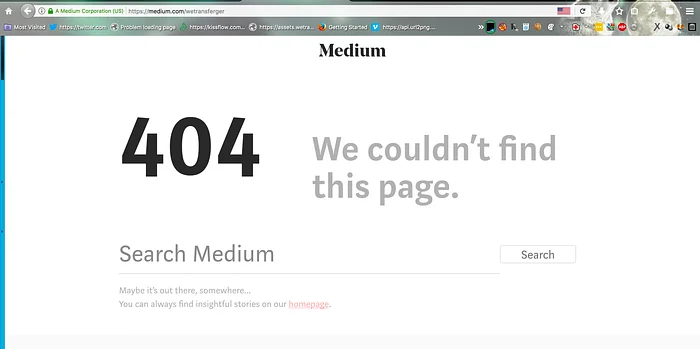
The screenshot shows the Medium error page reached at https://medium.com/wetransferger, captioned by the researcher as "Looks something wrong with this link".
Step 2: claim the publication name
The researcher went to https://medium.com/me/publications and created a new publication using the same name, wetransferger. Medium accepted it, and the publication link was then under the researcher's control. Anything could be placed on it.
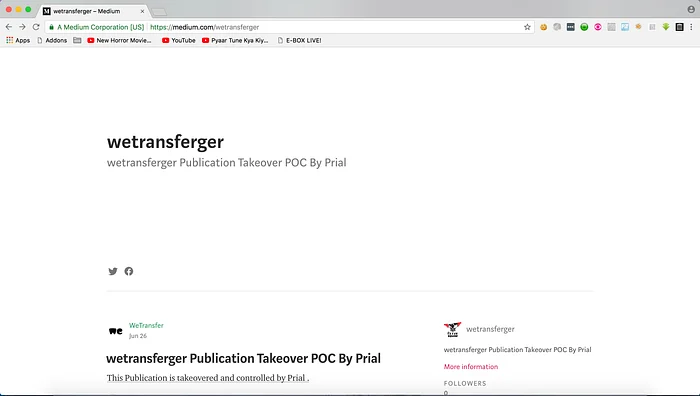
The screenshot shows the newly created publication, captioned "Publication Takeovered ;)".
Step 3: observe the redirect now landing on attacker content
With the publication claimed, any user who visits https://wetransfer.com/blogger is taken to the researcher's Medium publication. The WeTransfer path still behaves exactly as before; only the destination has changed hands.
Step 4: repeat across the list
The researcher was able to claim 5 unclaimed publications from the list above. The remaining redirects were not exploitable because their Medium links contained an underscore, and Medium does not allow an underscore in a publication link. Those targets therefore cannot be registered by anyone, which removes the dangling reference.
Step 5: report and reward
The issue was reported to the WeTransfer Bug Bounty programme, which rewarded the researcher with 100 Euro plus a one-year WeTransfer Plus account.
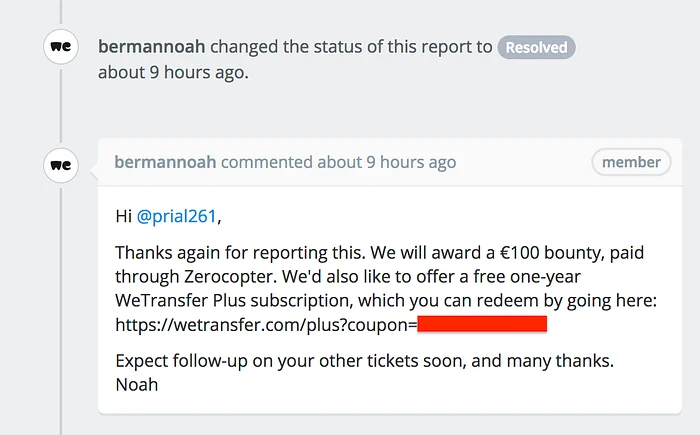
The screenshot shows the reward, captioned "Bounty Time :P".
Root cause
The redirects on wetransfer.com point at Medium publication names that WeTransfer never claimed. Medium allocates publication names on a first-come, first-served basis, so an unclaimed name is available to anyone who registers it. Nothing enforces that the names stay reserved, and the site keeps sending traffic to a destination it does not own. This is the broken link hijacking pattern: a link that is valid at the HTTP level but whose endpoint is claimable by a third party.
The only accidental defence in the set was the underscore rule on Medium, which made the targets whose links contained an underscore unregisterable. That is a property of the third-party platform, not of WeTransfer's configuration, so it protected those paths by luck rather than by design.
Impact
An attacker who claims one of the unclaimed publication names controls the content that visitors to the corresponding wetransfer.com path will see. Because the redirect originates from WeTransfer's own domain, users have no indication that the destination is not the company's. The attacker can place anything on the publication. The report does not describe any further use of the position, such as credential phishing or malware distribution, and does not state how much traffic these paths receive.
The exposure is limited to the paths whose Medium names are both unclaimed and valid under Medium's naming rules. Names containing an underscore fall outside it.
Fix
The report does not describe what WeTransfer changed. The measure it recommends is for site owners generally: if you use Medium publication links from your site, make sure each one is valid and claimed by you. In practice that means registering every publication name your redirects reference, and reviewing redirect targets periodically so that a name which becomes available again does not silently turn into a dangling link.
Variants to test
- Enumerate redirects to third-party platforms. Brute-force paths on the target host and collect every 301 whose
Locationpoints at a hosted service where names are user-registerable (Medium, GitHub Pages, Netlify, Read the Docs, status pages, form builders). A positive result is a redirect to a name that returns a not-found or unclaimed page on the third party. - Check the claimability of each name. For each candidate, try to register the name on the third-party platform with a test account. A positive result is a successful registration, after which the original redirect resolves to your content.
- Test naming-rule gaps. Where a name cannot be registered because of a character rule (as with underscores on Medium), note it as unexploitable but check whether the platform offers an alias or normalisation that makes an equivalent name claimable.
- Look beyond
blogpaths. The same pattern applies to help-centre links, social handles, documentation subdomains and CDN buckets referenced by redirects. A positive result is any redirect from the target's domain to a resource the target does not own and that you can take over. - Re-check periodically. A name that is claimed today can lapse. A scheduled check of every redirect target for an unclaimed response turns this into an ongoing control rather than a one-off finding.
What happened, in plain words
WeTransfer is a file-sharing service: you go to its website, upload a file, and it gives you a link you can send to someone else. The company also runs a blog, and at the time of this report that blog lived on Medium, a separate website where anyone can publish articles. To make things convenient, WeTransfer put a set of short addresses on its own site, all starting with the word blog, that simply forward visitors to the matching Medium page. For example, someone typing wetransfer.com/blogger in their browser would be sent on to a Medium page called wetransferger.
Here is the problem. On Medium, a publication name is not reserved for anyone in advance. It is first come, first served: whoever registers a name first owns it. WeTransfer had set up these forwarding addresses pointing at Medium names, but had never actually registered some of those names on Medium. So the forwarding address was live and working, while the place it pointed to was empty and available for anyone to grab. This kind of issue is called broken link hijacking: a link that works perfectly at the technical level, but whose destination can be taken over by a stranger.
The researcher who found this was able to register several of those free Medium names himself. From then on, anyone who visited the corresponding WeTransfer address landed on a page he controlled, and he could put whatever he liked on it. He reported it, and WeTransfer paid him 100 Euro plus a one-year WeTransfer Plus account.
Background you need first
A few ideas come up again and again below, so here they are from zero.
A redirect. When you visit a web address, the server can answer in one of two ways. It can send back the page itself, or it can answer "not here, go there instead" and give the new address. That second answer is a redirect. Think of it like a shop with a sign on the door saying "we have moved to 12 High Street". You did not get the shop, you got directions to it. In the technical language of the web, that answer carries a status code of 301, which means "moved permanently", and a header called Location that holds the new address. A header is just a small labelled line of information the server sends alongside its answer.
A status code and a size. When a tool talks to a website, it reports back a short summary. CODE:301 means the server answered with a redirect. SIZE:0 means the body of the answer was empty, which makes sense: a redirect has nothing to show, only directions.
Medium and publications. Medium is a publishing platform. Besides individual writers, it hosts publications, which are like mini-magazines with their own name and address, for example medium.com/somename. Anyone with a Medium account can create a publication, as long as the name is not already taken.
Brute-forcing and DIRB. Websites often have pages that are not linked from anywhere obvious. A common way to find them is to try a long list of likely names and see which ones answer. That is called brute-forcing, and DIRB is a free tool that does exactly this: you give it a website and a word list, and it requests site/word1, site/word2 and so on, reporting what came back. It is like walking down a street trying every door handle instead of waiting to be invited in.
A bug bounty programme. Companies sometimes invite outsiders to test their systems and pay for genuine problems found. WeTransfer ran such a programme on a platform called Zerocopter, which handles the submissions and the payments.
The vulnerability class. The weakness here is a mix of two labels. Broken link hijacking means a link on a trusted site points at something the site does not control, and someone else can take that something over. Publication takeover is the specific version of it on Medium: registering a publication name that another party's links point to.
How the researcher found it
The researcher was testing wetransfer.com, WeTransfer's main site, and ran DIRB against it to look for hidden paths. Among the results were a group of paths that all began with blog and all answered with a redirect to a Medium address. The full list, exactly as recorded, was:
https://wetransfer.com/blogger(CODE:301|SIZE:0), Location:https://medium.com/wetransfergerhttps://wetransfer.com/bloggers(CODE:301|SIZE:0), Location:https://medium.com/wetransfergershttps://wetransfer.com/blogindex(CODE:301|SIZE:0), Location:https://medium.com/wetransferindexhttps://wetransfer.com/blogs(CODE:301|SIZE:0), Location:https://medium.com/wetransfershttps://wetransfer.com/blogspot(CODE:301|SIZE:0), Location:https://medium.com/wetransferspothttps://wetransfer.com/blog_ajax(CODE:301|SIZE:0), Location:https://medium.com/wetransfer_ajaxhttps://wetransfer.com/blog_inlinemod(CODE:301|SIZE:0), Location:https://medium.com/wetransfer_inlinemodhttps://wetransfer.com/blog_report(CODE:301|SIZE:0), Location:https://medium.com/wetransfer_reporthttps://wetransfer.com/blog_search(CODE:301|SIZE:0), Location:https://medium.com/wetransfer_searchhttps://wetransfer.com/blog_usercp(CODE:301|SIZE:0), Location:https://medium.com/wetransfer_usercp
Reading that list line by line: each line names a path on WeTransfer's site, such as blogger. The CODE:301 says the server answered with a redirect. The SIZE:0 says the answer had no content. The Location part gives the address the browser is told to go to, which in every case is a Medium publication name beginning with wetransfer.
Why was this worth chasing? Because the destination is on a platform where names are handed out first come, first served. If WeTransfer had not registered one of those names, then the redirect was pointing at a place anyone could claim. The link was alive, but the destination was not under the company's control.
Taking it over, step by step
Step 1: check whether the destination is free
The researcher opened the destination for the blogger path, https://medium.com/wetransferger, in a browser. Instead of a publication, Medium showed an error page. That error is the clue: if the name belonged to a real publication, the page would have loaded; an error means nobody has claimed it.
The screenshot shows that Medium error page, with the researcher's caption "Looks something wrong with this link".
Step 2: register the name
Next he went to https://medium.com/me/publications, which is the page on Medium where you manage your own publications, and created a new publication with the same name, wetransferger. Medium accepted it. From that moment the publication address belonged to him, and he could put any content on it he wanted.
The screenshot shows the newly created publication, captioned "Publication Takeovered ;)".
Step 3: watch the redirect land on the new content
With the name now registered, anyone visiting https://wetransfer.com/blogger is sent to the researcher's Medium publication. Nothing on WeTransfer's side changed: the redirect still does exactly what it always did. Only the destination changed hands, which is the whole point of the attack. A visitor sees a WeTransfer address in their browser bar and has no reason to suspect the page they arrive at is not the company's.
Step 4: repeat across the list
He was able to claim 5 of the unclaimed publications from the list. The rest could not be exploited, because their Medium links contained an underscore character, and Medium does not allow an underscore in a publication name. Those names therefore cannot be registered by anyone, which removes the risk for those paths.
Step 5: report and get paid
He reported the issue to the WeTransfer bug bounty programme, and the company rewarded him with 100 Euro plus a one-year WeTransfer Plus account.
The screenshot shows the reward, captioned "Bounty Time :P".
Why it worked
The redirects on wetransfer.com pointed at Medium publication names that WeTransfer had never claimed. Medium gives out publication names on a first-come, first-served basis, so an unclaimed name is available to anyone who registers it. Nothing actually enforces that the names stay reserved, and the site keeps sending visitors to a destination it does not own. That is the broken link hijacking pattern: a link that is valid at the technical level, but whose endpoint a third party can claim.
The only accidental protection in the set was Medium's rule against underscores, which made the targets whose links contained an underscore impossible to register. That is a property of Medium, not of WeTransfer's setup, so those paths were safe by luck rather than by design.
What the impact is
Anyone who claims one of the unclaimed publication names controls what visitors to the matching wetransfer.com path will see. Because the redirect starts from WeTransfer's own domain, users get no signal that the destination is not the company's. The person in control can put anything on the publication. The report does not describe any further use of that position, such as tricking people into entering passwords or distributing malicious software, and it does not say how much traffic these paths receive.
The exposure is limited to the paths whose Medium names are both unclaimed and allowed under Medium's naming rules. Names containing an underscore fall outside it.
How to fix it
The report does not describe what WeTransfer changed. The advice it gives is for site owners in general: if you use Medium publication links from your site, make sure each one is valid and claimed by you. In practice that means registering every publication name your redirects point to, and reviewing redirect targets from time to time, so that a name which becomes available again does not quietly turn into a dangling link.
Things to try on other sites
- Find redirects to third-party platforms. Brute-force paths on the target site and collect every 301 whose
Locationpoints at a hosted service where names can be registered by users (Medium, GitHub Pages, Netlify, Read the Docs, status pages, form builders). A positive result is a redirect to a name that shows a not-found or unclaimed page on the third party. - Check whether each name can be claimed. For each candidate, try to register the name on the third-party platform with a test account. A positive result is a successful registration, after which the original redirect resolves to your content.
- Test naming-rule gaps. Where a name cannot be registered because of a character rule (as with underscores on Medium), note it as not exploitable, but check whether the platform offers an alias or some normalisation that makes an equivalent name claimable.
- Look beyond
blogpaths. The same pattern applies to help-centre links, social handles, documentation subdomains and storage buckets referenced by redirects. A positive result is any redirect from the target's domain to a resource the target does not own and that you can take over. - Re-check periodically. A name that is claimed today can lapse. A scheduled check of every redirect target for an unclaimed response turns this into an ongoing control rather than a one-off finding.
Glossary
- 301: an HTTP status code meaning "moved permanently"; the server tells the browser to go to a different address.
- Broken link hijacking: a link on a trusted site that points at a destination the site does not control, and that someone else can take over.
- Brute-forcing: trying a long list of likely names or paths automatically to discover what exists.
- Bug bounty programme: a scheme where a company invites outsiders to test its systems and pays for genuine problems found.
- DIRB: a free tool that requests many candidate paths on a website from a word list and reports which ones answer.
- Header: a small labelled line of information a web server sends alongside its answer, such as where to redirect to.
- Location: the header that holds the address a redirect sends the browser to.
- Medium: a publishing website where individuals and groups can post articles and run publications.
- Publication: a named mini-magazine on Medium, with its own address such as
medium.com/somename. - Publication takeover: registering a publication name that another party's links point to, so that their visitors arrive at your content.
- Redirect: a server answer that tells the browser to go to a different address instead of showing the page requested.
- Status code: a three-digit number in a web answer that summarises what happened, such as 301 for a redirect.
- Underscore: the
_character; Medium does not allow it in publication names. - Zerocopter: the platform that handled WeTransfer's bug bounty programme.