demo.weblate.org is vulnerable to SWEET32 Vulnerability
The server was reported to accept 64-bit block ciphers such as Triple-DES, which are exposed to the SWEET32 birthday attack. An attacker positioned on the same network could, in principle, recover small amounts of encrypted data from long-lived connections.
 Originally disclosed on HackerOne
- Fixed in under an hour
- Disclosed after 22 days
Cryptographic protocols like TLS, SSH, IPsec, and OpenVPN commonly use block cipher algorithms, such as AES, Triple-DES, and Blowfish, to encrypt data between clients and servers. To use such algorithms, the data is broken into fixed-length chunks, called blocks, and each block is encrypted separately according to a mode of operation. Older block ciphers, such as Triple-DES and Blowfish use a block size of 64 bits, whereas AES uses a block size of 128 bits. A attacker can can decrypt victim data using Sweet32 birthday attck vulnerability over wifi or (local network) PoC:
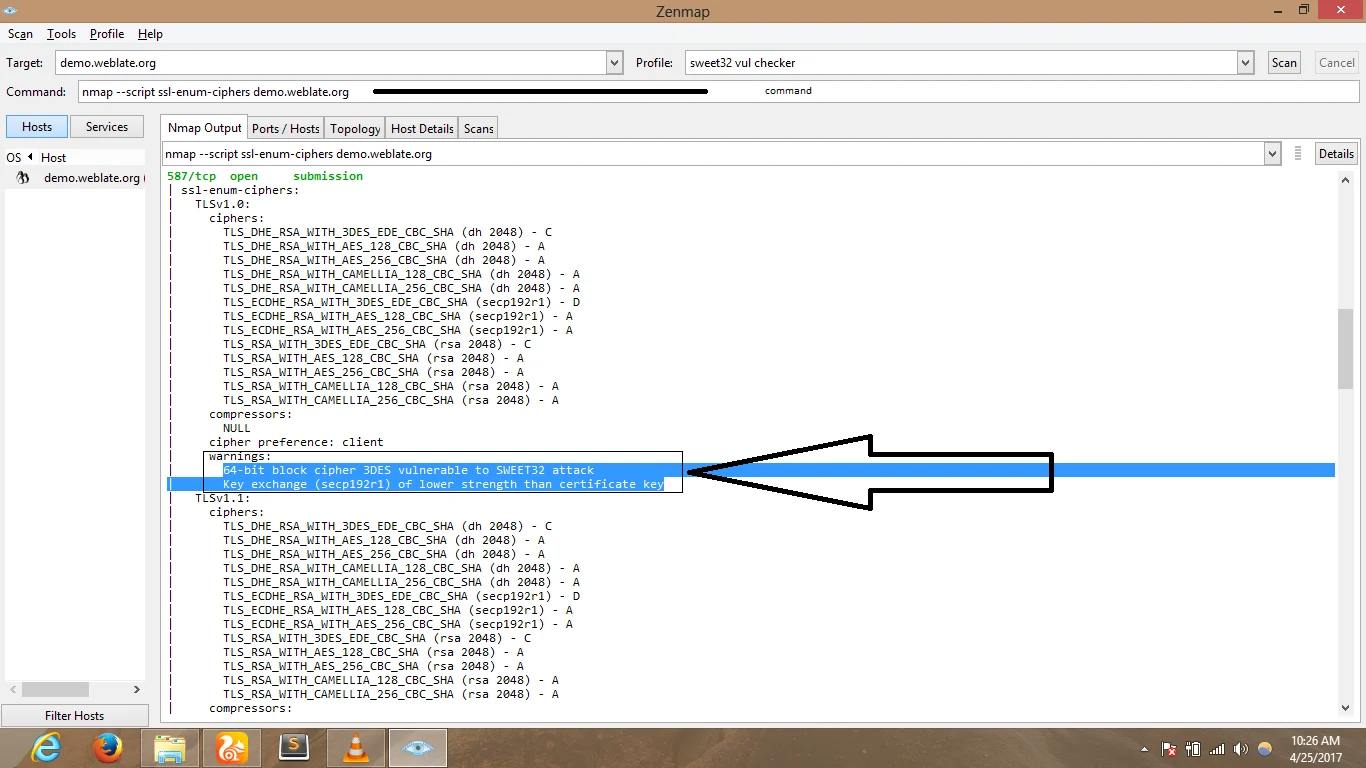
- open nmap and type: nmap --script ssl-enum-ciphers demo.weblate.org
2.and wait until it finishes the scan 3. here are the results
64-bit block cipher 3DES vulnerable to SWEET32 attack Key exchange (secp192r1) of lower strength than certificate key
see the attachment please....
Attachments
Not written yet. The AI write-up for this report has not been written yet. The Original tab links to the source.
How it worked
Root cause
Likely the TLS configuration still offers legacy 64-bit block ciphers (Triple-DES) and a weak key-exchange curve instead of restricting to modern 128-bit ciphers.
Impact
An attacker on the same local network or Wi-Fi could potentially recover small portions of encrypted traffic from very long connections, though the text gives no demonstration of this.
What the attacker needed
Attacker on the same network or Wi-Fi; long-lived connection with much data
How it was found
- Run an nmap scan with the ssl-enum-ciphers script against the host.
- Wait for the scan to finish.
- Read the results, which list a 64-bit block cipher as vulnerable to SWEET32.
Explained by bugbounty.wiki with AI from the original and checked against quotes from it; it can still be wrong. Read the original before relying on a detail.
Not written yet. The AI write-up for this report has not been written yet. The Original tab links to the source.
Old ciphers scramble data in small chunks. When a lot of data goes through one connection, an attacker who can watch the traffic can slowly work out parts of it, a bit like guessing a password by trying many combinations. This only matters if the attacker is already on the same network and the connection carries a lot of data.
What is Crypto?
Encryption, signatures, randomness or certificate checks that do not protect what they claim to.