Weblate |Security Misconfiguration| Method Enumeration Possible on domain
The web server responds to OPTIONS requests and reveals which HTTP methods it allows. An attacker could use this information to learn about the server's capabilities, but the report does not show any direct exploitation.

- Fixed in under an hour
- Disclosed after 41 days
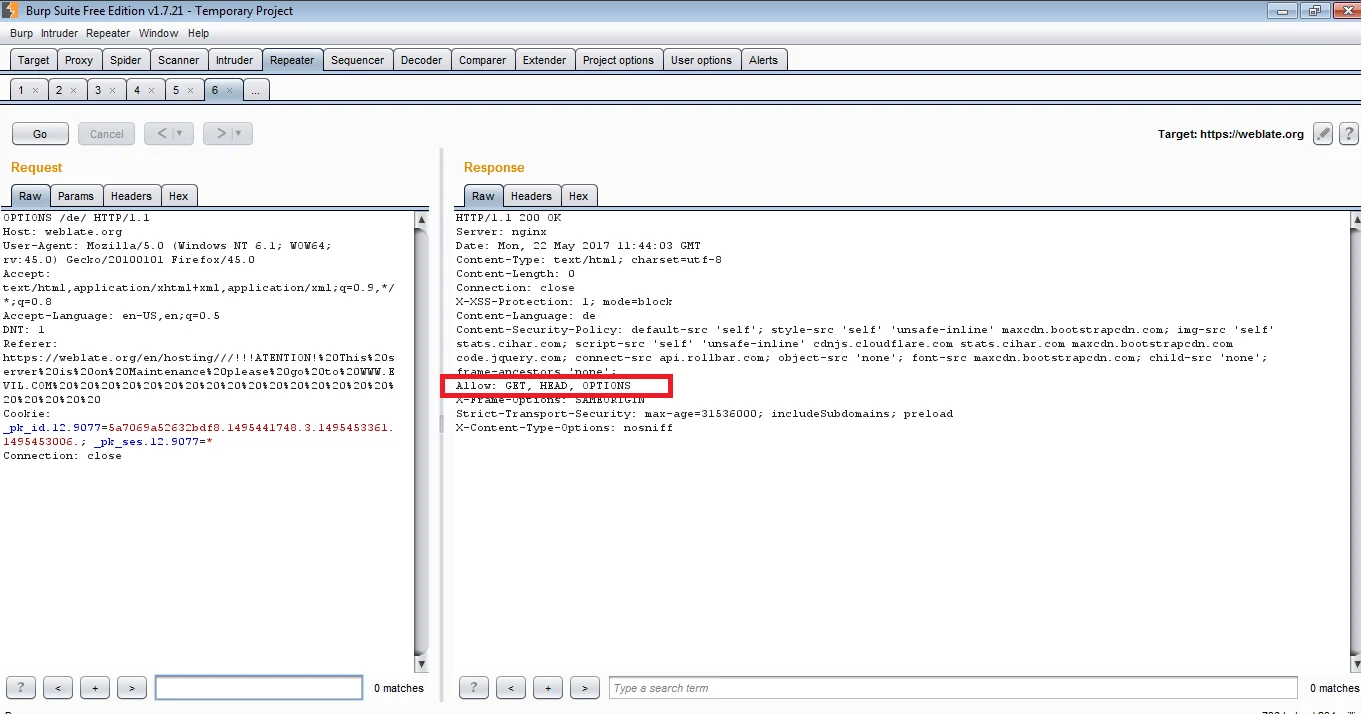
Hi Team, I have found an instance in application where application is alllowing OPTIONS method to be processed in HTTP request from weblate.org and in response to my request i got the information that these methods are allowed by application server "GET, HEAD, OPTIONS"
Ideally server should not entertain this request in any manner however i am able to get the info that which http methods are enabled here like HEAD,PUT & GET
Please see the below attached screenshots for issue details.
Url on which i found this issue-https://weblate.org/de/ (request triggered on changing the language preference)
Please also refer -https://www.owasp.org/index.php/Test_HTTP_Methods_(OTG-CONFIG-006)
Original request used here is mentioned below
GET /de/ HTTP/1.1 Host: weblate.org User-Agent: Mozilla/5.0 (Windows NT 6.1; WOW64; rv:45.0) Gecko/20100101 Firefox/45.0 Accept: text/html,application/xhtml+xml,application/xml;q=0.9,/;q=0.8 Accept-Language: en-US,en;q=0.5 DNT: 1 Referer: https://weblate.org/en/hosting///!!!ATENTION!%20This%20server%20is%20on%20Maintenance%20please%20go%20to%20WWW.EVIL.COM%20%20%20%20%20%20%20%20%20%20%20%20%20%20%20%20%20%20%20%20%20 Cookie: _pk_id.12.9077=5a7069a52632bdf8.1495441748.3.1495453361.1495453006.; _pk_ses.12.9077=* Connection: close
Attachments
Not written yet. The AI write-up for this report has not been written yet. The Original tab links to the source.
How it worked
Root cause
Likely the web server is configured to respond to OPTIONS requests with an Allow header, which is standard behaviour but can be seen as information disclosure.
Impact
An attacker could learn which HTTP methods are enabled, which may help in planning further attacks, but no direct impact is demonstrated.
What the attacker needed
None
The fix
The server should be configured to not respond to OPTIONS requests or to limit the information returned, if this is considered unnecessary exposure.
How it was found
- Send an OPTIONS request to the target URL.
- Observe the response listing allowed HTTP methods.
Explained by bugbounty.wiki with AI from the original and checked against quotes from it; it can still be wrong. Read the original before relying on a detail.
Not written yet. The AI write-up for this report has not been written yet. The Original tab links to the source.
When you visit a website, your browser sends a request using a method like GET. Servers can also respond to other methods, such as OPTIONS, which asks what methods are allowed. Here, the server answered an OPTIONS request and listed the allowed methods, which the reporter sees as unnecessary information exposure.
What is Info disclosure?
Data the application should keep private (personal data, internal details, other users' records) reaches someone it should not.