aspen | clickjacking
The website did not send an X-Frame-Options header, so an attacker could embed it in an iframe on another site and trick users into clicking on elements they did not intend to click. The report only demonstrates the missing header and does not show a working clickjacking exploit.

- Disclosed after 1 hour
Hi Team,
Found vulnerability of clickjacking on the domain "aspen.io".
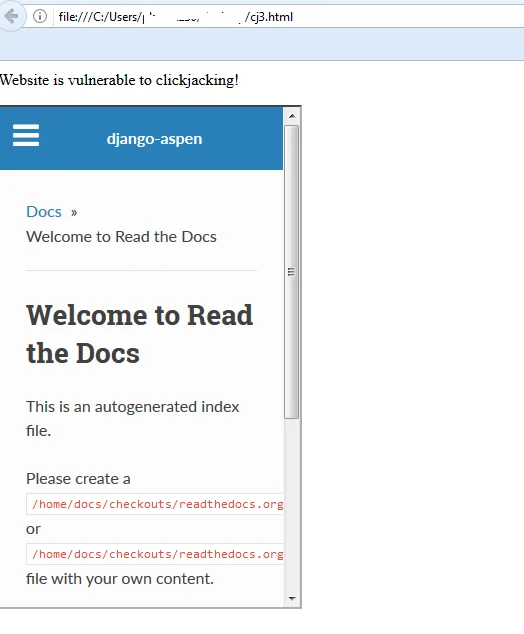
Please refer the below attached screenshot as POC.
<html> <head> <title>Clickjack test page</title> </head> <body> <p>Website is vulnerable to clickjacking!</p> <iframe src="http://django.aspen.io/en/latest/" height="500"></iframe> </body> </html>2.save it as <anyname>.html eg cj.html 3.and just simply open that in browser
Issue Details :Clickjacking (User Interface redress attack, UI redress attack, UI redressing) is a malicious technique of tricking a Web user into clicking on something different from what the user perceives they are clicking on, thus potentially revealing confidential information or taking control of their computer while clicking on seemingly innocuous web pages.
The server didn't return an X-Frame-Options header which means that this website could be at risk of a clickjacking attack. The X-Frame-Options HTTP response header can be used to indicate whether or not a browser should be allowed to render a page in a <frame> or <iframe>. Sites can use this to avoid clickjacking attacks, by ensuring that their content is not embedded into other sites.
This vulnerability affects Web Server.
As far as i know this data is enough to prove that your site is vulberable to Clickjacking.. according to OWASP its more than enough.. https://www.owasp.org/index.php/Testing_for_Clickjacking_(OWASP-CS-004)
Solution
https://www.owasp.org/index.php/Clickjacking_Defense_Cheat_Sheet check this out..here is the solution for that.
Refer the attached screenshot for issue details.
Attachments
Not written yet. The AI write-up for this report has not been written yet. The Original tab links to the source.
How it worked
Root cause
Likely the web server does not send the X-Frame-Options HTTP response header, allowing the page to be framed by other sites.
Impact
An attacker could trick a user into clicking on something different from what the user perceives, potentially revealing confidential information or taking control of their computer.
What the attacker needed
Victim visits attacker-controlled page; target page lacks X-Frame-Options header
How it was found
- Create an HTML file containing an iframe that loads the target site.
- Save the file with any name, for example cj.html.
- Open the saved file in a browser.
Explained by bugbounty.wiki with AI from the original and checked against quotes from it; it can still be wrong. Read the original before relying on a detail.
Not written yet. The AI write-up for this report has not been written yet. The Original tab links to the source.
Clickjacking is when a malicious site loads a real site in an invisible frame and tricks you into clicking buttons there. This report says the site is missing a security header that tells browsers not to allow such framing. The reporter only shows that the header is absent, not that an attack actually works.
What is UI spoofing?
The interface lies to the user: a framed page catches their clicks, or a browser shows the wrong address or a fake prompt. Paid when it leads to a sensitive action or convincing phishing.




