SMS Invite Form Abuse
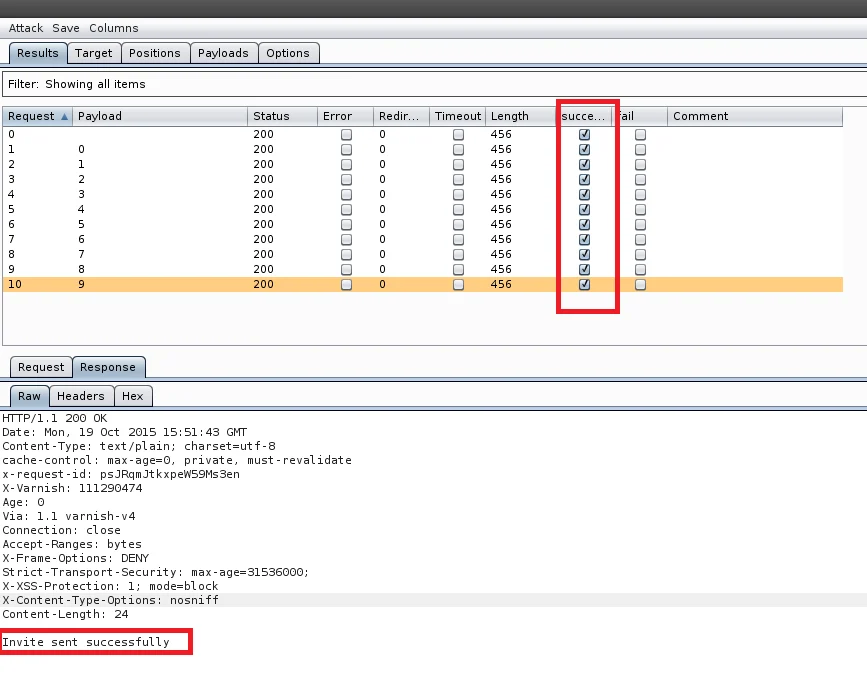
The invite form on whisper.sh accepted automated POST requests without any rate limiting or CAPTCHA, allowing an attacker to send repeated SMS messages to arbitrary phone numbers. This could result in SMS flooding to a single user or a large range of users.

- Triaged in 5 months
- Fixed in 16 months
- Paid in 16 months
- Disclosed after 17 months
whisper.sh fails to protect the invite form from abuse from attackers. If a malicious individual wants to abuse this functionality, they could send repeated/automated requests to the same phone number or range of phone numbers that do no actually belong to himself. This would result in lots of arbitrary SMS messages to a single user or large range of multiple users just by launching automated POST requests to wispher.sh.
POST /invite HTTP/1.1 Host: whisper.sh User-Agent: Mozilla/5.0 (X11; Linux x86_64; rv:18.0) Gecko/20100101 Firefox/18.0 Accept: / Accept-Language: en-US,en;q=0.5 Accept-Encoding: gzip, deflate Content-Type: application/x-www-form-urlencoded; charset=UTF-8 X-Requested-With: XMLHttpRequest Referer: https://whisper.sh/search?q=INJECTX Content-Length: 24 Cookie: _ga=GA1.2.1840275725.1445267554; _cb_ls=1; _chartbeat2=DTMT5SBzHnwjDQlfSX.1445267560697.1445267560697.1; _gat=1 Connection: close Pragma: no-cache Cache-Control: no-cache
phoneNumber=518-373-1319
HTTP/1.1 200 OK Date: Mon, 19 Oct 2015 15:51:43 GMT Content-Type: text/plain; charset=utf-8 cache-control: max-age=0, private, must-revalidate x-request-id: psJRqmJtkxpeW59Ms3en X-Varnish: 111290474 Age: 0 Via: 1.1 varnish-v4 Connection: close Accept-Ranges: bytes X-Frame-Options: DENY Strict-Transport-Security: max-age=31536000; X-XSS-Protection: 1; mode=block X-Content-Type-Options: nosniff Content-Length: 24
Invite sent successfully
To help prevent automated attacks, the form should utilize some form of captcha system that requires user knowledge in order to send repeat attempts and should block repeat requests to the same number multiple times.
Attachments
Context
Whisper is a service reachable at whisper.sh, and the feature in scope here is its invite form. The form takes a phone number and sends an SMS invitation to it. The report describes the endpoint as POST /invite, which accepts a form-encoded phoneNumber parameter and replies with a plain-text confirmation.
The weakness class recorded for the report is Uncontrolled Resource Consumption: the invite form can be driven repeatedly, and each request causes the service to send an SMS.
Setup
The researcher needed no account or special role. The request shown is sent unauthenticated apart from ordinary browser cookies, and the only input is a phone number. The tooling visible in the request is a Firefox 18 user agent on Linux, with the request issued as an XMLHttpRequest from a search page on the same site.
Finding it
The invite form was reachable directly and accepted repeated submissions. Nothing in the flow tied a submission to a human, a session, or a single destination number, so an attacker could send automated requests to one number or to a range of numbers that do not belong to them. The result is a large volume of arbitrary SMS messages to a single user or across many users, simply by launching automated POST requests at whisper.sh.
Exploitation
Step 1: Send an invite request directly
The researcher issued the invite request outside the normal page flow, as an AJAX-style form post:
POST /invite HTTP/1.1
Host: whisper.sh
User-Agent: Mozilla/5.0 (X11; Linux x86_64; rv:18.0) Gecko/20100101 Firefox/18.0
Accept: */*
Accept-Language: en-US,en;q=0.5
Accept-Encoding: gzip, deflate
Content-Type: application/x-www-form-urlencoded; charset=UTF-8
X-Requested-With: XMLHttpRequest
Referer: https://whisper.sh/search?q=INJECTX
Content-Length: 24
Cookie: _ga=[redacted]; _cb_ls=1; _chartbeat2=[redacted]; _gat=1
Connection: close
Pragma: no-cache
Cache-Control: no-cache

phoneNumber=518-373-1319
The important parts are the path /invite, the form-encoded body carrying a single phoneNumber value, and the X-Requested-With: XMLHttpRequest header, which marks the call as the same kind of request the site's own front end makes. The Referer points at a search page, showing the request can be sent from a page on the site rather than only from the invite UI. The cookies present are ordinary analytics cookies, not an authenticated session.
Step 2: Observe the response
The server accepted the request and confirmed the SMS was sent:
HTTP/1.1 200 OK
Date: Mon, 19 Oct 2015 15:51:43 GMT
Content-Type: text/plain; charset=utf-8
cache-control: max-age=0, private, must-revalidate
x-request-id: psJRqmJtkxpeW59Ms3en
X-Varnish: 111290474
Age: 0
Via: 1.1 varnish-v4
Connection: close
Accept-Ranges: bytes
X-Frame-Options: DENY
Strict-Transport-Security: max-age=31536000;
X-XSS-Protection: 1; mode=block
X-Content-Type-Options: nosniff
Content-Length: 24

Invite sent successfully
The 200 OK with the body Invite sent successfully is the confirmation that an SMS was dispatched. The response carries no challenge and no rate-limit signal. The report does not show repeated requests, but nothing in the flow blocks them.
Root cause
The invite endpoint trusts the client to submit it once. There is no captcha or other proof of user knowledge gating the request, and no block on repeat requests to the same number. Because the endpoint is reachable directly and returned success for the captured submission, an automated script could plausibly generate SMS traffic. The existing response headers (X-Frame-Options, HSTS, X-XSS-Protection, X-Content-Type-Options) are general hardening and do nothing about request volume or destination reuse.
Impact
An attacker can send repeated or automated requests to a single phone number, or to a range of numbers that do not belong to them. This produces large volumes of arbitrary SMS to one user or to many users. The cost and nuisance fall on the recipients and on the service sending the messages. The report does not quantify message volume, cost or delivery rates.
Fix
The report recommends two changes: add a captcha system that requires user knowledge before repeat attempts are sent, and block repeat requests to the same number multiple times. The report does not state whether either was implemented.
Variants to test
- Direct POST to the invite endpoint. Send the form-encoded
phoneNumberparameter without going through the UI. A positive result is a200with a success body and an SMS arriving. - Repeat the same number. Submit the identical request several times in a row. A positive result is success on every attempt with no block or challenge.
- Iterate over a range of numbers. Vary
phoneNumberacross many values. A positive result is success for each distinct number. - Drop the AJAX marker. Remove
X-Requested-Withand resend. A positive result is that the endpoint still accepts the request, showing the header is not a control. - Change the referer. Send from a different page or omit it. A positive result is that the request is still accepted, showing no origin check on the invite call.
Hunting notes
Invite and verification flows that trigger an outbound SMS or email are the place to look. During recon, find endpoints that accept a phone number or address and return a plain success message, especially ones called as AJAX from a search or profile page. The signal is a 200 with a confirmation body and no captcha, token or per-destination limit in the response. To show impact, demonstrate the same request succeeding repeatedly for one number and then for several distinct numbers, as this report does with a single captured request and response pair.
The report includes one attachment.
What happened, in plain words
Whisper is a service you reach at whisper.sh. One of its features is an invite form: you type in a phone number, and the service sends that number a text message (an SMS) inviting the person to join. That is a normal, friendly feature. The problem is that the form had no way of telling a real person from a script.
A script is just a program that repeats an action automatically, very fast. Because the invite form accepted requests from anyone, with no puzzle to solve and no limit on how often the same number could be asked for, someone could write a script that fires the invite request over and over. Each request makes the service send one more SMS. Point the script at one phone number and that person's phone fills up with texts. Point it at a long list of numbers and a lot of people get texts they never asked for.
The report calls this class of problem Uncontrolled Resource Consumption. In everyday terms: a service has a limited, paid resource (here, the ability to send text messages), and nothing stops one visitor from using it up or making it spend money and annoy people. It is like a shop that hands out free samples to anyone who asks, with no limit per customer: one person can queue up a hundred times and take the whole tray.
The researcher sent an invite request and got back a plain confirmation that the SMS had gone out. That one request and its reply are the evidence. The report then recommends two fixes: a captcha (a small puzzle only a human can solve) and a block on sending to the same number repeatedly.
The service and the feature
Whisper is a service reachable at whisper.sh. The feature in scope is its invite form. The form takes a phone number and sends an SMS invitation to it. The report describes the endpoint as POST /invite, which accepts a form-encoded phoneNumber parameter and replies with a plain-text confirmation.
A few words before we go further:
- An endpoint is a specific address on a website that does one job. Think of a large office building: the street address gets you to the building, but each department has its own door.
/inviteis the door for "send an invitation". - POST is one of the ways a browser can talk to a server. When you just open a page, the browser usually uses GET, which means "give me this page". POST means "here is some data, please do something with it". Sending a form is the classic POST.
- A parameter is a named piece of data sent along with a request. Here the name is
phoneNumberand the value is the phone number to text. - Form-encoded means the data is packed the way a web form packs it:
name=value, with an&between pairs if there are several. It is plain text, not a fancy format. - Plain-text confirmation means the server's reply is just a short line of text, not a web page.
The weakness class recorded for the report is Uncontrolled Resource Consumption: the invite form can be driven repeatedly, and each request causes the service to send an SMS.
Setup
The researcher needed no account or special role. The request shown is sent unauthenticated apart from ordinary browser cookies, and the only input is a phone number.
- Unauthenticated means "not logged in". The server did not ask who the sender was, and did not require a password or a session that proves a real account.
- A cookie is a small note that a website stores in your browser and that your browser sends back with every request to that site. Cookies are how sites remember you between page loads. Some cookies are for logging you in; others are just for statistics. The ones in this request are the statistics kind, which is why the report says they are not an authenticated session.
The tooling visible in the request is a Firefox 18 user agent on Linux, with the request issued as an XMLHttpRequest from a search page on the same site.
- A user agent is a line the browser sends to identify itself, such as "I am Firefox 18 on Linux". It is a label, not a security check.
- XMLHttpRequest is the browser feature that lets a page fetch data in the background without reloading. Websites use it all the time, for example to show search suggestions as you type. The header
X-Requested-With: XMLHttpRequestis a marker that says "this request came from a page's background code", as opposed to you typing an address into the bar.
Finding it
The invite form was reachable directly and accepted repeated submissions. Nothing in the flow tied a submission to a human, a session, or a single destination number, so an attacker could send automated requests to one number or to a range of numbers that do not belong to them. The result is a large volume of arbitrary SMS messages to a single user or across many users, simply by launching automated POST requests at whisper.sh.
In plain terms, three things were missing:
- Proof of a human. No captcha, no puzzle, nothing that a script would struggle with.
- Proof of a session. No login and no per-visitor counter that would let the server say "you have already asked for this".
- A limit per destination. Nothing stopped the same phone number being requested again and again.
Any one of those would have made abuse harder. All three being absent made it trivial.
Exploitation
Step 1: Send an invite request directly
The researcher issued the invite request outside the normal page flow, as an AJAX-style form post:
POST /invite HTTP/1.1
Host: whisper.sh
User-Agent: Mozilla/5.0 (X11; Linux x86_64; rv:18.0) Gecko/20100101 Firefox/18.0
Accept: */*
Accept-Language: en-US,en;q=0.5
Accept-Encoding: gzip, deflate
Content-Type: application/x-www-form-urlencoded; charset=UTF-8
X-Requested-With: XMLHttpRequest
Referer: https://whisper.sh/search?q=INJECTX
Content-Length: 24
Cookie: _ga=[redacted]; _cb_ls=1; _chartbeat2=[redacted]; _gat=1
Connection: close
Pragma: no-cache
Cache-Control: no-cache

phoneNumber=518-373-1319
Line by line, in plain words:
POST /invite HTTP/1.1: the method is POST ("here is data, do something"), the path is/invite(the invitation department), andHTTP/1.1is the version of the language browsers and servers speak.Host: whisper.sh: which website this request is for. One server can host many sites, so the request names the one it wants.User-Agent: ...: the browser's self-description. Here it says Firefox 18 on 64-bit Linux. This is just a label; it does not prove anything about the sender.Accept: */*: "I can handle any kind of reply".Accept-Language: en-US,en;q=0.5: "I prefer English, and I will accept other languages with lower priority".Accept-Encoding: gzip, deflate: "you may compress the reply to save bandwidth".Content-Type: application/x-www-form-urlencoded; charset=UTF-8: this is the important one for the body. It says the data below is packed like a web form, in UTF-8 text. Without it the server would not know how to read the body.X-Requested-With: XMLHttpRequest: the marker that says "this came from a page's background code", the same kind of call the site's own front end makes. Sending it makes the request look like normal site traffic.Referer: https://whisper.sh/search?q=INJECTX: the page the request claims to have come from. Here it is a search page on the same site, which shows the request can be sent from a page on the site rather than only from the invite screen. (The odd-lookingq=INJECTXis just the search term in that page's address.)Content-Length: 24: how many bytes the body is. The server uses this to know where the body ends.Cookie: ...: the small notes the browser is holding for this site. The report notes these are ordinary analytics cookies, not an authenticated session. Analytics cookies are the ones used for counting visits and similar statistics.Connection: close: "when you are done, close the connection".Pragma: no-cacheandCache-Control: no-cache: "do not reuse a stored copy of this; treat it as fresh".- A blank line: this separates the headers (the envelope) from the body (the contents).
phoneNumber=518-373-1319: the body. One parameter, namedphoneNumber, with a phone number as its value. This is the entire input the attacker controls.
Why send it this way? Because the point is to show the endpoint works on its own, without the invite screen. If the request succeeds when sent directly, then the only thing standing between a script and the SMS system is the request itself, and a script can send requests all day.
Step 2: Observe the response
The server accepted the request and confirmed the SMS was sent:
HTTP/1.1 200 OK
Date: Mon, 19 Oct 2015 15:51:43 GMT
Content-Type: text/plain; charset=utf-8
cache-control: max-age=0, private, must-revalidate
x-request-id: psJRqmJtkxpeW59Ms3en
X-Varnish: 111290474
Age: 0
Via: 1.1 varnish-v4
Connection: close
Accept-Ranges: bytes
X-Frame-Options: DENY
Strict-Transport-Security: max-age=31536000;
X-XSS-Protection: 1; mode=block
X-Content-Type-Options: nosniff
Content-Length: 24

Invite sent successfully
Line by line:
HTTP/1.1 200 OK: the server's status line.200is the standard code for "all good, here is your answer".Date: ...: when the server produced the reply.Content-Type: text/plain; charset=utf-8: the reply is plain text, not a web page. That is why the body is a single sentence.cache-control: max-age=0, private, must-revalidate: instructions about storing the reply.privatemeans it is for this one client, not a shared cache.x-request-id: ...: an internal label the server attaches to this one request, useful for tracing it in logs.X-Varnish: ...,Age: 0,Via: 1.1 varnish-v4: signs that the reply passed through Varnish, a piece of software that sits in front of web servers to speed up replies.Age: 0means the reply was not served from a stored copy.Connection: close: the connection will be closed after this reply.Accept-Ranges: bytes: the server can send parts of a file if asked. Not relevant here.X-Frame-Options: DENY: a browser instruction that stops other sites from embedding this site in a frame. It is general hardening.Strict-Transport-Security: max-age=31536000;: tells the browser to keep using HTTPS for this site for a year. Also general hardening.X-XSS-Protection: 1; mode=block: an old browser instruction about blocking suspected cross-site scripting. General hardening.X-Content-Type-Options: nosniff: tells the browser to trust the declared content type and not guess. General hardening.Content-Length: 24: the body is 24 bytes long.Invite sent successfully: the body. This is the confirmation that an SMS was dispatched.
The 200 OK with the body Invite sent successfully is the confirmation that an SMS was dispatched. The response carries no challenge and no rate-limit signal. The report does not show repeated requests, but nothing in the flow blocks them.
"No challenge" means the server never asked the sender to prove anything. "No rate-limit signal" means it never said "slow down" or "too many requests". "No per-number state" means it did not remember that this number had already been invited. All three are things a careful service would do; here, none of them happened.
Root cause
The invite endpoint trusts the client to submit it once. There is no captcha or other proof of user knowledge gating the request, and no block on repeat requests to the same number. Because the endpoint is reachable directly and returned success for the captured submission, an automated script could plausibly generate SMS traffic. The existing response headers (X-Frame-Options, HSTS, X-XSS-Protection, X-Content-Type-Options) are general hardening and do nothing about request volume or destination reuse.
A captcha is a small test that is easy for a person and hard for a program, such as reading distorted letters. "Proof of user knowledge" means exactly that: the sender has to show they know something a script does not. "Destination reuse" means sending to the same phone number again and again. The hardening headers listed are about how browsers should treat the page; they say nothing about how many requests a server will accept, so they cannot help with this problem.
Impact
An attacker can send repeated or automated requests to a single phone number, or to a range of numbers that do not belong to them. This produces large volumes of arbitrary SMS to one user or to many users. The cost and nuisance fall on the recipients and on the service sending the messages. The report does not quantify message volume, cost or delivery rates.
In everyday terms: the recipients get spam texts they did not ask for, and the service pays for every message it sends. The report does not put numbers on how many messages, how much money, or how many actually arrived.
Fix
The report recommends two changes: add a captcha system that requires user knowledge before repeat attempts are sent, and block repeat requests to the same number multiple times. The report does not state whether either was implemented.
In plain words: make the sender prove they are human, and make the server remember which numbers have already been invited so it can refuse duplicates.
Variants to test
These are the follow-up checks a tester would run to see how far the problem goes. Each one has a clear "positive result", meaning the sign that the problem is present.
- Direct POST to the invite endpoint. Send the form-encoded
phoneNumberparameter without going through the UI. A positive result is a200with a success body and an SMS arriving. - Repeat the same number. Submit the identical request several times in a row. A positive result is success on every attempt with no block or challenge.
- Iterate over a range of numbers. Vary
phoneNumberacross many values. A positive result is success for each distinct number. - Drop the AJAX marker. Remove
X-Requested-Withand resend. A positive result is that the endpoint still accepts the request, showing the header is not a control. - Change the referer. Send from a different page or omit it. A positive result is that the request is still accepted, showing no origin check on the invite call.
Why these five? Each one removes a piece of the request that might, in theory, be acting as a guard. If the request still works without it, that piece was never a guard at all.
Hunting notes
Invite and verification flows that trigger an outbound SMS or email are the place to look. During recon, find endpoints that accept a phone number or address and return a plain success message, especially ones called as AJAX from a search or profile page. The signal is a 200 with a confirmation body and no captcha, token or per-destination limit in the response. To show impact, demonstrate the same request succeeding repeatedly for one number and then for several distinct numbers, as this report does with a single captured request and response pair.
"Recon" means the early exploration phase where you look around a site to see what it does and where its doors are. "Outbound" means the service sends something out to the outside world, such as a text or an email. The pattern to look for is simple: a form that makes the company spend money or contact someone, and a reply that just says "done" with nothing asking you to prove you are human.
The report includes one attachment.
Glossary
- AJAX: a way for a web page to talk to a server in the background, without reloading the page.
- Analytics cookie: a cookie used to count visits and gather statistics, not to log you in.
- API: a set of addresses and rules a program uses to talk to a service; here, the
/inviteendpoint is the part of the service's API that sends invitations. - Captcha: a small test that is easy for a human and hard for a program, used to prove a real person is sending the request.
- Cookie: a small note a website stores in your browser and your browser sends back with each request to that site.
- Endpoint: a specific address on a website that performs one job, such as
/invite. - Form-encoded: data packed the way a web form packs it, as
name=valuepairs joined by&. - HSTS (Strict-Transport-Security): a header that tells the browser to keep using HTTPS for a site for a set period.
- HTTP: the language browsers and servers use to exchange requests and replies.
- Parameter: a named piece of data sent with a request, such as
phoneNumber. - POST: an HTTP method meaning "here is some data, please do something with it".
- Rate limit: a cap on how many requests a client may make in a period; the report notes there was no rate-limit signal.
- Recon: the early exploration of a site to find what it does and where its endpoints are.
- Referer: a header saying which page the request came from.
- SMS: a text message sent to a mobile phone.
- Unauthenticated: not logged in; the server does not know or check who is sending the request.
- Uncontrolled Resource Consumption: a weakness where a service lets one client use up a limited or costly resource, here the sending of SMS messages.
- User agent: the line a browser sends to identify itself, such as its name and version.
- Varnish: software that sits in front of web servers to speed up replies; its traces appear in the response headers.
- XMLHttpRequest: the browser feature that lets a page fetch data in the background; the
X-Requested-With: XMLHttpRequestheader marks a request as coming from such code.