CVE-2024-21733 Apache Tomcat HTTP Request Smuggling (Client- Side Desync) (CWE: 444)
Apache Tomcat mishandled the Content-Length of incomplete POST requests, so an error response could include data left over from another user's earlier request. An attacker could use this to desynchronise a victim's browser connection and smuggle sensitive data, potentially including clear-text credentials.

- Disclosed after 10 days
Summary by the program
[SECURITY] CVE-2024-21733 Apache Tomcat - Information Disclosure Severity: Important Vendor: The Apache Software Foundation
Versions Affected: Apache Tomcat 9.0.0-M11 to 9.0.43 Apache Tomcat 8.5.7 to 8.5.63
Description: Incomplete POST requests triggered an error response that could contain data from a previous request from another user.
Mitigation: Users of the affected versions should apply one of the following mitigations:
- Upgrade to Apache Tomcat 9.0.44 or later
- Upgrade to Apache Tomcat 8.5.64 or later
Credit: This vulnerability was reported responsibly to the Tomcat security team by xer0dayz from Sn1perSecurity LLC.
History: 2024-01-19 Original advisory
Full Security Advisory: https://lists.apache.org/thread/h9bjqdd0odj6lhs2o96qgowcc6hb0cfz
The report
Apache Tomcat from 8.5.7 through 8.5.63, from 9.0.0-M11 through 9.0.43 are vulnerable to client-side de-sync attacks.
Client-side de-sync (CSD) vulnerabilities occur when a web server fails to correctly process the Content-Length of POST requests. By exploiting this behavior, an attacker can force a victim's browser to de-synchronize its connection with the website, causing sensitive data to be smuggled from the server and/or client connections.
Users are recommended to upgrade to version 8.5.64 onwards or 9.0.44 onwards, which contain a fix for the issue.
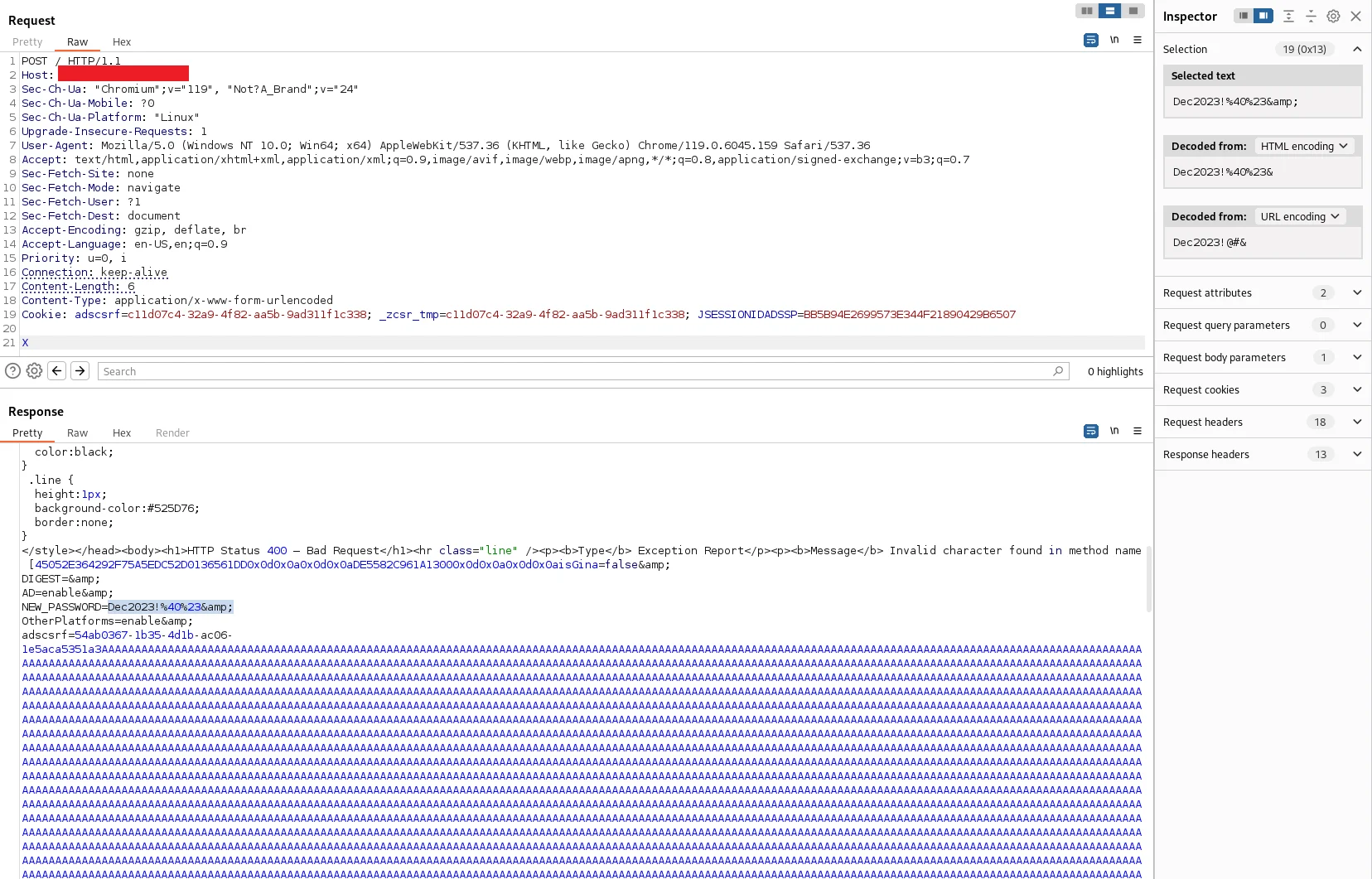
PoC:
POST / HTTP/1.1
Host: hostname
Sec-Ch-Ua: "Chromium";v="119", "Not?A_Brand";v="24"
Sec-Ch-Ua-Mobile: ?0
Sec-Ch-Ua-Platform: "Linux"
Upgrade-Insecure-Requests: 1
User-Agent: Mozilla/5.0 (Windows NT 10.0; Win64; x64) AppleWebKit/537.36 (KHTML, like Gecko) Chrome/119.0.6045.159 Safari/537.36
Accept: text/html,application/xhtml+xml,application/xml;q=0.9,image/avif,image/webp,image/apng,*/*;q=0.8,application/signed-exchange;v=b3;q=0.7
Sec-Fetch-Site: none
Sec-Fetch-Mode: navigate
Sec-Fetch-User: ?1
Sec-Fetch-Dest: document
Accept-Encoding: gzip, deflate, br
Accept-Language: en-US,en;q=0.9
Priority: u=0, i
Connection: keep-alive
Content-Length: 6
Content-Type: application/x-www-form-urlencoded

X
In some cases, this can leak sensitive data such as clear-text credentials (see attached screenshot).
Credit: This vulnerability was reported responsibly to the Tomcat security team by xer0dayz from Sn1perSecurity LLC.
History: 2024-01-19 Original advisory
References: [3] https://tomcat.apache.org/security-9.html [4] https://tomcat.apache.org/security-8.html
Impact
An attacker can force a victim's browser to de-synchronize its connection with the website, causing sensitive data to be smuggled from the server and/or client connections.
Attachments
Not written yet. The AI write-up for this report has not been written yet. The Original tab links to the source.
How it worked
Root cause
Likely the server did not correctly process the Content-Length of incomplete POST requests, so an error response reused data from a previous request on the same connection.
Impact
An attacker could force a victim's browser to desynchronise its connection and smuggle sensitive data from server or client connections, and in some cases this could leak clear-text credentials.
What the attacker needed
Tomcat 8.5.7-8.5.63 or 9.0.0-M11-9.0.43
The fix
The issue was fixed by upgrading to Apache Tomcat 8.5.64 or later, or 9.0.44 or later.
Explained by bugbounty.wiki with AI from the original and checked against quotes from it; it can still be wrong. Read the original before relying on a detail.
Not written yet. The AI write-up for this report has not been written yet. The Original tab links to the source.
When a browser sends a request to a website, it says how long the request body is using a number called Content-Length. Tomcat got this wrong for cut-off requests, so its error page could accidentally show pieces of a different user's earlier request. That means private information, such as login details, might leak to the wrong person.
What is Smuggling / CRLF?
A front end and a back end split one connection's bytes into requests differently, letting an attacker hide a request inside another user's.