Authenticated. Not Authorized.
A crypto custody platform's API returned administrative wallet information to a low-privileged Viewer when the request used only the session cookie, without the signed-request context. An attacker with a Viewer account could read wallet policies, approval thresholds, user permissions and key identifiers they were not authorised to see.

The first 401 Unauthorized looked like a correctly enforced security boundary.
The full write-up lives on its author's site
It belongs to its author, so we link to it rather than copy it. The other two tabs are our own rewrites, checked against it.
Context
Institutional crypto custody platforms sit between an organisation and the keys that control its funds, so their permission model is the product. The platform discussed here defines wallet roles that separate administration from spending and from read-only access:
- Wallet Admin: Manage wallet settings, policies, whitelists and approvals.
- Wallet Spend: Initiate withdrawals and permitted spending operations.
- Wallet View: Read-only access to balances, transactions and addresses.
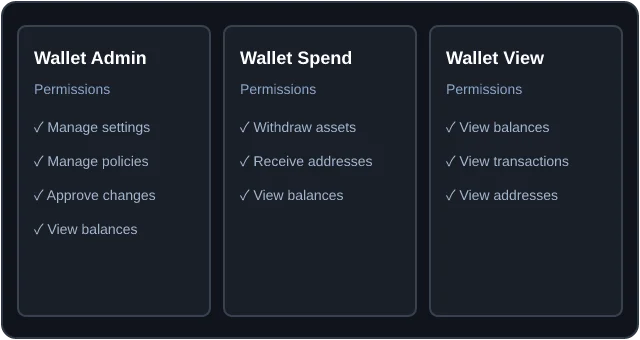
Simplified representation of the application’s wallet roles and permission boundaries
Wallet membership and administrative access were clearly separate concepts. When accessing a wallet as a Viewer, the application disabled its Users tab and explicitly indicated missing permissions. That visible boundary is what made the API worth testing: the interface said one thing, and the question was whether the backend said the same.
Setup
The research took place earlier in 2026 against the platform's API. The researcher worked with a legitimate administrative identity as a baseline and a lower-privileged identity (a Wallet Viewer) to replay requests. The administrative request carried multiple cookies alongside HMAC-based authentication headers, including authorization and timestamp information. No specific tooling, endpoint paths or versions are given in the report.
The precondition for the whole investigation is a user who is already a member of a wallet with a restricted role. The findings concern what that user can read, not what they can do.
Finding it
The first signal was a 401 Unauthorized returned when the administrative request was replayed under the lower-privileged identity. On its face that looks like a correctly enforced security boundary. The researcher's question was which control was actually rejecting the request: was the backend enforcing wallet-level permissions, or was the request simply failing authentication?

That ambiguity is the crux. A request that carries several authentication artefacts at once (session cookies plus HMAC-signed headers) can fail for reasons unrelated to authorization, and a blanket rejection hides whether the permission check exists at all. The researcher decided to isolate the authentication components rather than treat the request as a single authentication unit.
Exploitation
Step 1: Establish a baseline
A legitimate administrative request was captured and used as the reference. It contained multiple cookies alongside HMAC-based authentication headers, including authorization and timestamp information.
Step 2: Replay under a lower-privileged identity
Replaying the administrative request under the Viewer identity returned:
401 Unauthorized
This is the observation that started the investigation, not a conclusion.
Step 3: Isolate the authentication context
Among the cookies carried by the request, the researcher identified the application's primary session cookie as the relevant authentication credential. The session cookie and the HMAC-based authentication were then tested independently, keeping the wallet and the user's assigned permissions unchanged.
The interesting difference was between invalid authentication combinations and the absence of the signed-request context altogether. With the Viewer's session accepted on its own, the backend returned:
200 OK
The response contained administrative wallet information that the Viewer was not intended to receive:
- Multisig configuration and approval thresholds.
- Wallet policies and operational metadata.
- Wallet users and their assigned permissions.
- Key identifiers and wallet configuration details.
The authentication context had changed. The user's wallet permissions had not. No signing keys were compromised and the HMAC mechanism was not broken; the issue was an authorization inconsistency associated with the application's session-based authentication path.
Step 4: Look for the same pattern elsewhere
An authorization flaw in one endpoint raised the question of whether the same weakness existed elsewhere, since applications often reuse middleware, authorization logic and API design patterns. This is variant analysis. The same observable session-dependent authorization pattern turned up across three functionalities:
- Enterprise-level user enumeration. A low-privileged enterprise user could retrieve organisational membership information intended for privileged roles.
- Wallet-level user enumeration. A Wallet Viewer could retrieve wallet members and their assigned permissions despite the interface explicitly restricting that functionality.
- Wallet configuration disclosure. A Wallet Viewer could retrieve administrative wallet configuration, including security policies and approval mechanisms.
Across all three, the same session-based authentication mechanism was associated with the observed authorization inconsistency. The first two reports were closed as duplicates of earlier submissions; the third was independently validated and rewarded. The researcher could not confirm whether they shared the same underlying implementation defect, but the behavioural similarities justified looking beyond individual endpoints.
Step 5: Get it reproduced
The initial triage response was that the vulnerability could not be reproduced. The researcher suspected that request authentication was masking the underlying authorization issue, clarified the relevant conditions, and the triage team then reproduced and validated it. A structured test matrix documenting the inconsistent behaviour across authentication contexts followed. The customer acknowledged the authorization discrepancy, and the report was accepted and rewarded.
Root cause
The working hypothesis was inconsistent authorization enforcement across authentication paths, potentially involving middleware composition or response-level permission checks. Without source code access the exact implementation defect could not be confirmed, so this remains likely rather than proven.
The expected authorization flow is straightforward:
Authenticated principal
        ↓
Resource membership
        ↓
Action authorization
        ↓
Property-level authorization
        ↓
Authorized response
A principal may legitimately access a wallet without being authorized to receive every property associated with it. Without source code access the exact implementation defect could not be confirmed.
Impact
The confirmed impact was unauthorized information disclosure within wallets the user already had access to. No unauthorized modifications or transactions were demonstrated. The exposed information nevertheless revealed security-sensitive details about wallet permissions, approval mechanisms and administrative relationships: multisig configuration and approval thresholds, wallet policies and operational metadata, wallet users and their assigned permissions, and key identifiers and wallet configuration details. The enterprise-level variant extended the same pattern to organisational membership information intended for privileged roles.
Fix
No specific remediation is described as having been applied. The report sets out three improvements it would focus on:
- Enforce consistent authorization policies across all supported authentication mechanisms.
- Validate both resource-level permissions and access to sensitive response properties.
- Add negative authorization tests for every supported role and authentication path.
Those tests should validate response properties, not just HTTP status codes. Returning 200 OK was not necessarily the problem; returning unauthorized information was.
Variants to test
- Strip one authentication artefact at a time. Where a request carries a session cookie plus signed headers, replay it with only the session, only the signature, and neither. A positive result is a
200with data the role should not see when the signed context is absent. - Compare every role against every sensitive property. Take the highest-privilege response for a resource and replay it as each lower role. A positive result is any administrative field (thresholds, policies, member lists, key identifiers) present in the lower-privilege response.
- Test the same pattern at each tenancy level. If wallet-level membership leaks, try the enterprise or organisation level with a low-privileged account. A positive result is membership or role information for users outside the caller's intended scope.
- Check the UI boundary against the API. Where the interface disables a tab or shows a missing-permission message, call the endpoint behind it directly. A positive result is data the interface explicitly withheld.
- Re-test after a non-reproducible triage result. Clarify the exact authentication conditions and supply a matrix of contexts. A positive result is the same inconsistency reproducing once the conditions are stated precisely.
Hunting notes
This kind of bug hides where several authentication mechanisms coexist: session cookies alongside HMAC-signed requests, API keys alongside bearer tokens, or legacy and new auth paths served by the same backend. The recon signal is a request that carries more than one credential, and a 401 that arrives without a clear reason. Treat that rejection as an observation rather than an assurance, and decompose the request until you know which component produced it.
A second signal is a UI that visibly restricts a feature, such as a disabled Users tab with an explicit missing-permissions message. That tells you the developers intended a boundary, and the API behind it is worth calling directly.
The report was accepted and rewarded after the triage team reproduced and validated the vulnerability. After the relevant conditions were clarified, the triage team reproduced and validated the vulnerability, and a structured test matrix followed.
What happened, in plain words
A security researcher was looking at a website that organisations use to store and move cryptocurrency. Think of it like a bank's online portal, but for companies that hold digital money. The site lets different people in an organisation have different levels of access: some can manage everything, some can only spend, and some can only look. The researcher found that a person with only "look" permission could still get back secret settings from the site's behind-the-scenes data service, even though the visible website hid those settings. The person could log in, but the system returned restricted wallet information to a user without the required permissions. This is called an authorization gap. The researcher found three variations of the same pattern, two were closed as duplicates of earlier reports, and one was accepted and rewarded.
1. Understanding the permission model
Before touching anything, the researcher spent time learning how the platform decides who can do what. This is called the permission model, or role-based access control (RBAC). In plain terms, the platform gives each person a role, and each role comes with a list of allowed actions.
The platform defined three wallet roles:
- Wallet Admin: Manage wallet settings, policies, whitelists and approvals.
- Wallet Spend: Initiate withdrawals and permitted spending operations.
- Wallet View: Read-only access to balances, transactions and addresses.
Simplified representation of the application’s wallet roles and permission boundaries
A wallet here is a container for cryptocurrency funds, like a company bank account. A whitelist is a list of approved addresses that money can be sent to. An approval is a second person confirming a sensitive action. The image shows how these roles sit apart from each other: Admin can change settings, Spend can move money, View can only read.
The researcher also noticed that being a member of a wallet and having administrative access were treated as separate ideas. When someone with the Viewer role opened a wallet, the website disabled the Users tab and showed a message saying permissions were missing. That visible boundary is important: the website was telling users "you are not allowed here", which made the researcher ask whether the hidden data service behind the website agreed.
2. A 401 that didn’t convince me
A 401 Unauthorized is an HTTP status code. HTTP is the language browsers and servers use to talk. A 401 means "I do not know who you are, or your credentials are not acceptable". It is like a bouncer saying "you cannot come in" without explaining whether the problem is your ticket or your name.
The researcher first made a legitimate administrative request. A request is a message the browser (or a tool) sends to the server asking for something. This request carried several cookies and HMAC-based authentication headers.
A cookie is a small piece of data a website stores in your browser and sends back with every request, often used to remember that you are logged in. A header is extra information attached to a request, like a label on an envelope. HMAC stands for Hash-based Message Authentication Code. It is a way to prove that a message was created by someone who holds a secret key and was not altered on the way. The request included authorization and timestamp information inside those headers.
When the researcher replayed the administrative request while logged in as a lower-privileged user (a Viewer), the server returned:
401 Unauthorized
Line by line: this is not a request but the response status line. 401 is the code, and Unauthorized is the reason phrase. It looks like the system is protecting the data.
But the researcher asked a sharper question: which security control was actually rejecting the request? Was the backend checking wallet-level permissions, or was the request simply failing authentication? Authentication means proving who you are. Authorization means deciding what you are allowed to do. A 401 usually points to authentication, but a request carrying several credentials at once can fail for reasons unrelated to permissions. The researcher decided to isolate the authentication components rather than treat the request as a single authentication unit.
3. Isolating the authentication context
Among the cookies in the request, the researcher identified the application's primary session cookie as the relevant authentication credential. A session cookie is like a wristband you get at an event: it proves you already checked in, without you showing your ID again on every request.
The researcher then tested the session cookie and the HMAC-based authentication separately, keeping the wallet and the user's assigned permissions unchanged. The goal was to see which part of the request was doing the rejecting.
What caught the researcher's attention was the difference between invalid authentication combinations and the absence of the signed-request context altogether. In other words, when the HMAC-signed part was missing, the backend behaved differently from when it was present but wrong.
With the Viewer's session accepted on its own, the backend returned:
200 OK
Line by line: 200 is the HTTP status code for success, and OK is the reason phrase. The server is saying "here is your data".
The response contained administrative wallet information that the Viewer was not intended to receive:
- Multisig configuration and approval thresholds.
- Wallet policies and operational metadata.
- Wallet users and their assigned permissions.
- Key identifiers and wallet configuration details.
Multisig means multiple signatures are required to approve a transaction, like a company cheque that needs two signatories. Approval thresholds are the rules about how many approvals are needed. Wallet policies are the rules the wallet follows. Operational metadata is background information about how the wallet is set up. Key identifiers are labels or references to cryptographic keys, not the keys themselves. Wallet configuration details describe how the wallet is arranged.
The authentication context had changed: the user was still the same Viewer. The user's wallet permissions had not changed. Yet restricted wallet information was returned to a user without the required permissions. The researcher had not compromised any signing keys or broken the HMAC mechanism. The issue was an authorization inconsistency associated with the application's session-based authentication path.
The confirmed impact was unauthorized information disclosure within wallets the user already had access to. No unauthorized modifications or transactions were demonstrated. However, the exposed information revealed security-sensitive details about wallet permissions, approval mechanisms and administrative relationships.
4. One pattern, three findings
Finding an authorization flaw in one endpoint made the researcher wonder whether similar weaknesses existed elsewhere. An endpoint is a specific address or function in an API that a client can call, like a particular counter at a service desk. An API (Application Programming Interface) is the set of rules and addresses that lets one piece of software ask another for data or actions, without a human clicking buttons.
Applications often reuse middleware, authorization logic and API design patterns. Middleware is code that sits between the incoming request and the final handler, like a security checkpoint in a corridor. If one checkpoint is faulty, other doors using the same checkpoint may be faulty too. This is the idea behind variant analysis: taking a known bug pattern and looking for it in other places.
During the investigation, the researcher identified the same observable session-dependent authorization pattern across three functionalities:
- Enterprise-level user enumeration. A low-privileged enterprise user could retrieve organisational membership information intended for privileged roles. User enumeration means being able to list users or members, often revealing who exists and what role they have.
- Wallet-level user enumeration. A Wallet Viewer could retrieve wallet members and their assigned permissions despite the interface explicitly restricting that functionality.
- Wallet configuration disclosure. A Wallet Viewer could retrieve administrative wallet configuration, including security policies and approval mechanisms.
Across all three findings, the same session-based authentication mechanism was associated with the observed authorization inconsistency. The first two reports were closed as duplicates of earlier submissions. The third was independently validated and rewarded. Although the researcher could not confirm whether they shared the same underlying implementation defect, their behavioural similarities justified investigating authorization beyond individual endpoints.
5. From Non-Reproducible to Validated
The initial response from triage was that the vulnerability could not be reproduced. Triage is the first team that reads a bug report and decides whether it is real and worth passing on. "Non-reproducible" means they tried to make the bug happen and could not.
The researcher suspected that request authentication was masking the underlying authorization issue. In other words, the researcher suspected that request authentication was masking the underlying authorization issue. After clarifying the relevant conditions, the triage team successfully reproduced and validated the vulnerability.
The researcher followed up with a structured test matrix documenting the inconsistent behaviour across authentication contexts. A test matrix is a table of test combinations. The customer acknowledged the authorization discrepancy, and the report was accepted and rewarded.
6. An Engineering Perspective
The researcher's working hypothesis was inconsistent authorization enforcement across authentication paths, potentially involving middleware composition or response-level permission checks. Middleware composition means how different pieces of middleware are stacked and in what order. Response-level permission checks means filtering the data just before it is sent back.
Without source code access, the researcher could not confirm the exact implementation defect. The expected authorization flow was straightforward:
Authenticated principal
        ↓
Resource membership
        ↓
Action authorization
        ↓
Property-level authorization
        ↓
Authorized response
Line by line: this is a diagram written in a code block. Authenticated principal means the system first confirms who is asking. Resource membership means it checks whether that person belongs to the wallet or resource. Action authorization means it checks whether the role allows the requested action. Property-level authorization means it checks whether the role allows each individual field in the response, such as approval thresholds or member lists. Authorized response means only the permitted data is sent back. The arrows show the order.
A principal may legitimately access a wallet without being authorized to receive every property associated with it. To address this issue, the researcher would focus on three improvements:
- Enforce consistent authorization policies across all supported authentication mechanisms.
- Validate both resource-level permissions and access to sensitive response properties.
- Add negative authorization tests for every supported role and authentication path.
Negative authorization tests are tests that check a user is refused something they should not have, not just that an allowed user succeeds. The tests should validate response properties, not just HTTP status codes. Returning 200 OK wasn't necessarily the problem. Returning unauthorized information was.
Final thoughts
A security control can work exactly as intended while another fails silently. A rejected request is an observation, not a security assurance.
Glossary
- API: A set of rules and addresses that lets software ask another system for data or actions.
- Authentication: Proving who you are, for example by logging in.
- Authorization: Deciding what an authenticated person is allowed to do or see.
- Cookie: A small piece of data stored by the browser and sent with requests, often used to keep you logged in.
- Session cookie: A cookie that represents an active login session.
- Header: Extra information attached to an HTTP request or response.
- HMAC: A way to prove a message was created by someone with a secret key and was not altered.
- HTTP: The language browsers and servers use to exchange requests and responses.
- Status code: A number in an HTTP response indicating the result, such as 200 for success or 401 for unauthorized.
- 401 Unauthorized: An HTTP status meaning the request lacks valid authentication credentials.
- 200 OK: An HTTP status meaning the request succeeded.
- Endpoint: A specific address or function in an API that can be called.
- RBAC: Role-based access control, where permissions are assigned to roles rather than individuals.
- Wallet: A container for cryptocurrency funds and the keys that control them.
- Multisig: A setup where multiple signatures are required to approve a transaction.
- Approval threshold: The number of approvals needed before an action is allowed.
- Whitelist: A list of approved addresses or items.
- User enumeration: Being able to list users or members, often revealing who exists and their roles.
- Variant analysis: Looking for the same bug pattern in other parts of an application.
- Middleware: Code that processes a request between the incoming connection and the final handler.
- Triage: The first team that reviews a bug report and decides whether it is valid.
- Test matrix: A table of test combinations, such as different authentication contexts and roles.
- Principal: The identity making a request, such as a user or service.
- Property-level authorization: Checking permission for each individual field in a response, not just the whole resource.

