Breaking BigBlueButton’s API With One Query Parameter — Inside CVE-2026–46353
BigBlueButton versions before 3.0.21 skip checksum validation when the presentationUploadExternalUrl parameter is present in an API request. An unauthenticated attacker can create meetings, list live sessions, join as a moderator, and end sessions.

Bug Bounty
The full write-up lives on its author's site
It belongs to its author, so we link to it rather than copy it. The other two tabs are our own rewrites, checked against it.
Context
BigBlueButton (BBB) is an open-source web conferencing system widely integrated into Learning Management Systems (LMS) such as Moodle and Canvas. Its API is the channel through which an LMS drives the conferencing server: creating meetings, joining users, querying state and ending sessions.
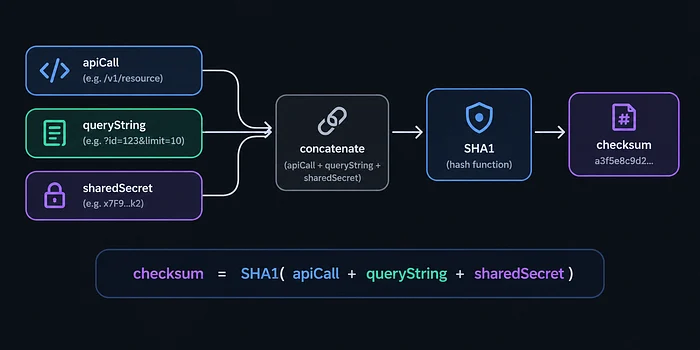
To secure communication between the LMS and the BBB server, every API request carries a cryptographic checksum derived from the server's sharedSecret. Without knowing that secret, an attacker should not be able to forge valid requests to create, join or query meetings. The vulnerability described here, tracked as CVE-2026-46353, removes that requirement entirely for versions of BBB below 3.0.21.
Setup
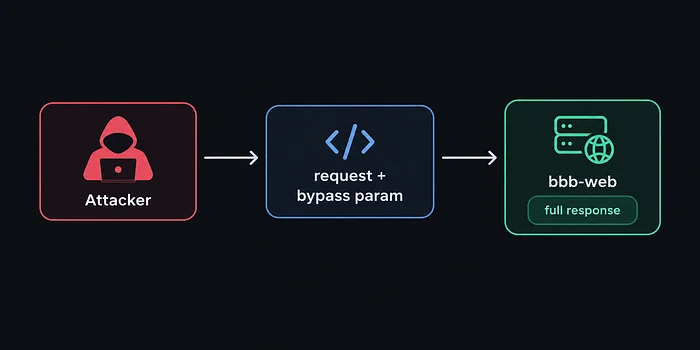
The research was carried out as targeted recon against BBB instances sitting behind enterprise LMS deployments. No accounts, roles or special tooling are described: the whole point of the flaw is that the requests below are unauthenticated. The only precondition is network reachability of the /bigbluebutton/api/ endpoint on a vulnerable instance (prior to 3.0.21).
The researcher's stated focus was parameter handling across core API endpoints, specifically logic flaws where optional or legacy parameters might alter the control flow of the authentication parser before it reaches checksum verification.
Finding it
The starting observation is that the API rejects an unsigned request. A control request without a checksum fails as expected:
[Control Request - Unauthenticated]GET /bigbluebutton/api/create?name=TestResponse: <response><returncode>FAILED</returncode><key>checksumError</key></response>
The response body is a FAILED return code with the key checksumError, which is the normal behaviour for a request that does not carry a valid checksum. What looked wrong was the handling of the optional presentationUploadExternalUrl parameter: in the affected versions it triggers an exceptional handling branch in the validation code, and that branch changes the control flow before the checksum stage is reached.
Exploitation
Step 1: Trigger the bypass
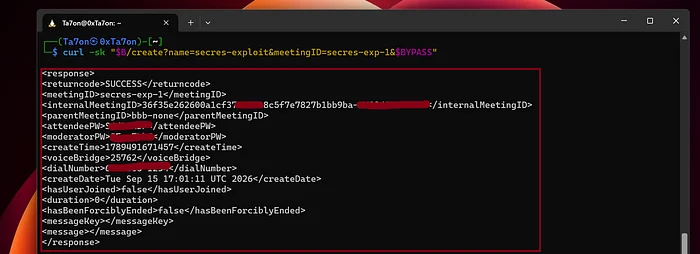
Appending presentationUploadExternalUrl=1 to the same unauthenticated request skips validation entirely:
GET /bigbluebutton/api/create?name=TargetMeeting&presentationUploadExternalUrl=1 HTTP/1.1Host: bbb.target.com
The request still carries no checksum. The only difference from the control request is the extra query parameter, which the report says skips validation entirely.

Step 2: Enumerate live meetings
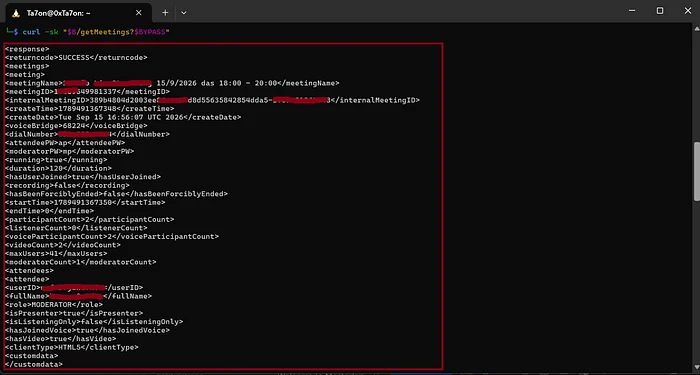
Applying the same bypass to getMeetings lets an unauthenticated attacker dump active sessions, participant metadata and internal credentials across the server:
GET /bigbluebutton/api/getMeetings?presentationUploadExternalUrl=1 HTTP/1.1Host: bbb.target.com
The value returned by this call includes the moderatorPW for running meetings, which is what makes the next step possible.
Step 3: Join as moderator
Extracting the moderatorPW from Step 2 allows immediate escalation into any running session:
curl -sk -o /dev/null -w "%{http_code}\n" "$B/join?meetingID=<id>&[redacted]&fullName=x&$BYPASS"Return 302
The command prints the HTTP status code, which the report shows as 302.
Step 4: Remote denial of service
Issuing an end call with the meeting ID instantly terminates the target session:
curl -sk "$B/end?meetingID=<id>&[redacted]&$BYPASS"
The same bypass is appended to the end call, which takes the meeting ID and moderator password.
Root cause
Inside CreateMeeting.java / ValidationService.java in BBB versions prior to 3.0.21, the presentationUploadExternalUrl parameter triggers an exceptional handling branch. When the parameter is present, the validation logic short-circuits and completely skips the checksum execution block. A single appended query string therefore neutralises the cryptographic security model of the entire API.
The design lesson the researcher draws is that input parsing logic must be audited before security checks: in an API gateway or MVC controller, an exceptional input can alter early validation routines and route execution around the check that was supposed to protect everything downstream.
Impact
The consequences listed are:
- Unauthenticated API takeover: complete administrative reach over
/bigbluebutton/api/. - Data exposure: disclosure of active user lists, roles and media streams.
- Session hijacking: impersonation of moderators and administrators, using the passwords leaked by
getMeetings. - Denial of service: mass disruption through continuous meeting creation or termination.
On scoring, the official assignment is CVSS 8.1 High (AV:N/AC:L/PR:L/UI:N/S:U/C:H/I:H/A:N). The researcher argues that because no prior authentication or low-privilege access is required to execute the bypass, the true operational risk aligns with CVSS 9.8 Critical (AV:N/AC:L/PR:N/UI:N/S:U/C:H/I:H/A:H).
The flaw was reported responsibly, patched in version 3.0.21 and later, and a bounty was awarded.
Fix
The remediation steps given are:
- Upgrade immediately: update BigBlueButton instances to 3.0.21+. Version 3.0.23+ is recommended to cover additional session-handling patches such as CVE-2026-46355.
- Access control: do not expose
/bigbluebutton/api/directly to untrusted networks without explicit IP restriction or WAF filtering. - Secret rotation: regenerate and update the API
sharedSecretacross all integrations after updating. - Log inspection: search proxy and application logs for historic occurrences of
presentationUploadExternalUrl.
Variants to test
What happened, in plain words
BigBlueButton is a free, open-source tool for holding online meetings and classes. Many schools and companies do not run it on its own: they plug it into a learning platform such as Moodle or Canvas, and that platform tells BigBlueButton when to start a meeting, who may join it, and when to close it.
The channel the learning platform uses to give those instructions is called an API. Think of an API as a service counter: you walk up, hand over a written request, and the person behind the counter either does what you asked or refuses. BigBlueButton's counter is supposed to check a kind of wax seal on every request before doing anything. The seal is a long string of characters computed from a secret password that only the learning platform and the BigBlueButton server know. If the seal is missing or wrong, the request is refused.
The researcher found that adding one extra item to the request, a setting called presentationUploadExternalUrl, makes the validation logic skip the seal check completely. Anyone who can reach the server can then create meetings, list every meeting currently running, join any of them as a moderator, or shut them down. No account, no password, no seal.
The problem was fixed in BigBlueButton version 3.0.21 and later, and it was given the tracking number CVE-2026-46353. A CVE is a public catalogue entry for a known security flaw, so that everyone can refer to the same bug by the same name. The researcher reported it responsibly, meaning they told the makers privately and gave them time to fix it before writing about it, and a bounty was paid.
Background: what BigBlueButton is and how it guards its API
BigBlueButton, often shortened to BBB, is an open-source web conferencing system. "Open source" means its code is public and anyone can run their own copy. It is widely integrated into Learning Management Systems, or LMS for short: software such as Moodle and Canvas that schools use to organise courses, assignments and classes. The LMS is the front door students see; BBB is the engine doing the video calls behind it.
The two talk to each other through BBB's API. An API, as above, is a fixed set of addresses you can send requests to, each with a defined job. For BBB those jobs include creating a meeting, letting a user join, asking about the current state, and ending a session.
To make sure a request really comes from the trusted learning platform and not from a stranger, every API request carries a cryptographic checksum. A checksum here is a short fingerprint computed from the request plus a secret password, the sharedSecret, which both sides know. The server recomputes the fingerprint; if it matches, the request is genuine. If you do not know the secret, you cannot produce a matching fingerprint, so you cannot forge a valid request. That is the whole security model in one sentence.
How the researcher found it
The work was targeted recon: deliberately looking around at BBB servers that sit behind large company or university learning platforms. The researcher was not trying to break into accounts. The focus was on how the API handles the extra pieces of information attached to a request, called parameters, across the main API addresses.
A parameter is the part of a web address after a question mark. In ?name=Test, the parameter is name and its value is Test. Some parameters are optional, and some are leftovers from older versions of the software. The researcher's idea was simple: maybe one of these optional or legacy parameters changes the path the code takes through its checks, so that the seal check is never reached. This is a logic flaw: the code does what it was written to do, but the order of its decisions can be steered into a shortcut.
The control request: proving the door is locked
Before trying anything clever, the researcher sent a request with no seal at all, to confirm the server refuses it. This is the control: the baseline that shows normal behaviour.
[Control Request - Unauthenticated]GET /bigbluebutton/api/create?name=TestResponse: <response><returncode>FAILED</returncode><key>checksumError</key></response>
Line by line:
[Control Request - Unauthenticated]is a label saying this request was sent without logging in or proving identity.GET /bigbluebutton/api/create?name=Testis the request itself.GETis the standard browser verb for "please give me or do this". The path/bigbluebutton/api/createis the API address whose job is to create a meeting.?name=Testis a parameter giving the meeting a name.Response: <response><returncode>FAILED</returncode><key>checksumError</key></response>is what came back. The server answered with a structured message saying the operation failed, and the reason key ischecksumError, meaning the seal was missing or wrong.
That is exactly what should happen. The interesting part came next: the optional parameter presentationUploadExternalUrl. In the affected versions, when this parameter is present, the validation code takes an exceptional branch, a special side path, and that side path runs before the seal check is reached.
Step 1: Trigger the bypass
The researcher took the same refused request and added one parameter.
GET /bigbluebutton/api/create?name=TargetMeeting&presentationUploadExternalUrl=1 HTTP/1.1Host: bbb.target.com
Line by line:
GET /bigbluebutton/api/createis again the address that creates a meeting.?name=TargetMeetingnames the meetingTargetMeeting.&presentationUploadExternalUrl=1is the extra parameter. The&separates it from the previous one. Its value is simply1; the value does not matter, only that the parameter is there.HTTP/1.1states the version of the web protocol being spoken.Host: bbb.target.comtells the server which site name the request is for. In a real test this would be the address of the vulnerable server.
There is still no seal anywhere in this request. The only difference from the control request is the extra parameter, which the report says skips validation entirely. The reason this step matters is that it proves the bypass works at all: if meeting creation succeeds without a seal, the rest of the API is likely open too.
Step 2: List every live meeting
Creating a meeting is one thing; reading what is already running is another. The researcher applied the same trick to getMeetings, the API address that reports on current meetings.
GET /bigbluebutton/api/getMeetings?presentationUploadExternalUrl=1 HTTP/1.1Host: bbb.target.com
Line by line:
GET /bigbluebutton/api/getMeetingsasks the server for a list of its meetings.?presentationUploadExternalUrl=1is the same bypass parameter, again with no seal attached.HTTP/1.1andHost: bbb.target.comare the protocol version and target site name, as before.
With the seal check skipped, this call returns a dump of active sessions, information about the participants, and internal credentials across the server. Among those credentials is the moderatorPW, the moderator password for running meetings. That password is the key to the next step: it is what lets someone enter a meeting with the highest level of control rather than as an ordinary attendee.
Step 3: Join a meeting as a moderator
With a moderator password in hand, the researcher sent a join request using the bypass.
curl -sk -o /dev/null -w "%{http_code}\n" "$B/join?meetingID=<id>&[redacted]&fullName=x&$BYPASS"Return 302
Line by line:
curlis a command-line tool for sending web requests, the same kind of request a browser sends but without the window.-skeeps curl quiet, hiding its progress chatter.-ktells curl to ignore certificate warnings. Certificates are the padlocks that prove a website is who it claims to be; ignoring them is common in testing.-o /dev/nullthrows away the response body, since only the status code matters here.-w "%{http_code}\n"prints the HTTP status code, the three-digit number the server uses to summarise its answer."$B/join?meetingID=<id>&[redacted]&fullName=x&$BYPASS"is the address.$Bis a variable holding the server's base address.joinis the API address for entering a meeting.meetingID=<id>identifies which meeting,[redacted] supplies the moderator password taken from Step 2, andfullName=xgives a display name.$BYPASS` is a variable holding the bypass parameter, so the seal check is skipped here too.Return 302is the result: HTTP status 302. A 302 is a redirect, the server saying "go over there instead". In this flow it is the redirect that starts the join process, which means the join was accepted.
This step matters because it turns read access into control: the moderator password lets someone enter a session with host-level control.
Step 4: Shut a meeting down remotely
Finally, the researcher ended a meeting from outside.
curl -sk "$B/end?meetingID=<id>&[redacted]&$BYPASS"
Line by line:
curl -sksends the request quietly and without certificate checks, as in the previous step."$B/end?meetingID=<id>&[redacted]&$BYPASS"targets theendaddress, which closes a meeting. It names the meeting withmeetingID=<id>, supplies the moderator password, and appends the bypass parameter so no seal is required.
Because the same bypass is attached, the server does not ask for a checksum, and the end call is issued with the meeting ID and moderator password. This step matters because it shows the flaw is not only about reading data: the report lists denial of service through meeting termination as an impact.
The root cause
Inside two source files, CreateMeeting.java and ValidationService.java, in BBB versions before 3.0.21, the presentationUploadExternalUrl parameter triggers an exceptional handling branch. When the parameter is present, the validation logic short-circuits: it jumps past the block that would compute and compare the checksum. A single appended query string therefore neutralises the cryptographic security model of the entire API.
The lesson the researcher draws is about order. Input parsing, the part that reads and interprets what the user sent, must be audited before the security checks, because an unusual input can change the early decisions and route execution around the check that was supposed to protect everything downstream. In everyday terms: if the receptionist is allowed to wave people through before the security guard looks at their badge, then the guard may as well not be there.
Impact
The consequences listed are:
- Unauthenticated API takeover: complete administrative reach over
/bigbluebutton/api/. "Unauthenticated" means without logging in at all. - Data exposure: disclosure of active user lists, roles and media streams.
- Session hijacking: impersonation of moderators and administrators, using the passwords leaked by
getMeetings. A session is one person's active connection to the service; hijacking it means acting as that person. - Denial of service: mass disruption through continuous meeting creation or termination. Denial of service means making a service unusable for the people who need it.
On scoring, the official assignment is CVSS 8.1 High (AV:N/AC:L/PR:L/UI:N/S:U/C:H/I:H/A:N). CVSS is a standard scoring system for the severity of a security flaw; the letters and colons in brackets are its shorthand for things like whether the attack works over the network and whether the attacker needs an account. The researcher argues that because no prior authentication or low-privilege access is required to execute the bypass, the true operational risk aligns with CVSS 9.8 Critical (AV:N/AC:L/PR:N/UI:N/S:U/C:H/I:H/A:H). The difference between the two scores is essentially whether an attacker needs any kind of account first; the researcher says they do not.
The flaw was reported responsibly, patched in version 3.0.21 and later, and a bounty was awarded. A bounty is a payment some organisations give to people who find and privately report security problems.
Fix
The remediation steps given are:
- Upgrade immediately: update BigBlueButton instances to 3.0.21+. Version 3.0.23+ is recommended to cover additional session-handling patches such as CVE-2026-46355.
- Access control: do not expose
/bigbluebutton/api/directly to untrusted networks without explicit IP restriction or WAF filtering. A WAF, web application firewall, is a filter that inspects incoming web traffic and blocks suspicious requests before they reach the application. - Secret rotation: regenerate and update the API
sharedSecretacross all integrations after updating. Rotating a secret means replacing it with a new one, so that anyone who learned the old one loses their advantage. - Log inspection: search proxy and application logs for historic occurrences of
presentationUploadExternalUrl. Logs are the records servers keep of the requests they received; searching them shows whether the bypass was already tried against your server.
Variants to test
Glossary
- API: a fixed set of addresses a program can send requests to, each with a defined job, like a service counter with numbered windows.
- Authentication: proving who you are, usually by logging in.
- Unauthenticated: done without logging in or proving identity at all.
- Authentication bypass: a flaw that lets someone skip the identity check entirely.
- BigBlueButton (BBB): an open-source web conferencing system for online meetings and classes.
- LMS (Learning Management System): software such as Moodle or Canvas that schools use to organise courses and classes, often plugged into BBB.
- Checksum: a short fingerprint computed from a request plus a secret, used to prove the request is genuine.
- sharedSecret: the secret password shared between the learning platform and the BBB server, used to compute checksums.
- Cryptographic: using mathematics designed to be very hard to reverse without the secret.
- Parameter: an extra piece of information attached to a web address after a question mark, such as
?name=Test. - Query string: the part of a web address from the question mark onwards, holding the parameters.
- Endpoint: one specific API address, such as
/bigbluebutton/api/create. - GET: the standard web verb for asking a server to give or do something.
- HTTP status code: the three-digit number a server uses to summarise its answer, such as 302 for a redirect.
- 302: a redirect, the server telling the client to go somewhere else; here it marks the start of the join flow.
- Control request: a baseline request sent to confirm normal behaviour before testing something unusual.
- Recon (reconnaissance): deliberately looking around a system to learn how it works before testing it.
- Logic flaw: a bug where the code does what it was written to do, but the order or combination of its decisions can be steered into an unintended shortcut.
- Short-circuit: skipping a block of code entirely because an earlier condition sent execution down another path.
- Root cause: the underlying reason a flaw exists, as opposed to its visible symptoms.
- moderatorPW: the moderator password for a BBB meeting, which grants host-level control.
- Session: one person's active connection to a service.
- Session hijacking: taking over someone else's active session and acting as them.
- Denial of service (DoS): making a service unusable for the people who need it.
- Data exposure: unintended disclosure of data such as user lists, roles or media streams.
- CVE: a public catalogue entry for a known security flaw, so everyone can refer to the same bug by the same name.
- CVSS: a standard scoring system for the severity of a security flaw, from low to critical.
- Bounty: a payment some organisations give to people who find and privately report security problems.
- Responsible disclosure: telling the makers of software about a flaw privately and giving them time to fix it before publishing details.
- Patch: a software update that fixes a flaw.
- Secret rotation: replacing a secret with a new one so that anyone who learned the old one loses their advantage.
- WAF (web application firewall): a filter that inspects incoming web traffic and blocks suspicious requests before they reach the application.
- IP restriction: only allowing requests from a list of known network addresses.
- Logs: the records servers keep of the requests they received.
- curl: a command-line tool for sending web requests without a browser window.
- Certificate: the padlock mechanism that proves a website is who it claims to be;
-kin curl tells it to ignore certificate warnings.

