Bug bounty failure stories to learn from: how we ended up to hack a bank with no reward
The authors scanned ISP address ranges and found Cisco routers reachable with default credentials, sometimes granting admin access, but the affected devices belonged to the providers' customers rather than the providers, so the reports were rejected as out of scope. They also developed an exploit for a known denial-of-service flaw in an email filtering appliance and had it rejected because denial-of-service activity was excluded by the programmes' policies.
 Published on redtimmy.com
With the difficult period of the covid-19 pandemic still ongoing, some collaborators of Red Timmy have lost their job, fired from the employers where they worked. Because bills don’t pay themselves, some of us have thought to keep the wolf from the door by investing resources in bug bounty programs, waiting for better…
The full write-up lives on its author's site
It belongs to its author, so we link to it rather than copy it. The other two tabs are our own rewrites, checked against it.
Context
This is not a single vulnerability write-up but a set of three failure stories from Red Timmy Security (@redtimmysec), published on 4 February 2021, about bug bounty work that produced no reward. The common thread is that the technical findings were real, but the programs, scopes or policies made them ineligible. The weaknesses involved are default credentials on network devices and a denial of service in an email filtering product.
The three stories are:
- Default
cisco/ciscocredentials on ISP routers found by scanning provider IPv4 space, rejected because the hosts belonged to the providers' customers. - A critical DoS in a popular anti-spam appliance, developed from a public security bulletin with no public exploit, rejected because DoS is out of scope.
- A vulnerable host belonging to a real bank, found by scanning the internet for a known CVE, where the bank had no bug bounty program and no usable security contact.
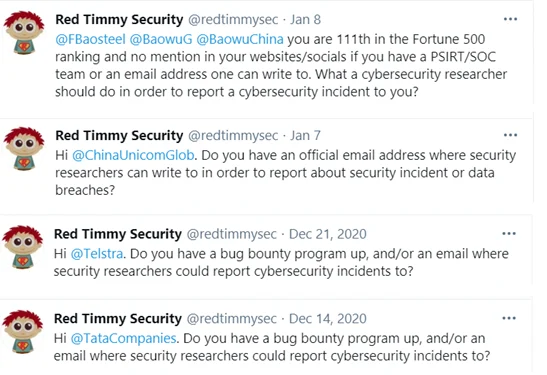
The authors frame the post around the covid-19 pandemic: some collaborators had lost their jobs and turned to bug bounty programs to keep the wolf from the door. They chose to publish failures rather than successes because there is more to learn from them.
Setup
The researchers' starting assumption was that most bug bounty hunters concentrate on web applications, so they decided to focus on infrastructure and exclude anything on ports 80 and 443, where competition is higher. They selected two ISPs that ran bug bounty programs and scanned their IPv4 address space for common services.
For the second story they monitored the networks of several bug bounty program owners and picked a very popular product, common to most of them, used by businesses to filter spam and malicious email. They procured a vulnerable virtual appliance, analysed its components, found how to trigger the bug, developed an exploit and tested it rigorously in a local environment so as not to harm the target.
For the third story they had, over previous months, developed proof-of-concept exploits for high impact known vulnerabilities that had no public exploit. They implemented a test mode in those exploits that reports whether a host is vulnerable without sending code over the network that could be considered too malicious, then scanned the entire internet.
Finding it
Story 1: default credentials on ISP routers
On various subnets the scan found Cisco routers with telnet enabled. Some service banners clearly indicated that the system belonged to the ISP being scanned. Others in the same subnet were anonymous, with no indication of the owner, but showed something like this:
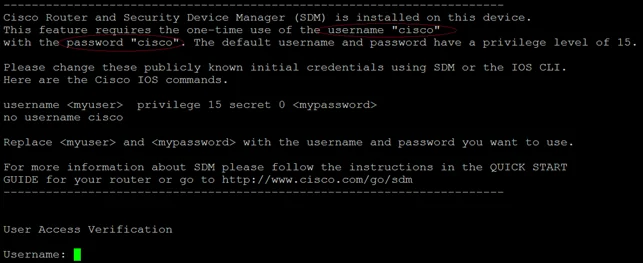
The banner advised the default cisco/cisco credentials, so the researchers tested for default authentication. On hundreds of scanned systems they found, for each provider, some devices accessible with username cisco and password cisco.
After authentication the granted permission level varied: sometimes level 1 (read-only user), sometimes level 15 (admin).
Story 2: a DoS with no public exploit
The researchers studied the freely available security bulletins for the email filtering product and chose a critical DoS that, if exploited, would paralyse the service and block all incoming and outgoing email. Security advisories of this kind do not give many technical details, so a dose of R&D was needed to reproduce it.
Story 3: a bank in the scan output
A few hours after starting the internet-wide scan, the output log files contained an entry similar to this:
IP - host.somebank.domain -> [VULNERABLE]
The host belonged to a real bank with a Bank Identifier Code assigned, but there was no mention of any public bug bounty program on its websites or social media.
Exploitation
Story 1, step 1: read the device state as a read-only user
As a level 1 user the researchers could dump the current device status and configuration. For example, they could enumerate the machines active in the network and establish the internal IP subnet in use:
PROMPT>show arpProtocol Address Age (min) Hardware Addr Type InterfaceInternet xxx.xxx.xxx.114 27 0000.0000.0333 ARPA FastEthernet4.1125Internet xxx.xxx.xxx.115 - 0022.557f.77de ARPA FastEthernet4.1125Internet [redacted] - 0022.547f.a7d4 ARPA Vlan1Internet [redacted] 115 7479.f309.6079 ARPA Vlan1Internet [redacted] 116 48cd.6ecc.643c ARPA Vlan1
The output lists the ARP table, including public addresses on FastEthernet4.1125 and internal addresses on Vlan1, which reveals the internal subnet.
Story 1, step 2: use the router as a bounce host
Even at read-only level the device could be used as a bounce host to attack other networks and systems, with the victim logging the router's IP address as the origin and potentially causing reputational damage to the company owning the hacked device. In the example below the researchers connected to google.com from the router using the telnet command:
PROMPT>telnet www.google.com 80Translating "www.google.com"…domain server (xx.xxx.xxx.xx) [OK]Trying www.google.com ([redacted], 80)… OpenHEAD / HTTP/1.0 <-- OUR REQUEST
Case B)
VVVVVV Services, Inc. XXXSERVICE-MANAGEMENT-xx-xx-xxx-0 (NET-xx-xx-xxx-0-1) xx.xx.xxx.0 - xx.xx.xxx.xxx
They had assumed that "Service Management" and "IP management" pointed to internal ISP subnets. The triage step showed otherwise. The written policy of one of the two providers said:
In general any vulnerability that could realistically place the online security of XXXXXXX at risk is in scope and might be rewarded.
That sentence covered more than web targets, but it was not accompanied by a list or range of in-scope IP addresses for the infrastructural part of the program. Scanning the entire IP range therefore risks hitting customer devices rather than the provider's own.
As a side note, one of the devices with default credentials, a router, belonged to the largest hydroelectric power plant company in the world, operating in a country without a bug bounty program. The researchers say this was not an isolated case of gaining a foothold in the infrastructure of such companies.
Story 2, step 1: build the exploit locally
The researchers worked through the following steps:
- Procure a vulnerable version of the virtual appliance to test.
- Analyse its components.
- Find how to trigger the bug of interest.
- Develop an exploit.
- Test the exploit rigorously in a local environment, to avoid harming the target, and confirm it works.
They then created a report, attached a proof of concept and submitted everything to the concerned entities.
Story 2, outcome: DoS is out of scope
A few hours later the submission was rejected because denial of service attacks, even against a critical business infrastructure, were not contemplated in the chosen bug bounty programs. Almost all the policies explicitly stated something like:
Out of scope: Any activity that could lead to the disruption of our service e.g. denial of service attacks.
The approach of starting from known vulnerabilities in common products with no public exploit proved valid in general, because in other circumstances it earned a bounty. For this case the lesson is to read the rules and policies twice before engaging in any exploitation venture.
Story 3, step 1: prove the finding without harming the host
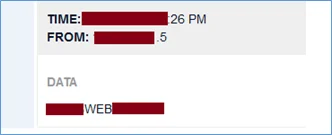
A log file entry alone is not enough to open a ticket with a bank. A piece of information that cannot be retrieved from the public internet is needed as proof, obtained with the least invasive payload possible. The researchers chose to exfiltrate the hostname configured in the vulnerable system:
Story 3, step 2: try to find a security contact
There was no trace on the internet of the bank's SOC or PSIRT team. An email to the info@ address on the bank's web portal received no response. The researchers then sent a private message on Twitter, which finally got an answer:
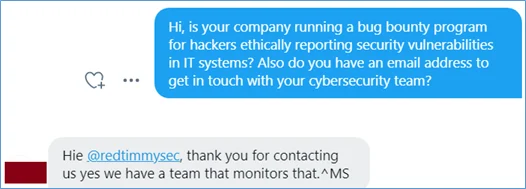
The first answer did not look promising. They tried to explain better who they were and why they were contacting the bank, but their interlocutor disappeared. A couple of days later they made a last attempt:
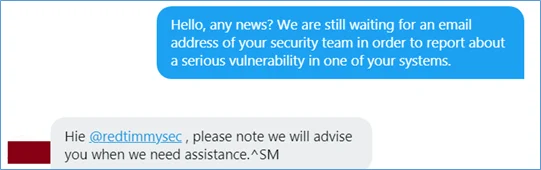
The last reply mentioned advice and assistance. The bank was still vulnerable at the time of writing.
Root cause
None of the three failures is a software flaw in the researchers' own code. They are process and policy failures:
- Story 1: the devices shipped with default
cisco/ciscocredentials, and telnet was enabled and reachable from the internet. The program's scope was written in prose ("any vulnerability that could realistically place the online security of XXXXXXX at risk") without an explicit list or range of in-scope IP addresses, so ownership of the scanned hosts could not be established before testing. Whois description fields such as "IP Management" and "Service Management" were a misleading signal, and the triage confirmed the hosts belonged to customers. - Story 2: the vulnerability was a denial of service, and the programs' policies explicitly excluded any activity that could disrupt the service. The technical work was sound; the eligibility rule was not checked first.
- Story 3: the bank had no bug bounty program and no discoverable security contact, so there was no channel through which a responsible report could be triaged. The "shoot in the pile" method, picking a CVE first and then looking for vulnerable hosts tied to a program, only makes sense with an up-to-date database of in-scope assets for all programs of interest; otherwise a lot of time goes into manually checking whether each vulnerable host is in scope.
Impact
- Story 1: with level 1 access an attacker can dump device status and configuration, enumerate active machines and internal subnets, and use the router as a bounce host to attack other systems, with the victim logging the router's IP and the owning company suffering potential reputational damage. With level 15 access the device is fully controlled: the configuration can be exported and modified, and the device can be flashed with attacker code. A malicious agent could therefore attack internal machines and services as well. The affected devices belonged to the providers' customers, not the providers.
- Story 2: the DoS would cause service paralysis and block all incoming and outgoing email for the affected business. It was not eligible for a reward under the chosen programs.
- Story 3: a real bank with a Bank Identifier Code was running a vulnerable host reachable from the internet, with no public bug bounty program and no reachable security team. The researchers compare the risk to fraud such as the Bangladesh Bank heist. The host was still vulnerable at the time of writing.
Fix
The report does not say whether any of this was done.
For program owners, the report's lessons are:
For researchers, read the rules twice before engaging, and never spend energy on hosts or IPs not explicitly indicated as in scope.
The report also announces a change of policy by the authors: except in rare cases selected at their discretion, they will stop responsibly reporting RCEs to companies without a bug bounty or security policy in place, regardless of how prestigious the company is. They call this the "No-mercy disclosure policy":
if an internet system is vulnerable and the company owning it does not run a bug bounty program nowadays, sooner or later a thing called providence or fate will take care of making a crypto currency miner appear in that system
Variants to test
- Default credentials on network gear. Test
cisco/ciscoagainst telnet and management web panels on hosts you are authorised to test. A positive result is a successful login, and the privilege level shown after login tells you whether it is read-only or admin. - Management web servers on non-standard ports. After gaining any access, run
show running-configand look forip http serverandip http portentries. A positive result is a web panel on the disclosed port that accepts the same credentials. - Bounce capability. From a compromised device, try
telnet <host> <port>to an external service. A positive result is an open connection and a relayed response, which shows the device can be used to originate traffic. - Known vulnerabilities without public exploits. Pick a product common to several programs, read its security bulletins, procure a vulnerable version, reproduce the bug locally and build a test mode that only checks for vulnerability. A positive result is a host that reports vulnerable without disruptive payloads being sent.
- Scope verification before testing. For each candidate host, check whois and the program's written scope. A positive result is an explicit in-scope IP range or asset entry that covers the host; anything else should be treated as out of scope.
What happened, in plain words
This is a story about three attempts to earn money through bug bounty programs, all of which ended without a reward. A bug bounty program is an offer made by a company: if you find a security weakness in our systems and tell us about it in the way we ask, we may pay you. The company writes rules about which of its systems you are allowed to test (the "scope") and which kinds of weakness it will pay for. If your finding falls outside those rules, you get nothing, even if the weakness is real and serious.
The authors are a group of security researchers called Red Timmy Security. They explain that during the covid-19 pandemic some of their collaborators lost their jobs, and some of the group turned to bug bounty work to keep the wolf from the door, that is, to pay the bills while waiting for better times. They decided to publish their failures rather than their successes, because failures teach more. They had been posting cryptic messages on Twitter, and this post explains them.
The three stories are:
- They scanned the internet addresses of two internet service providers (ISPs, the companies that sell you your home internet connection) and found network routers that could be logged into with the factory default username and password. The routers turned out to belong to the providers' customers, not the providers, so the findings were out of scope.
- They found a way to crash a popular email filtering product, a device that sits in front of a company's mail system and removes spam and malicious email. They built the attack themselves from public information. The programs they had chosen did not pay for denial of service attacks, that is, attacks that make a service stop working, so the report was rejected.
- While scanning the whole internet for a known weakness, they found a vulnerable machine belonging to a real bank. The bank had no bug bounty program and no security contact they could reach, so there was no proper way to report it.
Each story is told below in the same order as the original, with the same commands and outputs, explained from scratch.
Setting the scene
The researchers noticed that most bug bounty hunters concentrate on websites, because websites are everywhere and everyone knows how to look at them. That means competition is fierce on the standard web ports, port 80 and port 443. A port is like a numbered door on a computer: port 80 is the usual door for unencrypted web traffic and port 443 for encrypted web traffic. So the researchers decided to look at other doors, the ones used by network infrastructure: routers, switches, mail gateways and similar equipment. They picked two ISPs that ran bug bounty programs and scanned their blocks of internet addresses (their IPv4 address space, meaning the range of numeric addresses assigned to them) looking for common services.
For the second story, they watched the networks of several companies that run bug bounty programs and picked a product that almost all of them use: an email filtering appliance. They obtained a copy of a vulnerable version of this product, which is sold as a virtual appliance, meaning a ready-made virtual machine you can run on your own computer. They took it apart, worked out how to trigger the bug, wrote an attack for it, and tested that attack carefully on their own local copy so as not to harm anyone. Only then did they write a report.
For the third story, they had spent months building proof-of-concept attacks for serious known weaknesses that had no public attack code available. A proof of concept (PoC) is a small demonstration that a weakness is real. They added a "test mode" to these attacks: a mode that only asks a machine "are you vulnerable?" without sending anything that could damage it. Then they scanned the entire internet with it.
Story 1: the default password on ISP routers
What they found
On various subnets (subdivisions of a network) the scan found Cisco routers with telnet enabled. Telnet is an old protocol for opening a text session on a remote machine, like a remote control for a computer, and it is not encrypted, so anyone watching the network can read everything, including passwords. Some of these routers announced themselves with a banner, a short greeting message shown before you log in, that clearly said the system belonged to the ISP being scanned. Others in the same subnet were anonymous, with no indication of the owner, but showed something like this:
The banner suggested the default username cisco and password cisco. Many devices ship with a factory default login so that the buyer can set them up; if nobody changes it, anyone who knows the default can get in. The researchers tested for exactly that, and on hundreds of scanned systems they found, for each provider, some devices that let them in with username cisco and password cisco.
After logging in, the level of permission they got varied. Sometimes it was level 1, a read-only user who can look but not change anything. Sometimes it was level 15, the administrator level with full control.
Step 1: looking around as a read-only user
Even as a level 1 user they could dump the current device status and configuration, that is, print out the device's settings and its view of the network. For example, they could list the machines active on the network and work out the internal IP subnet in use:
PROMPT>show arpProtocol Address Age (min) Hardware Addr Type InterfaceInternet xxx.xxx.xxx.114 27 0000.0000.0333 ARPA FastEthernet4.1125Internet xxx.xxx.xxx.115 - 0022.557f.77de ARPA FastEthernet4.1125Internet [redacted] - 0022.547f.a7d4 ARPA Vlan1Internet [redacted] 115 7479.f309.6079 ARPA Vlan1Internet [redacted] 116 48cd.6ecc.643c ARPA Vlan1
Line by line: PROMPT> is the command prompt, the place where you type. show arp is the command: ARP is the address resolution protocol, a way for a machine to keep a table of which IP address (the numeric address of a machine on a network) belongs to which hardware address (the fixed identifier of a network card). The output is that table. Each row lists an address, how many minutes ago it was last seen, its hardware address, the type, and the interface, which is the network connection it was seen on. The rows on FastEthernet4.1125 show public addresses, and the rows on Vlan1 show internal addresses such as [redacted], [redacted] and [redacted]. A VLAN is a virtual local network, a way of separating traffic inside one physical network. Seeing internal addresses like these tells the researcher what the private network behind the router looks like, which is useful for planning further steps. The xxx parts are redacted numbers.
Step 2: using the router as a stepping stone
Even at read-only level, the device could be used as a bounce host: a machine that relays traffic for you, so that the traffic appears to come from it rather than from you. The victim would log the router's IP address as the origin of the attack, which could damage the reputation of the company that owns the hacked device. In the example below the researchers connected to google.com from the router using the telnet command:
PROMPT>telnet www.google.com 80Translating "www.google.com"…domain server (xx.xxx.xxx.xx) [OK]Trying www.google.com ([redacted], 80)… OpenHEAD / HTTP/1.0 <-- OUR REQUEST
Case B)
VVVVVV Services, Inc. XXXSERVICE-MANAGEMENT-xx-xx-xxx-0 (NET-xx-xx-xxx-0-1) xx.xx.xxx.0 - xx.xx.xxx.xxx
Line by line: in case A, OrgName is the organisation name, OrgId an identifier for it, Address lines give a postal address, and Attn: IP Management says the contact is an "IP Management" team. In case B, the organisation is VVVVVV Services, Inc., followed by a network identifier SERVICE-MANAGEMENT-xx-xx-xxx-0 and the range of addresses it covers, xx.xx.xxx.0 - xx.xx.xxx.xxx. The names and numbers are redacted.
The researchers had assumed that "Service Management" and "IP management" pointed to internal ISP subnets. The triage step, the stage where the program's team reviews a report and decides whether it counts, showed otherwise. The written policy of one of the two providers said:
In general any vulnerability that could realistically place the online security of XXXXXXX at risk is in scope and might be rewarded.
That sentence covered more than web targets, but it was not accompanied by a list or range of in-scope IP addresses for the infrastructural part of the program. Scanning an entire IP range therefore risks hitting customer devices rather than the provider's own. The lesson: never again spend energy on hosts or IPs not explicitly indicated as in scope.
As a side note, one of the devices with default credentials, a router, belonged to the largest hydroelectric power plant company in the world, operating in a country without a bug bounty program. The researchers say this was not an isolated case of gaining a foothold, a first point of access, in the infrastructure of such companies.
Story 2: a crash bug with no public attack
The idea
Zero-day exploits and bug bounty programs do not get along. A zero-day is a weakness that the vendor does not know about yet, so no fix exists. Programs normally ban the use of such code. That is why, when a researcher finds a zero-day, they contact the vendor, not the vulnerable company running the program, to get a patch first. A patch is a fix. Then, when the fix is released, two weeks or one month after the patch becomes available (depending on the program's terms), they cross their fingers and hope the affected company has not fixed its system yet. If so, they submit the report. In no other way would a monetary award be paid.
But even without zero-days, there are many systems affected by known vulnerabilities. Often a security bulletin exists for a product but not the exploit code to take advantage of it. A security bulletin is the vendor's public notice that a weakness exists and has been fixed. So the researchers decided to start from publicly known flaws for which there is no public exploit yet.
The work
They monitored the networks of different bug bounty program owners and selected a very popular product, common to most of them, used by businesses to filter spam and malicious email. They studied the freely available security bulletins for this product and chose a critical DoS, a denial of service, that if exploited would paralyse the service and block all incoming and outgoing email. Security advisories of this kind do not give many technical details, so a dose of research and development (R&D) was needed to reproduce it. They worked through the following steps:
- Procure a vulnerable version of the virtual appliance to test.
- Analyse its components.
- Find how to trigger the bug of interest.
- Develop an exploit.
- Test the exploit rigorously in a local environment, to avoid harming the target, and confirm it works.
They then created a report, attached a proof of concept and submitted everything to the concerned entities.
The outcome: denial of service is out of scope
A few hours later the submission was rejected because denial of service attacks, even against a critical business infrastructure, were not contemplated in the chosen bug bounty programs. Almost all the policies explicitly stated something like:
Out of scope: Any activity that could lead to the disruption of our service e.g. denial of service attacks.
The approach of starting from known vulnerabilities in common products with no public exploit proved valid in general, because in other circumstances it earned a bounty. For this case the lesson is to read the rules and policies twice before engaging in any exploitation venture.
Story 3: the bank found by accident
The scan
As already highlighted, some researchers start by choosing one or more bug bounty programs and then try to find as many vulnerabilities as possible on the systems in scope. Others prefer the approach "discover a zero-day, notify the vendor, wait a few weeks for the fix, cross fingers, submit a report to the vulnerable company running a bug bounty program". A mistreated methodology, which Red Timmy calls "shoot in the pile", consists in choosing a CVE number first and then checking whether any of the systems that can be compromised with that bug are linked to an existing bounty program. A CVE number is a public identifier for a known vulnerability, like a catalogue number.
Having developed over previous months a few PoCs for high impact known vulnerabilities with no public exploit, they thought to scan the entire internet and see how many hackable systems were covered by a bug bounty program. They also implemented a test mode in those exploits that reports whether a host is vulnerable without sending code over the network that could be considered too malicious. A few hours after the scan started, the output log files contained an entry similar to this:
IP - host.somebank.domain -> [VULNERABLE]
Line by line: IP is the numeric address of the host, host.somebank.domain is its name, and [VULNERABLE] is the scanner's verdict that the host can be attacked with the chosen bug. The name is redacted here.
The host belonged to a real bank with a Bank Identifier Code assigned, but there was no mention of any public bug bounty program on its websites or social media. A Bank Identifier Code is the standard international code that identifies a bank in payments. The researchers decided to contact the bank to check whether a private program existed. Regardless, they still intended to report the flaw responsibly even without a prize, because this is just the type of bank ideal for frauds like the one against the bank of Bangladesh a few years earlier.
Proving it without harming the host
A log file entry alone is not enough to open a ticket with a bank. A piece of information that cannot be retrieved from the public internet is needed as proof, obtained with the least invasive payload possible. A payload is the part of an attack that actually does something on the target. They chose to exfiltrate the hostname configured in the vulnerable system, meaning to make the system reveal its own name to them:
Finding someone to talk to
There was no trace on the internet of the bank's SOC or PSIRT team. A SOC is a security operations centre, the team that watches a company's systems, and a PSIRT is a product security incident response team, the group that handles reports about security flaws. An email to the info@ address on the bank's web portal received no response. The researchers then sent a private message on Twitter, which finally got an answer:
The first answer did not look promising. They tried to explain better who they were and why they were contacting the bank, but their interlocutor disappeared. A couple of days later they made a last attempt:
The last reply mentioned advice and assistance. The bank was still vulnerable at the time of writing.
Why it went wrong
None of the three failures is a software flaw in the researchers' own code. They are process and policy failures:
- Story 1: the devices shipped with default
cisco/ciscocredentials, and telnet was enabled and reachable from the internet. The program's scope was written in prose ("any vulnerability that could realistically place the online security of XXXXXXX at risk") without an explicit list or range of in-scope IP addresses, so ownership of the scanned hosts could not be established before testing. Whois description fields such as "IP Management" and "Service Management" were a misleading signal, and the triage confirmed the hosts belonged to customers. - Story 2: the vulnerability was a denial of service, and the programs' policies explicitly excluded any activity that could disrupt the service. The technical work was sound; the eligibility rule was not checked first.
- Story 3: the bank had no bug bounty program and no discoverable security contact, so there was no channel through which a responsible report could be triaged. The "shoot in the pile" method, picking a CVE first and then looking for vulnerable hosts tied to a program, only makes sense with an up-to-date database of in-scope assets for all programs of interest; otherwise a lot of time goes into manually checking whether each vulnerable host is in scope.
What the impact was
- Story 1: with level 1 access an attacker can dump device status and configuration, enumerate active machines and internal subnets, and use the router as a bounce host to attack other systems, with the victim logging the router's IP and the owning company suffering potential reputational damage. With level 15 access the device is fully controlled: the configuration can be exported and modified, and the device can be flashed with attacker code. A malicious agent could therefore attack internal machines and services as well. The affected devices belonged to the providers' customers, not the providers.
- Story 2: the DoS would cause service paralysis and block all incoming and outgoing email for the affected business. It was not eligible for a reward under the chosen programs.
- Story 3: a real bank with a Bank Identifier Code was running a vulnerable host reachable from the internet, with no public bug bounty program and no reachable security team. The researchers compare the risk to fraud such as the Bangladesh Bank heist. The host was still vulnerable at the time of writing.
How to fix it
The report does not say whether any of this was done.
For program owners, the report's lessons are:
For researchers, read the rules twice before engaging, and never spend energy on hosts or IPs not explicitly indicated as in scope.
The report also announces a change of policy by the authors: except in rare cases selected at their discretion, they will stop responsibly reporting RCEs to companies without a bug bounty or security policy in place, regardless of how prestigious the company is. RCE stands for remote code execution, the ability to run your own code on someone else's machine over the network. They call this the "No-mercy disclosure policy":
if an internet system is vulnerable and the company owning it does not run a bug bounty program nowadays, sooner or later a thing called providence or fate will take care of making a crypto currency miner appear in that system
A crypto currency miner is software that uses a machine's computing power to generate cryptocurrency for someone else, which is a common thing to find on badly protected servers.
Things to try, if you are authorised
- Default credentials on network gear. Test
cisco/ciscoagainst telnet and management web panels on hosts you are authorised to test. SSH is the encrypted replacement for telnet. A positive result is a successful login, and the privilege level shown after login tells you whether it is read-only or admin. - Management web servers on non-standard ports. After gaining any access, run
show running-configand look forip http serverandip http portentries. A positive result is a web panel on the disclosed port that accepts the same credentials. - Bounce capability. From a compromised device, try
telnet <host> <port>to an external service. A positive result is an open connection and a relayed response, which shows the device can be used to originate traffic. - Known vulnerabilities without public exploits. Pick a product common to several programs, read its security bulletins, procure a vulnerable version, reproduce the bug locally and build a test mode that only checks for vulnerability. A positive result is a host that reports vulnerable without disruptive payloads being sent.
- Scope verification before testing. For each candidate host, check whois and the program's written scope. A positive result is an explicit in-scope IP range or asset entry that covers the host; anything else should be treated as out of scope.
Glossary
- Bug bounty program: a company's offer to pay researchers who find and report security weaknesses in its systems according to its rules.
- Scope: the list of systems, addresses and types of weakness a bug bounty program covers.
- Out of scope: not covered by the program, so no reward is payable.
- Triage: the stage where a program's team reviews a report and decides whether it counts.
- ISP: internet service provider, the company that sells internet connections.
- IPv4 address space: the range of numeric internet addresses assigned to an organisation.
- Port: a numbered door on a computer that identifies which service you are talking to; 80 and 443 are the usual web ports.
- TCP: the protocol that carries most internet connections reliably.
- Telnet: an old, unencrypted protocol for opening a text session on a remote machine.
- SSH: an encrypted protocol for the same purpose as telnet.
- Banner: a short greeting message a service shows before you log in.
- Default credentials: the factory username and password a device ships with, which should be changed on setup.
- Subnet: a subdivision of a network.
- VLAN: a virtual local network, a way of separating traffic inside one physical network.
- ARP: address resolution protocol, a table mapping IP addresses to hardware addresses on a local network.
- IP address: the numeric address of a machine on a network.
- Hardware address: the fixed identifier of a network card.
- Interface: a network connection on a device.
- DNS: the domain name system, the internet's phone book, translating names to addresses.
- HTTP: the language browsers and web servers use to exchange pages and data.
- HEAD request: an HTTP request that asks for a page's headers without the page body.
- Bounce host: a machine used to relay traffic so that it appears to come from that machine.
- Firmware: the built-in software that runs a device.
- Flashing: replacing a device's built-in software.
- Configuration: the full set of settings a device is running with.
- Whois: a public directory service that says who is registered as the owner of an address or domain.
- Zero-day: a weakness the vendor does not know about yet, so no fix exists.
- Patch: a fix for a software weakness.
- Security bulletin: a vendor's public notice that a weakness exists and has been fixed.
- Denial of service (DoS): an attack that makes a service stop working.
- Exploit: code or steps that take advantage of a weakness.
- Proof of concept (PoC): a small demonstration that a weakness is real.
- Payload: the part of an attack that actually does something on the target.
- Exfiltrate: to make a system reveal information to you.
- CVE number: a public identifier for a known vulnerability.
- RCE: remote code execution, running your own code on someone else's machine over the network.
- SOC: security operations centre, the team that watches a company's systems.
- PSIRT: product security incident response team, the group that handles reports about security flaws.
- Bank Identifier Code: the standard international code that identifies a bank in payments.
- Crypto currency miner: software that uses a machine's computing power to generate cryptocurrency for someone else.
- Virtual appliance: a ready-made virtual machine you can run on your own computer.
- R&D: research and development, the work of studying something and building something new from it.
- Foothold: a first point of access inside someone's infrastructure.



