Bypassing URL Validation with IPv6: An SSRF Story
 Published on medium.com
Bug Bounty
The full write-up lives on its author's site
It belongs to its author, so we link to it rather than copy it. The other two tabs are our own rewrites, checked against it.
Context
The target was an application that lets authenticated users configure webhooks. A webhook is a URL the platform calls out to when a chosen event happens, so the backend makes an outbound HTTP request to a destination the user supplies. The feature exposed an authenticated API endpoint for creating webhooks, and the application enforced a public-URL-only policy: it rejected loopback, link-local and cloud metadata addresses.
The researcher's question was whether that policy held for every way of writing an IP address, or only for the IPv4 forms the validator was written around.
Setup
The report describes an authenticated API endpoint for creating webhooks. The requests use a teamId query parameter and a JSON body with a url and an events array. The only event used throughout is project.created. To confirm that the backend actually made outbound requests, the researcher used an external callback domain under their own control, which recorded DNS lookups and HTTP requests. No specific tooling, versions or account roles beyond an authenticated user are described.
Finding it
The validator blocked the obvious internal destinations. The researcher started with the standard IPv4 loopback address and got a rejection:
POST /api/v1/webhooks?teamId=<teamId>Content-Type: application/json{ "url": "<attacker-controlled-url>", "events": ["project.created"]}
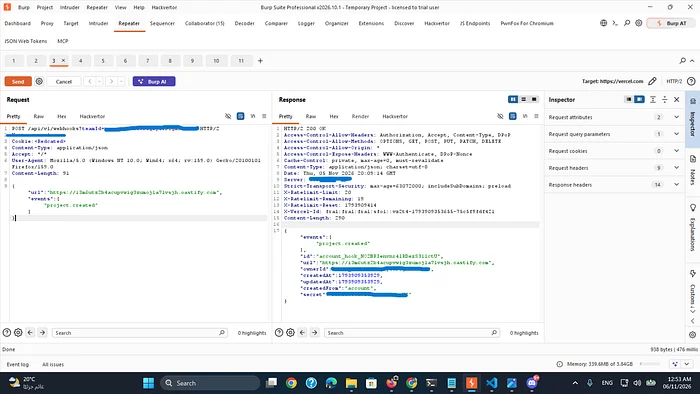
Sending the loopback address itself:
{ "url": "http://[redacted]:80/", "events": ["project.created"]}
returned:
400 Bad Request
{ "error": { "code": "validation_error", "message": "Webhook URL should be a public URL." }}
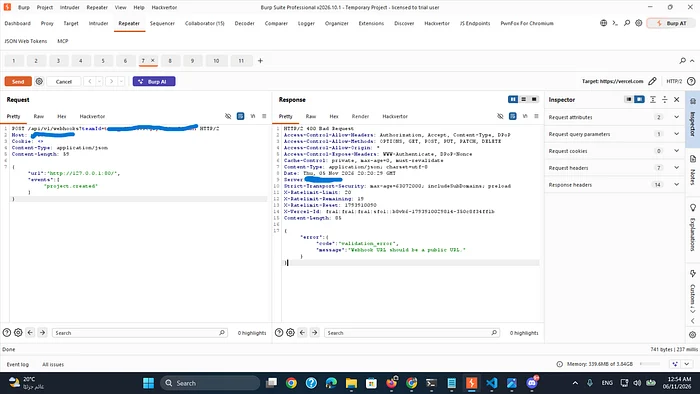
Other tested addresses and representations, including [redacted], localhost, and decimal, hexadecimal and octal IPv4 formats, were also rejected. So the validator was not naive about IPv4 spellings; it handled the usual tricks. What it did not appear to handle was IPv6.
Exploitation
Step 1: send the IPv6 loopback equivalent
The researcher replaced the IPv4 loopback with its IPv6 equivalent, [::1], in the same JSON body:
{ "url": "http://[::1]:80/", "events": ["project.created"]}
This time the response was:
200 OK
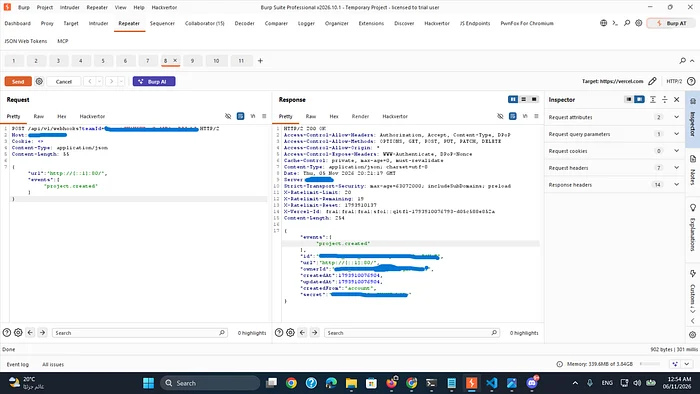
The webhook was successfully created, and the application returned a secret token. The contrast was clear:
[redacted]was rejected.[::1]was accepted.
Step 2: try other IPv6 representations
The researcher continued with alternative IPv6 representations of restricted destinations:
[::1] — Accepted[::ffff:[redacted]] — Accepted[::ffff:[redacted]] — Accepted[64:ff9b::7f00:1] — Accepted
These cover the IPv6 loopback, IPv4-mapped IPv6 forms of loopback and of the link-local metadata address, and a NAT64 representation of [redacted]. All were accepted. The results indicated that the validator was not properly normalising and checking IPv6 destinations.
Step 3: confirm the backend makes the request
Accepting a URL is not the same as calling it. To verify webhook execution, the researcher configured a webhook using an external callback domain under their control, then triggered the project.created event by creating a project:
POST /api/v9/projects?teamId=<teamId>Content-Type: application/json{ "name": "ssrf-confirm-new-collab", "framework": "nextjs"}
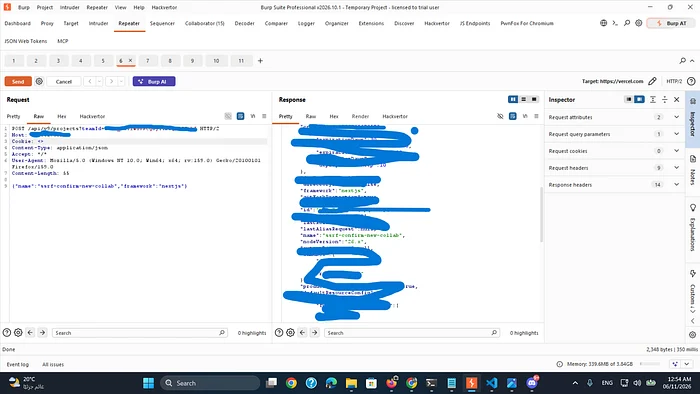
After the event was triggered, the callback service recorded DNS lookups and HTTP requests originating from the application's infrastructure.
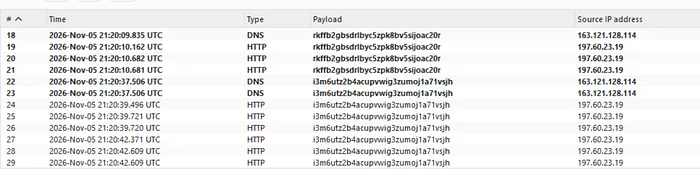
This confirmed that the backend performed outbound HTTP requests when webhook events were triggered.
Step 4: attempt to read internal responses
The researcher then investigated whether internal response data could be retrieved through the webhook functionality. The platform did not expose delivery logs, HTTP response codes or response bodies, and several possible delivery endpoints returned 404 Not Found. As a result, successful internal response retrieval or data exfiltration could not be demonstrated.
The report separates what was proven from what was not:
| Confirmed | Not demonstrated |
|---|---|
| IPv6 URL validation bypass | Successful internal data retrieval |
| Webhook creation using restricted IPv6 representations | Credential extraction |
| Server-side outbound HTTP requests | Internal data exfiltration |
Root cause
The validator was written around IPv4. It rejected loopback, link-local and cloud metadata addresses in their IPv4 forms, including decimal, hexadecimal and octal spellings, but it was not properly normalising and checking IPv6 destinations before applying the policy. Because [::1], [::ffff:[redacted]], [::ffff:[redacted]] and [64:ff9b::7f00:1] are not the strings the IPv4 checks look for, they passed validation and the webhook was created. The report states this directly: the validator was not properly normalising and checking IPv6 destinations. The existing defences stopped the IPv4 spellings they were designed for, but the IPv6 equivalents of the same destinations passed validation.
Impact
The vulnerability creates an SSRF attack surface that could potentially expose internal infrastructure. An authenticated user could configure webhook destinations that bypassed the application's IPv4-focused validation, and the backend made outbound HTTP requests when the relevant event fired.
The actual impact depends on backend network access and on whether requests to internal destinations are successfully executed. In this assessment the researcher could not show internal response retrieval, credential extraction or data exfiltration, because the platform exposed no delivery logs, response codes or response bodies. The finding is the bypass and the confirmed outbound request, not demonstrated internal access.
Fix
The report recommends five changes:
- IP normalisation: properly parse and validate both IPv4 and IPv6 addresses.
- Block restricted ranges: reject loopback, private, link-local, reserved and IPv6 unique-local addresses.
- DNS validation: validate resolved destination IPs and prevent DNS rebinding.
- Egress filtering: restrict webhook workers from accessing sensitive internal infrastructure.
- Delivery monitoring: provide controlled webhook delivery status and HTTP response information.
The report does not say which of these, if any, were implemented.
Variants to test
- IPv4-mapped IPv6. Send
[::ffff:[redacted]]and[::ffff:[redacted]]where the validator only blocks the plain IPv4 forms. A positive result is a200 OKand a created webhook where the IPv4 form returned400. - NAT64 prefixes. Send
[64:ff9b::7f00:1]and other NAT64-encoded internal addresses. A positive result is acceptance plus an outbound request from the platform's infrastructure. - Other IPv6 spellings. Try compressed and expanded forms, uppercase hex, and IPv6 unique-local addresses. A positive result is any accepted destination that the policy should have blocked.
- DNS-based bypass. Point a domain you control at an internal address and see whether the validator checks the resolved IP or only the hostname. A positive result is acceptance and a callback or connection from the backend to the internal target.
- Redirect-based bypass. Use a public URL that redirects to an internal address. A positive result is the backend following the redirect and making the second request.
- Out-of-band confirmation. Use a callback service to record DNS lookups and HTTP requests, as in this report. A positive result is a recorded request originating from the application's infrastructure after the event fires.
What happened, in plain words
A website let logged-in users set up "webhooks". A webhook is a simple idea: you give the site a web address (a URL), and the site promises to send a message to that address whenever something happens, for example when a new project is created. To keep people from abusing this, the site checked every URL you gave it and refused any address that pointed back inside its own network. The researcher found that this check only understood the older style of network address (IPv4). When the same internal destination was written in the newer style (IPv6), the check let it through. The site then accepted the webhook, and when an event fired the backend made outbound HTTP requests, confirmed via a callback domain. The researcher could not prove that any internal data came back, because the site did not show webhook delivery results. So the confirmed finding is the bypass and the outbound request, not stolen data.

The image above is the article's header illustration for the story.
Before the details, a few words that come up constantly.
- API: a way for one program to talk to another over the internet, usually by sending a request to a specific address and getting a structured answer back. Think of it as a service counter: you hand over a form, the clerk processes it and hands back a receipt.
- Endpoint: one specific address on that counter, for example the one that creates webhooks.
- JSON: a text format for those forms, made of names and values in curly braces, like
{"name": "value"}. - Token: a short secret string that proves who you are, a bit like a wristband at an event. The site hands it to you when you log in, and you show it with each request.
- SSRF: short for Server-Side Request Forgery. It means tricking a server into making a request on your behalf, usually to a place you could not reach yourself, such as the server's own internal network.
- Loopback address: the address a computer uses to talk to itself. In IPv4 it is
[redacted]; in IPv6 it is::1. Like calling your own phone number. - Link-local address: an address only valid on the local network segment, not routed across the internet.
- Cloud metadata address: a special internal address that cloud providers use to hand a server information about itself, sometimes including credentials. Reaching it from outside is a classic SSRF goal.
- Validator: the part of the application that inspects your input and decides whether to accept or reject it.
1. The attack surface
The application had a feature where a logged-in user could register a webhook. The report shows the request used to create one:
POST /api/v1/webhooks?teamId=<teamId>Content-Type: application/json{ "url": "<attacker-controlled-url>", "events": ["project.created"]}
Line by line:
POST /api/v1/webhooks?teamId=<teamId>is the request line.POSTmeans "I am sending data to create something"./api/v1/webhooksis the endpoint for webhooks.?teamId=<teamId>is a parameter that says which team the webhook belongs to; the angle brackets are a placeholder, not literal text.Content-Type: application/jsontells the server the body is in JSON format, so it knows how to read it.- The body
{ "url": "<attacker-controlled-url>", "events": ["project.created"] }has two fields.urlis where the site should send its message.eventsis a list of events that should trigger the message; here onlyproject.created, meaning "a project was created".
The site had a rule: the URL must be public. It rejected loopback, link-local and cloud metadata addresses. The researcher's question was simple: does that rule hold for every way of writing an address, or only for the IPv4 forms the check was built around?
2. Testing the IPv4 loopback address
The first test was the obvious one, the address a computer uses to reach itself:
{ "url": "http://[redacted]:80/", "events": ["project.created"]}
This JSON says: create a webhook whose destination is http://[redacted]:80/. [redacted] is the IPv4 loopback address, and :80 is the port, the numbered door on that machine where a web server usually listens. The event list is the same as before.
The response was a rejection:
400 Bad Request
{ "error": { "code": "validation_error", "message": "Webhook URL should be a public URL." }}
What this means:
400 Bad Requestis the server saying "I will not accept this request as it stands".- The JSON body explains why.
codeis a short machine-readable label,validation_error, meaning the input failed a check.messageis the human-readable explanation: the webhook URL should be a public URL.
So the validator was doing its job for this spelling. The researcher also tried [redacted] (the cloud metadata address), localhost (the name for the same loopback destination), and decimal, hexadecimal and octal ways of writing IPv4 addresses. All were rejected. That matters: the check was not naive about IPv4. It knew the usual tricks. The gap was elsewhere.
3. The IPv6 bypass
IPv6 is the newer version of the internet's addressing system. It writes addresses differently, in groups of hexadecimal digits separated by colons, and it has its own loopback address, ::1. When an IPv6 address appears inside a URL, it is wrapped in square brackets, so it becomes [::1].
The researcher sent the IPv6 equivalent of the same loopback destination:
{ "url": "http://[::1]:80/", "events": ["project.created"]}
This is the same request as before, with one change: [redacted] has been replaced by [::1]. The port :80 and the event list are unchanged. The point of the test is to see whether the validator treats the two spellings of the same destination the same way.
This time the answer was:
200 OK
200 OK means the server accepted the request and did what was asked. The webhook was created, and the application returned a secret token.
The contrast was clear:
[redacted]was rejected.[::1]was accepted.
The researcher then tried other IPv6 ways of writing restricted destinations:
[::1] — Accepted[::ffff:[redacted]] — Accepted[::ffff:[redacted]] — Accepted[64:ff9b::7f00:1] — Accepted
What each line is:
[::1]is the IPv6 loopback address, the same destination as[redacted].[::ffff:[redacted]]is an IPv4-mapped IPv6 address. IPv6 has a notation for carrying an IPv4 address inside it, and this is the IPv4 loopback carried that way. It still means "this machine".[::ffff:[redacted]]is the cloud metadata address carried in the same IPv4-mapped form.[64:ff9b::7f00:1]is a NAT64 representation. NAT64 is a translation scheme that lets IPv6-only networks reach IPv4 destinations; the IPv4 address is encoded inside the IPv6 address. Here it encodes[redacted].
All four were accepted. The conclusion the researcher drew was that the validator was not properly normalising and checking IPv6 destinations. Normalising means rewriting every equivalent spelling into one standard form before comparing it against the block list. If the check only looks for the exact IPv4 strings, none of these IPv6 strings match, so they pass.
4. Confirming the server actually makes the request
Accepting a URL is not the same as calling it. A site could store the webhook and never send anything. To prove the backend really makes the outbound request, the researcher set up a webhook pointing at an external callback domain under their own control. A callback domain is simply a server the researcher runs, which records every request that arrives at it.
Then the researcher triggered the project.created event by creating a project:
POST /api/v9/projects?teamId=<teamId>Content-Type: application/json{ "name": "ssrf-confirm-new-collab", "framework": "nextjs"}
Line by line:
POST /api/v9/projects?teamId=<teamId>is the request that creates a project for a team. Note the version in the path isv9here, notv1as for webhooks; that is what the report shows.Content-Type: application/jsonagain says the body is JSON.- The body gives the project a
nameand aframework. The name is just a label chosen for this test; the framework value is part of the request the report shows.
Creating the project fires the project.created event. If the webhook works, the site should now send a request to the callback domain. After the event was triggered, the callback service recorded DNS lookups and HTTP requests originating from the application's infrastructure.
A DNS lookup is the step where a computer turns a domain name into an IP address, like looking up a name in a phone book. Seeing those lookups and the HTTP requests arrive at the callback server confirmed that the backend performed outbound HTTP requests when webhook events were triggered. That is the difference between "the site accepted my URL" and "the site actually called it".
5. Trying to read internal responses
The researcher then investigated whether internal response data could be retrieved through the webhook feature. The idea would be to point a webhook at an internal address and somehow read what that internal service answered.
The platform did not expose delivery logs, HTTP response codes or response bodies. Several possible delivery endpoints also returned 404 Not Found. 404 means "there is nothing at this address". As a result, successful internal response retrieval or data exfiltration could not be demonstrated.
The report separates what was proven from what was not:
| Confirmed | Not demonstrated |
|---|---|
| IPv6 URL validation bypass | Successful internal data retrieval |
| Webhook creation using restricted IPv6 representations | Credential extraction |
| Server-side outbound HTTP requests | Internal data exfiltration |
This separation is the honest part of the work. The bypass and the outbound request are facts. Reading internal data is not, because the platform gave no way to see the answer.
6. Why it happened
The validator was written around IPv4. It rejected loopback, link-local and cloud metadata addresses in their IPv4 forms, including decimal, hexadecimal and octal spellings, but it was not properly normalising and checking IPv6 destinations before applying the policy. Because [::1], [::ffff:[redacted]], [::ffff:[redacted]] and [64:ff9b::7f00:1] are not the strings the IPv4 checks look for, they passed validation and the webhook was created. The report states this directly: the validator was not properly normalising and checking IPv6 destinations. The existing defences stopped the IPv4 spellings they were designed for, but the IPv6 equivalents of the same destinations passed validation.
7. Impact
The vulnerability creates an SSRF attack surface that could potentially expose internal infrastructure. An authenticated user could configure webhook destinations that bypassed the application's IPv4-focused validation, and the backend made outbound HTTP requests when the relevant event fired.
The actual impact depends on backend network access and on whether requests to internal destinations are successfully executed. In this assessment the researcher could not show internal response retrieval, credential extraction or data exfiltration, because the platform exposed no delivery logs, response codes or response bodies. The finding is the bypass and the confirmed outbound request, not demonstrated internal access.
8. Fix
The report recommends five changes:
- IP normalisation: properly parse and validate both IPv4 and IPv6 addresses.
- Block restricted ranges: reject loopback, private, link-local, reserved and IPv6 unique-local addresses.
- DNS validation: validate resolved destination IPs and prevent DNS rebinding.
- Egress filtering: restrict webhook workers from accessing sensitive internal infrastructure.
- Delivery monitoring: provide controlled webhook delivery status and HTTP response information.
A word on two of these. DNS rebinding is a trick where a domain name first resolves to a harmless public address and later to an internal one, so a check done once can be fooled. Egress filtering means controlling what the servers are allowed to connect out to, so even a successful bypass cannot reach sensitive places. The report does not say which of these, if any, were implemented.
9. Variants to test
If you want to look for the same class of bug elsewhere, these variations are worth trying.
- IPv4-mapped IPv6. Send
[::ffff:[redacted]]and[::ffff:[redacted]]where the validator only blocks the plain IPv4 forms. A positive result is a200 OKand a created webhook where the IPv4 form returned400. - NAT64 prefixes. Send
[64:ff9b::7f00:1]and other NAT64-encoded internal addresses. A positive result is acceptance plus an outbound request from the platform's infrastructure. - Other IPv6 spellings. Try compressed and expanded forms, uppercase hex, and IPv6 unique-local addresses. A positive result is any accepted destination that the policy should have blocked.
- DNS-based bypass. Point a domain you control at an internal address and see whether the validator checks the resolved IP or only the hostname. A positive result is acceptance and a callback or connection from the backend to the internal target.
- Redirect-based bypass. Use a public URL that redirects to an internal address. A positive result is the backend following the redirect and making the second request.
- Out-of-band confirmation. Use a callback service to record DNS lookups and HTTP requests, as in this report. A positive result is a recorded request originating from the application's infrastructure after the event fires.
10. Conclusion
This assessment demonstrates how incomplete IPv6 handling can undermine URL validation and introduce an SSRF vulnerability. The key lesson is that URL validation must account for all IP address representations, not just IPv4. The researcher's closing line is worth keeping: good security research is about proving what actually happened, not claiming impact that cannot be demonstrated.
Glossary
- API: a way for programs to talk to each other over the internet by sending requests to specific addresses and receiving structured answers.
- Endpoint: one specific address on an API, such as the one that creates webhooks.
- JSON: a text format for data, made of names and values in curly braces.
- Token: a short secret string that proves who you are or identifies a resource, like a wristband at an event.
- Webhook: a URL a service calls out to when a chosen event happens, so the service makes an outbound request to a destination you supply.
- Event: something that happens in an application, such as a project being created, which can trigger a webhook.
- SSRF (Server-Side Request Forgery): tricking a server into making a request on your behalf, usually to a place you could not reach yourself.
- IPv4: the older internet addressing system, written as four numbers separated by dots, such as
[redacted]. - IPv6: the newer addressing system, written in hexadecimal groups separated by colons, such as
::1. - Loopback address: the address a computer uses to talk to itself;
[redacted]in IPv4 and::1in IPv6. - Link-local address: an address valid only on the local network segment, not routed across the internet.
- Cloud metadata address: a special internal address cloud providers use to give a server information about itself, sometimes including credentials.
- Port: the numbered door on a machine where a particular service listens, such as
:80for a web server. - Validator: the part of an application that inspects input and decides whether to accept or reject it.
- Normalisation: rewriting every equivalent spelling of a value into one standard form before comparing it against a rule.
- IPv4-mapped IPv6: an IPv6 notation that carries an IPv4 address inside it, such as
::ffff:[redacted]. - NAT64: a translation scheme that lets IPv6-only networks reach IPv4 destinations by encoding the IPv4 address inside an IPv6 address.
- DNS lookup: the step where a computer turns a domain name into an IP address, like looking up a name in a phone book.
- DNS rebinding: a trick where a domain name first resolves to a harmless public address and later to an internal one, so a check done once can be fooled.
- Callback domain: a server you control that records every request that arrives at it, used to prove a backend really made a request.
- Out-of-band confirmation: proving a request happened by observing it on a separate channel, such as a callback server, rather than in the application's own response.
- Egress filtering: controlling what servers are allowed to connect out to, so a bypass cannot reach sensitive places.
- Exfiltration: getting data out of a system without permission.
- Credential extraction: obtaining secrets such as passwords or tokens from a system.
- 400 Bad Request: the server's answer meaning it will not accept the request as it stands.
- 404 Not Found: the server's answer meaning there is nothing at the requested address.
- 200 OK: the server's answer meaning the request was accepted and carried out.



