CVE-2026-123890 | VMware vCenter Directory Service Authentication Bypass Vulnerability
An unauthenticated attacker with network access to VMware vCenter could obtain an authenticated session as the built-in [redacted] account, taking control of the vSphere environment and the ESXi hosts and virtual machines it manages. The flaw is in the VMware Directory Service (vmdir), where the SRP-6a session key is disclosed over DCE/RPC without authentication.

CVE-2026-123890 is a critical authentication bypass in the VMware Directory Service component of VMware vCenter. An attacker with network access to vCenter, and no credentials, can obtain an authenticated session as the built-in [email protected] account, taking control of the vSphere environment and the…
The full write-up lives on its author's site
It belongs to its author, so we link to it rather than copy it. The other two tabs are our own rewrites, checked against it.
Context
CVE-2026-123890 is an authentication bypass in the VMware Directory Service (vmdir), the LDAP-backed identity store that sits behind vCenter Single Sign-On. vmdir is where vSphere keeps its identity data, and SSO is what turns a set of credentials into a session that the rest of vCenter trusts. The bug lets someone with network reachability to the vCenter Server appliance, and no credentials at all, obtain an authenticated session as the built-in [redacted] account. From there the attacker controls the vSphere environment and the ESXi hosts and virtual machines it manages.
Broadcom rates it 9.8 (Critical) under CVSS v3.1 in Broadcom Security Advisory VMSA-2026-0009. Exploitation needs no user interaction and no special configuration. It has been exploited in the wild: Google Threat Intelligence Group and Mandiant report that the suspected PRC-nexus actor ARMORY CASTLE used it as a zero-day from early September 2026, and CISA added it to the Known Exploited Vulnerabilities catalogue on November 20, 2026.
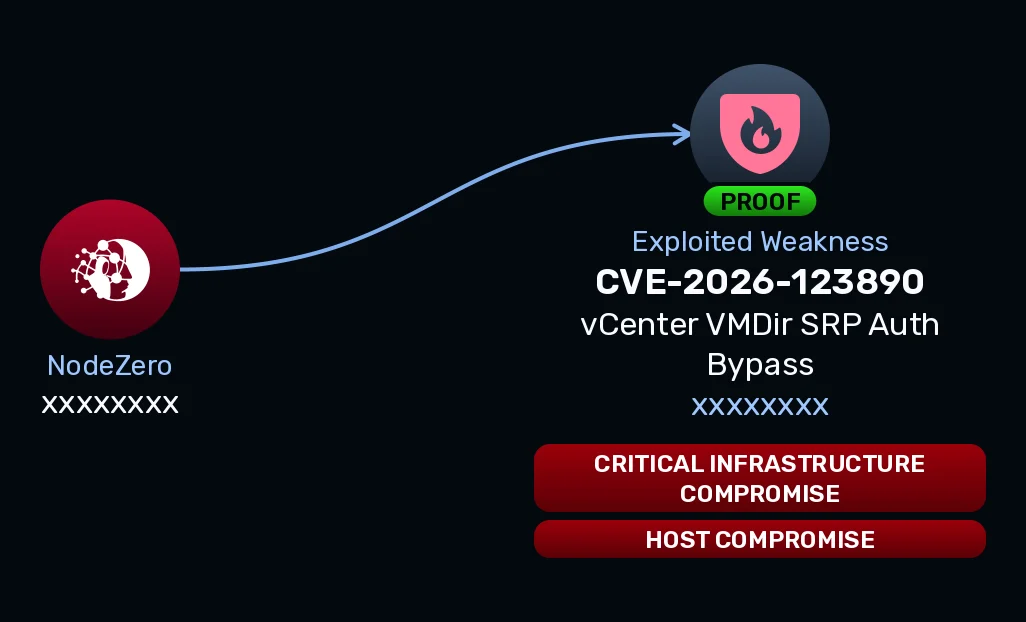
Setup
The attack does not require an account, a role or any tooling beyond the ability to talk to vCenter over the network. The precondition is network reachability to the vCenter Server appliance. Internet exposure is not required: in the intrusion Google Threat Intelligence Group documented, the attacker reached vCenter from inside the network after compromising a separate appliance.
Finding it
Google Threat Intelligence Group's analysis places the root cause in unauthenticated disclosure of the SRP-6a session key over DCE/RPC. SRP-6a is the password-authenticated key exchange vmdir uses to establish a session. Because that key can be recovered without authenticating, an attacker can derive a valid session and present it as the default vSphere SSO administrator, [redacted].
The report stresses that this is not the same bug as CVE-2026-59309, an earlier VMware Directory Service bypass disclosed on July 29, 2026. Google Threat Intelligence Group observed exploitation against a vCenter that had already been patched for that earlier issue, which is the signal that a second, distinct flaw was in play.
Exploitation
The report describes the mechanism rather than publishing a request sequence, so there are no payloads or commands to reproduce here. The chain is:
- Reach the vCenter Server appliance over the network. No credentials are needed.
- Interact with vmdir over DCE/RPC in a way that causes the SRP-6a session key to be disclosed without authentication.
- Recover that key and use it to derive a valid session.
- Present the session as
[redacted], which yields administrative access to vCenter.
Root cause
The weakness is classified as CWE-288, Authentication Bypass Using an Alternate Path or Channel. The report classifies the weakness as CWE-288 and places the root cause in unauthenticated disclosure of the SRP-6a session key over DCE/RPC, without describing the specific code defect. The report does not describe the specific code defect beyond this.
Why the existing defences did not stop it: the report does not analyse the implementation. What it does establish is that patching for the earlier vmdir bypass, CVE-2026-59309, did not close this one, since exploitation was observed against a vCenter already patched for that issue.
Impact
Successful exploitation gives administrative access to vCenter as [redacted], with high confidentiality, integrity and availability impact. That means control of the vSphere environment and of the ESXi hosts and virtual machines it manages. The conditions are narrow but shallow: network reachability to the appliance, no credentials, no user interaction, no special configuration. Internal reachability is enough, as the documented intrusion shows.
Fix
Broadcom's advisory lists no workaround for CVE-2026-123890; patching is the only vendor-provided remedy. Fixed builds:
| Product | Fixed version |
|---|---|
| VMware vCenter | 9.1.1.0200 |
| VMware vCenter | 9.0.2.0200 |
| VMware vCenter | 8.0 U3m |
| VMware Cloud Foundation | 5.2.5 |
| Telco Cloud Platform and Telco Cloud Infrastructure | per Broadcom KB463116 |
| VMware vCenter 7.0 | no public fixed build; extended support customers are directed to contact Broadcom Support |
Affected versions:
- VMware vCenter 9.1.x.x prior to 9.1.1.0200
- VMware vCenter 9.0.x.x prior to 9.0.2.0200
- VMware vCenter 8.0 prior to 8.0 U3m
- VMware vCenter 7.0 (no public fixed build listed)
- VMware Cloud Foundation vCenter 5.x prior to 5.2.5
- VMware Telco Cloud Platform 3.0, 4.x, 5.0.x, 5.1.x, 5.2 and VMware Telco Cloud Infrastructure 3.0
Beyond patching, Google Threat Intelligence Group recommends restricting network access to the vCenter Server appliance, forwarding its logs to a SIEM, and reviewing vCenter for signs of prior compromise, noting that reactive patching alone is not sufficient.
Variants to test
These follow from the mechanism described, not from anything the report demonstrates:
- Other vmdir RPC paths. Enumerate DCE/RPC interfaces exposed by the appliance and look for any operation that returns key material before authentication completes. A positive result is a value you can use to build a session without supplying a password.
- SRP-6a implementations elsewhere. Any service using SRP-6a over an RPC transport is worth checking for early key disclosure. A positive result is a session that the server accepts without the client ever proving knowledge of the password.
- Patch-level differential. Compare a build patched for CVE-2026-59309 against a fully fixed build on the same RPC calls. A positive result is a call that still leaks key material on the older build.
Hunting notes
This class of bug hides in identity services that expose a non-HTTP management channel: LDAP-backed stores, SSO components and anything speaking DCE/RPC next to a web front end. During recon, the signal is a vCenter appliance whose version falls in the affected ranges above, especially one that has been patched for earlier vmdir issues but not for this one. Because no credentials and no user interaction are needed, a single reachable appliance is enough to demonstrate impact; the report notes in-the-wild exploitation against a vCenter patched for the previous bypass, and CISA added it to the KEV catalogue with a November 23, 2026 remediation deadline for federal agencies.
Timeline
- September 2026: Google Threat Intelligence Group reports, based on forensic evidence, that ARMORY CASTLE exploited CVE-2026-123890 as a zero-day in early September 2026.
- November 19, 2026: Broadcom published Security Advisory VMSA-2026-0009, and the CVE record was published.
- November 19, 2026: Google Threat Intelligence Group and Mandiant published their analysis of the ARMORY CASTLE intrusion.
- November 20, 2026: Broadcom revised the advisory to VMSA-2026-0009.1.
- November 20, 2026: CISA added CVE-2026-123890 to the Known Exploited Vulnerabilities catalogue, with a November 23, 2026 remediation due date for federal agencies.
References
- Broadcom Security Advisory VMSA-2026-0009
- NIST NVD Record: CVE-2026-123890
- CISA Known Exploited Vulnerabilities Catalogue: CVE-2026-123890
- Google Threat Intelligence Group: ARMORY CASTLE Exploits vSphere
- The Hacker News: Critical VMware vCenter Zero-Day Flaw Lets Network Attackers Bypass Authentication
What happened, in plain words
A serious security hole was found in VMware vCenter, a piece of software that many companies use to run and manage their virtual computers. The hole let anyone who could reach the vCenter machine over a network log in as the most powerful built-in account, without knowing any password at all. That account is called [redacted], and whoever holds it controls the whole virtual environment: the physical servers (ESXi hosts) and every virtual machine running on them.
A few terms are worth unpacking before going further, because the rest of this article leans on them.
- Virtual machine (VM): a computer that exists as software inside a real computer. One physical server can run many virtual machines at once, each with its own operating system.
- ESXi host: the physical server that runs virtual machines. VMware makes it.
- vCenter: the central control panel for a group of ESXi hosts. Administrators use it to create, move, start and stop virtual machines across many servers at once. If you control vCenter, you control everything underneath it.
- Authentication: proving who you are, usually with a username and password. Authentication bypass means getting past that check without proving anything.
- Session: a short-lived "you are logged in" state that a server keeps after you authenticate, so you do not have to type your password for every single action. Think of a wristband at an event: you show your ticket once, get the band, and after that the staff only look at the band.
- Credentials: the username and password (or other proof) used to log in.
- Zero-day: a flaw that attackers use before the vendor has a fix available, so defenders have no patch to apply at the time of the attack.
- In the wild: real attacks against real organisations, as opposed to something only demonstrated in a lab.
The flaw is tracked as CVE-2026-123890. A CVE is a public catalogue number for a known vulnerability, so people around the world can refer to the same bug unambiguously. Broadcom, the company that now owns VMware, rates it 9.8 out of 10, which is "Critical", the top severity band. The rating system is called CVSS, and 9.8 is about as bad as it gets.
This was not just a theoretical problem. Google Threat Intelligence Group and Mandiant reported that a group they suspect is linked to China, tracked as ARMORY CASTLE, used the flaw as a zero-day starting in early September 2026. On 20 November 2026 the US government's cybersecurity agency, CISA, added it to a list of vulnerabilities known to be exploited, with a deadline of 23 November 2026 for federal agencies to fix it.
Context
The flaw lives in a component called the VMware Directory Service, shortened to vmdir. To understand what that is, start with two ideas.
- Directory service: a central list of users, groups and their passwords, used by many systems to check identities. A company phone book, but for accounts.
- LDAP: the standard language used to talk to a directory service. Think of it as the format of the questions you can ask the phone book ("does this user exist?", "what is their password hash?").
vmdir is the LDAP-backed identity store behind vCenter Single Sign-On, or SSO. SSO is the feature that lets you log in once and then use many parts of vCenter without logging in again. vmdir holds the identity data, and SSO turns a set of credentials into a session that the rest of vCenter trusts.
The bug lets someone who can reach the vCenter Server appliance over the network, with no credentials at all, obtain an authenticated session as the built-in [redacted] account. From there the attacker controls the vSphere environment and the ESXi hosts and virtual machines it manages.
Broadcom rates it 9.8 (Critical) under CVSS v3.1 in Broadcom Security Advisory VMSA-2026-0009. Exploitation needs no user interaction and no special configuration. It has been exploited in the wild: Google Threat Intelligence Group and Mandiant report that the suspected PRC-nexus actor ARMORY CASTLE used it as a zero-day from early September 2026, and CISA added it to the Known Exploited Vulnerabilities catalogue on November 20, 2026.
A security advisory is the vendor's official notice about a flaw, listing affected versions and fixes. VMSA is Broadcom's prefix for VMware security advisories. PRC-nexus means the actor is believed to be connected to the People's Republic of China. The Known Exploited Vulnerabilities catalogue (KEV) is CISA's public list of bugs that are confirmed to be used in real attacks; being on it is a strong signal to patch quickly.
Setup
The attack does not require an account, a role or any tooling beyond the ability to talk to vCenter over the network. The precondition is network reachability to the vCenter Server appliance. Internet exposure is not required: in the intrusion Google Threat Intelligence Group documented, the attacker reached vCenter from inside the network after compromising a separate appliance.
In plain terms: the attacker does not need to be on the public internet facing vCenter. They only need a network path to it, which they can get by first breaking into some other machine inside the same company network and then reaching vCenter from there. That is why "it is only internal" is not a comfort here.
Finding it
Google Threat Intelligence Group's analysis places the root cause in unauthenticated disclosure of the SRP-6a session key over DCE/RPC. SRP-6a is the password-authenticated key exchange vmdir uses to establish a session. Because that key can be recovered without authenticating, an attacker can derive a valid session and present it as the default vSphere SSO administrator, [redacted].
This paragraph is dense, so here is each piece.
- DCE/RPC: a way for programs on different machines to call each other's functions over a network, like a phone line between two programs. It is not a web page; it is a lower-level channel.
- Key exchange: the process two parties use to agree on a secret value used to protect their conversation. A session key is that secret, valid for one session.
- SRP-6a: a specific password-based key exchange protocol. Its whole point is that the server should only hand out a usable session after the client has proven it knows the password. The proof and the key are meant to be tied together.
- Unauthenticated disclosure: the key is handed out before that proof happens. So the key alone is enough to build a session, and the password check never really matters.
A simple comparison: imagine a hotel that gives you a room key card before checking your ID, on the promise that you will show ID later. If someone can just take the key card and walk to the room, the ID check is decoration. Here, the "key card" is the SRP-6a session key, and the "room" is an authenticated vCenter session.
The report stresses that this is not the same bug as CVE-2026-59309, an earlier VMware Directory Service bypass disclosed on July 29, 2026. Google Threat Intelligence Group observed exploitation against a vCenter that had already been patched for that earlier issue, which is the signal that a second, distinct flaw was in play.
That detail matters for defenders: if you patched for the July bug and assumed you were safe, you were not. Two different holes existed in the same component, and fixing one did not fix the other.
Exploitation
The report describes the mechanism rather than publishing a request sequence, so there are no payloads or commands to reproduce here. The chain is:
- Reach the vCenter Server appliance over the network. No credentials are needed.
- Interact with vmdir over DCE/RPC in a way that causes the SRP-6a session key to be disclosed without authentication.
- Recover that key and use it to derive a valid session.
- Present the session as
[redacted], which yields administrative access to vCenter.
Step by step in everyday words:
- Get a network path. The attacker needs to be able to send traffic to the vCenter machine. No username, no password, no account on the system.
- Ask vmdir for the key over DCE/RPC. The attacker sends a request on that channel that makes vmdir reveal the session key before any password proof has happened. This is the actual flaw.
- Turn the key into a session. With the key in hand, the attacker can construct a session that vCenter will accept, because the key is what the session is built from.
- Claim to be the built-in admin. The attacker presents that session as
[redacted], the default top-level SSO administrator, and is treated as logged in.
There is no code to copy here because the public analysis describes the mechanism, not a ready-made exploit. That is common for critical bugs: the vendor and researchers describe enough for defenders to act, without handing attackers a working tool.
Root cause
The weakness is classified as CWE-288, Authentication Bypass Using an Alternate Path or Channel. The alternate path is the DCE/RPC interface to vmdir: the SRP-6a exchange is supposed to bind a session to proof of the password, but the session key is disclosed before that proof is established, so the key alone is enough to construct a session. The report does not describe the specific code defect beyond this.
CWE is a catalogue of weakness types, the way CVE is a catalogue of specific bugs. CWE-288 means, in plain words: the front door has a lock, but there is a side door that skips the lock. Here the front door is the normal SSO login, and the side door is the DCE/RPC interface to vmdir.
Why the existing defences did not stop it: the report does not analyse the implementation. What it does establish is that patching for the earlier vmdir bypass, CVE-2026-59309, did not close this one, since exploitation was observed against a vCenter already patched for that issue.
Impact
Successful exploitation gives administrative access to vCenter as [redacted], with high confidentiality, integrity and availability impact. That means control of the vSphere environment and of the ESXi hosts and virtual machines it manages. The conditions are narrow but shallow: network reachability to the appliance, no credentials, no user interaction, no special configuration. Internal reachability is enough, as the documented intrusion shows.
The three impact words come from CVSS and are worth knowing:
- Confidentiality: can the attacker read things they should not? High here, because an admin can see everything.
- Integrity: can the attacker change things they should not? High, because an admin can modify or delete virtual machines.
- Availability: can the attacker disrupt normal operation? High, because an admin can shut things down.
"Narrow but shallow" is a useful way to read it: the attacker must be able to reach the machine, but once there, the barrier is almost nothing. No password, no tricking a user into clicking something, no special settings to be in place.
Fix
Broadcom's advisory lists no workaround for CVE-2026-123890; patching is the only vendor-provided remedy. Fixed builds:
| Product | Fixed version |
|---|---|
| VMware vCenter | 9.1.1.0200 |
| VMware vCenter | 9.0.2.0200 |
| VMware vCenter | 8.0 U3m |
| VMware Cloud Foundation | 5.2.5 |
| Telco Cloud Platform and Telco Cloud Infrastructure | per Broadcom KB463116 |
| VMware vCenter 7.0 | no public fixed build; extended support customers are directed to contact Broadcom Support |
Affected versions:
- VMware vCenter 9.1.x.x prior to 9.1.1.0200
- VMware vCenter 9.0.x.x prior to 9.0.2.0200
- VMware vCenter 8.0 prior to 8.0 U3m
- VMware vCenter 7.0 (no public fixed build listed)
- VMware Cloud Foundation vCenter 5.x prior to 5.2.5
- VMware Telco Cloud Platform 3.0, 4.x, 5.0.x, 5.1.x, 5.2 and VMware Telco Cloud Infrastructure 3.0
How to read the table: find your product, then compare your installed version with the fixed version. "Prior to" means any version older than the listed one is affected. A build is a specific compiled release of the software, identified by its version string. VMware Cloud Foundation is a larger bundle that includes vCenter, and Telco Cloud Platform is a variant aimed at telecom operators. Extended support is a paid arrangement that keeps older software supported after normal support ends.
Beyond patching, Google Threat Intelligence Group recommends restricting network access to the vCenter Server appliance, forwarding its logs to a SIEM, and reviewing vCenter for signs of prior compromise, noting that reactive patching alone is not sufficient.
- Restricting network access means only letting the machines that truly need to reach vCenter do so, and blocking everything else. If the attacker cannot reach the side door, they cannot use it.
- A SIEM is a system that collects logs (records of what happened) from many machines in one place, so you can search them and set alerts. Forwarding vCenter's logs there means you can spot suspicious activity later.
- Reviewing for signs of prior compromise means checking whether someone already used the bug before you patched. Patching closes the door, but it does not remove an intruder who is already inside.
Variants to test
These follow from the mechanism described, not from anything the report demonstrates:
- Other vmdir RPC paths. Enumerate DCE/RPC interfaces exposed by the appliance and look for any operation that returns key material before authentication completes. A positive result is a value you can use to build a session without supplying a password.
- SRP-6a implementations elsewhere. Any service using SRP-6a over an RPC transport is worth checking for early key disclosure. A positive result is a session that the server accepts without the client ever proving knowledge of the password.
- Patch-level differential. Compare a build patched for CVE-2026-59309 against a fully fixed build on the same RPC calls. A positive result is a call that still leaks key material on the older build.
In plain words:
- Look at other doors in the same building. vmdir exposes more than one DCE/RPC interface. If one of them also hands out secret material before checking who you are, it is the same class of mistake. "Enumerate" means list them all and try each one.
- Look for the same mistake in other products. SRP-6a is a standard protocol, so other software may use it over a similar channel and make the same early-disclosure error.
- Compare old and new builds side by side. Send the same calls to a machine patched only for the July bug and to a fully fixed machine. If the older one still leaks key material, you have found a call that behaves differently between the two builds.
Hunting notes
This class of bug hides in identity services that expose a non-HTTP management channel: LDAP-backed stores, SSO components and anything speaking DCE/RPC next to a web front end. During recon, the signal is a vCenter appliance whose version falls in the affected ranges above, especially one that has been patched for earlier vmdir issues but not for this one. Because no credentials and no user interaction are needed, a single reachable appliance is enough to demonstrate impact; the report notes in-the-wild exploitation against a vCenter patched for the previous bypass, and CISA added it to the KEV catalogue with a November 23, 2026 remediation deadline for federal agencies.
A few of those terms:
- HTTP is the protocol browsers use to load web pages. A non-HTTP management channel is a way to talk to the software that is not a web page, which often gets less attention from security teams and security scanners.
- Recon (reconnaissance) means surveying what is on a network before attacking: which machines exist, what software they run, which versions.
- Identity service is any component whose job is to know who users are, such as a directory or SSO system. These are attractive targets because breaking them gives access to everything that trusts them.
Timeline
- September 2026: Google Threat Intelligence Group reports, based on forensic evidence, that ARMORY CASTLE exploited CVE-2026-123890 as a zero-day in early September 2026.
- November 19, 2026: Broadcom published Security Advisory VMSA-2026-0009, and the CVE record was published.
- November 19, 2026: Google Threat Intelligence Group and Mandiant published their analysis of the ARMORY CASTLE intrusion.
- November 20, 2026: Broadcom revised the advisory to VMSA-2026-0009.1.
- November 20, 2026: CISA added CVE-2026-123890 to the Known Exploited Vulnerabilities catalogue, with a November 23, 2026 remediation due date for federal agencies.
Forensic evidence means traces left on the compromised systems, such as log entries and files, that investigators use to reconstruct what happened. The gap between September and November is the zero-day period: attacks were happening before the advisory and CVE record were published.
References
- Broadcom Security Advisory VMSA-2026-0009
- NIST NVD Record: CVE-2026-123890
- CISA Known Exploited Vulnerabilities Catalogue: CVE-2026-123890
- Google Threat Intelligence Group: ARMORY CASTLE Exploits vSphere
- The Hacker News: Critical VMware vCenter Zero-Day Flaw Lets Network Attackers Bypass Authentication
NIST NVD is the US National Vulnerability Database, the main public record for CVE entries.
Glossary
- Authentication bypass: getting past a login check without providing valid proof of identity.
- Broadcom: the company that owns VMware and publishes the security advisories for its products.
- Build: a specific compiled release of software, identified by a version string.
- Confidentiality: the property that data can only be read by those allowed to read it.
- CVE: a public catalogue number for a specific known vulnerability.
- CWE: a public catalogue of weakness types, such as "authentication bypass using an alternate path".
- CWE-288: the weakness type "Authentication Bypass Using an Alternate Path or Channel", meaning a second route skips the normal login check.
- CVSS: the standard scoring system for vulnerability severity, from 0 to 10.
- DCE/RPC: a protocol that lets programs on different machines call each other's functions over a network, separate from web traffic.
- Directory service: a central store of users, groups and passwords used to check identities.
- ESXi host: a physical server running VMware's hypervisor, which hosts virtual machines.
- Extended support: a paid arrangement that keeps older software supported after normal support ends.
- Forensic evidence: traces left on systems, such as logs and files, used to reconstruct an intrusion.
- HTTP: the protocol browsers use to load web pages.
- Identity service: any component whose job is to know who users are, such as a directory or SSO system.
- In the wild: attacks happening against real organisations, not just in a lab.
- Integrity: the property that data cannot be changed by those not allowed to change it.
- Key exchange: the process two parties use to agree on a secret value for protecting their conversation.
- Known Exploited Vulnerabilities catalogue (KEV): CISA's public list of vulnerabilities confirmed to be used in real attacks.
- LDAP: the standard protocol for querying a directory service.
- NIST NVD: the US National Vulnerability Database, the main public record for CVE entries.
- Non-HTTP management channel: a way to manage software that is not a web page, often less monitored.
- Patch: a software update that fixes a flaw.
- PRC-nexus: believed to be connected to the People's Republic of China.
- Recon (reconnaissance): surveying a network to learn what machines and software it contains.
- Security advisory: a vendor's official notice about a vulnerability, its affected versions and its fix.
- Session: a short-lived logged-in state a server keeps after authentication, so you do not re-enter your password each time.
- Session key: the secret value that protects one session.
- SIEM: a system that collects logs from many machines in one place for searching and alerting.
- SRP-6a: a password-based key exchange protocol designed so a session is only usable after the client proves it knows the password.
- SSO (Single Sign-On): logging in once and then using many related systems without logging in again.
- Unauthenticated disclosure: revealing secret material before the requester has proven who they are.
- vCenter: VMware's central management console for a group of ESXi hosts and their virtual machines.
- vmdir (VMware Directory Service): the LDAP-backed identity store behind vCenter Single Sign-On.
- VMSA: Broadcom's prefix for VMware security advisories.
- VMware Cloud Foundation: a larger VMware bundle that includes vCenter.
- Zero-day: a flaw exploited before the vendor has a fix available.

