CVE-2026-18650: Missing authorization in the Liman package queue
The package-queue API endpoint accepted installation jobs from authenticated users without checking the action-level server_details permission. A low-privilege user assigned to a managed server could therefore enqueue a package that was installed by a privileged package manager on the target, running its lifecycle script as root.

medium.com
Published on medium.com
Security Research
The full write-up lives on its author's site
It belongs to its author, so we link to it rather than copy it. The other two tabs are our own rewrites, checked against it.
Context
Liman MYS is a management system that operates on remote systems. Its package workflow accepts an uploaded package, creates an installation job and hands that job to the execution component. The captured Render Engine source invokes a privileged package manager on the managed target, and such an operation can run package lifecycle scripts under the installation identity.
The vulnerability described here, CVE-2026-18650, sits at the control-plane boundary: permission to access a server object was allowed to become permission to initiate privileged package execution. The research record lists CWE-862 (missing authorization) and CVSS v3.1 8.8 High (AV:N/AC:L/PR:L/UI:N/S:U/C:H/I:H/A:H). The official affected range is 2.2.3 through versions before 2.3.1.
Setup
The demonstrated actor was authenticated, non-admin and assigned only to the target server. The evidence explicitly states that the actor lacked server_details. Authentication alone could not answer whether this account was entitled to request package installation, which is the question the missing check should have answered.
The real-product test ran on 31 July 2026 against the installed official liman 2.2.3-1106 package in an isolated QEMU lab. The package states that product code was not patched for this run. The test used an inert package whose only effect was to create fixed marker text.
Finding it
The vulnerable route was:
POST /api/servers/{server_id}/packages/queue
In the captured source, QueueController::create() created the installation job without enforcing the required action permission. Downstream execution then treated the accepted job as authorized work. The route required authentication, but the action-level server_details authorization check was absent from the vulnerable controller.
What made this look wrong is the mismatch between the two decisions: the account could see and be assigned to a server object, but had no permission to perform the privileged action on it. The controller conflated the two.
Exploitation
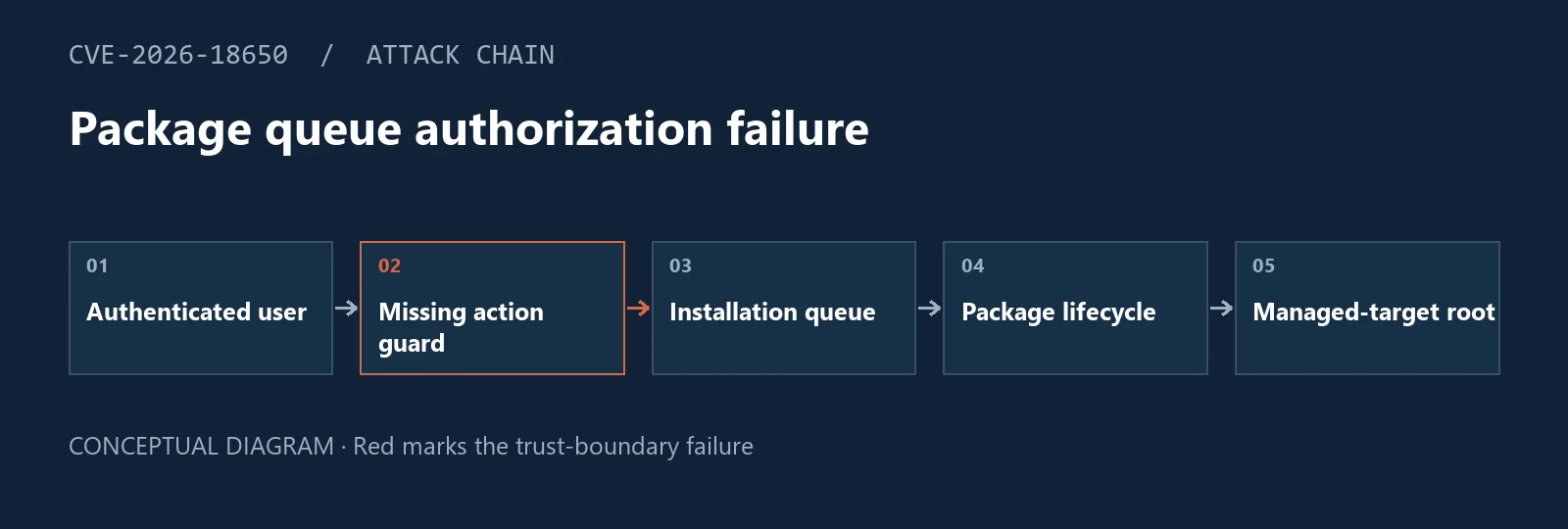
The security-relevant chain was:
- A low-privilege account submitted a package-queue request.
- The controller accepted it without the action-level guard.
- The worker transferred the package to the managed system.
- A privileged package manager installed it.
- The package's inert lifecycle script created a proof marker.
Step 1: upload the package
The captured sequence distinguishes upload, queue acceptance and execution. Upload creation returned HTTP 201, and the upload data transfer returned HTTP 204.
Step 2: enqueue the installation
The low-privilege queue request to POST /api/servers/{server_id}/packages/queue returned HTTP 200 with an installation job initially marked pending.
Step 3: observe execution
The preserved queue-status artifact records:
status: done
The installed inert package and marker were recorded as root:root 644 at /tmp/liman-rce-poc.
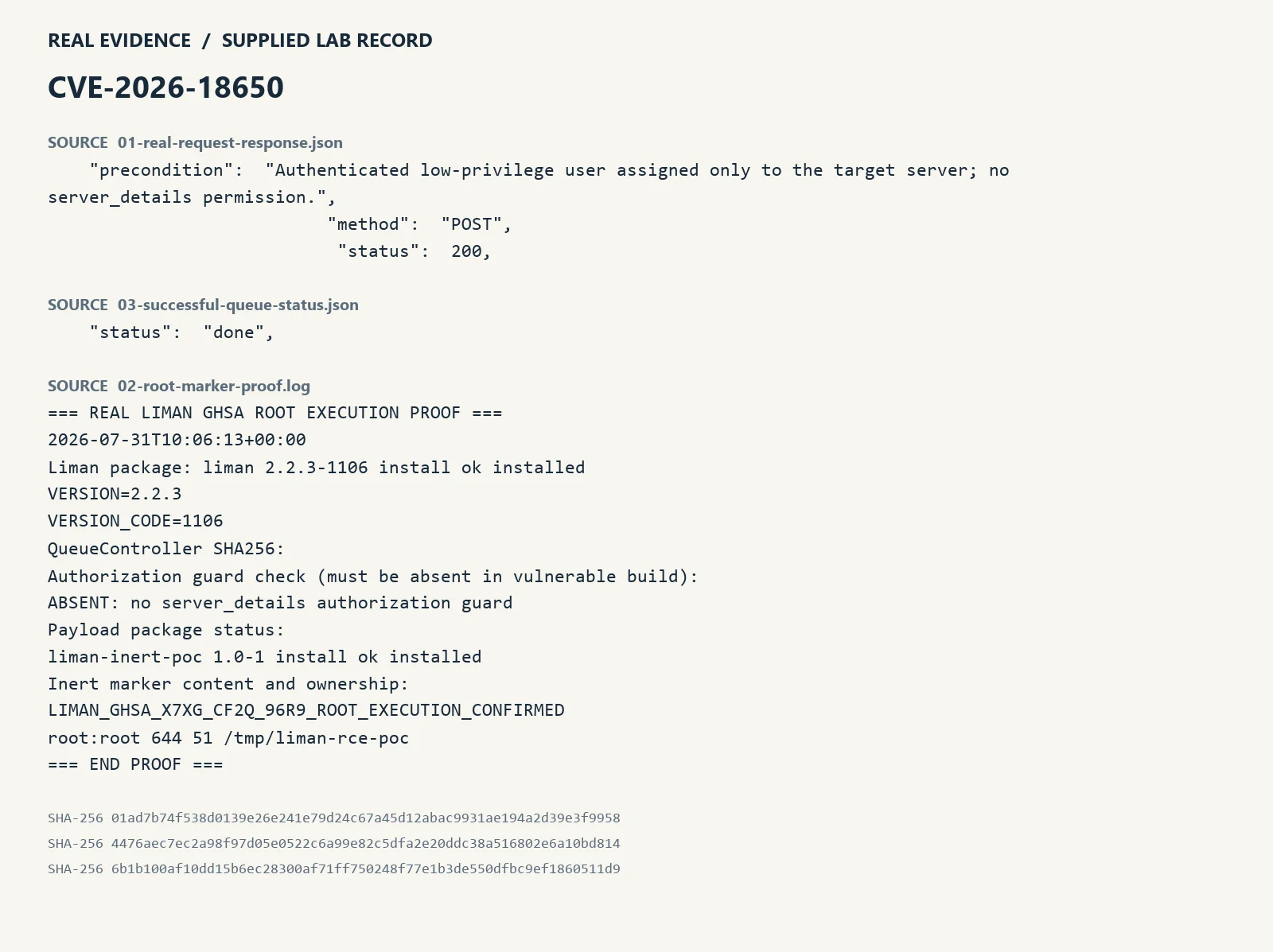
The marker alone would not identify the initiating principal. Its evidentiary value comes from the associated request, the stated permission precondition, the queue record, the package status and the controller identity. The root result was not inferred from a successful upload: the harmless package only created fixed marker text.
Negative controls
The package also contains an earlier Windows integration harness. With the same low-privilege model, its vulnerable path returned HTTP 202 and its guarded path returned HTTP 403. That harness was not a complete Liman installation, and its results must not be substituted for a full patched-product retest.
The later real_poc artifacts establish the positive result on the actual vulnerable product. A corresponding complete run on the fixed distribution was not found. An older 05_VERIFICATION_LIMITS.md predates these real-product artifacts and describes a narrower stage of the work; the newer evidence is used while preserving the remaining retest limitation.
Root cause
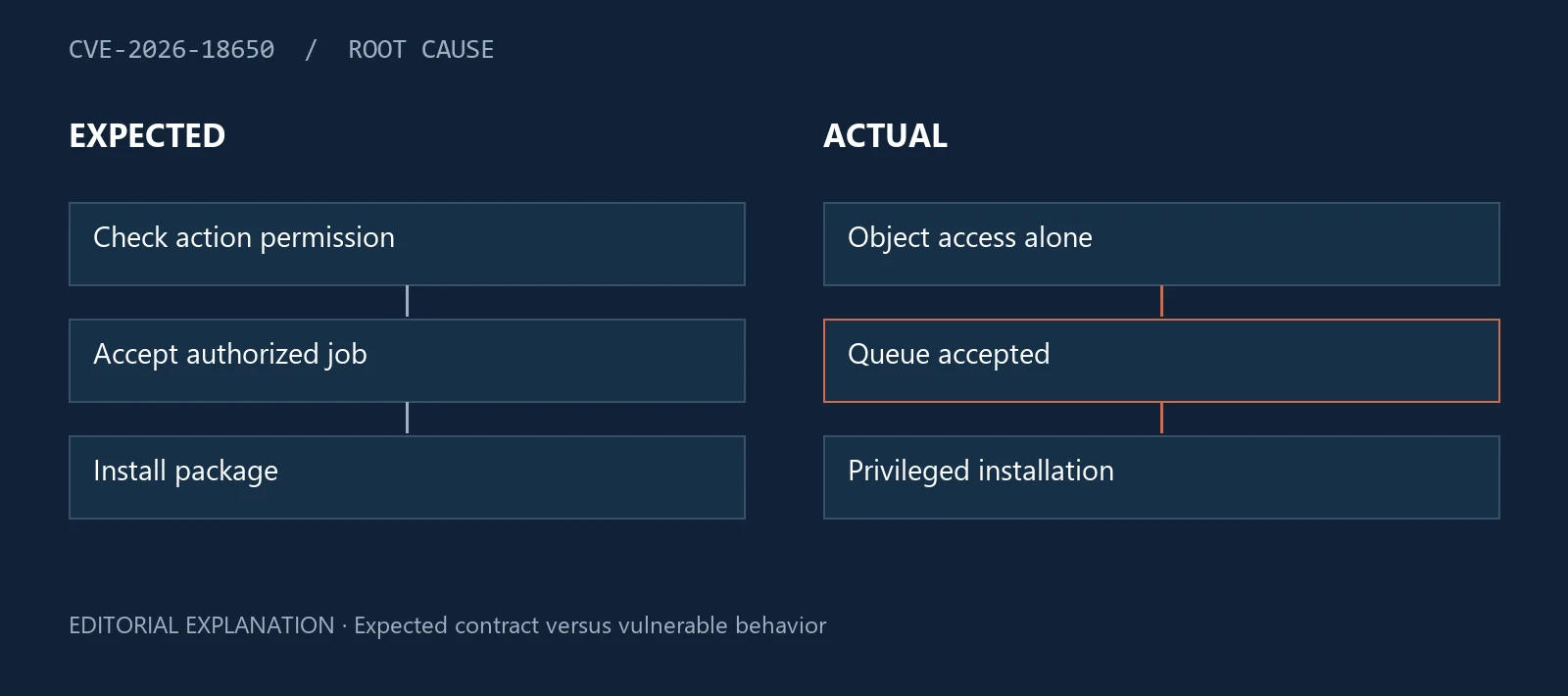
The package-queue API required authentication but lacked the action-level server_details authorization check in the vulnerable controller. QueueController::create() created the installation job without enforcing the required action permission, and downstream execution treated the accepted job as authorized work.
In other words, server-object access was treated as authorization for package installation. The decision belonged at the controller boundary, before unauthorized work enters the queue, and it was not made there.
Impact
The preserved result demonstrates a privileged package lifecycle effect caused by a low-privilege request. The CNA rates potential confidentiality, integrity and availability impact as high. The controlled test did not exercise credential extraction, destructive actions or persistence.
The precondition is an authenticated, non-admin account assigned to the target server but lacking server_details. Under those conditions, the account could enqueue an installation, and such an operation can run package lifecycle scripts under the installation identity on the managed target.
Fix
Commit b0d5bada, dated 6 July 2026, added a constructor guard using Permission::can(..., 'liman', 'id', 'server_details') and an HTTP 403 failure. This places the decision at the controller boundary before unauthorized work enters the queue.
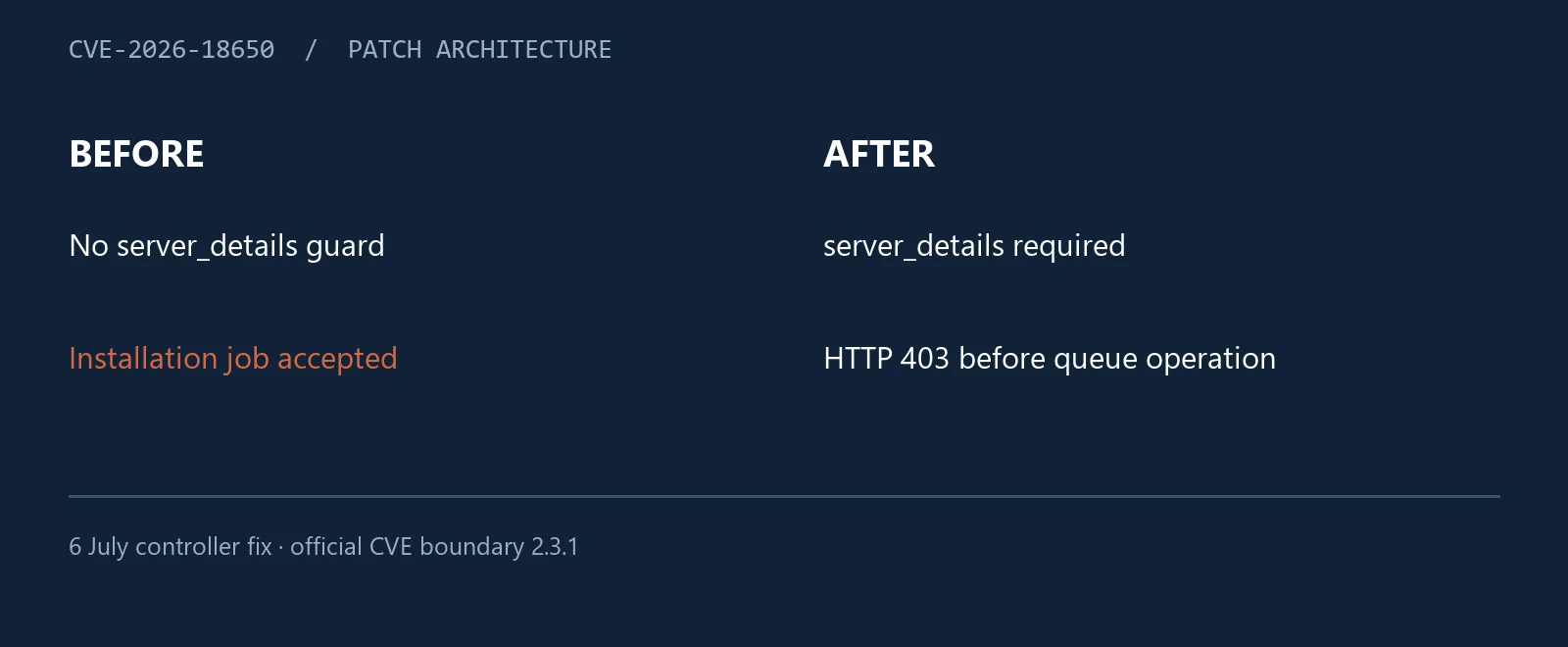
The repository tag release.master.1107 resolves directly to that fix commit. That tag is distinct from the CNA's affected-version declaration. The official CVE boundary is 2.3.1, represented by the later release.master.1111 release; a tag name is not itself proof that every deployed binary contains a particular fix.
A full fixed-distribution retest is not claimed here.
Variants to test
Timeline
- 6 July 2026: repository authorization fix.
- 27 July 2026: 2.3.1 release publication.
- 31 July 2026: preserved real-product test on 2.2.3-1106.
- 4 August 2026: CVE publication and researcher credit.
The test used an inert package in an isolated lab. A fresh exploit or patched-product retest was not performed for this publication.
References
- Official CVE record
- Controller authorization fix
- Fix tag and 2.3.1 release
- Evidence: controlled laboratory records retained by the author.
- Related research: Liman credential-sharing authorization.
What happened, in plain words
Liman MYS is a piece of software that lets an administrator manage other computers from one central place. Think of it like a building manager who holds the keys to many flats: instead of walking to each flat, the manager sends instructions from a single office. One of the things Liman can do is install software packages on those managed computers. You upload a package, Liman creates an installation job, and a worker component carries that job out on the target machine.
A security researcher, Ahmet Sadık Şahiner, found that a user with very little power in Liman could ask it to install a package on a computer they were assigned to, even though that user lacked the server_details permission. Liman checked that the user was logged in, but it did not check whether the user had the specific permission needed to start a package installation. The installation then ran on the managed computer, and a harmless test package left a marker file owned by the root user, the most powerful account on a Linux system.
The flaw is tracked as CVE-2026-18650. A CVE is a public catalogue number given to a known security weakness so that people can talk about it unambiguously. The weakness class is CWE-862, which simply means "missing authorization": the software forgot to ask "are you allowed to do this?" before doing it. The severity score is CVSS v3.1 8.8 High. CVSS is a standard way of scoring how serious a flaw is, and 8.8 out of 10 is high. The official affected range is Liman 2.2.3 through versions before 2.3.1.
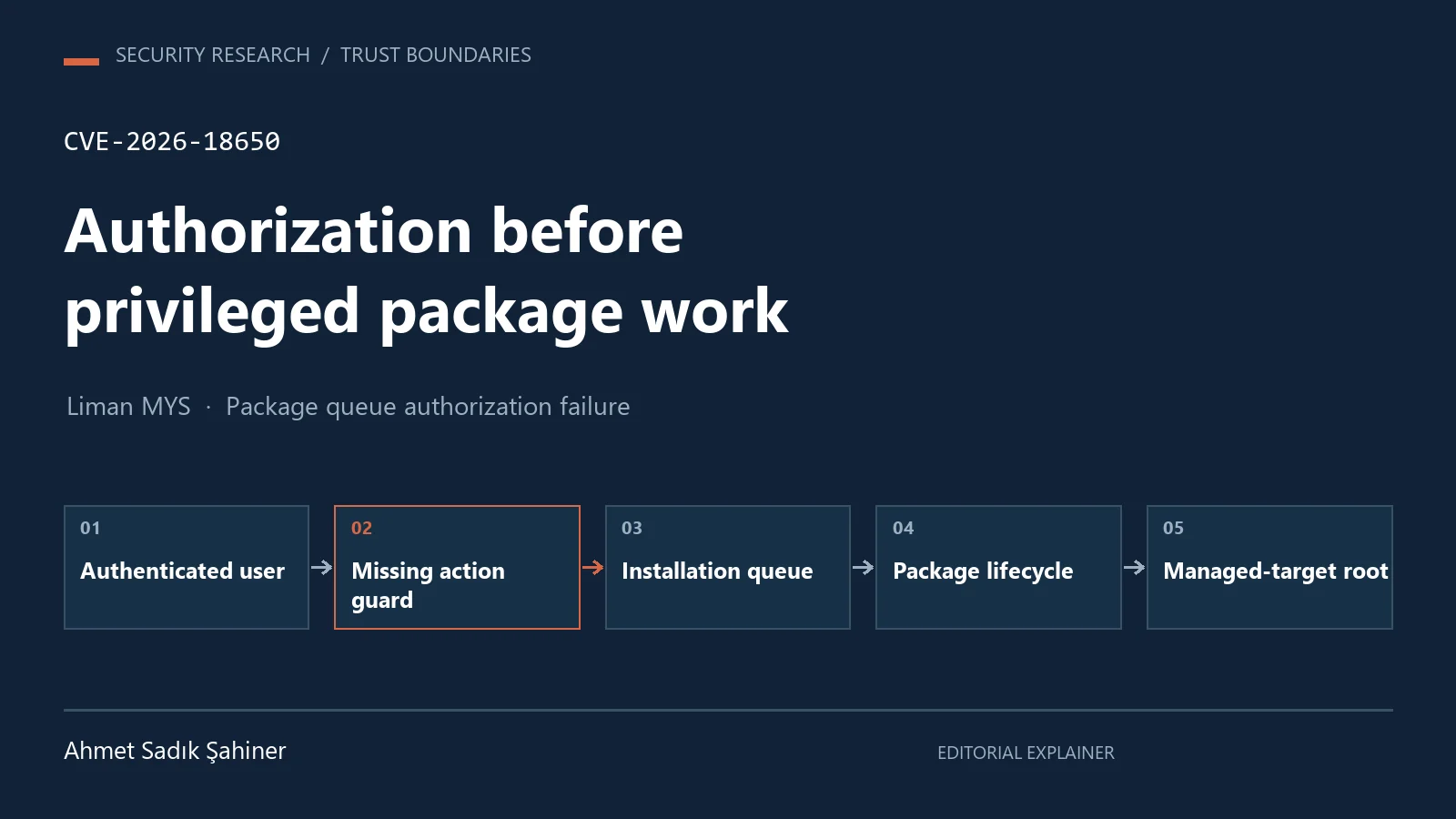
This image is a conceptual diagram of the flow: a low-privilege request goes through the missing authorization check and ends in root execution on a managed target. It is an illustration of the idea, not a screenshot of the test.
The product and the threat model
Liman manages operations on remote systems. Its package workflow accepts an uploaded package, creates an installation job and hands that job to the execution component. The captured Render Engine source invokes a privileged package manager on the managed target, and such an operation can run package lifecycle scripts under the installation identity.
A few of those words need unpacking for a newcomer:
- A package is a bundle of software plus instructions for installing it. On Linux, the package manager is the program that puts packages onto the system.
- A lifecycle script is a small script that the package manager runs automatically at certain moments, for example just after installation. It is a normal feature of packaging, and it is why installing a package can do more than copy files.
- The installation identity is the user account under which that installation runs. If the package manager runs as
root, the lifecycle script also runs asroot. - The control plane is the part of Liman that receives requests and decides what work to schedule. The managed target is the remote computer where the work actually happens.
The vulnerability sits exactly at that boundary: permission to access a server object was allowed to become permission to initiate privileged package execution. In everyday terms, being allowed into a building was treated as being allowed to rewire its electricity.
The demonstrated actor was authenticated, non-admin and assigned only to the target server. "Authenticated" means the person had logged in successfully. "Non-admin" means they were an ordinary user, not an administrator. "Assigned to the target server" means Liman knew this account was connected with that one machine. The evidence explicitly states that the actor lacked server_details. That is the name of the specific permission the vulnerable controller failed to check. Authentication alone could not answer whether this account was entitled to request package installation, which is the question the missing check should have answered.
The real-product test ran on 31 July 2026 against the installed official liman 2.2.3-1106 package in an isolated QEMU lab. QEMU is software that emulates a computer, so the whole experiment ran inside a disposable virtual machine rather than on anyone's real infrastructure. The package states that product code was not patched for this run, so the test exercised the vulnerable version as shipped. The test used an inert package whose only effect was to create fixed marker text. "Inert" means it did nothing harmful: no data theft, no damage, just a file with known contents.
Finding it
The vulnerable route was:
POST /api/servers/{server_id}/packages/queue
Line by line:
POSTis the HTTP method used when a browser or program sends data to a server to create something. When you submit a web form, your browser usually sends a POST request./api/servers/{server_id}/packages/queueis the address, or path, being called. An API is a way for programs to talk to each other over the web, using the same kind of requests browsers use. Here the API is Liman's own interface for managing servers.{server_id}is a placeholder for the identifier of a particular server. In a real request it would be replaced by a number or code naming that machine.packages/queuemeans "put a package into the queue", that is, schedule an installation job to be carried out later.
In the captured source, QueueController::create() created the installation job without enforcing the required action permission. A controller is the part of a web application that receives an incoming request and decides what to do with it. QueueController::create() is the specific function in that controller that handles creating a queue entry. Downstream execution then treated the accepted job as authorized work: once the job was in the queue, the worker component simply carried it out, assuming that whoever put it there had been allowed to.
What made this look wrong is the mismatch between the two decisions: the account could see and be assigned to a server object, but had no permission to perform the privileged action on it. The controller conflated the two. Seeing a thing and being allowed to act on it are different questions, and the code only asked the first one.
Exploitation
The security-relevant chain was:
- A low-privilege account submitted a package-queue request.
- The controller accepted it without the action-level guard.
- The worker transferred the package to the managed system.
- A privileged package manager installed it.
- The package's inert lifecycle script created a proof marker.
Each step matters because it shows where the missing decision should have been made. Step 2 is the moment the request should have been refused. Because it was not, steps 3 to 5 followed, with a privileged package manager installing the package on the target.
Step 1: upload the package
The captured sequence distinguishes upload, queue acceptance and execution. Upload creation returned HTTP 201, and the upload data transfer returned HTTP 204.
HTTP status codes are three-digit numbers a server sends back to say how a request went. HTTP 201 means "created": the server accepted the request and made a new record, here the upload entry. HTTP 204 means "no content": the request succeeded and there is nothing to send back, which is typical when the body of the upload has been received. The researcher recorded these separately because they are two different actions: first you announce an upload, then you send its bytes.
Step 2: enqueue the installation
The low-privilege queue request to POST /api/servers/{server_id}/packages/queue returned HTTP 200 with an installation job initially marked pending.
HTTP 200 means "OK": the server accepted the request. pending is the job's starting state, meaning it is waiting to be picked up. The important point is that this request came from the low-privilege account and was accepted anyway. A correct system would have answered with HTTP 403, which means "forbidden": I understood you, and you are not allowed to do this.
Step 3: observe execution
The preserved queue-status artifact records:
status: done
This is a line from the saved queue record. status is the field holding the job's current state, and done means the worker finished the job. It is the evidence that the request did not merely sit in a queue: the installation actually ran.
The installed inert package and marker were recorded as root:root 644 at /tmp/liman-rce-poc.
Reading that line by line:
/tmp/liman-rce-pocis the path of the marker file on the managed target./tmpis a temporary directory on Linux.root:rootmeans the file is owned by the userrootand the grouproot.rootis the superuser, the account with full control of the system. A file created by an ordinary user would normally carry that user's name instead.644is the file permission setting: the owner can read and write it, everyone else can only read it. The ownership is the security-relevant part here, because it shows the package lifecycle script ran with root privileges.
This panel shows the real evidence from the isolated product test: the accepted low-privilege request, the completed queue job and the root-owned marker file.
The marker alone would not identify the initiating principal. A principal is the identity making a request, here the low-privilege account. Anyone could in principle create a file, so the file by itself proves little. Its evidentiary value comes from the associated request, the stated permission precondition, the queue record, the package status and the controller identity. In other words, the proof is the chain: this account, lacking this permission, sent this request, and this job ran and produced this file. The root result was not inferred from a successful upload: the harmless package only created fixed marker text. Uploading a file successfully says nothing about whether it will be installed as root, so the researcher waited for the actual execution result.
This diagram shows the attack chain conceptually: a missing action guard lets privileged package work happen on the managed target.
Negative controls
The package also contains an earlier Windows integration harness. A harness is a test setup built to exercise a piece of code in a controlled way. With the same low-privilege model, its vulnerable path returned HTTP 202 and its guarded path returned HTTP 403. HTTP 202 means "accepted": the request was taken for processing. HTTP 403 means "forbidden", as above. The guarded path refused with 403.
That harness was not a complete Liman installation, and its results must not be substituted for a full patched-product retest. A small test rig can show that a check behaves a certain way, but it cannot stand in for the real product running in its real configuration.
The later real_poc artifacts establish the positive result on the actual vulnerable product. real_poc is the name of the directory holding the real-product evidence. A corresponding complete run on the fixed distribution was not found. An older 05_VERIFICATION_LIMITS.md predates these real-product artifacts and describes a narrower stage of the work; the newer evidence is used while preserving the remaining retest limitation. In plain terms: the vulnerable version was proven, the fixed version was not re-tested end to end for this publication, and the article says so rather than implying otherwise.
Root cause
The package-queue API required authentication but lacked the action-level server_details authorization check in the vulnerable controller. QueueController::create() created the installation job without enforcing the required action permission, and downstream execution treated the accepted job as authorized work.
In other words, server-object access was treated as authorization for package installation. The decision belonged at the controller boundary, before unauthorized work enters the queue, and it was not made there.
This distinction is worth holding on to, because it is the heart of the whole report. Authentication answers "who are you?". Authorization answers "are you allowed to do this particular thing?". A system can get the first completely right and still be broken if it never asks the second. The everyday comparison: a hotel key card that opens the front door does not mean it should open the safe.
This figure illustrates the root cause: access to a server object was treated as authorization for package installation.
Impact
The preserved result demonstrates a privileged package lifecycle effect caused by a low-privilege request. The CNA rates potential confidentiality, integrity and availability impact as high. The CNA is the organisation that assigns and publishes the CVE record. Confidentiality, integrity and availability are the three classic security goals: keeping data secret, keeping it correct, and keeping systems usable. Rating all three as high means the potential damage is serious on every axis.
The controlled test did not exercise credential extraction, destructive actions or persistence. That is a deliberate limit: the researcher did not try to steal passwords, delete anything, or leave a way back in. The test proved the door was open without walking through it.
The precondition is an authenticated, non-admin account assigned to the target server but lacking server_details. Under those conditions, the account could enqueue an installation that ran package lifecycle scripts under the installation identity on the managed target. In the demonstrated case this was not an anonymous stranger: it required a real, logged-in account assigned to the machine in question. That still matters, because low-privilege accounts are often exactly what an attacker obtains first.
Fix
Commit b0d5bada, dated 6 July 2026, added a constructor guard using Permission::can(..., 'liman', 'id', 'server_details') and an HTTP 403 failure. This places the decision at the controller boundary before unauthorized work enters the queue.
A commit is a saved change in a source-code repository, identified by a short hash such as b0d5bada. A constructor guard is a check placed in the code that runs when the controller is set up to handle a request, so it runs before the main action. Permission::can(...) is the permission-checking function being called. The arguments name the permission being tested: 'liman', 'id' and 'server_details'. If the check fails, the request is answered with HTTP 403 instead of being queued.
This comparison shows the patch conceptually: the controller now requires server_details before queue operations. A full fixed-distribution retest is not claimed.
The repository tag release.master.1107 resolves directly to that fix commit. A tag is a label attached to a particular point in a code repository, often used to mark a release. That tag is distinct from the CNA's affected-version declaration. The official CVE boundary is 2.3.1, represented by the later release.master.1111 release; a tag name is not itself proof that every deployed binary contains a particular fix. A binary is the compiled program that actually runs on a machine. The point is practical: seeing a version label does not guarantee the code inside a particular installation includes the change, so you should verify rather than assume.
A full fixed-distribution retest is not claimed here.
Variants to test
Each one is a question you can ask of a system, with a clear sign of what a positive result looks like.
- An endpoint is one specific address in an API, like one door in a building.
- Audit means being able to reconstruct afterwards who did what and why it was allowed.
- A regression test is an automated check that a fixed bug stays fixed.
Timeline
- 6 July 2026: repository authorization fix.
- 27 July 2026: 2.3.1 release publication.
- 31 July 2026: preserved real-product test on 2.2.3-1106.
- 4 August 2026: CVE publication and researcher credit.
The test used an inert package in an isolated lab. A fresh exploit or patched-product retest was not performed for this publication.
References
- Official CVE record
- Controller authorization fix
- Fix tag and 2.3.1 release
- Evidence: controlled laboratory records retained by the author.
- Related research: Liman credential-sharing authorization.
Glossary
- API: a way for programs to talk to each other over the web, using requests and responses like a browser does.
- Audit: the ability to reconstruct afterwards who did what, and under which permission it was allowed.
- Authentication: proving who you are, usually by logging in.
- Authorization: deciding whether an identified user is allowed to perform a specific action.
- Binary: the compiled program file that actually runs on a machine.
- CNA: the organisation that assigns and publishes CVE records.
- Commit: a saved change in a source-code repository, identified by a short hash.
- Control plane: the part of a system that receives requests and decides what work to schedule.
- Controller: the part of a web application that receives a request and decides what to do with it.
- Constructor guard: a permission check placed in code that runs when the controller is set up, before the main action.
- CVE: a public catalogue number for a known security weakness.
- CVSS: a standard scoring system for the severity of a security flaw, from 0 to 10.
- CWE-862: the weakness category meaning "missing authorization", where a required permission check is absent.
- Endpoint: one specific address in an API that accepts requests.
- Harness: a test setup built to exercise a piece of code in a controlled way.
- HTTP 200: the server accepted the request and it succeeded.
- HTTP 201: the server created a new record as a result of the request.
- HTTP 202: the server accepted the request for processing.
- HTTP 204: the request succeeded and there is no content to return.
- HTTP 403: the server understood the request and refused it because the caller is not allowed.
- Inert package: a harmless test package whose only effect is to create known marker content.
- Installation identity: the user account under which a package installation, and its lifecycle scripts, run.
- Lifecycle script: a script a package manager runs automatically at set moments, such as just after installation.
- Managed target: the remote computer where Liman carries out work.
- Marker file: a file with fixed contents created by a test to prove that code ran.
- Package: a bundle of software plus instructions for installing it.
- Package manager: the program on a system that installs, updates and removes packages.
- POST: the HTTP method used to send data to a server to create something.
- Principal: the identity making a request.
- QEMU: software that emulates a computer, used here to run an isolated virtual lab.
- Regression test: an automated check that a fixed bug stays fixed.
- root: the superuser account on Linux, with full control of the system.
- root:root: file ownership showing both the owning user and group are
root. - 644: a file permission setting where the owner can read and write, and others can only read.
- server_details: the specific Liman permission that governs acting on a server's details.
- Tag: a label attached to a point in a code repository, often marking a release.
- Worker: the component that picks up queued jobs and carries them out.

