CVE-2026–119618 — Heap Corruption and RCE in Apache HTTP Server’s mod_http2
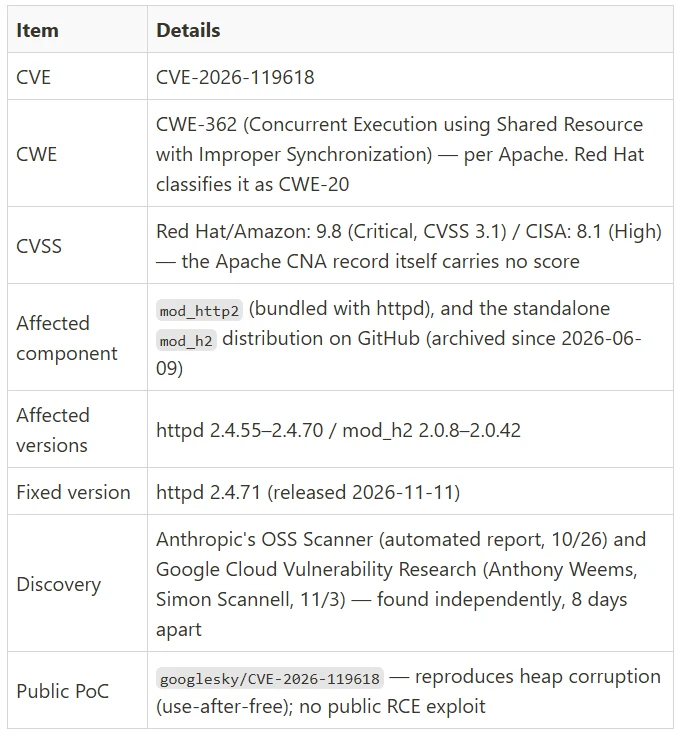
A race condition in Apache HTTP Server's mod_http2 module causes a worker thread to write a synthesised Content-Length header into a table shared across the request rather than one private to it, corrupting the heap. A remote unauthenticated attacker sending concurrent HTTP/2 requests could crash the server, and the advisory states arbitrary command execution with httpd's privileges is possible, though only heap corruption has been publicly demonstrated.
 Published on medium.com
Security
The full write-up lives on its author's site
It belongs to its author, so we link to it rather than copy it. The other two tabs are our own rewrites, checked against it.
Context
Apache HTTP Server's mod_http2 implements HTTP/2 for httpd. Unlike HTTP/1.1, which processes requests one at a time in order over a single connection, HTTP/2 multiplexes several streams concurrently over one TCP connection. To make that work, mod_http2 keeps request processing in a separate worker thread pool (H2Workers), distinct from the connection thread:
- The connection thread reads and writes HTTP/2 frames and manages streams.
- Worker threads handle the actual request processing for each stream. These are mod_http2-specific threads that do not show up in
mod_statusand are not counted againstThreadsPerChild.
So multiple worker threads run concurrently on top of a single HTTP/2 connection, processing requests in parallel. The bug described here is a race condition in that model: a header is written into a table shared across the request instead of one private to it, and the mistake corrupts the heap. It triggers over unauthenticated HTTP/2 (h2 or h2c) traffic alone.

Setup
The report does not describe a lab setup, accounts or roles. The relevant preconditions are configuration-level: the server must have HTTP/2 enabled, either h2 (HTTP/2 over TLS) or h2c (HTTP/2 over cleartext TCP). The public proof of concept, googlesky/CVE-2026-119618, targets the h2c path. Per-virtual-host Protocols settings matter as well as the server-wide setting.
Finding it
The flaw is summarised in Apache's own security advisory as:
Concurrent Execution using Shared Resource with Improper Synchronization vulnerability in Apache HTTP Server's
mod_http2inassign_headers()can lead to RCE.
Red Hat's analysis pins down the mechanism more precisely:
a worker thread writes into memory owned by the connection thread through a shared, lock-free allocator.
The function at the centre is assign_headers(). When an HTTP/2 request ends with no body, carries a Content-Type header, but no Content-Length, mod_http2 needs to synthesize a zero-length Content-Length header and insert it. Before the fix, that synthesized header went into a table that multiple worker threads can reach concurrently, with no lock.
Exploitation
Step 1: send a bodyless request with a Content-Type
The public PoC pinned down the trigger experimentally:
A request that ends without a body and carries a
Content-Typebut noContent-Lengthtriggers the bug.
PUT /anything HTTP/2
Content-Type: application/octet-stream
<ends immediately with END_STREAM, no body>
On receiving this, mod_http2 decides there is a Content-Type but no body, so it needs to synthesize Content-Length: 0, and enters the assign_headers() path. The request itself looks entirely ordinary.
Step 2: fire the pattern across concurrent streams
Sending this pattern across multiple concurrent streams on the same connection pushes worker threads into touching the same shared table at nearly the same instant, opening the race window. When another worker thread, processing a different stream, touches the same structure at nearly the same moment, while the allocator underneath apr_table_setn is mid-reallocation, one thread ends up writing into memory that has already been freed, or not yet initialised.
The report does not give a response or output for the PoC.
Reachability
| Path | Reachable? | Notes |
|---|---|---|
Protocols includes h2 |
Yes | HTTP/2 over TLS |
Protocols includes h2c |
Yes | HTTP/2 over cleartext TCP, the path the public PoC targets |
Per-virtual-host Protocols |
Yes, for that vhost | Check vhost blocks, not just the server-wide setting |
| HTTP/1.1 only | No | Per Red Hat, servers serving only HTTP/1.1 are not affected |
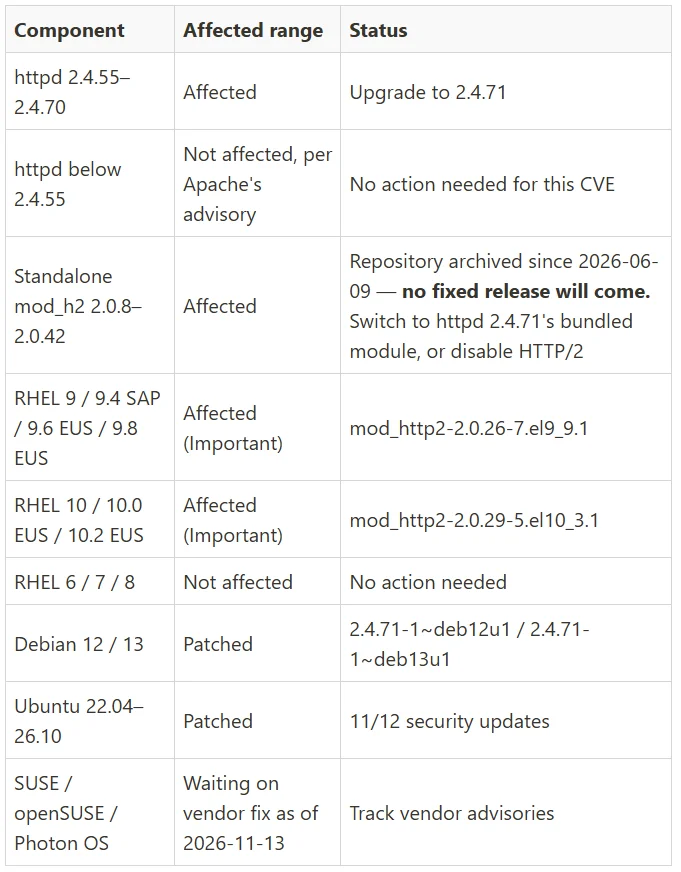
One easy trap: servers that upgraded to 2.4.67 in May for an unrelated HTTP/2 flaw (CVE-2026-23918) are still inside this CVE's affected range (2.4.55 to 2.4.70). Having recently patched an HTTP/2 bug does not mean you are safe from this one.
Root cause
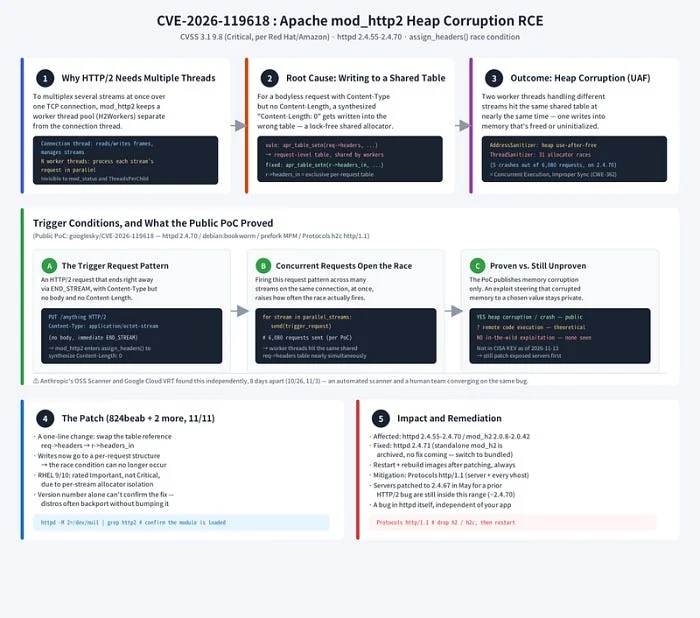
The vulnerable code wrote the synthesized header into req->headers:
if (stream->body_eos && r_type_present && !content_length_present) { apr_table_setn(req->headers, "Content-Length", "0");}
The patch changed exactly one line:
if (stream->body_eos && r_type_present && !content_length_present) { apr_table_setn(r->headers_in, "Content-Length", "0");}
req->headers is a structure multiple worker threads can reach concurrently. r->headers_in belongs exclusively to the one worker thread handling that specific request. The vulnerable version wrote to the shared table with no lock, relying on a lock-free allocator; the patched version has no path for another thread to touch the table concurrently.
req->headers (vulnerable) |
r->headers_in (patched) |
|
|---|---|---|
| Ownership scope | HTTP/2 request-structure level, reachable from multiple worker threads | request_rec level, exclusive to the worker thread handling that request |
| Synchronization | No explicit lock (relies on a lock-free allocator) | No path for another thread to touch it concurrently |
| Outcome | Concurrent writes, allocator race, use-after-free | The race condition has no way to occur |
The commit message itself gives no explanation, as Sysdig's researchers noted. The fix is a genuinely one-line change, but that single line touches the core concurrency question of who owns this memory.
Red Hat downgraded its own RHEL 9/10 builds from Critical to Important for a related reason: those builds allocate a separate allocator per HTTP/2 stream, which "substantially increases the complexity of exploiting the flaw." The same source-level defect carries very different real-world exploitability depending on how the memory allocator happens to be configured.
Impact
Red Hat states that "a remote attacker could execute arbitrary commands with the privileges of the httpd process." As of 2026-11-13, though, what is publicly demonstrated stops at heap corruption (a crash); no public exploit has proven actual code execution yet.
The bug lives entirely inside httpd's own HTTP/2 implementation, independent of whatever application code it is serving. No amount of hardening the application prevents it; patching is the only complete fix.
Fix
The fix landed as three commits on the 2.4.x branch (824beab, 1b47e95, 5566851, all on 2026-11-11). The core change swaps one table reference: req->headers becomes r->headers_in.
Confirming the patch takes more than checking a version string. As Sysdig points out, distributions frequently backport fixes without bumping the upstream version number.
httpd -v rpm -q mod_http2 dpkg -l | grep libapache2-mod-http2 httpd -M 2>/dev/null | grep http2apache2ctl -M 2>/dev/null | grep http2
A common false alarm in the field: Red Hat's Hardened Images httpd image is listed as "affected" per the vendor advisory, but the image does not actually ship mod_http2 at all, making it a case where the risk can simply be accepted. Do not panic off the version number alone; check whether the module is actually loaded first.
Immediate steps, where patching is possible
- Upgrade httpd on every server to 2.4.71 (or your distro's patched package).
- Restart httpd and rebuild images after patching. A running process keeps the old module loaded in memory; bumping the package version without restarting leaves the server just as vulnerable.
- If you are running standalone
mod_h2, switch to the module bundled with httpd 2.4.71. The standalone repository is archived and will never get a fix.
Interim mitigation if patching is not immediately possible
Neither Apache's advisory nor the oss-security notice offers an official workaround, but Wiz recommends the following (this is Wiz's guidance, not Apache's):
Protocols http/1.1
- Remove
h2andh2cfrom the config entirely, leaving only HTTP/1.1. - Apply this at the server level and in every VirtualHost block; many setups redefine
Protocolsper-vhost. - Restart or reload after the change.
- Test latency-sensitive services first: clients fall back to HTTP/1.1, which can slow workloads that depend on multiplexing.
Containing the blast radius
- Run httpd workers as an unprivileged user, limiting what a compromised worker can read or write.
- Keep secrets (API keys, DB credentials) in a secrets manager rather than environment variables or files the worker process can read directly.
Detection
- Repeated segfaults in httpd child processes on an HTTP/2-enabled server, exactly the symptom the public PoC produces.
- Since disclosure (11/11 onward), review httpd worker processes for shells, downloads, or unusual outbound connections.
- Runtime detection tools like Falco/Sysdig cannot see HTTP/2 frames directly, but post-exploitation steps (a shell spawned by a worker, a reverse shell, a downloaded binary executing, the web server process being replaced) were verified to be caught by existing rules with no modification.
Variants to test
- Per-vhost
Protocolsoverrides. A server-wideProtocols http/1.1does not cover a VirtualHost that redefinesProtocolsto includeh2orh2c. A positive result is an HTTP/2-enabled vhost that still accepts the bodylessPUTpattern after the server-level mitigation. h2con cleartext ports. The public PoC targetsh2c; test cleartext listeners as well as TLS ones. A positive result is a cleartext endpoint negotiating HTTP/2 and accepting the bodyless request pattern.- Backported packages. Compare the running module against the upstream version string; a distro may carry the fix without a version bump. A positive result is a package whose version looks vulnerable but whose
assign_headers()usesr->headers_in. - Standalone
mod_h2deployments. The standalone repository is archived and will never get a fix. A positive result is a server loading the standalone module rather than the one bundled with httpd 2.4.71. - Allocator configuration. RHEL 9/10 builds use a separate allocator per HTTP/2 stream, which substantially increases exploitation complexity. A positive result on such a build would need to be assessed against the higher exploitation complexity Red Hat describes.
What happened, in plain words
A web server is the program that sits on a computer somewhere and answers the requests your browser sends when you type in an address or click a link. One of the most widely used web servers in the world is the Apache HTTP Server, usually just called httpd. It can be extended with extra pieces called modules, and one of those modules, mod_http2, teaches the server a newer, faster way of talking to browsers called HTTP/2.
This report is about a bug in that module. When the server is handling several requests at the same time, the bug can make two of them interfere with each other's memory. The result is that the server's memory gets scrambled, which usually makes it crash. The people who make Apache describe the flaw as one that could, in principle, let an attacker run their own commands on the server. As of 2026-11-13, though, what has been shown publicly is the crash, not the command execution.
The image at the top of the article is the title card: the CVE number, the product name, and the author's name and reading time. A CVE is simply a catalogue number for a publicly known security flaw, so people around the world can refer to the same bug unambiguously.
At a glance
The summary card repeats the essentials: the bug is a race condition in mod_http2, it writes a header into the wrong table, and that corrupts the heap. It can be triggered by ordinary HTTP/2 traffic from anyone, with no login. Red Hat, the company that maintains a popular commercial version of Linux, says a remote attacker could execute arbitrary commands with the privileges of the httpd process. But the publicly demonstrated result so far is heap corruption, meaning a crash, and no public exploit has proven actual code execution yet.
A few of those words deserve a plain explanation before we go further.
- A race condition is what happens when two workers do something at the same time and the result depends on who gets there first. Think of two people editing the same shared shopping list at once: if both write at the same moment, one entry can overwrite or smudge the other. Nothing is wrong with either person; the problem is the shared list and the lack of a rule about taking turns.
- A header is a small labelled line that travels with a web request or response, carrying information about it rather than the content itself. When your browser asks for a page, it sends headers such as what kind of content it accepts. The server answers with headers such as how long the content is.
- The heap is the part of a program's memory it uses for things created while it is running, as opposed to fixed space reserved in advance. If a program writes to a part of the heap it no longer owns, the data there can be damaged, and the program can crash or, worse, be made to do something unintended.
- RCE, short for remote code execution, means an attacker somewhere else on the network manages to make the server run code of the attacker's choosing. It is the worst outcome for a server bug, which is why the advisory language matters.
1. Background: why HTTP/2 needs more than one thread
To understand the bug you need to know how the server divides up its work.
The older version of the web protocol, HTTP/1.1, handles requests one at a time, in order, over a single connection. If a page needs twenty images, the browser asks for them one after another (with some tricks to overlap), and the server deals with them in sequence. It is like a single shop assistant serving a queue: each customer is served fully before the next.
HTTP/2 changes that. It lets several requests travel at once over the same connection, each one in its own stream. A stream is just one conversation inside the shared connection. It is like the same shop assistant now handling several customers at the same counter simultaneously, each with their own little ticket.
To make this work, mod_http2 uses two kinds of workers:
- The connection thread reads and writes the HTTP/2 frames (the small packets of data that make up the conversation) and keeps track of the streams.
- Worker threads do the actual request processing for each stream. These are threads created specifically by
mod_http2. They do not show up inmod_status, a built-in page that normally reports what the server is doing, and they are not counted against a setting calledThreadsPerChild, which controls how many worker processes the server keeps.
A thread is a unit of work inside a program. One program can run several threads at once, each doing a different job, sharing the same memory. That sharing is what makes threads fast, and it is also what makes them dangerous: if two threads touch the same piece of memory without a rule about taking turns, they can corrupt it.
So multiple worker threads run at the same time on top of a single HTTP/2 connection, processing requests in parallel. The bug in this report is a race condition in exactly that arrangement: a header is written into a table shared across the request instead of one private to it, and the mistake corrupts the heap. It triggers over unauthenticated HTTP/2 traffic alone, meaning anyone who can reach the server can send it, with no username or password.
2. Root cause: a worker thread writing into a shared table
The image here is the section heading card for the root cause discussion. The section itself explains where the mistake lives in the code.
Apache's own security advisory summarises the flaw like this:
Concurrent Execution using Shared Resource with Improper Synchronization vulnerability in Apache HTTP Server's
mod_http2inassign_headers()can lead to RCE.
In plain words: two things run at the same time, they share a resource, and nothing makes them take turns properly. The function where this happens is called assign_headers(). A function is a named block of code that does one job; this one's job is to assign headers to a request.
Red Hat's analysis pins the mechanism down more precisely:
a worker thread writes into memory owned by the connection thread through a shared, lock-free allocator.
An allocator is the part of a program that hands out chunks of memory when something asks for space, and takes them back when they are finished. Lock-free means it does this without a lock, a mechanism that would make one thread wait while another is using the shared structure. Lock-free designs are fast, but they rely on everything else being careful about what it touches.
The function at the centre is assign_headers(). When an HTTP/2 request ends with no body, carries a Content-Type header, but no Content-Length, mod_http2 needs to make up a zero-length Content-Length header and insert it. A body is the actual content of a request, for example the file you are uploading. Content-Type says what kind of content it is, such as application/octet-stream for raw binary data. Content-Length says how many bytes the body contains. If a request says what type it is but never says how long it is, the server fills in the length itself, as zero.
Before the fix, that made-up header went into this table:
if (stream->body_eos && r_type_present && !content_length_present) { apr_table_setn(req->headers, "Content-Length", "0");}
Line by line:
if (stream->body_eos && r_type_present && !content_length_present) {is the condition. It asks three questions at once: has the body finished (body_eos, end of stream)? Is a content type present (r_type_present)? And is a content length absent (!content_length_present, where the exclamation mark means not)? Only if all three are true does the code inside run.apr_table_setn(req->headers, "Content-Length", "0");is the action. It sets the header namedContent-Lengthto the value0in a table calledreq->headers. Theapr_table_setnpart is a helper from Apache's portable runtime library that stores a name and value pair in a table.
The patch changed exactly one line:
if (stream->body_eos && r_type_present && !content_length_present) { apr_table_setn(r->headers_in, "Content-Length", "0");}
Line by line:
- The condition is identical. The same three questions are asked, and the same requests reach this code.
- The action now writes to
r->headers_ininstead ofreq->headers. Everything else about the line is the same: the same header name, the same value, the same helper function.
That one change is the whole fix, and the reason is ownership. req->headers is a structure that multiple worker threads can reach at the same time. r->headers_in belongs exclusively to the one worker thread handling that particular request. The vulnerable version wrote to the shared table with no lock. When another worker thread, processing a different stream, touched the same structure at nearly the same moment, while the allocator underneath apr_table_setn was in the middle of rearranging memory, one thread would end up writing into memory that had already been freed, or not yet set up. That is the corruption.
The commit message itself gives no explanation, as Sysdig's researchers noted. The fix is a genuinely one-line change, but that single line touches the core concurrency question of who owns this memory.
Red Hat lowered the severity of its own RHEL 9 and 10 builds from Critical to Important for a related reason: those builds give each HTTP/2 stream its own separate allocator, which, in Red Hat's words, "substantially increases the complexity of exploiting the flaw." The same defect in the source code carries very different real-world exploitability depending on how the memory allocator happens to be set up. RHEL is Red Hat Enterprise Linux, a commercial distribution of Linux.
3. Trigger conditions: which requests reach this code path
The public proof of concept, a demonstration program published under the name googlesky/CVE-2026-119618, pinned down the trigger experimentally:
A request that ends without a body and carries a
Content-Typebut noContent-Lengthtriggers the bug.
A proof of concept, or PoC, is a small piece of code that demonstrates a bug really exists, without being a full attack tool.
PUT /anything HTTP/2
Content-Type: application/octet-stream
<ends immediately with END_STREAM, no body>
Line by line:
PUT /anything HTTP/2is the request line.PUTis the method, the verb telling the server what kind of action is wanted;PUTnormally means store this content at this address./anythingis the path being asked for, and here it is deliberately meaningless.HTTP/2says which version of the protocol is being used.Content-Type: application/octet-streamis a header saying the content is raw binary data. It is the content type the condition checks for.<ends immediately with END_STREAM, no body>is not a real header. It is a note in the example explaining that the request stops right there, with no body at all.END_STREAMis the HTTP/2 signal that a stream has finished.
On receiving this, mod_http2 decides there is a Content-Type but no body, so it needs to make up Content-Length: 0, and enters the assign_headers() path. The request itself looks entirely ordinary, which is part of why this is dangerous: nothing about it looks like an attack.
Sending this pattern across multiple concurrent streams on the same connection pushes worker threads into touching the same shared table at nearly the same instant, opening the race window. When another worker thread, processing a different stream, touches the same structure at nearly the same moment, while the allocator underneath apr_table_setn is mid-reallocation, one thread ends up writing into memory that has already been freed, or not yet initialised.
The report does not give a response or output for the PoC. A segfault is the operating system stepping in when a program tries to touch memory it is not allowed to, and stopping that program. It is the usual visible sign of memory corruption.
Reachability
Not every server can be hit. This table lays out which configurations are exposed.
| Path | Reachable? | Notes |
|---|---|---|
Protocols includes h2 |
Yes | HTTP/2 over TLS |
Protocols includes h2c |
Yes | HTTP/2 over cleartext TCP, the path the public PoC targets |
Per-virtual-host Protocols |
Yes, for that vhost | Check vhost blocks, not just the server-wide setting |
| HTTP/1.1 only | No | Per Red Hat, servers serving only HTTP/1.1 are not affected |
A few terms in that table:
Protocolsis the Apache configuration directive that lists which versions of the web protocol the server will speak.- TLS is the encryption layer that puts the padlock in your browser and turns
httpintohttps. - Cleartext TCP means unencrypted traffic, the plain
httpcase. - A virtual host, or vhost, is one of several websites served by the same server program. A single machine can host many sites, each with its own configuration block, and each block can set its own
Protocols.
One easy trap: servers that upgraded to 2.4.67 in May for an unrelated HTTP/2 flaw, CVE-2026-23918, are still inside this CVE's affected range, 2.4.55 to 2.4.70. Having recently patched an HTTP/2 bug does not mean you are safe from this one.
4. The patch: three commits, one line that matters
The fix landed as three commits on the 2.4.x branch, numbered 824beab, 1b47e95 and 5566851, all on 2026-11-11. A commit is a recorded change to a codebase, with a message and a date, so anyone can see what changed and when.
The core change, as shown above, swaps one table reference: req->headers becomes r->headers_in. What that swap actually buys:
req->headers (vulnerable) |
r->headers_in (patched) |
|
|---|---|---|
| Ownership scope | HTTP/2 request-structure level, reachable from multiple worker threads | request_rec level, exclusive to the worker thread handling that request |
| Synchronization | No explicit lock (relies on a lock-free allocator) | No path for another thread to touch it concurrently |
| Outcome | Concurrent writes, allocator race, use-after-free | The race condition has no way to occur |
A use-after-free is exactly what it sounds like: a program keeps using a chunk of memory after it has handed it back, and by then something else may have taken it over. It is one of the classic ways memory corruption turns into something worse than a crash.
Confirming the patch takes more than checking a version string. As Sysdig points out, distributions frequently backport fixes without bumping the upstream version number. Backporting means taking a fix written for a newer version and applying it to an older one, so the version number can look old while the fix is present.
httpd -v rpm -q mod_http2 dpkg -l | grep libapache2-mod-http2 httpd -M 2>/dev/null | grep http2apache2ctl -M 2>/dev/null | grep http2
This block is a set of commands to run on the server, each checking a different thing. They are written on one line here, but in practice you would run them one at a time.
httpd -vasks the server program to print its version.rpm -q mod_http2asks the RPM package manager, used on Red Hat style systems, which version of themod_http2package is installed.dpkg -l | grep libapache2-mod-http2asks the dpkg package manager, used on Debian style systems, to list installed packages, then filters the list for the HTTP/2 module. The vertical bar passes the output of one command into the next, andgrepsearches text for a pattern.httpd -M 2>/dev/null | grep http2asks the server to list the modules it has loaded, then filters for http2. The2>/dev/nullpart throws away error messages so they do not clutter the output.apache2ctl -M 2>/dev/null | grep http2does the same thing through the control tool used on Debian style systems, where the server is usually calledapache2rather thanhttpd.
A common false alarm in the field: Red Hat's Hardened Images httpd image is listed as affected in the vendor advisory, but the image does not actually ship mod_http2 at all, making it a case where the risk can simply be accepted. Do not panic off the version number alone; check whether the module is actually loaded first. An image here means a prebuilt package of a server, the kind used in containers.
5. Affected versions and remediation
The image here is the section heading card for affected versions and remediation. The section itself is about what to do.
Immediate steps, where patching is possible
- Upgrade httpd on every server to 2.4.71, or your distribution's patched package.
- Restart httpd and rebuild images after patching. A running process keeps the old module loaded in memory; bumping the package version without restarting leaves the server just as vulnerable. A process is a running copy of a program, and it holds its code in memory from the moment it starts until it stops, so replacing files on disk does not change what is already running.
- If you are running standalone
mod_h2, switch to the module bundled with httpd 2.4.71. The standalone repository is archived and will never get a fix. A repository is a place where code is published and kept.
Interim mitigation if patching is not immediately possible
Neither Apache's advisory nor the oss-security notice offers an official workaround, but Wiz recommends the following. This is Wiz's guidance, not Apache's.
Protocols http/1.1
This is a configuration line. Protocols is the directive, and http/1.1 is the only value given, so the server is told to speak only the older protocol and nothing else.
- Remove
h2andh2cfrom the config entirely, leaving only HTTP/1.1. - Apply this at the server level and in every VirtualHost block; many setups redefine
Protocolsper vhost. - Restart or reload after the change.
- Test latency-sensitive services first: clients fall back to HTTP/1.1, which can slow workloads that depend on multiplexing. Latency is the delay before data starts arriving, and multiplexing is the trick of carrying several conversations at once over one connection.
Containing the blast radius
- Run httpd workers as an unprivileged user, limiting what a compromised worker can read or write. An unprivileged user is an account with only the permissions it needs and no administrative rights.
- Keep secrets such as API keys and database credentials in a secrets manager rather than environment variables or files the worker process can read directly. An API key is a long random string that identifies a program to another service, like a password for software. A secrets manager is a dedicated tool for storing such strings safely.
Detection
- Repeated segfaults in httpd child processes on an HTTP/2-enabled server, exactly the symptom the public PoC produces.
- Since disclosure on 11/11, review httpd worker processes for shells, downloads, or unusual outbound connections. A shell is a command prompt, the thing an attacker wants if they get code running.
- Runtime detection tools like Falco and Sysdig cannot see HTTP/2 frames directly, but post-exploitation steps, such as a shell spawned by a worker, a reverse shell, a downloaded binary executing, or the web server process being replaced, were verified to be caught by existing rules with no modification. Post-exploitation means what an attacker does after getting in.
One last thing worth noting: this bug lives entirely inside httpd's own HTTP/2 implementation, independent of whatever application code it is serving. No amount of hardening the application prevents it; patching is the only complete fix.
Variants to test
- Per-vhost
Protocolsoverrides. A server-wideProtocols http/1.1does not cover a VirtualHost that redefinesProtocolsto includeh2orh2c. A positive result is an HTTP/2-enabled vhost that still accepts the bodylessPUTpattern after the server-level mitigation. h2con cleartext ports. The public PoC targetsh2c; test cleartext listeners as well as TLS ones. A positive result is a cleartext endpoint negotiating HTTP/2 and accepting the bodyless request pattern.- Backported packages. Compare the running module against the upstream version string; a distribution may carry the fix without a version bump. A positive result is a package whose version looks vulnerable but whose
assign_headers()usesr->headers_in. - Standalone
mod_h2deployments. The standalone repository is archived and will never get a fix. A positive result is a server loading the standalone module rather than the one bundled with httpd 2.4.71. - Allocator configuration. RHEL 9 and 10 builds use a separate allocator per HTTP/2 stream, which substantially increases exploitation complexity. A positive result on such a build would need to be assessed against the higher exploitation complexity Red Hat describes.
The embed at the end is a link to a short video, https://youtube.com/shorts/uAz7pN1I-W8.
Glossary
- Allocator: the part of a program that hands out and reclaims chunks of memory.
- API key: a long random string that identifies a program to another service, like a password for software.
- Apache HTTP Server (httpd): a widely used web server program.
- Backporting: applying a fix written for a newer version to an older one, often without changing the version number.
- Body: the actual content of a request or response, such as an uploaded file.
- Cleartext: data sent unencrypted, without TLS.
- Commit: a recorded change to a codebase, with a message and a date.
- Connection thread: the thread in
mod_http2that reads and writes HTTP/2 frames and manages streams. - Content-Length: a header saying how many bytes the body contains.
- Content-Type: a header saying what kind of content the body is.
- CVE: a catalogue number for a publicly known security flaw.
- END_STREAM: the HTTP/2 signal that a stream has finished.
- Falco / Sysdig: runtime detection tools that watch what programs do while they run.
- Function: a named block of code that does one job.
- h2: HTTP/2 over TLS.
- h2c: HTTP/2 over cleartext TCP, without TLS.
- Header: a small labelled line travelling with a request or response, carrying information about it.
- Heap: the part of a program's memory used for things created while it runs.
- HTTP/1.1: the older web protocol, handling requests one at a time in order over a connection.
- HTTP/2: the newer web protocol, carrying several streams at once over one connection.
- Image: a prebuilt package of a server, as used in containers.
- Latency: the delay before data starts arriving.
- Lock-free: a design that avoids making threads wait for a lock, relying instead on careful handling of shared memory.
- mod_h2: a standalone version of the HTTP/2 module, separate from the one bundled with httpd.
- mod_http2: the module that implements HTTP/2 for Apache HTTP Server.
- mod_status: a built-in Apache page that reports what the server is doing.
- Module: an optional piece of software that adds features to a server.
- Multiplexing: carrying several conversations at once over one connection.
- PoC (proof of concept): a small piece of code demonstrating that a bug exists.
- Post-exploitation: what an attacker does after getting in.
- Process: a running copy of a program.
- Protocols: the Apache configuration directive listing which web protocol versions the server speaks.
- Race condition: a bug where two workers act at the same time and the result depends on who gets there first.
- RCE (remote code execution): an attacker elsewhere on the network makes the server run code of their choosing.
- RHEL: Red Hat Enterprise Linux, a commercial Linux distribution.
- Segfault: the operating system stopping a program that touched memory it is not allowed to.
- Secrets manager: a dedicated tool for storing passwords and keys safely.
- Shell: a command prompt.
- Stream: one conversation inside a shared HTTP/2 connection.
- Thread: a unit of work inside a program; several can run at once, sharing memory.
- ThreadsPerChild: an Apache setting controlling how many worker processes the server keeps.
- TLS: the encryption layer behind the padlock in your browser and
https. - Unprivileged user: an account with only the permissions it needs and no administrative rights.
- Use-after-free: using a chunk of memory after it has been handed back, when something else may own it.
- Virtual host (vhost): one of several websites served by the same server program.
- Worker thread: a thread in
mod_http2that processes the requests for a stream.



