[CVE-2026–123007] Unauthenticated RCE via Integer Underflow in NGINX’s HTTP/2 Flow Control
An integer underflow in NGINX's HTTP/2 flow-control logic allows an unauthenticated attacker to corrupt heap memory and achieve remote code execution. The flaw is reachable on any NGINX with HTTP/2 enabled, even when serving only static files.
 Published on medium.com
Nginx
The full write-up lives on its author's site
It belongs to its author, so we link to it rather than copy it. The other two tabs are our own rewrites, checked against it.
Context
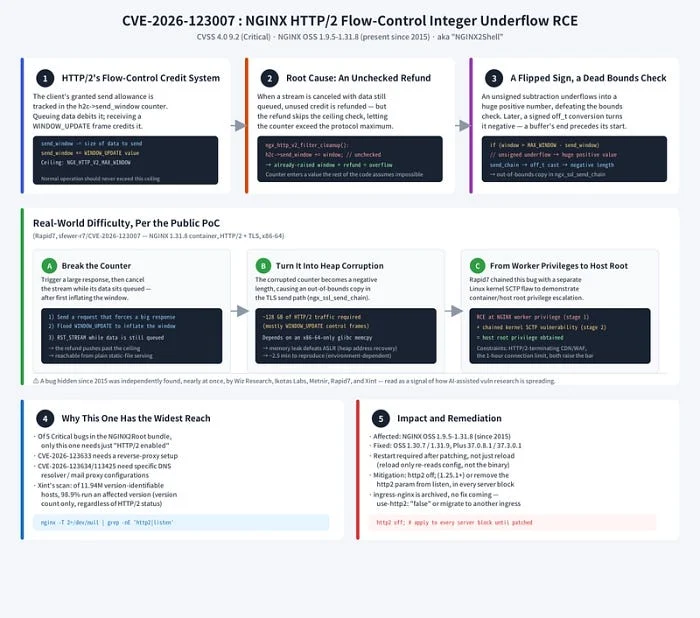
NGINX multiplexes many requests over a single HTTP/2 connection, and each stream's response data is governed by a credit system called flow control. The client grants the server a window representing how much it is ready to receive, and NGINX tracks the connection's remaining credit in a counter, h2c->send_window. Queuing response data subtracts that data's size from the counter, and receiving a WINDOW_UPDATE frame from the client increases it. The counter has a protocol-defined ceiling, NGX_HTTP_V2_MAX_WINDOW, which under normal operation it should never exceed.
CVE-2026-123007 breaks that invariant. In the HTTP/2 flow-control logic, refunding unsent data credit for a cancelled stream skips a bounds check, letting the counter exceed its protocol maximum. A chain of signed and unsigned integer conversions that all trust that counter then collapses into an out-of-bounds heap memory copy. It triggers unauthenticated on any NGINX with HTTP/2 enabled, with no backend application or third-party module required, even a server doing nothing but serving static files.

At a glance
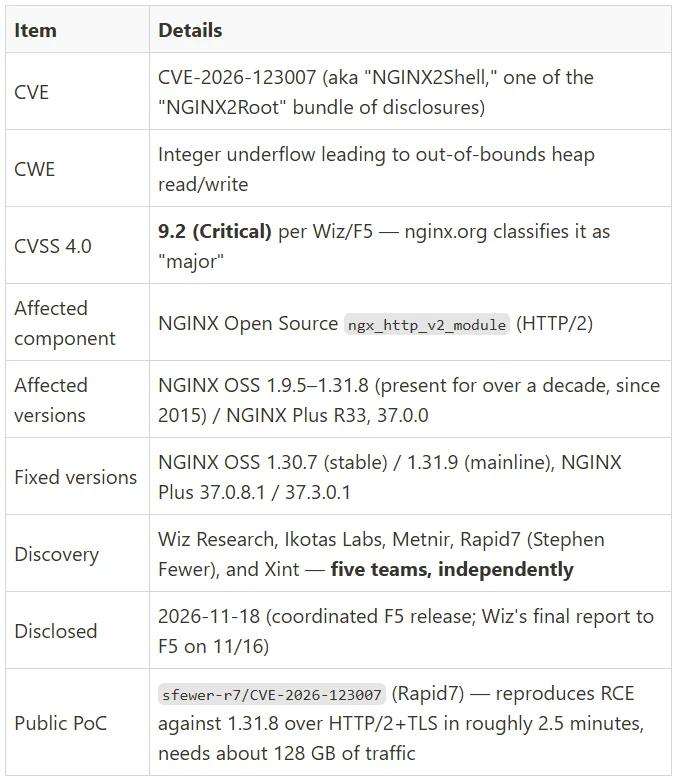
The bug was found independently by five research teams at almost the same moment: Wiz Research, Ikotas Labs, Metnir, Rapid7 and Xint. The code in question has existed since NGINX 1.9.5 in 2015. Wiz Research confirmed RCE with an ASLR bypass on official NGINX 1.31.7 and 1.31.8 builds, over HTTP/2 plus TLS, on 64-bit systems, serving response data straight from memory.
Setup
The trigger conditions are narrow in configuration terms and broad in deployment terms.
| Condition | Detail |
|---|---|
| HTTP/2 enabled | http2 on or listen ... http2;; without it, this CVE is moot |
| Transport | Wiz confirmed RCE over HTTPS (TLS) on 64-bit systems; whether plaintext h2c is equally viable is not documented publicly |
| Attack pattern | Trigger a large response, cancel the stream while the response sits queued, and meanwhile send a flood of WINDOW_UPDATE frames to push the window to an arbitrary value |
| Backend requirement | None; reachable from plain static file serving (contrast with CVE-2026-123633, which needs a reverse-proxy setup) |
Rapid7's Stephen Fewer published a working PoC, sfewer-r7/CVE-2026-123007, which quantifies how hard this is in practice:
- Succeeded against an NGINX 1.31.8 container with HTTP/2 and TLS enabled.
- Required roughly 128 GB of HTTP/2 traffic, mostly control frames such as
WINDOW_UPDATE, not actual data. - Completed in roughly 2.5 minutes, with the caveat that this varies by environment.
- Depends on an x86-64-specific glibc memory-copy routine, so it is sensitive to architecture and libc combination.
- Needs an ASLR bypass by recovering heap addresses from server responses, the typical difficulty profile of a memory-safety bug.
Rapid7's team went further, demonstrating that this HTTP/2 bug chains with a separate Linux kernel SCTP networking flaw to reach root on the host, not stopping at the NGINX worker's privileges but escaping the container or host entirely.
Finding it
The chain has three stages, as laid out in Wiz Research's technical writeup.
Stage 1: refunding credit for data that was never sent
If a stream is cancelled while its response data is still sitting in the queue, send_window has already been debited for it. ngx_http_v2_filter_cleanup() clears out that unsent data and refunds the unused credit:
h2c->send_window += window;
This refund never checks whether the result exceeds NGX_HTTP_V2_MAX_WINDOW. If the client already increased the window via WINDOW_UPDATE while that data sat queued, adding the refund on top can push the counter past the protocol's own ceiling. h2c->send_window now holds a value the rest of the HTTP/2 code assumes can never occur.
Stage 2: a bounds check that no longer does anything
The next problem lives in ngx_http_v2_state_window_update(), which handles incoming WINDOW_UPDATE frames from the client:
if (window > NGX_HTTP_V2_MAX_WINDOW - h2c->send_window)
This check computes remaining headroom as ceiling minus current counter. But if send_window has already blown past the ceiling, that subtraction is unsigned arithmetic: it cannot represent a negative number, so it wraps around into a huge positive value instead. The check now has no way of noticing the counter is already broken; it reads the wrapped value as plenty of headroom left and approves further increases.
Stage 3: from a flipped sign to a memory copy
The corrupted counter eventually reaches ngx_http_v2_send_chain(), where it is cast to the signed type off_t to compute how much data to send. A sufficiently large value becomes negative in that conversion, and that negative length gets handed to a structure describing a slice of the response buffer, producing a buffer whose end pointer sits before its start pointer.
When this malformed buffer reaches the TLS send path, ngx_ssl_send_chain(), another round of signed and unsigned conversion turns the invalid length into an out-of-bounds heap memory copy. An attacker can use this to leak memory, defeating ASLR, and corrupt the heap, arriving at unauthenticated remote code execution.
Exploitation
Step 1: confirm HTTP/2 is enabled
Check the running version and whether HTTP/2 appears in the configuration:
nginx -vnginx -T 2>/dev/null | grep -nE 'http2|listen'
The first command prints the NGINX version; the second dumps the full configuration and filters for http2 and listen directives, showing whether HTTP/2 is switched on and on which listeners.
Step 2: trigger a large response and cancel the stream
Open a stream that produces a large response so that response data is queued and send_window is debited, then cancel the stream while that data is still queued. The cancellation path runs ngx_http_v2_filter_cleanup(), which refunds the unused credit without checking the ceiling.
Step 3: flood WINDOW_UPDATE frames
While the response sits queued, send a flood of WINDOW_UPDATE frames to push the window to an arbitrary value. Once the refund has pushed send_window past NGX_HTTP_V2_MAX_WINDOW, the headroom check in ngx_http_v2_state_window_update() wraps and approves further increases rather than rejecting them.
Step 4: drive the corrupted counter into the send path
The inflated counter reaches ngx_http_v2_send_chain(), is cast to off_t, and becomes negative. The resulting malformed buffer reaches ngx_ssl_send_chain(), where the invalid length turns into an out-of-bounds heap copy. Rapid7's PoC performs this whole sequence against an NGINX 1.31.8 container with HTTP/2 and TLS enabled, moving roughly 128 GB of mostly control-frame traffic in about 2.5 minutes; it needs an ASLR bypass by recovering heap addresses from server responses.
Real-world constraints
- A CDN or WAF that terminates HTTP/2 in front of NGINX may not forward the attacker's crafted payload through intact; this is implementation-dependent.
- A slow connection might not deliver all 128 GB before NGINX's default one-hour connection limit cuts it off.
- From a detection standpoint the traffic pattern stands out: an unusually long-lived HTTP/2 connection carrying a large volume of
WINDOW_UPDATEframes and heavy traffic is a clear signal.
Root cause
The mistake is a missing bounds check on the credit refund in ngx_http_v2_filter_cleanup(). The refund adds the unused window back to h2c->send_window unconditionally, so a client that has already raised the window with WINDOW_UPDATE while data was queued can push the counter past NGX_HTTP_V2_MAX_WINDOW. Every later consumer of the counter trusts the invariant that it cannot exceed the ceiling. The headroom check in ngx_http_v2_state_window_update() relies on unsigned subtraction, which wraps instead of going negative, so it cannot detect the broken state. The cast to signed off_t in ngx_http_v2_send_chain() then turns the large value negative, and the signed/unsigned conversion in ngx_ssl_send_chain() turns the invalid length into an out-of-bounds heap copy. The existing defences, the ceiling and the headroom check, both depend on the counter never being corrupted in the first place.
Impact
An unauthenticated attacker can leak memory to defeat ASLR and corrupt the heap, leading to remote code execution on any NGINX with HTTP/2 enabled, with no backend application or third-party module required. Wiz Research confirmed RCE with an ASLR bypass on official NGINX 1.31.7 and 1.31.8 builds, over HTTP/2 plus TLS, on 64-bit systems. Rapid7 demonstrated chaining the bug with a separate Linux kernel SCTP networking flaw to reach root on the host, escaping the container or host entirely.
According to Xint's Shodan-based scan, 98.9% of 11.94 million version-identifiable NGINX hosts were running an affected release. That figure counts versions only; it does not confirm whether HTTP/2 is actually enabled or whether a fix has already landed. Given that NGINX powers roughly 30% of the web server market, the base population is enormous regardless.
Of the ten "NGINX2Root" vulnerabilities disclosed together, five are rated Critical with RCE potential:
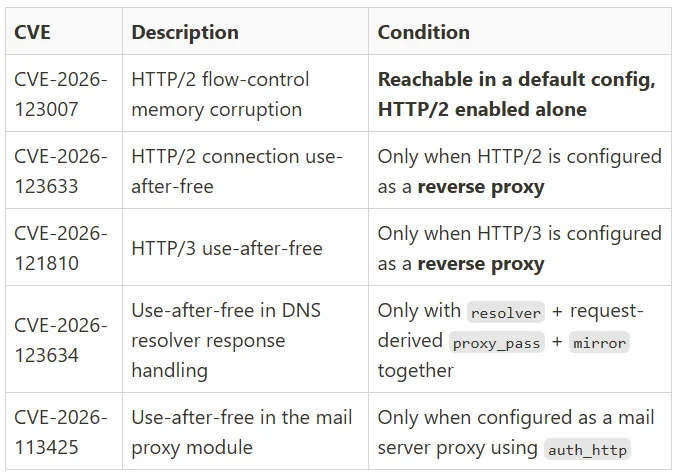
CVE-2026-123007 has by far the broadest blast radius here precisely because it needs no special proxy, mail or DNS configuration, just HTTP/2 turned on in an otherwise default setup.
Why five teams found this at the same time
A bug nobody caught for over a decade was independently found by five different research teams at almost the same moment. Wiz Research attributes this convergence to the advance of AI-assisted vulnerability research tooling, their own platform "Wiz Atlas" plus the AI models they used to validate the finding's impact. Memory-safety bugs have traditionally required tracing subtle interactions between memory operations and multiple code paths, and that complexity itself has acted as a practical barrier for years. Wiz's own assessment: "complexity can no longer be relied upon as a barrier to discovery or exploitation."
The public disclosure timeline to F5 bears this out:
- 10/21: Wiz reports an HTTP/2 use-after-free (a separate CVE, 2026-123633) to F5; F5 confirms another team had already reported the same bug.
- 11/10: F5 supplies a patch for 123633 for review.
- 11/16: Wiz reports a second HTTP/2 vulnerability (later assigned CVE-2026-123007) to F5.
- 11/17: F5 confirms this matches an existing report and assigns it CVE-2026-123007, slating it for the 11/18 release.
- 11/18: F5's coordinated security release and public disclosure.
Fix
Upgrade NGINX OSS to 1.30.7 (stable) or 1.31.9 (mainline), and NGINX Plus to [redacted] or 37.3.0.1. Restart after patching; do not rely on reload alone. nginx -s reload only re-reads configuration, it does not replace the running binary, and a worker process still running the old version stays vulnerable. Run nginx -t && nginx -s reload, then confirm the old worker processes have actually exited.
If patching is not immediately possible, disable HTTP/2:
http2 off;
On NGINX 1.25.1 and later, use the http2 off; directive. On earlier versions, remove the http2 parameter from every listen directive. Test application compatibility, for anything relying on HTTP/2, before reloading, and confirm old workers exit. It is safe to re-enable HTTP/2 once the patch is applied.
Containerised and orchestrated environments need special attention:
ingress-nginx, the community Kubernetes Ingress, has had its project archived, so no fix is coming. Disable it withuse-http2: "false"or migrate to another ingress controller.- F5 NGINX Ingress Controller: versions before 5.8.0 are affected, upgrade to 5.8.0 or later.
- NGINX Gateway Fabric: versions before 2.9.0 are affected (HTTP/2 on by default), upgrade to 2.9.0 or later.
Detection signals to watch for:
- An unusually long-lived HTTP/2 connection combined with a large volume of
WINDOW_UPDATEframes and heavy traffic. - Unexpected NGINX worker process crashes (segfaults), not a confirmed indicator on its own but worth investigating.
- Unexpected shells or command execution originating from an NGINX worker process.
Prioritise internet-facing NGINX instances with HTTP/2 enabled and no HTTP/2-terminating CDN or WAF in front of them. The real-world constraints, 128 GB of traffic and the x86-64/glibc dependency, are not grounds for complacency: Rapid7 has already demonstrated reproduction in about 2.5 minutes, and Xint's scan shows the unpatched population runs into the tens of millions.
Variants to test
- Plaintext h2c listeners. The report notes that whether plaintext h2c is equally viable is not documented publicly. A positive result is the same counter overflow and heap corruption over a cleartext HTTP/2 connection.
- Other architectures and libc combinations. The PoC depends on an x86-64-specific glibc memory-copy routine. A positive result is a working exploit path on a different architecture or libc, which would widen the affected population.
- HTTP/2-terminating intermediaries. A CDN or WAF in front of NGINX may or may not forward the crafted payload intact. A positive result is a proxy configuration that passes the
WINDOW_UPDATEflood and stream cancellation through to the origin. - Long-lived connection limits. NGINX's default one-hour connection limit may cut off a slow delivery of the 128 GB of traffic. A positive result is a target where the full sequence completes within the limit.
- Container escape chains. Rapid7 chained this bug with a separate Linux kernel SCTP networking flaw to reach root on the host. A positive result is another privilege-escalation primitive that turns the NGINX worker compromise into host or container escape.
What happened, in plain words
A very common piece of web server software called NGINX (say it "engine-x") had a serious flaw in the way it handles a newer version of the web's language, HTTP/2. An attacker who can reach a vulnerable server over the network, without any username or password, could send it a specially crafted stream of traffic and end up running their own commands on the machine. Security people call that remote code execution, or RCE.
The flaw was given the identifier CVE-2026-123007. A CVE is a public catalogue number for a known security bug, so that everyone talking about the same bug uses the same name.
The bug is not in a website built on top of NGINX. It is in NGINX itself, so even a server that does nothing but hand out plain files, like images or HTML pages, is exposed, as long as HTTP/2 is switched on. No extra software and no login is needed.
At a glance
The short version: NGINX keeps a running count of how much response data it is allowed to send to a browser. A mistake lets that count be pushed past the maximum the protocol allows. Later parts of the code trust the count completely, do some arithmetic that silently goes wrong, and end up copying memory outside the area they meant to touch. That memory mistake is what an attacker can turn into running code.
Five separate research teams found the same bug at almost the same time: Wiz Research, Ikotas Labs, Metnir, Rapid7 and Xint. The faulty code had been in NGINX since version 1.9.5, released in 2015, so it sat unnoticed for over a decade. Wiz Research confirmed that the bug could be turned into RCE, including a technique to get around a standard memory protection called ASLR, on official NGINX 1.31.7 and 1.31.8 builds, over HTTP/2 with TLS (the padlock encryption), on 64-bit systems, with the server sending response data straight from memory.
The background you need: what a web server and HTTP/2 are
A web server is a program that sits on a machine and answers requests from browsers. When you type an address, your browser connects to a server and asks for a page; the server sends the page back. NGINX is one of the most widely used web servers in the world.
HTTP is the set of rules both sides use to talk. The older version, HTTP/1.1, generally handles one request at a time per connection, like a single checkout till: the next customer waits until the previous one is done. HTTP/2 is a newer version that lets many requests travel at once over one connection. Each individual request-and-response is called a stream, like several conversations happening in parallel on one phone line.
Because many streams share one connection, the browser needs a way to stop the server from drowning it in data. HTTP/2 does this with flow control, a credit system. Think of a prepaid card: the browser tells the server how much it is willing to receive, the server spends from that balance as it sends, and the browser can top the balance up when it has room again.
In NGINX the balance is kept in a counter called h2c->send_window. When response data is queued to be sent, its size is subtracted from the counter. When the browser sends a WINDOW_UPDATE frame (a small control message meaning "I have room for more"), the counter goes up. The protocol sets a ceiling on this counter, NGX_HTTP_V2_MAX_WINDOW, and under normal operation it should never be able to go above it. That ceiling is one of the safety rails the rest of the code relies on.
Setup: what an attacker needs for this to work
The conditions are narrow in terms of configuration and very broad in terms of how many servers exist.
| Condition | Detail |
|---|---|
| HTTP/2 enabled | http2 on or listen ... http2;; without it, this CVE is moot |
| Transport | Wiz confirmed RCE over HTTPS (TLS) on 64-bit systems; whether plaintext h2c is equally viable is not documented publicly |
| Attack pattern | Trigger a large response, cancel the stream while the response sits queued, and meanwhile send a flood of WINDOW_UPDATE frames to push the window to an arbitrary value |
| Backend requirement | None; reachable from plain static file serving (contrast with CVE-2026-123633, which needs a reverse-proxy setup) |
Reading the table in plain words:
- The server must have HTTP/2 switched on. If it only speaks the older HTTP/1.1, this particular bug cannot be reached.
- Wiz confirmed the attack works over HTTPS, the encrypted version of the web. Whether it also works over unencrypted HTTP/2 (sometimes called h2c) is not documented publicly.
- The attacker's recipe is: ask for something big, cancel the request while the answer is still waiting to go out, and at the same time flood the server with "I have room for more" messages to push the counter to a value of the attacker's choosing.
- No application behind NGINX is needed. A server that only serves static files is enough. This is different from a related bug, CVE-2026-123633, which needs a reverse-proxy setup. A reverse proxy is a server that sits in front of other servers and forwards requests to them.
Rapid7's Stephen Fewer published a working proof of concept, a program that demonstrates the attack, at sfewer-r7/CVE-2026-123007. It shows how hard the attack is in practice:
- It succeeded against an NGINX 1.31.8 container (a packaged, isolated running copy of NGINX) with HTTP/2 and TLS enabled.
- It needed roughly 128 GB of HTTP/2 traffic, mostly small control messages such as
WINDOW_UPDATE, not actual page data. - It finished in roughly 2.5 minutes, though this varies by environment.
- It depends on a memory-copy routine specific to glibc (the standard C library on most Linux systems) on x86-64 processors, so it is sensitive to the processor type and the library version.
- It needs an ASLR bypass, recovering memory addresses from what the server sends back. That is the usual difficulty profile of a memory-safety bug.
Rapid7's team went further and showed that this HTTP/2 bug can be chained with a separate flaw in the Linux kernel's SCTP networking code to reach root, the highest privilege level on the host. In other words, the attacker does not stop at the limited rights of the NGINX worker process but escapes the container or host entirely.
Finding it: the three stages of the bug
The chain has three stages, as laid out in Wiz Research's technical writeup.
Stage 1: refunding credit for data that was never sent
Imagine you pay for a coffee, then cancel the order before it is made. A fair shop gives your money back. That is what NGINX tries to do here: if a stream is cancelled while its response data is still sitting in the queue, the counter has already been reduced for that data, so NGINX clears the unsent data and refunds the unused credit.
h2c->send_window += window;
Line by line:
h2c->send_windowis the running balance of how much the server is still allowed to send on this connection.+=means "add the right-hand side to the left-hand side and store the result back".windowis the amount of credit being refunded for the cancelled stream.
So the line adds the refund back to the balance. The problem is what it does not do: it never checks whether the result is above NGX_HTTP_V2_MAX_WINDOW. If the browser had already topped up the balance with WINDOW_UPDATE messages while that data sat in the queue, adding the refund on top can push the counter past the protocol's own ceiling. The counter now holds a value that the rest of the HTTP/2 code assumes can never happen.
Stage 2: a bounds check that no longer does anything
A bounds check is a test that makes sure a number stays inside allowed limits, like a bouncer checking that a queue does not exceed the room's capacity. The next problem lives in ngx_http_v2_state_window_update(), the function that handles incoming WINDOW_UPDATE messages from the browser.
if (window > NGX_HTTP_V2_MAX_WINDOW - h2c->send_window)
Line by line:
if (...)means "if the condition inside the brackets is true, do something about it".windowis the amount of extra credit the browser is asking to add.NGX_HTTP_V2_MAX_WINDOW - h2c->send_windowworks out the remaining headroom: the ceiling minus the current balance. If the balance is 80 and the ceiling is 100, there are 20 left.>compares the requested increase with that headroom. If the request is bigger than the headroom, the check should reject it.
The flaw is in the subtraction. These numbers are unsigned, meaning they cannot represent negative values. If send_window has already gone past the ceiling, then ceiling minus balance should be negative, but an unsigned number cannot be negative, so it wraps around into a huge positive value instead. The check reads that wrapped value as "plenty of headroom left" and approves further increases rather than rejecting them. It has no way of noticing that the counter is already broken.
Stage 3: from a flipped sign to a memory copy
The corrupted counter eventually reaches ngx_http_v2_send_chain(), the function that actually sends response data. There it is cast to the signed type off_t to work out how much data to send. A cast is an instruction to treat a value as a different type. Signed types can be negative; unsigned ones cannot. A sufficiently large unsigned value becomes negative when converted to a signed type, the same way an odometer rolling past its maximum can look like a small number.
That negative length is then handed to a structure describing a slice of the response buffer, producing a buffer whose end pointer sits before its start pointer. Picture a ruler where the "end" mark is to the left of the "start" mark: anything that measures the distance between them gets a nonsensical answer.
When this malformed buffer reaches the TLS send path, ngx_ssl_send_chain(), another round of signed and unsigned conversion turns the invalid length into an out-of-bounds heap memory copy. The heap is the pool of memory a program uses for data while it runs; an out-of-bounds copy means writing or reading outside the area that was reserved, like painting past the edge of your canvas onto the wall. An attacker can use this to leak memory, which helps defeat ASLR, and to corrupt the heap, which is the road to unauthenticated remote code execution.
Exploitation: the steps in order
Step 1: confirm HTTP/2 is enabled
Check the running version and whether HTTP/2 appears in the configuration:
nginx -vnginx -T 2>/dev/null | grep -nE 'http2|listen'
Line by line:
nginx -vasks NGINX to print its version number. Knowing the version tells you whether the server is in the affected range.nginx -Tasks NGINX to print its full configuration. The2>/dev/nullpart throws away error messages so they do not clutter the output.| grep -nE 'http2|listen'pipes that output intogrep, a search tool.-nshows line numbers,-Eallows a pattern with alternatives, and'http2|listen'matches lines containing eitherhttp2orlisten.
The result shows whether HTTP/2 is switched on and on which listeners. This step is done first because, without HTTP/2, the rest of the attack has nothing to aim at.
Step 2: trigger a large response and cancel the stream
Open a stream that produces a large response, so that response data is queued and send_window is reduced for it. Then cancel the stream while that data is still queued. The cancellation path runs ngx_http_v2_filter_cleanup(), which refunds the unused credit without checking the ceiling. This is the moment the counter can be pushed past its maximum, which is why the attacker needs a big response that is still waiting to be sent.
Step 3: flood WINDOW_UPDATE frames
While the response sits queued, send a flood of WINDOW_UPDATE frames to push the window to an arbitrary value. Once the refund has pushed send_window past NGX_HTTP_V2_MAX_WINDOW, the headroom check in ngx_http_v2_state_window_update() wraps and approves further increases rather than rejecting them. The flood is what turns a small accounting error into a counter value of the attacker's choosing.
Step 4: drive the corrupted counter into the send path
The inflated counter reaches ngx_http_v2_send_chain(), is cast to off_t, and becomes negative. The resulting malformed buffer reaches ngx_ssl_send_chain(), where the invalid length turns into an out-of-bounds heap copy. Rapid7's proof of concept performs this whole sequence against an NGINX 1.31.8 container with HTTP/2 and TLS enabled, moving roughly 128 GB of mostly control-message traffic in about 2.5 minutes; it needs an ASLR bypass by recovering heap addresses from server responses.
Real-world constraints
- A CDN or WAF that terminates HTTP/2 in front of NGINX may not forward the attacker's crafted payload through intact. A CDN is a network of servers that caches and delivers content close to users; a WAF is a web application firewall that inspects traffic and blocks suspicious patterns. Whether they pass this attack through depends on the implementation.
- A slow connection might not deliver all 128 GB before NGINX's default one-hour connection limit cuts it off.
- From a detection standpoint the traffic pattern stands out: an unusually long-lived HTTP/2 connection carrying a large volume of
WINDOW_UPDATEframes and heavy traffic is a clear signal.
Root cause
The mistake is a missing bounds check on the credit refund in ngx_http_v2_filter_cleanup(). The refund adds the unused window back to h2c->send_window unconditionally, so a client that has already raised the window with WINDOW_UPDATE while data was queued can push the counter past NGX_HTTP_V2_MAX_WINDOW. Every later consumer of the counter trusts the rule that it cannot exceed the ceiling. The headroom check in ngx_http_v2_state_window_update() relies on unsigned subtraction, which wraps instead of going negative, so it cannot detect the broken state. The cast to signed off_t in ngx_http_v2_send_chain() then turns the large value negative, and the signed/unsigned conversion in ngx_ssl_send_chain() turns the invalid length into an out-of-bounds heap copy. The existing defences, the ceiling and the headroom check, both depend on the counter never being corrupted in the first place.
Impact
An unauthenticated attacker, meaning someone with no account and no password, can leak memory to defeat ASLR and corrupt the heap, leading to remote code execution on any NGINX with HTTP/2 enabled, with no backend application or third-party module required. Wiz Research confirmed RCE with an ASLR bypass on official NGINX 1.31.7 and 1.31.8 builds, over HTTP/2 plus TLS, on 64-bit systems. Rapid7 demonstrated chaining the bug with a separate Linux kernel SCTP networking flaw to reach root on the host, escaping the container or host entirely.
According to Xint's Shodan-based scan, 98.9% of 11.94 million version-identifiable NGINX hosts were running an affected release. Shodan is a search engine for internet-connected devices. That figure counts versions only; it does not confirm whether HTTP/2 is actually enabled or whether a fix has already landed. Given that NGINX powers roughly 30% of the web server market, the base population is enormous regardless.
Of the ten "NGINX2Root" vulnerabilities disclosed together, five are rated Critical with RCE potential:
CVE-2026-123007 has by far the broadest blast radius here precisely because it needs no special proxy, mail or DNS configuration, just HTTP/2 turned on in an otherwise default setup.
Why five teams found it at the same time
A bug nobody caught for over a decade was independently found by five different research teams at almost the same moment. Wiz Research attributes this convergence to the advance of AI-assisted vulnerability research tooling, their own platform "Wiz Atlas" plus the AI models they used to validate the finding's impact. Memory-safety bugs have traditionally required tracing subtle interactions between memory operations and multiple code paths, and that complexity itself has acted as a practical barrier for years. Wiz's own assessment: "complexity can no longer be relied upon as a barrier to discovery or exploitation."
The public disclosure timeline to F5, the company that maintains NGINX, bears this out:
- 10/21: Wiz reports an HTTP/2 use-after-free (a separate CVE, 2026-123633) to F5; F5 confirms another team had already reported the same bug. A use-after-free is a bug where a program keeps using memory after it has been freed.
- 11/10: F5 supplies a patch for 123633 for review.
- 11/16: Wiz reports a second HTTP/2 vulnerability (later assigned CVE-2026-123007) to F5.
- 11/17: F5 confirms this matches an existing report and assigns it CVE-2026-123007, slating it for the 11/18 release.
- 11/18: F5's coordinated security release and public disclosure.
Fix
Upgrade NGINX OSS to 1.30.7 (stable) or 1.31.9 (mainline), and NGINX Plus to [redacted] or 37.3.0.1. NGINX OSS is the free open-source edition; NGINX Plus is the commercial edition; stable and mainline are the two release tracks.
Restart after patching; do not rely on reload alone. nginx -s reload only re-reads configuration, it does not replace the running binary, and a worker process still running the old version stays vulnerable. Run nginx -t && nginx -s reload, then confirm the old worker processes have actually exited. nginx -t tests the configuration for errors, and && means "only run the next command if this one succeeded".
If patching is not immediately possible, disable HTTP/2:
http2 off;
This single directive switches HTTP/2 off, which removes the attack surface entirely. On NGINX 1.25.1 and later, use the http2 off; directive. On earlier versions, remove the http2 parameter from every listen directive. Test application compatibility, for anything relying on HTTP/2, before reloading, and confirm old workers exit. It is safe to re-enable HTTP/2 once the patch is applied.
Containerised and orchestrated environments need special attention. Containers are lightweight isolated packages for running software, and orchestration tools such as Kubernetes manage many of them.
ingress-nginx, the community Kubernetes Ingress, has had its project archived, so no fix is coming. Disable it withuse-http2: "false"or migrate to another ingress controller. An ingress controller is the component that routes incoming traffic into a Kubernetes cluster.- F5 NGINX Ingress Controller: versions before 5.8.0 are affected, upgrade to 5.8.0 or later.
- NGINX Gateway Fabric: versions before 2.9.0 are affected (HTTP/2 on by default), upgrade to 2.9.0 or later.
Detection signals to watch for:
- An unusually long-lived HTTP/2 connection combined with a large volume of
WINDOW_UPDATEframes and heavy traffic. - Unexpected NGINX worker process crashes (segfaults), not a confirmed indicator on its own but worth investigating. A segfault is the operating system killing a program that touched memory it should not have.
- Unexpected shells or command execution originating from an NGINX worker process.
Prioritise internet-facing NGINX instances with HTTP/2 enabled and no HTTP/2-terminating CDN or WAF in front of them. The real-world constraints, 128 GB of traffic and the x86-64/glibc dependency, are not grounds for complacency: Rapid7 has already demonstrated reproduction in about 2.5 minutes, and Xint's scan shows the unpatched population runs into the tens of millions.
Variants to test
- Plaintext h2c listeners. The report notes that whether plaintext h2c is equally viable is not documented publicly. A positive result is the same counter overflow and heap corruption over a cleartext HTTP/2 connection.
- Other architectures and libc combinations. The proof of concept depends on an x86-64-specific glibc memory-copy routine. A positive result is a working exploit path on a different architecture or libc, which would widen the affected population.
- HTTP/2-terminating intermediaries. A CDN or WAF in front of NGINX may or may not forward the crafted payload intact. A positive result is a proxy configuration that passes the
WINDOW_UPDATEflood and stream cancellation through to the origin. - Long-lived connection limits. NGINX's default one-hour connection limit may cut off a slow delivery of the 128 GB of traffic. A positive result is a target where the full sequence completes within the limit.
- Container escape chains. Rapid7 chained this bug with a separate Linux kernel SCTP networking flaw to reach root on the host. A positive result is another privilege-escalation primitive that turns the NGINX worker compromise into host or container escape.
Glossary
- ASLR: Address Space Layout Randomisation, a protection that shuffles where things sit in memory so an attacker cannot predict addresses.
- Backend application: the program behind a web server that builds dynamic pages, as opposed to plain static files.
- Bounds check: a test that keeps a number inside allowed limits.
- Cast: an instruction to treat a value as a different data type.
- CDN: Content Delivery Network, a set of servers that cache and deliver content close to users.
- Container: a lightweight isolated package for running software on a shared machine.
- Counter: a variable that keeps a running total.
- CVE: a public catalogue number for a known security vulnerability.
- Flow control: HTTP/2's credit system that limits how much data a sender may send before the receiver grants more.
- glibc: the standard C library on most Linux systems.
- Heap: the pool of memory a program uses for data while it runs.
- HTTP/2: a version of the web's request-response protocol that carries many streams over one connection.
- h2c: HTTP/2 over an unencrypted connection.
- Ingress controller: the component that routes incoming traffic into a Kubernetes cluster.
- Kubernetes: a system for running and managing many containers.
- libc: the standard C library a program links against.
- Mainline: the faster-moving release track of NGINX.
- NGINX: a widely used web server and reverse proxy.
- NGINX OSS: the free open-source edition of NGINX.
- NGINX Plus: the commercial edition of NGINX.
- Out-of-bounds copy: reading or writing memory outside the area that was reserved.
- Proof of concept (PoC): a program that demonstrates an attack works.
- RCE: Remote Code Execution, running your own commands on someone else's machine over the network.
- Reverse proxy: a server that sits in front of other servers and forwards requests to them.
- Root: the highest privilege level on a Linux system.
- SCTP: a networking protocol in the Linux kernel.
- Segfault: the operating system killing a program that touched memory it should not have.
- Shodan: a search engine for internet-connected devices.
- Signed / unsigned: number types that can or cannot represent negative values.
- Stable: the slower, more thoroughly tested release track of NGINX.
- Static files: files such as images or HTML pages served as they are, without an application building them.
- Stream: one request-and-response inside an HTTP/2 connection.
- TLS: the encryption behind HTTPS, shown as the padlock in a browser.
- Unauthenticated: reachable without any account or password.
- Use-after-free: a bug where a program keeps using memory after it has been freed.
- WAF: Web Application Firewall, a filter that inspects web traffic and blocks suspicious patterns.
- WINDOW_UPDATE: an HTTP/2 control message in which the receiver grants more flow-control credit.
- Worker process: a child process of NGINX that handles actual requests.
- x86-64: the common 64-bit processor family used in most servers and PCs.


