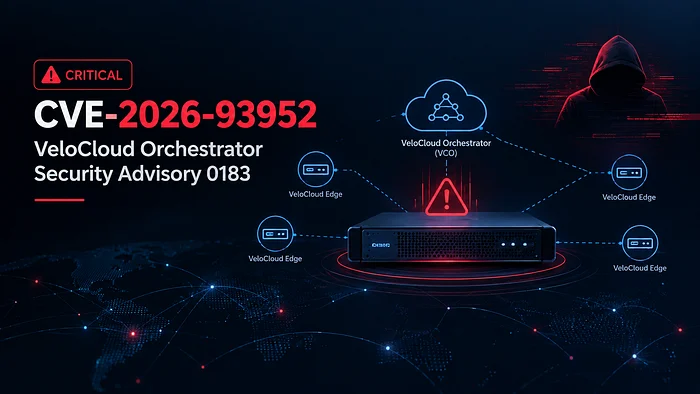
CVE-2026–93952: Critical VeloCloud Orchestrator Vulnerability
CVE-2026-93952 is an improper input validation flaw in VeloCloud Orchestrator On-Prem that lets a remote attacker reach privileged internal functionality without tenant or operator credentials, provided they have the public portion of an Edge authentication certificate and network access to the web interface. A successful attack could compromise the orchestrator, its managed data and possibly managed Edge devices.

medium.com
Published on medium.com
Cve
The full write-up lives on its author's site
It belongs to its author, so we link to it rather than copy it. The other two tabs are our own rewrites, checked against it.
Context
VeloCloud Orchestrator (VCO) is the management layer for VeloCloud environments. In the on-premises deployment, VCO On-Prem, it is the component that administrators use to manage the environment and the VeloCloud Edge devices that sit under it. Because it holds that central position, a compromise of the orchestrator is not a single-host problem: it can reach the data the orchestrator manages and, through it, the managed Edge devices.
On 22 September 2026, Arista Networks published Security Advisory 0183 disclosing CVE-2026-93952, a critical vulnerability in VCO On-Prem. The advisory assigns a CVSS v3.1 score of 10.0 (Critical) and states that the vulnerability is actively exploited. The same day, the CVE was added to the CISA Known Exploited Vulnerabilities (KEV) Catalogue.
Setup
The advisory describes the exploitation preconditions precisely, and they are worth reading carefully because they shape who is exposed. Arista states that exploitation requires:
- Certificate-based authentication between VeloCloud Edge and VCO.
- Access to the public portion of the VeloCloud Edge authentication certificate.
- Network access to the VCO web interface.
No VCO tenant or operator credentials are required. That last point is the one that changes the exposure calculation: an attacker does not need a valid login, only reachability to the web interface and the public half of the Edge authentication certificate.
Finding it
The vulnerability is classified as CWE-20: Improper Input Validation. The advisory states that the issue can allow a remote attacker to access privileged internal functionality and potentially compromise the confidentiality, integrity and availability of the VCO host and the data it manages.
Restricting the VCO web interface to trusted administrative networks can reduce exposure. Restricting that interface to trusted administrative networks reduces exposure, but it does not remove the underlying flaw.
Exploitation
The advisory does not describe the vulnerable input, so there is no payload sequence to reproduce here. What it does give is the set of conditions under which exploitation succeeds, and the indicators that defenders can use to determine whether it has happened.
Step 1: meet the preconditions
The attacker needs certificate-based authentication between a VeloCloud Edge and VCO to be in play, the public portion of the Edge authentication certificate, and network access to the VCO web interface. Tenant and operator credentials are not part of the requirement.
Step 2: reach privileged internal functionality
With those conditions met, the improper input validation allows access to privileged internal functionality on the orchestrator. Arista frames the outcome in terms of confidentiality, integrity and availability of the VCO host and its managed data, and warns that a compromised VCO may also give attackers access to managed VeloCloud Edge devices.
Step 3: hunt for the indicators
Arista provides several indicators for defenders. The filesystem paths to look for are:
/usr/local/sbin/.vcnode.js/usr/local/sbin/vc-sysmond/etc/systemd/system/vc-sysmon.service
A known malicious MD5 associated with vc-sysmond is:
[redacted]
The advisory also identifies the HTTP header:
x-vc-opt
and the IP addresses:
142.93.149.77104.248.126.159
as indicators requiring investigation.
If compromise is suspected, Arista recommends preserving VCO web access, application, system and database logs, as well as relevant filesystem timestamps, before remediation where operationally feasible.
Root cause
The advisory classifies the flaw as improper input validation (CWE-20). The advisory classifies the flaw as improper input validation (CWE-20) without describing the specific input, parser or code path involved. The advisory says the issue can allow a remote attacker to access privileged internal functionality.
Impact
Successful exploitation can compromise the orchestrator and the data it manages, affecting confidentiality, integrity and availability. Because VCO is the management layer, a compromised orchestrator may also provide attackers with access to managed VeloCloud Edge devices. The conditions are the ones listed above: certificate-based Edge-to-VCO authentication, the public portion of the Edge authentication certificate, and network access to the VCO web interface, with no tenant or operator credentials needed. Arista states that the vulnerability is actively exploited.
Fix
The primary remediation is to upgrade VCO to a fixed release. Arista currently lists these fixed releases:
VCO [redacted] and laterVCO [redacted] and later
Fixes for other supported release trains are being released separately. Organisations on affected 6.1.x or 7.0.x versions should monitor Arista's advisory and contact TAC regarding upgrade options.
Affected VCO On-Prem releases are:
| Release train | Affected up to and including |
|---|---|
| 5.2.x | [redacted] |
| 6.1.x | [redacted] |
| 6.4.x | [redacted] |
| 7.0.x | [redacted] |
Hosted and Dedicated VCO environments were also impacted but have already been patched.
Until the upgrade is available, Arista recommends:
- Restricting VCO web-interface access to trusted administrative networks.
- Monitoring unexpected access to the VCO.
- Monitoring unexpected outbound HTTP/HTTPS traffic.
- Blocking unnecessary outbound ports where possible.
- Looking for unexpected webshells or backdoor daemons.
- Reviewing administrator activity for unauthorised changes.
Because VCO is a management layer, remediation should include not only patching the orchestrator but also reviewing administrative activity and the state of managed Edge devices. A sensible order for affected environments is: identify, restrict exposure, hunt for IOCs, upgrade, then validate VCO and Edge state.
Variants to test
The advisory does not describe the vulnerable input, so there is no specific payload to adapt. The transferable lessons for similar management-plane targets are:
- Authentication paths that trust a certificate rather than a session. Where a device authenticates to a management plane with a certificate, check whether the public portion of that certificate is enough to reach functionality that should require a full authenticated session.
- Input validation on management interfaces.
- Exposure of the management interface. Enumerate which networks can reach the orchestrator's web interface. Arista recommends restricting VCO web-interface access to trusted administrative networks.
- Indicator hunting after the fact. On any VCO, check for the paths, the MD5, the
x-vc-optheader and the IP addresses listed above. If compromise is suspected, Arista recommends preserving logs and filesystem timestamps before remediation where operationally feasible.
What happened, in plain words
On 22 September 2026, a networking company called Arista Networks published a security notice numbered 0183. In it, Arista told the world about a serious flaw in one of its products, VeloCloud Orchestrator, and gave the flaw an identifier: CVE-2026-93952. A CVE is simply a public catalogue number for a known security bug, so that everyone talking about the same bug can be sure they mean the same thing.
Two things make this notice stand out. First, the flaw was rated 10.0 on the CVSS scale. CVSS is a standard scoring system for how bad a security bug is, running from 0 to 10, and 10.0 is the maximum. Second, Arista said the flaw is already being used by real attackers, not just demonstrated in a lab. The same day, the bug was added to a list kept by CISA, the US government's cybersecurity agency, called the Known Exploited Vulnerabilities (KEV) Catalogue. That list exists to tell organisations which bugs attackers are known to be using right now.
What VeloCloud Orchestrator is, and why it matters
Before the flaw makes sense, you need to know what the product does. VeloCloud is a family of networking products. At the centre of a VeloCloud setup sits the VeloCloud Orchestrator, usually shortened to VCO. Think of it as the control room of a building: the control room does not do the work itself, but from it you can see and operate everything else in the building. In a VeloCloud environment, the VCO is where administrators manage the whole network and the VeloCloud Edge devices that sit underneath it. An Edge device is the box at a branch office or data centre that actually handles network traffic; the orchestrator is the software that tells those boxes what to do.
There are two ways to run a VCO. In the hosted version, the vendor runs it for you. In the on-premises version, called VCO On-Prem, the customer runs it on their own servers. This flaw affects VCO On-Prem.
Because the orchestrator sits in the middle of everything, breaking into it is not like breaking into one ordinary computer. Whoever controls the orchestrator can reach the data it manages and, through it, the Edge devices it manages. That is why a bug here is treated so seriously.
Who is affected, and what an attacker needs
The advisory is precise about the conditions under which the flaw can be exploited. These conditions matter because they decide which organisations are actually at risk. Arista states that exploitation requires:
- Certificate-based authentication between VeloCloud Edge and VCO.
- Access to the public portion of the VeloCloud Edge authentication certificate.
- Network access to the VCO web interface.
No VCO tenant or operator credentials are required.
Each of these needs a short explanation.
A certificate is a digital identity document. Just as a passport proves who you are, a certificate proves that a particular computer or device is who it claims to be. It comes in two halves: a private part, which the owner keeps secret, and a public part, which can be shared. The public part is used to check that the private part really belongs to the device. In a VeloCloud setup, an Edge device proves its identity to the orchestrator using such a certificate. That is what "certificate-based authentication between VeloCloud Edge and VCO" means.
The second condition is the surprising one. The attacker needs only the public portion of the Edge authentication certificate, not the secret private half. In everyday terms, this is like a building where showing a photocopy of your ID badge is enough to get into the staff area, even though the badge itself is not secret.
The third condition is simply that the attacker's computer must be able to reach the VCO's web interface over the network. A web interface is the set of web pages an administrator opens in a browser to manage the product, the same way you open a website.
The last line is the one that changes the risk calculation. Credentials are the username and password (or similar login details) that a legitimate administrator uses. The advisory says no tenant or operator credentials are needed. In other words, an attacker does not need a valid login. They need reachability to the web interface and the public half of the Edge certificate. That is a much lower bar than a normal login-protected system.
What kind of flaw it is
The vulnerability is classified as CWE-20: Improper Input Validation. CWE is a catalogue of weakness types, the way a library catalogue lists categories of books. CWE-20 means the software accepts input from the outside world without checking it properly.
A simple comparison: imagine a form that asks for your age and expects a number. If you type a sentence instead and the form happily accepts it and does something unexpected, that is an input validation problem. In serious software, the consequence can be that malformed input reaches parts of the system it was never meant to reach.
According to the advisory, this flaw can let a remote attacker access privileged internal functionality. "Privileged" means functions reserved for trusted administrators, not ordinary users. "Internal" means parts of the product not meant to be reachable from outside. The advisory says this can potentially compromise the confidentiality, integrity and availability of the VCO host and the data it manages. Those three words are a standard way of describing what can go wrong:
- Confidentiality: data that should be secret may be read by the attacker.
- Integrity: data may be changed without authorisation.
- Availability: the service may be disrupted or taken down.
Restricting the VCO web interface to trusted administrative networks can reduce exposure. Restricting that interface to trusted administrative networks reduces exposure, but it does not remove the underlying flaw. In other words, locking the front door helps, but the broken lock is still broken.
How an attack would unfold
The advisory does not describe the vulnerable input, so there is no payload sequence to reproduce here. What it does give is the set of conditions under which exploitation succeeds, and the clues defenders can use to work out whether it has already happened.
Step 1: meet the preconditions
The attacker needs certificate-based authentication between a VeloCloud Edge and VCO to be in play, the public portion of the Edge authentication certificate, and network access to the VCO web interface. Tenant and operator credentials are not part of the requirement.
Step 2: reach privileged internal functionality
With those conditions met, the improper input validation allows access to privileged internal functionality on the orchestrator. Arista describes the outcome in terms of confidentiality, integrity and availability of the VCO host and its managed data, and warns that a compromised VCO may also give attackers access to managed VeloCloud Edge devices. With those conditions met, the improper input validation can allow access to privileged internal functionality on the orchestrator.
Step 3: hunt for the indicators
An indicator (often called an IOC, indicator of compromise) is a trace left behind by an attack, like a footprint in a garden. Arista provides several for defenders. The filesystem paths to look for are:
/usr/local/sbin/.vcnode.js/usr/local/sbin/vc-sysmond/etc/systemd/system/vc-sysmon.service
This block lists three file locations on the VCO server. A filesystem path is the address of a file on a computer, the way a postal address locates a house. The first two paths point to files in /usr/local/sbin/, a folder normally used for system programs: one called .vcnode.js (the leading dot often marks a hidden file) and one called vc-sysmond. The third points to a service definition file, vc-sysmon.service, in /etc/systemd/system/. A service in this context is a program that runs in the background on a Linux server, and systemd is the part of Linux that starts and manages such services. If these files exist on a VCO and should not, that is a reason to investigate.
A known malicious MD5 associated with vc-sysmond is:
[redacted]
An MD5 is a fingerprint for a file: a short string of characters calculated from the file's contents. Two files with the same contents produce the same MD5, and a changed file produces a different one. Comparing a file's MD5 against this known-bad value is a quick way to tell whether the file on your server is the malicious one. The report gives this value as a known malicious MD5 associated with vc-sysmond.
The advisory also identifies the HTTP header:
x-vc-opt
An HTTP header is a small piece of extra information sent alongside a web request or response, like the label on a parcel that says how it should be handled. Browsers and servers exchange headers constantly; most are ordinary and expected. x-vc-opt is named by the advisory as an indicator that needs investigation, meaning its appearance in traffic may be a sign of attack activity.
and the IP addresses:
142.93.149.77104.248.126.159
An IP address is the numeric address of a computer on a network, the equivalent of a street address for a house. The block above contains two addresses run together: [redacted] and [redacted]. The advisory lists them as indicators requiring investigation.
If compromise is suspected, Arista recommends preserving VCO web access, application, system and database logs, as well as relevant filesystem timestamps, before remediation where operationally feasible. Logs are the records a system keeps of what happened, like a diary. Timestamps record when files were created or changed. The reason to preserve them before fixing anything is that cleaning up can overwrite the very evidence an investigation needs.
Why the flaw exists
The advisory classifies the flaw as improper input validation (CWE-20). The advisory classifies the flaw as improper input validation (CWE-20) without describing the specific input, parser or code path involved. The advisory says the issue can allow a remote attacker to access privileged internal functionality.
What the impact is
Successful exploitation can compromise the orchestrator and the data it manages, affecting confidentiality, integrity and availability. Because VCO is the management layer, a compromised orchestrator may also provide attackers with access to managed VeloCloud Edge devices. The conditions are the ones listed above: certificate-based Edge-to-VCO authentication, the public portion of the Edge authentication certificate, and network access to the VCO web interface, with no tenant or operator credentials needed. Arista states that the vulnerability is actively exploited.
The fix
The primary remediation is to upgrade VCO to a fixed release. Arista currently lists these fixed releases:
VCO [redacted] and laterVCO [redacted] and later
This block names two version numbers, run together: VCO [redacted] and later, and VCO [redacted] and later. A release is a particular published version of software, and version numbers like these identify exactly which one. "And later" means any newer version in that line is also fixed. Upgrading means replacing the vulnerable version with one of these.
Fixes for other supported release trains are being released separately. A release train is a series of versions that share the same first number and receive updates together, such as all 6.1.x versions. Organisations on affected 6.1.x or 7.0.x versions should monitor Arista's advisory and contact TAC regarding upgrade options. TAC is a vendor's technical assistance centre, the support desk you call when you need help with a product.
The affected VCO On-Prem releases are:
| Release train | Affected up to and including |
|---|---|
| 5.2.x | [redacted] |
| 6.1.x | [redacted] |
| 6.4.x | [redacted] |
| 7.0.x | [redacted] |
Read the table like a list of recalled batches: if your VCO is on the 5.2 line and its version is [redacted] or lower, it is affected, and so on for each row. Hosted and Dedicated VCO environments were also impacted but have already been patched.
Until the upgrade is available, Arista recommends:
- Restricting VCO web-interface access to trusted administrative networks.
- Monitoring unexpected access to the VCO.
- Monitoring unexpected outbound HTTP/HTTPS traffic.
- Blocking unnecessary outbound ports where possible.
- Looking for unexpected webshells or backdoor daemons.
- Reviewing administrator activity for unauthorised changes.
A few of those terms need unpacking. Outbound traffic is data leaving your network towards the internet; attackers often need such a channel to control a compromised machine. A port is a numbered doorway on a computer through which a particular kind of traffic enters or leaves. A webshell is a small program an attacker places on a web server so they can run commands on it through ordinary web requests. A daemon is a program that runs quietly in the background, and a backdoor daemon is one planted by an attacker to keep access. Reviewing administrator activity means checking the records of what logged-in administrators did, to spot changes nobody authorised.
Because VCO is a management layer, remediation should include not only patching the orchestrator but also reviewing administrative activity and the state of managed Edge devices. A sensible order for affected environments is: identify, restrict exposure, hunt for IOCs, upgrade, then validate VCO and Edge state. In plain terms: first work out which systems are affected, then reduce who can reach them, then look for the traces listed above, then install the fix, and finally check that the orchestrator and the Edge devices are in the state you expect.
Lessons for similar systems
The advisory does not describe the vulnerable input, so there is no specific payload to adapt. The transferable lessons for similar management-plane targets are:
- Authentication paths that trust a certificate rather than a session. Where a device authenticates to a management plane with a certificate, check whether the public portion of that certificate is enough to reach functionality that should require a full authenticated session. A session here means a logged-in state: after you sign in, the system remembers you for a while. The lesson is to test whether a certificate alone can stand in for that login.
- Input validation on management interfaces. A parameter is a piece of information a web page sends to the server, such as a name typed into a form.
- Exposure of the management interface. Enumerate which networks can reach the orchestrator's web interface. Arista recommends restricting VCO web-interface access to trusted administrative networks. Enumerating means making a complete list rather than guessing.
- Indicator hunting after the fact. On any VCO, check for the paths, the MD5, the
x-vc-optheader and the IP addresses listed above. If compromise is suspected, Arista recommends preserving logs and filesystem timestamps before remediation where operationally feasible.
Glossary
- API: a defined way for one piece of software to talk to another, like a service counter with set procedures.
- Availability: the property that a service stays up and usable; one of the three classic impacts alongside confidentiality and integrity.
- Backdoor daemon: a background program planted by an attacker to keep access to a system.
- Certificate: a digital identity document proving that a device or service is who it claims to be; it has a public part and a secret private part.
- CISA: the US Cybersecurity and Infrastructure Security Agency.
- Confidentiality: the property that data is only readable by those authorised to see it.
- Credentials: login details such as a username and password that prove who a user is.
- CVE: a public catalogue number for a known security vulnerability.
- CVSS: a standard scoring system for the severity of a vulnerability, from 0 to 10.
- CWE: a catalogue of weakness types, such as CWE-20 for improper input validation.
- Daemon: a program that runs in the background on a Linux system.
- Edge device: in VeloCloud, the device at a site that handles network traffic under the orchestrator's management.
- Filesystem path: the address of a file or folder on a computer.
- Header (HTTP header): extra information sent with a web request or response, like a label on a parcel.
- Host: a computer or server running software.
- Indicator of compromise (IOC): a trace left by an attack that defenders can search for.
- Integrity: the property that data has not been changed without authorisation.
- IP address: the numeric address of a computer on a network.
- KEV Catalogue: CISA's list of vulnerabilities known to be exploited in the wild.
- Logs: records a system keeps of events that happened.
- MD5: a short fingerprint calculated from a file's contents, used to identify a file.
- On-premises: software run on the customer's own servers rather than by the vendor.
- Outbound traffic: data leaving a network towards the internet.
- Parameter: a piece of information a web page sends to a server, such as a form field.
- Port: a numbered doorway on a computer through which a particular kind of network traffic passes.
- Privileged: reserved for trusted administrators rather than ordinary users.
- Release / release train: a published version of software; a release train is a series of versions updated together, such as all 6.1.x versions.
- Remediation: the action taken to fix a vulnerability or remove an attacker.
- Service: a program that runs in the background and is managed by the operating system.
- Session: a logged-in state that a system remembers for a period after sign-in.
- Systemd: the part of Linux that starts and manages background services.
- TAC: a vendor's technical assistance centre, its support desk.
- Tenant: a customer's own isolated space within a shared service.
- Timestamp: a record of when a file or event occurred.
- VCO (VeloCloud Orchestrator): the central management software for a VeloCloud environment.
- Web interface: the web pages an administrator uses in a browser to manage a product.
- Webshell: a small program placed on a web server to run commands through ordinary web requests.

