How a Simple API Misconfiguration Leaked PII of 100,000+ Users
An API endpoint listing board participants had no authorization check, so any board participant could retrieve the email addresses, UUIDs, and full names of every other participant. Because invite codes were hardcoded in a public JavaScript file and never expired, the researcher could join many boards and collect PII for over 100,000 users.
 Published on medium.com
Bug Bounty
The full write-up lives on its author's site
It belongs to its author, so we link to it rather than copy it. The other two tabs are our own rewrites, checked against it.
Context
target.com is an all-in-one digital and visual collaboration platform: interactive whiteboards, live quizzes, surveys and brainstorming templates for hybrid and remote teams. The feature at the centre of this write-up is boards, shared whiteboards where a team collaborates on tasks, sticky notes and other tools, and where users can invite others for real-time collaboration.
By design, no user on a board is supposed to see the details of other participants. By design, no user on a board is supposed to see the details of other participants, and the endpoint below broke that boundary.
The company is referred to as target.com throughout because of an NDA with the affected company.
Setup
The researcher had been testing this company privately for almost 8 months before this finding. The work described here started when the company launched another private bug bounty program for a different product line, scoped to app.target.com. That scope is what pulled the researcher back in.
All findings came from manual testing: no scanners, no automation, just methodically walking through the application's features until something did not add up.
Finding it
While poking around the board feature, the researcher found an endpoint that quietly broke the participant privacy boundary:
GET /manager/api/brainstorms/{board-uuid}/participants
There was no authorization check on this endpoint. Any user who was a participant on any board could call it and pull back full details of every other participant on that board: email addresses, user UUIDs, first names and last names.
On its own that is a serious but bounded leak: you need to be on a board to read its participant list. The second half of the finding is what turned it into a mass exposure. Boards support two invite mechanisms:
- Direct email invites
- A shareable invite link, in the format:
https://app.target.com/HTEN234S
The trailing string (HTEN234S in this example) is the invite code, and critically, these invite codes never expire. A leaked code grants board membership, and because invite codes never expire, the code keeps working.
Exploitation
Step 1: Recon beyond the primary app
While doing recon beyond the primary app, the researcher found a subdomain, go.target.com. Digging through it surfaced a JavaScript file:
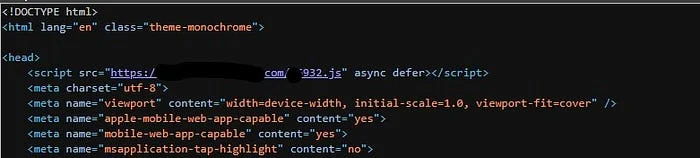
go.target.com/55932.js
Reviewing the file, the researcher found a list of invite codes hardcoded inside it. What purpose those codes were meant to serve in that file is still unknown to the researcher, but they were a gold mine.

Step 2: Join a board and read its participants
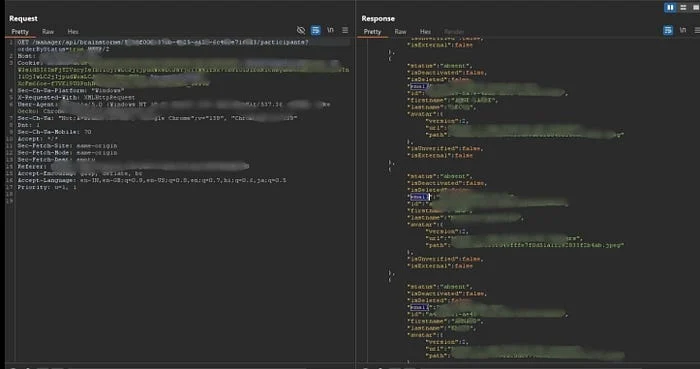
Using one of the codes from that file, the researcher joined one of the boards and immediately hit the participants API for that board's UUID. The result was 20,000+ users in a single board, with their full PII pulled in one request.

users on board
Step 3: Mine historical snapshots of the JS file
Getting 20K+ records from one leaked JS file was already bad, but the researcher wanted to know how far this went. Since go.target.com/55932.js had clearly been live for a while, the next step was the Wayback Machine, checking historical snapshots of it:
https://web.archive.org/web/20260000000000*/go.target.com/55932.js
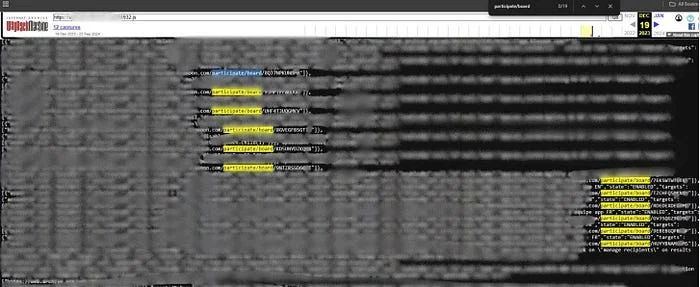
Older snapshots contained even more invite codes, codes that had since been rotated out of the live file but were still valid, because invite codes never expire.
Step 4: Enumerate archived URLs with the CDX API
From there, the researcher widened the net using the Wayback CDX API to pull every archived URL under the app's subdomain pattern:
https://web.archive.org/cdx/search/cdx?url=*.app.target.com&fl=original&collapse=urlkey
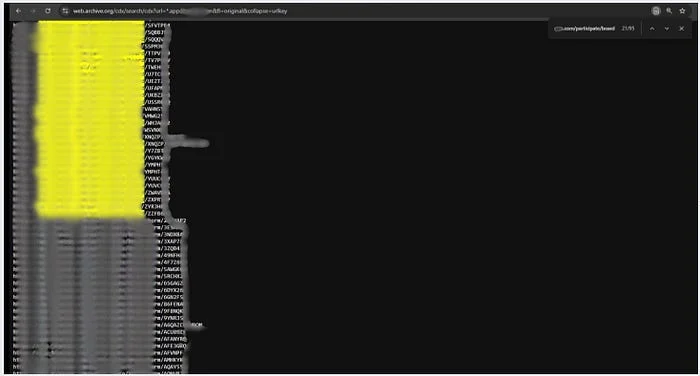
That query alone surfaced 100+ additional invite codes scattered across historical snapshots: codes that were never meant to be discoverable again, but whose invite links never expired.
Step 5: Repeat and scale
Joining board after board and repeating the same participants-API call, the numbers kept climbing. By the end, the researcher had access to the PII of 100,000+ users (emails, UUIDs and full names), all reachable through one API with no authorization check and a pile of stale, non-expiring invite codes.
Root cause
Two design mistakes compound here.
- Missing authorization on the participants endpoint.
GET /manager/api/brainstorms/{board-uuid}/participantsreturned full participant details to any participant of the board, with no check that the caller should see other participants' data. The expected privacy boundary (participants cannot see each other's details) was not enforced. - Invite codes that never expire, and that leak. Invite codes were hardcoded in a publicly reachable JavaScript file on
go.target.com, and because they never expire, every code ever published, including ones later rotated out of the live file and preserved in Wayback Machine snapshots, remained a valid way onto a board. Rotating a code out of the file did not revoke it.
The Wayback Machine supplied the historical copies that the live file no longer contained.
Impact
Under the conditions described, an attacker who obtains any valid invite code can join the corresponding board and then read the full PII of every participant on it: email addresses, user UUIDs, first names and last names. Because codes never expire, codes recovered from historical snapshots were still valid, just like live ones.
Scale in this case: 20,000+ users on a single board from one leaked JS file, and 100,000+ users in total once the Wayback-derived codes were used. The researcher says a separate write-up will cover a way to bypass the fix by abusing the board UUID itself.
Fix
The company added proper authorization checks on the participants endpoint. The fix was deployed in under 24 hours, and the researcher explicitly acknowledges how quickly the company moved once the report landed. A 4-digit bounty was awarded.
Variants to test
- Participant and member listing endpoints on other collaboration products. Look for endpoints of the form
/api/<resource>/{uuid}/participants,/members,/collaborators. A positive result is a response containing other users' emails, names or IDs to a caller who, by the product's own design, should not see them. - Invite codes in client-side JavaScript. Fetch JS bundles from app and auxiliary subdomains and grep for high-entropy strings used in invite or join URLs. A positive result is a code that successfully joins a board or workspace.
- Historical snapshots of those JS files. Query the Wayback Machine for archived copies of the same file and for the subdomain pattern via the CDX API. A positive result is additional codes that still work even though they are absent from the live file.
- Expiry behaviour of invite links. Join with an old code, then check whether the code still works after the owner rotates or regenerates it. A positive result is a rotated-out code that still grants access.
- Scope of the participants response. Compare what the endpoint returns against what the UI shows. A positive result is extra fields (email, UUID, full name) present in the API response but hidden in the interface.
What happened, in plain words
A collaboration website lets teams work together on shared digital whiteboards, which it calls boards. You can invite other people onto a board so you can all work on it at the same time. The site promises that people on a board cannot see each other's personal details. Two mistakes together exposed the personal information of more than 100,000 people.
First, there was a hidden web address (an API endpoint) that handed back the full list of everyone on a board, including their email addresses and full names, to anyone who was a member of that board. There was no authorization check on this endpoint.
Second, the site let people join a board with a shareable invite link, and those links never stopped working. Some of those invite links were sitting in plain sight inside a file that anyone's browser could download from a different part of the site. Older archived snapshots contained even more invite codes that were still valid.
Put together: find an old invite link, join the board, ask the API for the member list, and you get thousands of people's personal details in a single request. Repeat across many boards and the number climbs past 100,000.
The researcher reported it, the company fixed the API in under 24 hours, and a four-figure bounty was paid.
A quick word about the researcher
The author is Sagar Kirola, an independent security researcher. He says almost all of his findings come from manual testing: no automated scanners, just carefully clicking through an application's features until something does not add up. That is worth knowing as a beginner, because it means you do not need expensive tools to find bugs like this one. You need patience and curiosity.
Because of a non-disclosure agreement (NDA) with the company, the real name is replaced with target.com throughout. An NDA is a contract that says you will not publicly reveal certain information. Researchers sign these so companies can fix problems before attackers learn about them.
About the target
target.com is described as an all-in-one digital and visual collaboration platform. It offers interactive whiteboards, live quizzes, surveys and brainstorming templates for hybrid and remote teams.
The feature at the centre of this story is boards. A board is a shared whiteboard where a team collaborates on tasks, sticky notes and other tools, and where users can invite others for real-time collaboration. Think of it like a shared online noticeboard that several people can pin notes to at the same time.
By design, no user on a board is supposed to see the details of other participants. By design, no user on a board is supposed to see the details of other participants, and the endpoint below broke that boundary.
The researcher had been testing this company privately for almost 8 months before this finding. The work described here started when the company launched another private bug bounty program for a different product line, scoped to app.target.com. A bug bounty program is a scheme where a company invites researchers to look for security problems and pays them for valid reports. Scope means the list of things you are allowed to test; testing outside it is off limits. That scope is what pulled the researcher back in.
Finding it
While poking around the board feature, the researcher found an endpoint that quietly broke the participant privacy boundary:
GET /manager/api/brainstorms/{board-uuid}/participants
Let us unpack this line, because it is the heart of the whole story.
- API stands for Application Programming Interface. In everyday terms, it is the counter behind the shop window. The website you see is the shop window; the API is the counter where the page asks the server for data. When your browser loads a board, it is really sending requests to addresses like this one and drawing the answers on screen.
GETis the type of request. It means "give me something", as opposed to sending something in. You can seeGETin your browser's address bar requests all the time without noticing./manager/api/brainstorms/{board-uuid}/participantsis the path, the address of that particular counter.brainstormsis the internal name for boards here.{board-uuid}is a placeholder. A UUID (Universally Unique Identifier) is a long random-looking string that identifies one specific thing, in this case one specific board. Every board has its own, so the address changes per board. The curly braces just mean "put the board's ID here".participantssays what you want back: the list of people on that board.
Authorization is the server asking "are you allowed to do this?". Authentication is the server asking "who are you?". They are different questions, and this endpoint had no authorization check at all. Any user who was a participant on any board could call it and pull back full details of every other participant on that board: email addresses, user UUIDs, first names and last names.
PII stands for Personally Identifiable Information: data that can identify a real person, such as a name, an email address or an account ID. Leaking it is a privacy problem and often a legal one.
On its own that is a serious but bounded leak: you need to be on a board to read its participant list. The second half of the finding is what turned it into a mass exposure. Boards support two invite mechanisms:
- Direct email invites
- A shareable invite link, in the format:
https://app.target.com/HTEN234S
Here is what that link means. https://app.target.com is the site. The trailing string, HTEN234S in this example, is the invite code: a short password-like token that, when visited, adds you to the board. Anyone with the link can join, which is the point of a shareable link.
Critically, these invite codes never expire. An expiry date is the safety net on a shared secret: if a link leaks, it stops working after a while. Without one, a leaked code works forever. That single detail is what turned a low-impact bug into a mass PII exposure.
Finding the jackpot: a stray JavaScript file
While doing recon beyond the primary app, the researcher found a subdomain, go.target.com. Recon, short for reconnaissance, means looking around the target's wider footprint before attacking anything: other subdomains, old files, forgotten pages. A subdomain is a prefix on the main domain, like go. in go.target.com; companies often run many of them for different services, and they are easy to forget about.
Digging through it surfaced a JavaScript file:
go.target.com/55932.js
JavaScript is the programming language that runs in your browser and makes web pages interactive. A .js file is a file of that code, and your browser downloads it to run the page. Because the browser must download it, anyone can also open it and read it. That is the key idea: anything shipped to the browser is public, even if it is not linked from a menu.
Reviewing the file, the researcher found a list of invite codes hardcoded inside it. Hardcoded means written directly into the file as fixed text, rather than fetched from a database. What purpose those codes were meant to serve in that file is still unknown to the researcher, but they were a gold mine: each one was a working key to a board.
Step 2: join a board and read its participants
Using one of the codes from that file, the researcher joined one of the boards and immediately hit the participants API for that board's UUID. The result was 20,000+ users in a single board, with their full PII pulled in one request.
users on board
Why this step matters: joining the board was the only thing standing between the researcher and the participant list, because the API had no authorization check. One leaked code plus one request equalled 20,000 people's details. No password guessing, no clever exploit, just a valid key and a request the server should have refused.
Step 3: mine historical snapshots of the JS file
Getting 20K+ records from one leaked JS file was already bad, but the researcher wanted to know how far this went. Since go.target.com/55932.js had clearly been live for a while, the next step was the Wayback Machine, checking historical snapshots of it:
https://web.archive.org/web/20260000000000*/go.target.com/55932.js
The Wayback Machine is a free public archive run by the Internet Archive that periodically saves copies of web pages and files. Think of it as a giant library of old versions of the internet. The URL above asks it: show me every saved copy of this file.
web.archive.orgis the archive's site./web/20260000000000*is a date pattern; the asterisk means "any date matching this"./go.target.com/55932.jsis the file being looked up.
Older snapshots contained even more invite codes, codes that had since been rotated out of the live file but were still valid, because invite codes never expire. Rotating a code means replacing it with a new one and removing the old one from the current file. Codes rotated out of the live file were still valid, because invite codes never expire. The old code still opened the door.
Step 4: enumerate archived URLs with the CDX API
From there, the researcher widened the net using the Wayback CDX API to pull every archived URL under the app's subdomain pattern:
https://web.archive.org/cdx/search/cdx?url=*.app.target.com&fl=original&collapse=urlkey
This is a query to the archive's own API, so let us read it piece by piece:
https://web.archive.org/cdx/search/cdxis the archive's search endpoint. CDX is the name of the index format the archive uses for its saved URLs.?starts the list of parameters, the settings for the query.url=*.app.target.comsays: match every URL underapp.target.com. The*is a wildcard meaning "anything".&separates parameters.fl=originalmeans "fields: original", so return the original URL of each match rather than a long list of metadata.collapse=urlkeymeans "do not repeat the same URL many times"; it collapses duplicates so you get one line per unique address.
That query alone surfaced 100+ additional invite codes scattered across historical snapshots: codes that were never meant to be discoverable again, but whose invite links never expired. In other words, the archive held historical copies containing invite codes that were still valid.
Step 5: repeat and scale
Joining board after board and repeating the same participants-API call, the numbers kept climbing. By the end, the researcher had access to the PII of 100,000+ users (emails, UUIDs and full names), all reachable through one API with no authorization check and a pile of stale, non-expiring invite codes.
This is the part beginners often miss: the individual bug was small. The scale came from repetition. One code, one board, one request, then again, and again.
Root cause
Two design mistakes compound here.
- Missing authorization on the participants endpoint.
GET /manager/api/brainstorms/{board-uuid}/participantsreturned full participant details to any participant of the board, with no check that the caller should see other participants' data. The expected privacy boundary (participants cannot see each other's details) was simply not enforced server-side. Server-side means on the company's computers, where the real decisions must be made; anything checked only in the browser can be bypassed, because the browser belongs to the user. - Invite codes that never expire, and that leak. Invite codes were hardcoded in a publicly reachable JavaScript file on
go.target.com, and because they never expire, every code ever published, including ones later rotated out of the live file and preserved in Wayback Machine snapshots, remained a valid way onto a board. Rotating a code out of the file did not revoke it.
Existing defences did not stop this: the endpoint trusted board membership as sufficient authorisation, and the invite mechanism had no expiry to limit the lifetime of a leaked code. The Wayback Machine supplied the historical copies that the live file no longer contained.
Impact
Under the conditions described, an attacker who obtains any valid invite code can join the corresponding board and then read the full PII of every participant on it: email addresses, user UUIDs, first names and last names. Because codes never expire, a single leaked code gives indefinite access, and codes recovered from historical snapshots work just as well as live ones.
Scale in this case: 20,000+ users on a single board from one leaked JS file, and 100,000+ users in total once the Wayback-derived codes were used. The researcher says a separate write-up will cover a way to bypass the fix by abusing the board UUID itself.
Fix
The company added proper authorization checks on the participants endpoint. The fix was deployed in under 24 hours, and the researcher explicitly acknowledges how quickly the company moved once the report landed. A 4-digit bounty was awarded.
Variants to test
If you want to look for similar problems yourself, here are some angles to try. Each one is a place to look, not a guarantee.
- Participant and member listing endpoints on other collaboration products. Look for endpoints of the form
/api/<resource>/{uuid}/participants,/members,/collaborators. A positive result is a response containing other users' emails, names or IDs to a caller who, by the product's own design, should not see them. - Invite codes in client-side JavaScript. Fetch JS bundles from app and auxiliary subdomains and grep for high-entropy strings used in invite or join URLs. Client-side means code running in your browser; grep means searching text for a pattern; high-entropy means random-looking, like a password rather than a word. A positive result is a code that successfully joins a board or workspace.
- Historical snapshots of those JS files. Query the Wayback Machine for archived copies of the same file and for the subdomain pattern via the CDX API. A positive result is additional codes that still work even though they are absent from the live file.
- Expiry behaviour of invite links. Join with an old code, then check whether the code still works after the owner rotates or regenerates it. A positive result is a rotated-out code that still grants access.
- Scope of the participants response. Compare what the endpoint returns against what the UI shows. UI means user interface, the screens you see. A positive result is extra fields (email, UUID, full name) present in the API response but hidden in the interface.
Glossary
- API: Application Programming Interface; the set of addresses a website's pages use to ask the server for data or to send data back.
- Authentication: the server working out who you are.
- Authorization: the server working out whether you are allowed to do what you are asking.
- Board: a shared digital whiteboard on the target platform where a team collaborates in real time.
- Bug bounty program: a scheme where a company invites researchers to find security problems and pays for valid reports.
- Bounty: the payment a company makes for a valid security report.
- CDX API: the Wayback Machine's search interface for its index of archived URLs.
- Client-side: code that runs in your own browser, as opposed to on the company's servers.
- Endpoint: a specific address on a server that accepts requests, such as the participants API path.
- GET: the type of web request that asks for something to be returned, without changing anything.
- Hardcoded: written directly into a file as fixed text rather than looked up from a database.
- High-entropy: random-looking, like a password or a long code, rather than a normal word.
- Invite code: the short string at the end of a shareable invite link that, when used, adds you to a board.
- JavaScript: the programming language browsers run to make web pages interactive;
.jsfiles contain it. - Manual testing: finding problems by hand, by exploring features, rather than with automated scanners.
- NDA: non-disclosure agreement; a contract not to reveal certain information publicly.
- PII: Personally Identifiable Information; data that can identify a real person, such as a name, email address or account ID.
- Recon: reconnaissance; looking around a target's wider footprint, such as subdomains and old files, before testing.
- Rotating a code: replacing a code with a new one and removing the old one from the current file.
- Scope: the list of systems and addresses a researcher is permitted to test.
- Server-side: on the company's computers, where security checks must actually happen.
- Subdomain: a prefix on a main domain, such as
go.ingo.target.com. - UI: user interface; the screens and controls a person sees and uses.
- UUID: Universally Unique Identifier; a long random-looking string that identifies one specific thing, such as one board.
- Wayback Machine: a free public archive that saves copies of web pages and files over time.
- Wildcard: a
*character meaning "anything", used in patterns and queries.

