How I Found a CVE-2026–75582 in Just One Night
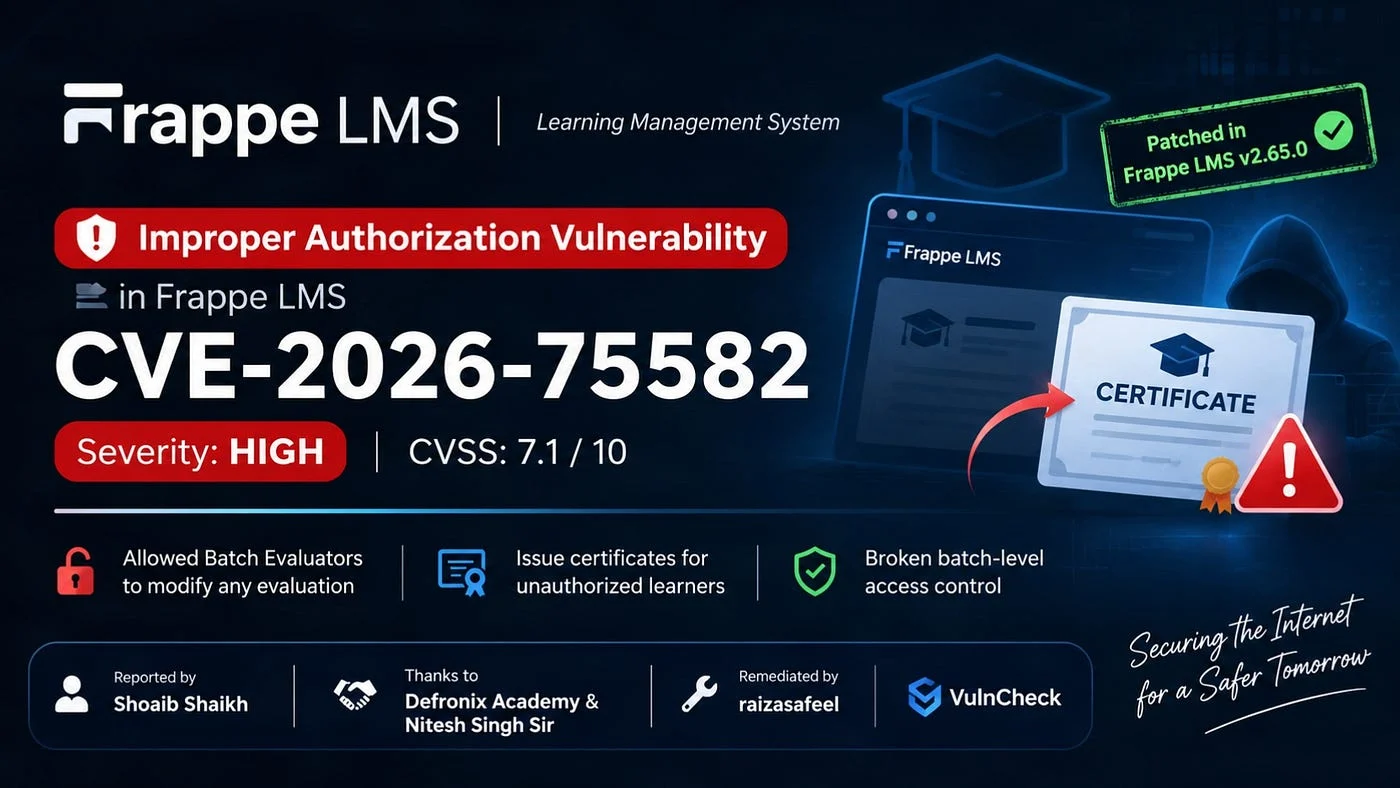
Frappe LMS did not enforce authorization strictly for batch evaluations and certificate issuance. An attacker could perform actions beyond their assigned role and permissions.
 Published on shoaibls.medium.com
As someone interested in application security and web penetration testing, I spend a lot of time exploring how web applications work internally.
The full write-up lives on its author's site
It belongs to its author, so we link to it rather than copy it. The other two tabs are our own rewrites, checked against it.
Context
Frappe LMS is a learning management system built on the Frappe framework. The feature at the centre of this story is the one that handles batch evaluations and certificate issuance: the operations that let a course batch be evaluated and certificates be generated for learners. Those operations are meant to be available only to users whose assigned role and permissions allow them.
The researcher's interest was in the authorisation layer behind that functionality, not in the user interface that exposes it. The write-up describes the result as an improper authorisation issue in Frappe LMS, later assigned CVE-2026-75582, with a CVSS score of 7.1 (High), fixed in Frappe LMS 2.65.0.
Setup
The report does not describe a lab, a set of test accounts, specific roles, tooling or a version of Frappe LMS used during testing. What it does say is that the work was done against Frappe LMS during a single research session, and that the finding was validated before it was reported. The only version named anywhere is 2.65.0, and that is the version in which the issue was fixed, not the version that was tested.
Finding it
The starting point was a general question rather than a specific endpoint: how does Frappe LMS enforce authorisation, and how are the different operations protected? The researcher deliberately looked past the normal user interface and thought about the permissions sitting behind the functionality.
The principle that guided the work is a familiar one: hiding a button or restricting an action in the frontend does not mean the backend enforces the same restriction. Applying that idea to Frappe LMS, the researcher examined sensitive functionality around batch evaluations and certificate issuance and found that the application was not enforcing authorisation as strictly as it should for those operations.

What made the finding worth pursuing was the impact rather than the surprise. A user should only be able to perform the actions permitted by their assigned role and permissions; when those boundaries are not enforced, functionality that should remain restricted becomes reachable. The researcher framed the issue in exactly those terms: not unexpected behaviour for its own sake, but a failure to enforce the boundary between what a user is allowed to do and what the application actually lets them do.
Exploitation
The report does not publish the requests, responses, endpoints, parameters or payloads used to demonstrate the issue. It describes the affected functionality (batch evaluations and certificate issuance) and the class of weakness (improper authorisation), and nothing more granular than that. Any step-by-step reproduction would therefore be reconstruction rather than a record of what was shown, so none is given here.
What the report does describe is the shape of the testing session:
- Investigate the application and analyse how it behaves around the sensitive operations.
- Look specifically for authorisation weaknesses, that is, operations that a user can invoke beyond the permissions their role should grant.
- Validate the finding and understand its security impact before treating it as a vulnerability.
- Avoid unnecessary access to sensitive data while validating.
- Report through the appropriate channel.
The whole sequence happened within one night of focused testing. The researcher notes that no weeks of chasing an obscure bug were needed: a focused session was enough to surface something that deserved a proper investigation.

Root cause
The report attributes the issue to improper authorisation: the application did not enforce authorisation as strictly as it should for the batch evaluation and certificate issuance operations. In other words, the permission boundary that should have gated those operations was not applied on the server side with the same strictness as the interface implied.
The report does not identify the specific code path, the check that was missing, or the framework mechanism that should have provided it, so the precise defect is not stated. The general lesson it draws is that frontend restrictions are not a security control: if the backend does not independently verify that the caller's role and permissions allow the operation, hiding the corresponding control in the UI achieves nothing against a user who calls the operation directly.
Impact
The impact follows from what the affected operations do. Batch evaluation and certificate issuance are sensitive actions: they concern how a batch is assessed and how certificates are produced for learners. If a user can invoke them without holding the role that should authorise them, that user reaches functionality intended to remain restricted.
The report does not quantify the impact further. It does not state which roles could reach the operations, whether an unauthenticated user could, how many records or learners could be affected, or what a certificate obtained this way would be worth. It says only that authorisation vulnerabilities of this kind can have a much greater impact than they initially appear to, and that the issue was rated High at CVSS 7.1.
Fix
The issue was addressed in Frappe LMS version 2.65.0. What it does record is the process: the finding was reported to the maintainers, acknowledged, and worked on until a fix shipped, after which the CVE was assigned.
Variants to test
The report gives no payloads, so the variants below are directions suggested by its reasoning rather than reproductions of its test cases. For each, a positive result is the same in kind: the server performs the sensitive action even though the caller's role should not permit it.
- Batch evaluation operations. Identify the requests the interface issues when an instructor evaluates a batch, then replay them from an account whose role should not allow evaluation. A positive result is a successful evaluation recorded against the batch.
- Certificate issuance. Find the request that generates a certificate for a learner and send it from an account that should not be able to issue certificates. A positive result is a certificate created for a learner the caller has no authority over.
- Role downgrade checks. Take a request captured with a privileged account and repeat it with a lower-privileged account, changing only the session. A positive result is identical behaviour from both accounts.
- UI-hidden actions. Enumerate actions the interface hides for the current user and call the underlying operations directly. A positive result is any hidden action that completes server-side.
- Object-level scope. Where the operation takes an identifier for a batch, course or learner, try identifiers belonging to other users or batches. A positive result is the operation acting on an object outside the caller's scope.
Hunting notes
This class of bug hides in the gap between what the interface offers and what the server checks. The signals worth watching during recon are operations that the UI only shows to certain roles, especially administrative or instructor-only actions such as evaluation, grading, certificate generation and batch management. If the frontend decides whether to render the control, the question to ask is whether the backend independently decides whether to honour the request.
The researcher's approach was to look past the interface and think about the permissions behind the functionality. That is a slower approach than spraying payloads, but it is what surfaced this issue in a single session.
On impact: the report shows that the case was made by explaining what the affected operations do and why they should be restricted, not by publishing a chain of requests. The write-up keeps the technical specifics out of public view and still conveys why the issue mattered, which is consistent with the responsible disclosure process it describes.
What happened, in plain words
A security researcher spent one night looking at a piece of software called Frappe LMS, a system that organisations use to run online courses. He found that two sensitive actions, evaluating a course batch and issuing certificates to learners, were not protected by authorisation as strictly as they should have been. The software was not checking permissions strictly enough on the server side. He reported the problem privately to the people who maintain the software, they fixed it in version 2.65.0, and the issue was later given an official identifier, CVE-2026-75582, with a severity rating of 7.1 (High).
This article walks through that story from the beginning, explaining every technical idea as it appears, so that you can follow it with nothing more than a browser and a computer.
A little about the researcher
The researcher is Shoaib Shaikh, an independent security researcher from India. He describes his interest as starting with curiosity about how web applications handle data, logins and permissions, and turning into hands-on learning and reporting vulnerabilities through responsible disclosure programmes. He mentions recognition from organisations including NASA, the U.S. Federal Communications Commission (FCC) and Philipps-Universität Marburg for his security research contributions. This particular story, he says, led to his first discovery associated with CVE-2026-75582.
Some background you need first
Before the story makes sense, a few ideas need explaining from zero.
What a web application is. When you open a website in your browser and it does more than show static pages, for example letting you log in, fill in forms or manage a course, the work is split between two places. Your browser shows the screen, and a server somewhere else stores the data and decides what is allowed. The screen is often called the frontend, and the server side is called the backend.
What an API is. An API is the set of addresses and rules the frontend uses to talk to the backend. Think of a restaurant: the menu and the waiter are the interface, and the kitchen is the backend. You do not walk into the kitchen yourself; you ask the waiter, and the kitchen prepares the dish. In a web application, when you click a button, the frontend sends a request to an API address on the server, and the server sends back a response. Anyone can send those requests, not only the official frontend, which is the key point of this whole story.
What a role and a permission are. Most applications have different kinds of users. A learner is one kind, an instructor another, an administrator another. The kind of user is called a role. A permission is a specific thing a role is allowed to do, such as "an instructor may evaluate a batch" or "an administrator may issue certificates". The application is supposed to check these permissions every time an action is requested.
What authorisation is. Authentication is proving who you are, usually by logging in with a username and password. Authorisation is a separate question: now that we know who you are, are you allowed to do this particular thing? A hotel is a good comparison. Your key card proves you are a guest (authentication), but it should only open your own room, not every room in the building (authorisation).
What an authorisation vulnerability is. It is a flaw where the application lets someone do something their role does not permit. The check is missing, too weak, or applied in the wrong place. This family of bugs is sometimes called broken access control.
What a CVE is. CVE stands for Common Vulnerabilities and Exposures. It is a public catalogue where each confirmed security flaw gets a unique identifier, so that everyone, vendors, researchers and defenders, can refer to the same issue unambiguously. CVE-2026-75582 is the identifier assigned to this one.
What a CVSS score is. CVSS is a standard way of scoring how serious a vulnerability is, on a scale from 0 to 10. Higher means more severe. This issue scored 7.1, which falls in the High band.
What responsible disclosure is. When someone finds a security flaw, the accepted practice is to tell the people who maintain the software privately, give them time to fix it, and only then talk about it publicly, without publishing details that could help attackers. This is called responsible disclosure.
The product and the feature
Frappe LMS is a learning management system, software that organisations use to publish courses, enrol learners and track progress. It is built on a framework called Frappe, which is the underlying toolkit the application is constructed with.
The feature at the centre of the story handles two things: batch evaluations and certificate issuance. A batch is a group of learners going through a course together. Evaluating a batch means assessing it, recording how it performed. Certificate issuance means generating the official certificate a learner receives on completing a course. Both are sensitive operations, because they affect how learners are assessed and what proof of completion they receive. Normally only users whose assigned role and permissions allow it should be able to run them.
The researcher was interested in the authorisation layer behind this functionality, not in the screens that expose it. In other words, he was not looking at what the buttons on the page do, but at what the server checks before carrying out the action behind each button.
It started with curiosity
His approach, as he describes it, was simple: do not just look at what an application allows users to do, understand what it should actually allow them to do. The gap between those two things is where security bugs live.
While exploring Frappe LMS, he became interested in how its authorisation mechanisms worked and how different operations were protected. He started looking beyond the normal user interface and thinking about the permissions behind the functionality.
The guiding principle here is worth stating plainly, because it is the heart of the finding: hiding a button or restricting an action in the frontend does not mean the backend enforces the same restriction. If the only thing stopping a user from performing an action is that the button is not drawn on their screen, then anyone who knows how to send the request directly may still be able to perform it. The screen is a suggestion; the server is the authority. A useful comparison is a shop that keeps expensive items in a back room. If the door to the back room is unlocked and only a sign says "staff only", the sign is not a lock.
The discovery: an authorisation issue
During his testing, he identified an improper authorisation issue in Frappe LMS. The vulnerability involved sensitive functionality related to batch evaluations and certificate issuance. In simple terms, the application was not enforcing authorisation as strictly as it should for these operations.
He stresses that this kind of flaw can have a much greater impact than it first appears. A user should only be able to perform actions permitted by their assigned role and permissions. When an application fails to enforce those boundaries correctly, functionality that should remain restricted becomes reachable.
He focused on understanding the security impact rather than simply noting unexpected behaviour, and that is when he realised it was not a minor issue. This distinction matters for anyone starting out: something behaving oddly is not automatically a vulnerability. It becomes one when you can explain what an attacker gains from it.
One night of research
What made the discovery memorable was how quickly it progressed. He started investigating the application, analysing its behaviour, and looking for authorisation weaknesses. Within that single research session he had identified something worth investigating further. He notes that he did not need weeks chasing an obscure bug: a focused night of testing surfaced an issue that deserved a proper investigation.
He is also careful to point out that finding a potential vulnerability is only the beginning. A researcher must validate the finding, understand its impact, avoid unnecessary access to sensitive data while checking, and report it through the appropriate channels. He wanted to be sure the issue was properly understood before considering the research complete.
Responsible disclosure
After identifying and validating the issue, he reported his findings to the maintainers. Rather than publicly sharing technical details that could put users at risk, he worked through the appropriate reporting process and allowed the maintainers time to investigate and address the issue. The vulnerability was acknowledged, and the maintainers worked on a fix.
Eventually the vulnerability was assigned CVE-2026-75582. It received a CVSS score of 7.1 (High) and was addressed in Frappe LMS version 2.65.0. Seeing a finding from one night of independent research become an officially recognised CVE was, he says, a special moment.
What he learned
He draws five lessons from the experience.
- Authorisation testing matters. Do not focus only on well-known bug classes such as SQL injection or cross-site scripting. Access control deserves equal attention.
- Understand the application, not just its endpoints. Knowing how an application handles roles, permissions and sensitive operations helps you spot weaknesses that automated tools miss.
- A finding is not complete without validation. Unexpected behaviour is not automatically a vulnerability; understanding the real security impact is essential.
- Responsible disclosure is part of security research. Reporting responsibly and giving maintainers a chance to fix the issue matters as much as finding it.
- You do not need a perfect setup to start. Sometimes curiosity, a grasp of web security fundamentals and the willingness to investigate something that looks wrong are enough.
A small milestone
For him, CVE-2026-75582 is not just another number on a profile. It is a reminder that consistent learning and practical research can lead to meaningful discoveries. One night of research, he writes, gave him another reason to keep exploring, learning and contributing to a safer internet.
Glossary
- API: the set of addresses and rules a frontend uses to send requests to a backend server; the waiter between the dining room and the kitchen.
- Authentication: proving who you are, typically by logging in.
- Authorisation: deciding, once identity is known, whether you are allowed to perform a particular action.
- Authorisation vulnerability: a flaw where the application lets someone do something their role does not permit, because the check is missing or too weak.
- Backend: the server-side part of an application that stores data and enforces rules.
- Batch: in a learning management system, a group of learners going through a course together.
- Batch evaluation: the operation that assesses a batch and records how it performed.
- Broken access control: another name for the family of flaws where permission checks are missing or incorrect.
- Certificate issuance: the operation that generates the certificate a learner receives on completing a course.
- Cross-site scripting (XSS): a well-known web vulnerability class in which an attacker gets code to run in another user's browser; mentioned only as an example of a popular bug class.
- CVE: Common Vulnerabilities and Exposures, a public catalogue giving each confirmed vulnerability a unique identifier.
- CVSS: a standard 0 to 10 scale for rating the severity of a vulnerability; higher is more serious.
- Frappe: the framework on which Frappe LMS is built.
- Frappe LMS: a learning management system, software for running online courses.
- Frontend: the part of an application you see and interact with in the browser.
- Learning management system (LMS): software for publishing courses, enrolling learners and tracking progress.
- Permission: a specific action a given role is allowed to perform.
- Request and response: a request is a message the browser sends to a server asking it to do something; the response is the server's reply.
- Responsible disclosure: reporting a vulnerability privately to the maintainers, allowing time for a fix, and avoiding public release of details that could put users at risk.
- Role: the category a user belongs to, such as learner, instructor or administrator, which determines what they may do.
- SQL injection: a well-known web vulnerability class in which attacker-supplied input alters a database query; mentioned only as an example of a popular bug class.
- Validation: confirming that a suspected vulnerability is real and understanding its actual security impact before reporting it.
- Version 2.65.0: the release of Frappe LMS in which the issue was fixed.

