How I Hacked A Crypto Company And Could Steal 1 Million Dollars Worth of Bitcoin
The author found that path normalisation could be bypassed to reach internal APIs, including an admin balance API that allowed viewing funds and performing admin functions like withdrawals. An attacker could have stolen up to $1 million in Bitcoin by cleaning out the account.
 Published on zoidsec.medium.com
Breaking path normalisation has been my biggest interest in the past couple of years. Let me explain exactly why I have chosen to invest time in this attack vector, and how to exploit it.
The full write-up lives on its author's site
It belongs to its author, so we link to it rather than copy it. The other two tabs are our own rewrites, checked against it.
Context
This is a write-up about breaking path normalisation to reach internal services behind a reverse proxy. The author, Blake (zoid, @z0idsec), describes himself as a part-time software engineer at Pentesterlab, an SRT member for Synack and a pentester for Cobalt. The target was a crypto company; the bug itself could not be disclosed at the time of writing, so the paths in the article are redacted and shown as example.com style placeholders.
The feature under attack is the reverse proxy in front of the application. Developers write proxy rules to block certain internal paths from being passed upstream to internal services. Path normalisation is what those rules rely on: the string identifying a path or file is modified so that it conforms to a valid path on the target operating system, typically by canonicalising components and directory separators. The author's point is that this normalisation can be broken, and that doing so is not the same as local file inclusion: no internal files are read, internal paths are reached.

Setup
The author keeps his tooling deliberately simple ("KISS, Keep It Stupid Simple"):
- Chrome DevTools
- ffuf
- Dirsearch
- Burp
- Assetnote Wordlists
- SecLists
No accounts, roles or versions are described. The precondition for the attack is a reverse proxy that normalises and filters paths before forwarding them, with internal services or APIs sitting behind it that the public is not meant to reach.
Finding it
The author explains why he invests time in this class of bug: there is no reflected payload to look for as with XSS, so it comes down to trial and error, looking for nuances and differences in responses, and to pure logical thinking. The payoff is access to internal services that the operator deliberately hid, which usually means solid impact.
He started with Chrome DevTools, looking through XHR requests and documents. There was not much there, so he opened Burp and began crawling the in-scope assets. He tests all paths with a pre-built wordlist plus reasoning, and on one path he hit the internal root API. Directory brute-forcing from there gave him access to the User Center API.
Exploitation
Step 1: reach the internal root API through the public path
The traversal that worked looked like this:
https://api.example.com/public/path/config/..;/..;/internal/path
The request starts on a public path (/public/path/config/) and uses ..; segments to climb out of it. The request uses ..; segments to climb out of the public path; the report does not explain the parsing difference. The author notes that every path may map to a different backend service or API, so the external attack surface with this technique is much higher than a single endpoint.
Step 2: enumerate and reach the Internal Admin Balance API
The User Center API did not provide much impact, so he continued testing other paths. On another path, using the same combination of traversal and directory brute-forcing, he reached the Internal Admin Balance API. That API leaked admin funds and allowed various admin functions:
- Withdrawal Funds
- View Token History
- View Balance
No further requests or responses for this second path are shown in the report.
Root cause
The mistake is in how the reverse proxy normalises and matches paths before forwarding them. The author frames this as breaking path normalisation rather than as a flaw in any single application endpoint. The report does not describe the proxy product or its configuration, so the exact parsing difference is not stated;
Impact
Path normalisation issues can produce a range of outcomes: sensitive information leaks, access to internal services such as JBoss EAP, Tomcat, AEM and APIs, services that have RCE by design, and APIs that can be written to for higher impact. The author rates the impact as very high in most cases.
On this target, the Internal Admin Balance API leaked admin funds and exposed admin functions including withdrawing funds, viewing token history and viewing balance. The author states that if a malicious hacker had found it first, they could have cleaned out the account and sent the company broke.
Fix
It states that the bug was reported 2 days after discovery, triaged and fixed within 1 day, and that the bounty was $9,000 USD, about $12,000 in the author's currency.

Variants to test
- Dot-segment with matrix parameter (
..;): send a request to a public prefix followed by..;/segments and an internal path, as in the request above. A positive result is a response from the internal service rather than the proxy's block page or a 404. - A positive result is any response whose body or headers differ from the public path's normal response and match an internal service.
- Directory brute-forcing behind the traversal: once one internal root is reachable, enumerate paths from it with ffuf, Dirsearch and the Assetnote and SecLists wordlists. A positive result is additional internal APIs, as happened here with the User Center API and then the Internal Admin Balance API.
- A positive result is a traversal that works on one path but not another, which points at a different upstream.
The author also promotes Dirstrike, a SaaS platform for high-scale directory brute-forcing without rate limits or IP bans, with a Discord at https://discord.gg/4Q4WgNR5wg.
What happened, in plain words
A security researcher called Blake, who goes by zoid online, found a way to slip past the front door of a crypto company's website and reach parts of it that were meant to stay private. The company had put a guard in front of its internal services, a piece of software called a reverse proxy, and that guard was supposed to block anyone from reaching the private parts. Blake found a trick in how the guard reads web addresses, and with it he reached an internal admin page that showed the company's funds and let him do admin things like withdrawing money and viewing token history. He reported it, the company fixed it within a day, and he was paid $9,000 USD.
This article explains that trick from scratch. You only need to know how to use a browser. Every technical word is explained where it first appears, and there is a glossary at the end.
Why spend time on this kind of bug
Blake says breaking path normalisation has been his biggest interest for the past couple of years. He introduces himself as a part-time software engineer at Pentesterlab, an SRT member for Synack and a pentester for Cobalt. A pentester is someone paid to attack a company's own systems, with permission, to find weaknesses before criminals do.
He explains why he chose this particular kind of bug. Most well-known attacks, like cross-site scripting (XSS, where a site echoes back text you typed and your browser runs it as code), have a clear pattern: you send something and you see it come back. Path normalisation has no such pattern. There is nothing reflected to look for. Instead you try small variations and watch how the server answers, looking for tiny differences. He calls it pure logical thinking and trial and error. The reward, he says, is a rush when you reach something internal, and the impact is usually serious, because companies hide these internal services precisely because they hold sensitive information. They put a reverse proxy in front to shut them off from the public.
What path normalisation is
The report quotes a definition:
Normalizing a path involves modifying the string that identifies a path or file so that it conforms to a valid path on the target operating system. Normalization typically involves Canonicalizing components and directory separators.
In plain words: a web address contains a path, the part after the site name, like /shop/items. Before a server acts on a path, it tidies it up into one standard form. That tidying is normalisation. It removes things like .. (which means "go up one folder") and turns different ways of writing a separator into one standard separator. Think of a postal address written as "12 High St. Flat 3" versus "Flat 3, 12 High Street": a sorting machine has to rewrite both into the same standard form before it can deliver the letter to the right door.
Developers rely on this tidying when they write reverse proxy rules. A reverse proxy is a server that sits in front of the real application and forwards requests to it, like a receptionist who decides which visitor goes to which office. The rules say things like "block any request whose path starts with /internal". The proxy tidies the path first, checks the rule, and only forwards what passes. Blake's whole attack is about breaking that tidying so the check and the real backend disagree about what the path means.
He adds an important note: do not confuse this with LFI, local file inclusion, where an attacker makes a server read one of its own files, such as a password file. Here no internal files are read. Internal paths are reached, meaning the request is delivered to a private service that was supposed to be unreachable from outside.
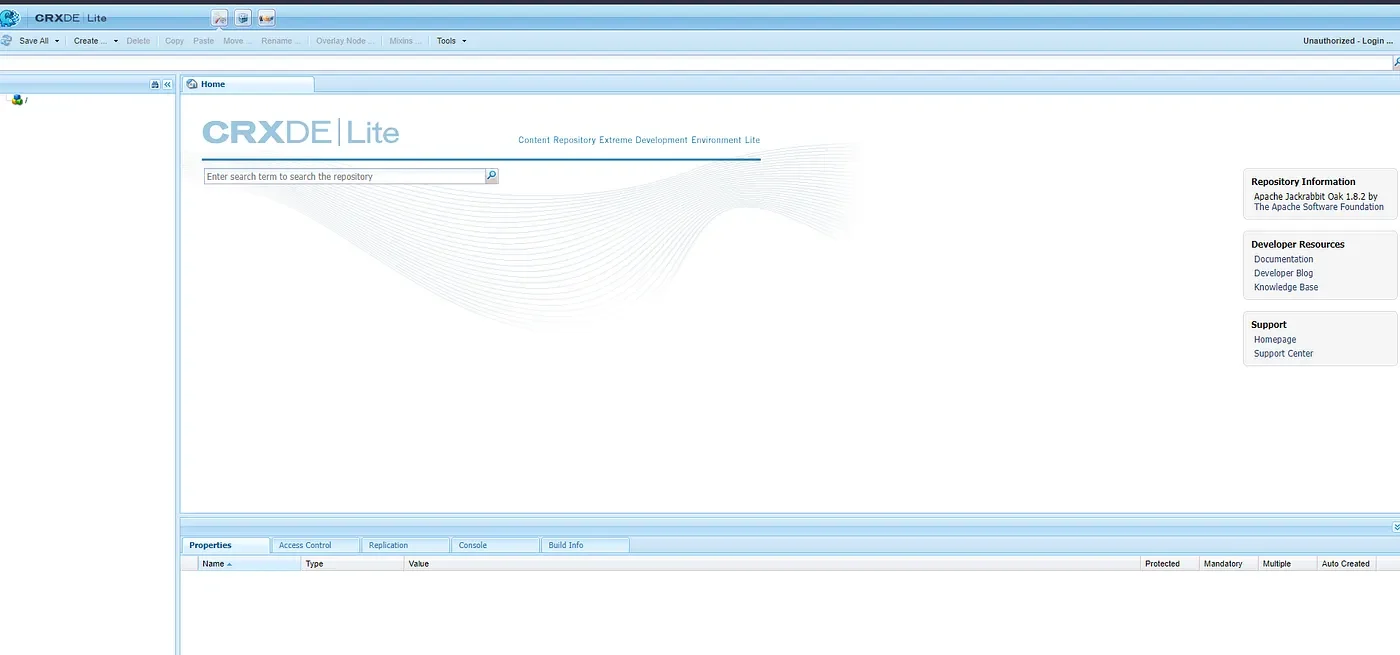
Here is a picture of a valid attack:
AEM Dispatcher bypass, access to CRXDE | Lite
The caption refers to Adobe Experience Manager (AEM), a content management product, and its Dispatcher, the proxy component in front of it. The image shows a request that got past the Dispatcher and reached CRXDE Lite, an administrative interface inside AEM. The point is the same shape of bug: a proxy meant to block a private path, and a request that slips past it.
What impact can this have
Blake lists what path normalisation bugs can lead to:
- Sensitive information leaks
- Access to internal services like JBoss EAP, Tomcat, AEM and APIs, plus more
- Some of those services have remote code execution (RCE) by design, meaning they can be made to run commands on the server
- Some let you write to the API, which raises the impact further
He rates the impact as very high in most cases.
What tools he uses
He keeps it simple, following the principle KISS, Keep It Stupid Simple:
- Chrome DevTools: the developer panel built into the Chrome browser, where you can watch every request a page makes
- ffuf: a command-line tool that fires many requests at once to guess hidden paths
- Dirsearch: a similar tool for guessing paths and files on a web server
- Burp: Burp Suite, a tool that sits between your browser and the site so you can inspect and replay requests
- Assetnote Wordlists: ready-made lists of common path names to try
- SecLists: another large collection of such lists
A wordlist here is just a long text file of guesses, like a dictionary of common folder and file names. Directory brute-forcing means sending a request for each guess and seeing which ones answer differently, which reveals paths that exist but are not linked anywhere.
As he says, finding these bugs needs pure logic, not just tools.
What the crypto hack looked like
He warns first that the bug could not be disclosed at the time, so everything is redacted. The real site names and paths are replaced with placeholders like example.com.
Step 1: getting to the internal root API
He started in Chrome DevTools, looking through the XHR requests and documents a page loads. XHR means XMLHttpRequest, the mechanism a page uses to fetch data in the background without reloading; today you would see these in the Network tab. There was not much there, so he opened Burp and started crawling the in-scope assets. Crawling means letting a tool walk the site automatically, following links and recording every address it finds. In-scope means the parts of the company's systems he was authorised to test.
He tests all paths with a wordlist he built beforehand plus his own reasoning. On one path he hit the internal root API. An API, application programming interface, is the set of addresses a program offers so other programs can ask it for data or actions, like a service counter where you name what you want and get it back in a fixed format. From there he performed directory brute-forcing and could access the User Center API.
The request that worked looked like this:
https://api.example.com/public/path/config/..;/..;/internal/path
Line by line:
https://api.example.comis the public site he is allowed to talk to.example.comis a placeholder, not the real company./public/path/config/is an ordinary public path. It looks harmless, and that is the point: the proxy's rules let it through...;is the trick...normally means "go up one folder". The semicolon after it makes the segment something called a matrix parameter, a way of attaching extra information to a path segment. Different pieces of software disagree about whether..;counts as "go up".- Repeating
..;/..;/climbs up twice, out of the public area. /internal/pathis where he wants to land: a private path the proxy was supposed to block.
The result is that the proxy forwards the request thinking it belongs under the public prefix, and the backend receives it and resolves it to the internal path. The two layers read the same string differently, and that gap is the bug.
He notes that every path may map to a different backend service or API, so the external attack surface, the total set of things an outsider can reach, is much higher with this technique than with a single endpoint.
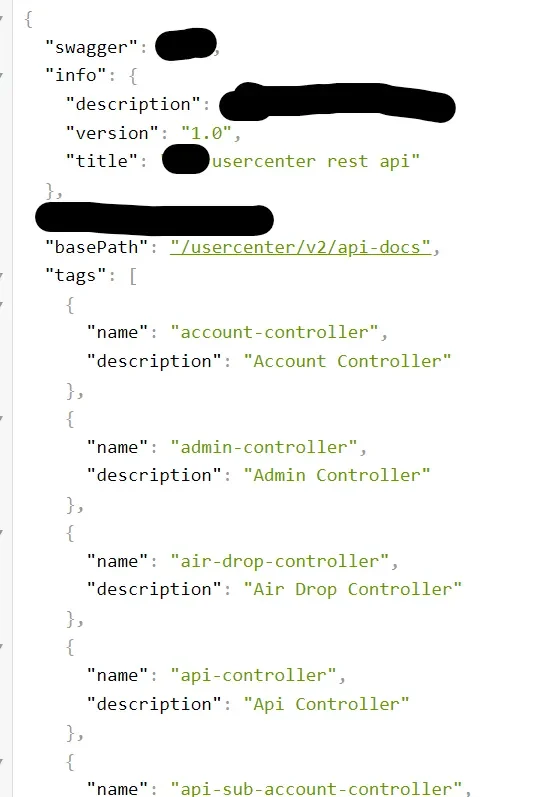
Internal User Center API
The screenshot is captioned Internal User Center API. This one did not provide much impact, so he kept testing other paths.
Step 2: reaching the Internal Admin Balance API
On another path, using the same combination of traversal and directory brute-forcing, he reached the Internal Admin Balance API. This one leaked admin funds and allowed several admin functions:
- Withdrawal Funds
- View Token History
- View Balance
The report does not show the requests or responses for this second path, so the exact address and parameters are not public.
He describes the potential disaster: if a malicious hacker had found this before him, they could have cleaned out the account and sent the company broke. That is his assessment of what was possible; the report does not show a withdrawal actually being carried out.
He reported it 2 days later. It was triaged and fixed within 1 day, and he was paid $9,000 USD, about $12,000 in his currency. Triaged means the company's security team confirmed the report was real and passed it to the people who could fix it.
Why it worked
The mistake sits in how the reverse proxy tidies and matches paths before forwarding them. Blake frames this as breaking path normalisation, not as a flaw in any single application page.
What to try if you want to look for this
- Dot segment with matrix parameter (
..;): send a request to a public prefix followed by..;/segments and an internal path, as in the request above. A positive result is a response from the internal service rather than the proxy's block page or a 404 (not found). - A positive result is any response whose body or headers differ from the public path's normal response and match an internal service.
- Directory brute-forcing behind the traversal: once one internal root is reachable, enumerate paths from it with ffuf, Dirsearch and the Assetnote and SecLists wordlists. A positive result is more internal APIs, as happened here with the User Center API and then the Internal Admin Balance API.
- A positive result is a traversal that works on one path but not another, which points at a different upstream.
He also promotes Dirstrike, a SaaS platform for high-scale directory brute-forcing without rate limits or IP bans, with a Discord at https://discord.gg/4Q4WgNR5wg. SaaS means software as a service, a tool you use online instead of installing. A rate limit is a cap on how many requests you may send in a period, and an IP ban blocks your address for sending too many.
Dirstrike SaaS platform
Glossary
- API (application programming interface): the set of addresses a program offers so other programs can ask it for data or actions.
- Assetnote Wordlists: ready-made lists of common path and file names used for guessing.
- Backend: the server or service that actually does the work behind a website, as opposed to what the visitor sees.
- Burp (Burp Suite): a tool that sits between your browser and a site so you can inspect, change and replay requests.
- Chrome DevTools: the developer panel in Chrome where you can watch a page's requests and responses.
- Crawling: letting a tool walk a site automatically, following links and recording addresses.
- CRXDE Lite: an administrative interface inside Adobe Experience Manager.
- Directory brute-forcing: sending a request for each guess from a wordlist to discover paths that exist but are not linked.
- Dirsearch: a tool for guessing paths and files on a web server.
- Dispatcher (AEM): the proxy component that sits in front of Adobe Experience Manager.
- Dot segment: a path segment of
.or.., meaning the current or parent folder. - Endpoint: a single address an API offers.
- ffuf: a command-line tool that sends many requests quickly to guess hidden paths.
- In-scope: the parts of a company's systems a tester is authorised to test.
- Internal path: an address on a server meant only for internal services, not the public.
- KISS (Keep It Stupid Simple): a principle of keeping tools and approaches as simple as possible.
- LFI (local file inclusion): a bug where a server is made to read one of its own files; different from reaching an internal path.
- Matrix parameter: extra information attached to a path segment after a semicolon, as in
..;. - Normalisation: rewriting a path into one standard form, removing dot segments and unifying separators.
- Path: the part of a web address after the site name, such as
/shop/items. - Pentester: someone paid to attack a company's own systems, with permission, to find weaknesses.
- Rate limit: a cap on how many requests you may send in a given period.
- RCE (remote code execution): a bug that lets an attacker make a server run commands.
- Reverse proxy: a server in front of an application that receives requests and forwards them to the right internal service, applying rules on the way.
- SaaS (software as a service): software you use online rather than install.
- SecLists: a large collection of wordlists for security testing.
- SRT (Synack Red Team): a group of freelance testers working through the Synack platform.
- Token: in this report, a digital asset held and moved by the crypto company.
- Traversal: using
..style segments to climb out of the intended path. - Triaged: confirmed as a real issue by the company's security team and passed on for fixing.
- Wordlist: a text file of guesses, such as common folder and file names.
- XHR (XMLHttpRequest): the mechanism a page uses to fetch data in the background without reloading.
- XSS (cross-site scripting): a bug where a site echoes back input and a browser runs it as code.



