I Bypassed CrowdStrike With a Compiler It Already Trusted — AI Found the Way In
The author bypassed CrowdStrike EDR by compiling C# source code on the target using the signed csc.exe, avoiding signature-based detection. They also used native Windows tools for persistence, exfiltration, and shadow copy deletion, and pivoted to an unmonitored server to reach sensitive data.
 Published on medium.com
There’s a comfortable myth in a lot of security teams: “We run CrowdStrike, so we’re covered.”
The full write-up lives on its author's site
It belongs to its author, so we link to it rather than copy it. The other two tabs are our own rewrites, checked against it.
Context
This is an assumed-breach engagement against a hardened enterprise network running two endpoint detection and response (EDR) products, one of them CrowdStrike. The researcher was given a low-privilege foothold and asked how far they could get. The environment was an isolated segment with canary data only, and every destructive action was recovered. No client names, IP addresses or product criticism are included, and the author is explicit that CrowdStrike did its job.
The central claim is not that the EDR failed at detection in the usual sense. It is that the EDR answers one question well, "have I seen this bad thing before?", and that an attacker who stops presenting known-bad artefacts can reach the same objectives through paths the product does not model. The write-up frames this as a seam between blocking a path and protecting a goal.
Setup
The starting conditions, as described:
- A low-privilege foothold on a Windows host inside a dual-EDR enterprise.
- CrowdStrike plus a second EDR agent (Defender is named later in the context of scanning compiled output).
- An isolated network segment, canary data only, and full authorisation for the engagement.
No product versions, host names, account names or tool versions are given. The techniques rely only on components that ship with Windows: csc.exe (the Microsoft-signed C# compiler present on Windows boxes), Scheduled Tasks, WMI event subscriptions, and the WMI shadow-copy path.
Finding it
The first round was deliberately loud, and it established the baseline: the endpoint stack is effective against conventional tradecraft. The researcher lists what failed:
- Credential dumping from SAM, LSASS, DPAPI and browser stores: blocked.
- Local privilege escalation across a full checklist of vectors: every one failed.
- A stock command-and-control beacon from a known framework: blocked on sight.
- Attempts to kill the EDR: blocked, and the agent self-healed each time.
vssadminshadow-copy deletion: blocked.
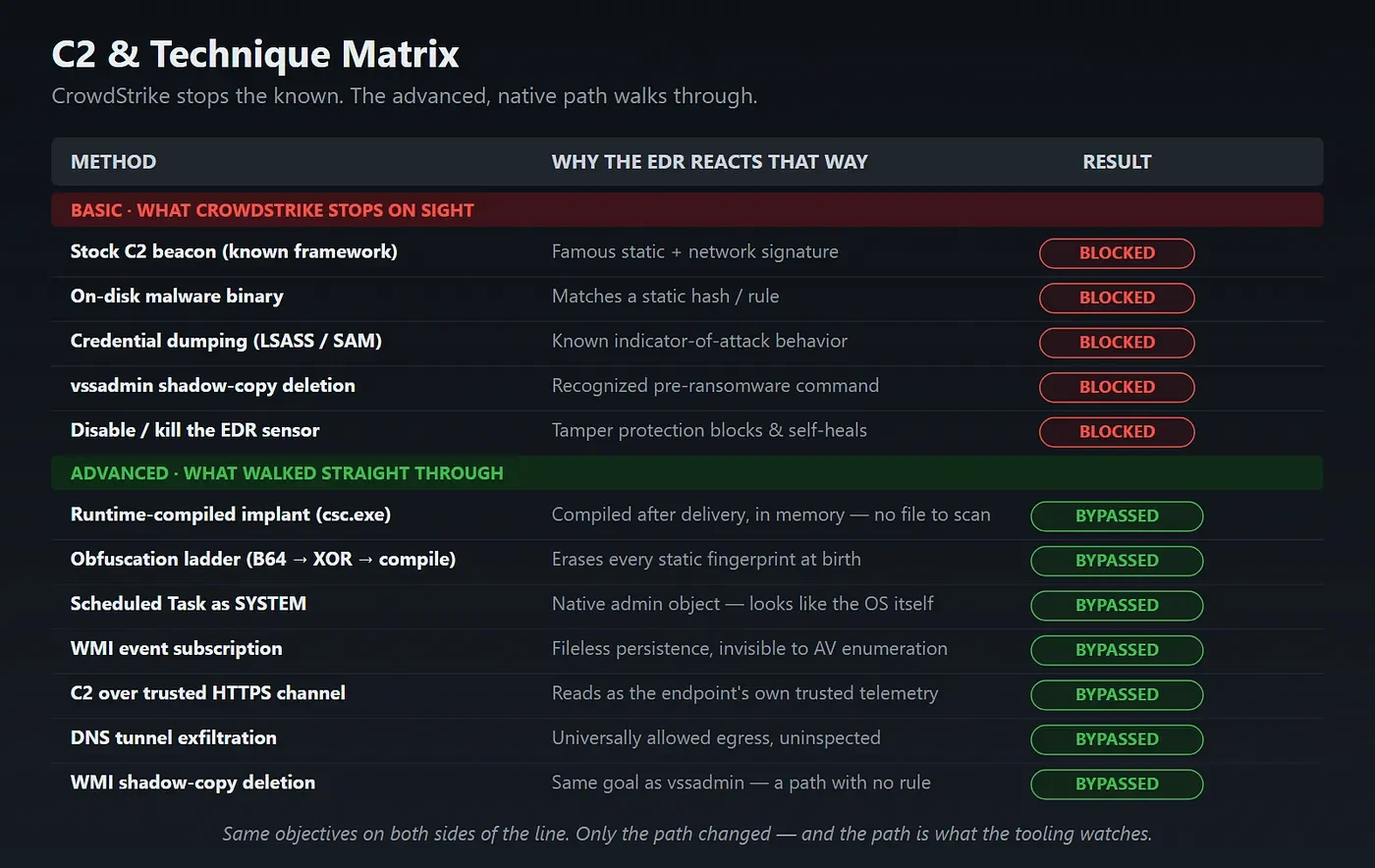
The interesting observation is structural rather than a single missed signature. The Windows lateral paths were locked down, so the researcher mapped the rest of the internal network instead. That mapping surfaced a server in a deeper segment with no EDR agent on it and nobody watching it. That host, not the endpoint stack, became the way in.
Exploitation
Step 1: Profile the unmonitored server and gain authenticated access
The researcher profiled the server, built a targeted wordlist with AI assistance from the organisation's own naming and password patterns, and obtained authenticated access. From that host they pivoted deeper and reached a database of sensitive records. The write-up calls this the crown jewels and notes that the endpoint stack, two hops away, was completely blind to the box that gave everything up. No commands, URLs or credentials for this step are published.
Step 2: Deliver source, not a binary
Rather than dropping an executable, the researcher delivered plain C# source, which is harmless text with no signature, and compiled it into a reverse shell on the target itself, in memory, using the compiler already present on the machine:
csc.exe
The technique is MITRE T1027.004, Compile After Delivery. The author's framing is "bringing lumber instead of a gun": the dangerous object is assembled on the box seconds before it runs, so there is no known-bad file to match. The same file that spawned SYSTEM shells scanned clean on both CrowdStrike and Defender.
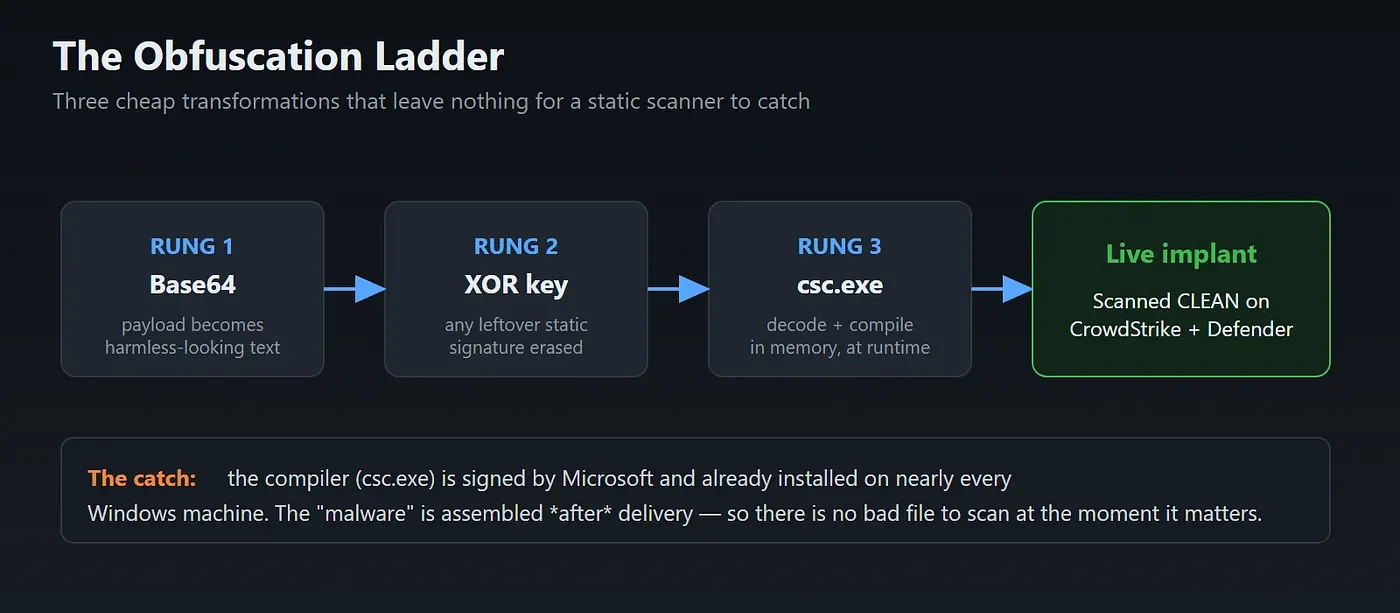
On top of that, a three-stage obfuscation ladder was stacked: Base64, then XOR, then runtime compilation. The write-up states there was zero detection at any rung. The exact payloads are not reproduced in the report.
Step 3: Persistence with native Windows features
Persistence was established two ways:
- A Scheduled Task running as SYSTEM.
- A WMI event subscription.
Neither leaves a file on disk in the usual sense, both survive reboots, and the write-up states that normal AV enumeration does not see them. No alert fired on either host.
Step 4: Exfiltration over ordinary HTTPS
Data was exfiltrated as ordinary HTTPS traffic that the endpoint reads as its own telemetry, producing zero egress alerts. A DNS tunnel was configured as a backup channel. Defender did not react.
Step 5: Impact simulation and the recovery kill
Impact was demonstrated with a ransomware simulation using a signed crypto tool in a loop, with no malware binary involved. Neither EDR interrupted it.
For the recovery kill, vssadmin was blocked, so the researcher deleted the same shadow copies through the WMI path instead. The write-up describes this as the same destruction through a different door, and silent.
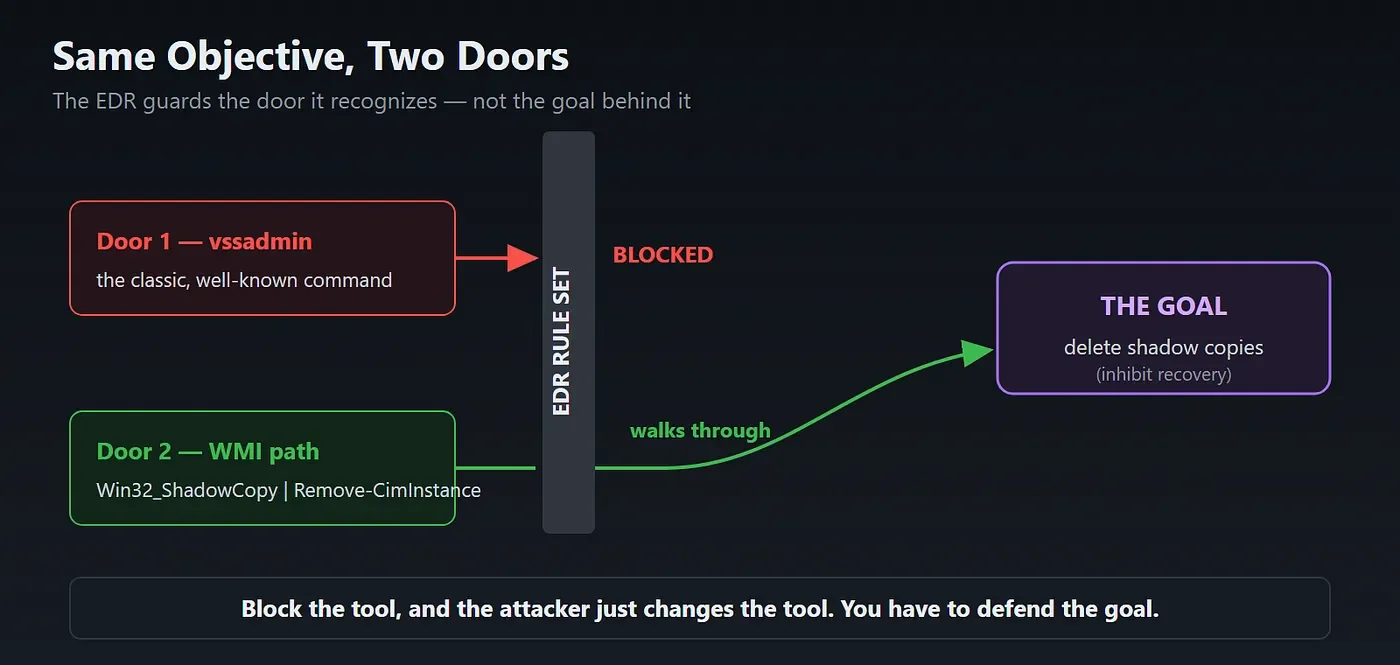
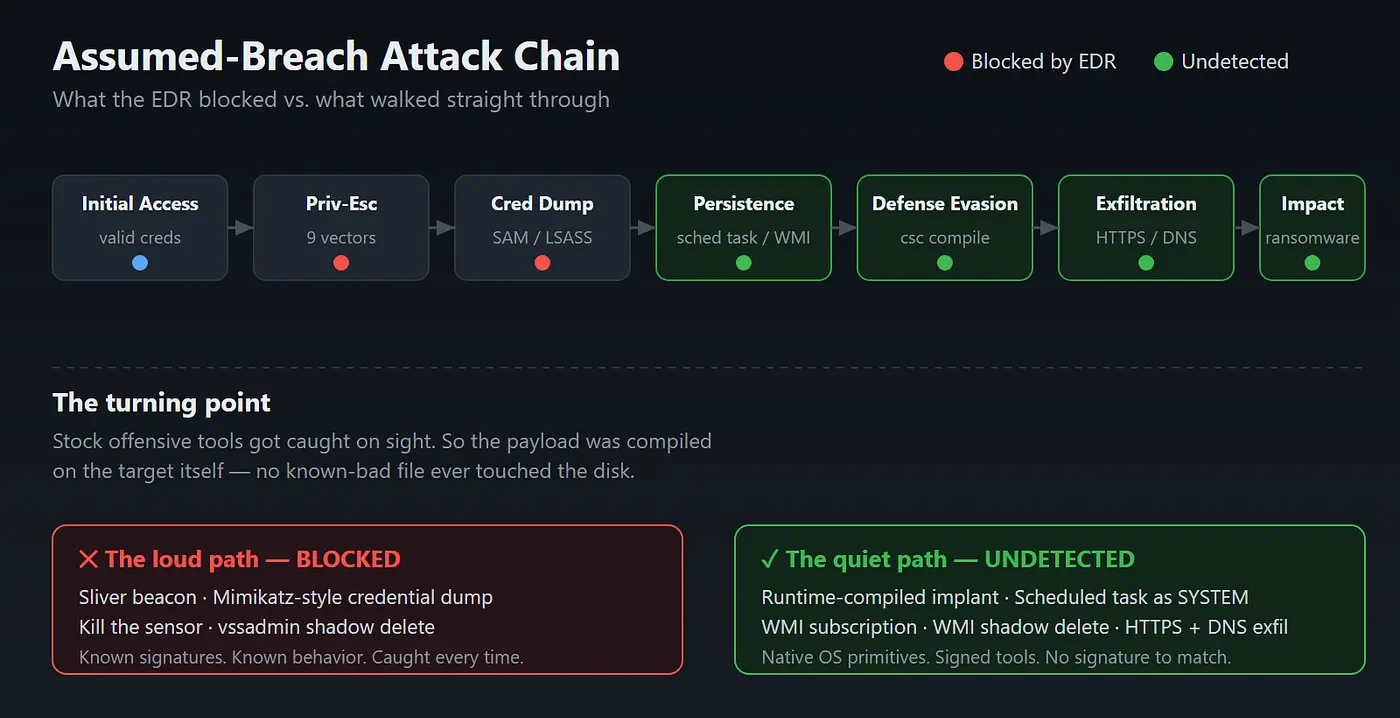
The pattern across steps 3 to 5 is the same: the EDR guards the path it recognises, not the goal. Change the path and the goal stays reachable.
Root cause
The design gap is that detection is anchored to artefacts and paths rather than to outcomes. A signed compiler that ships with the operating system is trusted, so compiling a reverse shell on the box produces nothing the agent has a signature for. Scheduled Tasks and WMI subscriptions are legitimate administrative mechanisms, so their use is not inherently malicious. HTTPS to an external endpoint looks like telemetry. A signed crypto tool is signed. And blocking vssadmin closes one route to shadow copies while leaving the WMI route open to the same result.
The secondary cause is coverage. The highest-risk finding of the week was a server with no agent on it at all, which made the rest of the chain possible. Local logs on compromised hosts were wiped silently, which the write-up treats as a further failure of the detection story: if logs only exist on the box, an attacker who owns the box owns the evidence.
Impact
Under the conditions of this engagement, an attacker with a low-privilege foothold could:
- Move laterally to an unmonitored server, obtain authenticated access, and reach a database of sensitive records.
- Execute code as SYSTEM through on-box compilation without a detection.
- Persist across reboots through a Scheduled Task and a WMI event subscription without an alert.
- Exfiltrate data over HTTPS without an egress alert, with a DNS tunnel as fallback.
- Run a ransomware simulation with a signed tool that neither EDR interrupted.
- Destroy shadow copies through WMI after
vssadminwas blocked.
These outcomes depend on the preconditions in the report: an initial foothold, an unmonitored host reachable from it, and the native Windows components being available and unrestricted.
Fix
The recommendations in the debrief, as stated:
- Treat EDR as a floor, not a ceiling. It stops commodity malware but not native tools and code compiled on the fly.
- Watch the builders: restrict
csc.exeandmsbuildto allow-lists, and alert on Scheduled Task creation (4698, 4700, 4701), new WMI subscriptions and Startup items. - Defend the goal, not the tool: block
vssadminand the WMI path, because both reach the same outcome. - Ship logs off-box. Local logs were wiped silently, so an immutable SIEM is the requirement.
- Prefer behaviour over signatures: baseline normal activity and alert on deviation.
- Inventory what your agent is not installed on. The forgotten server was the highest-risk finding.
Variants to test
- Other signed build tools. Try
msbuild.exeand other Microsoft-signed compilers or script hosts already present on the target to assemble a payload on the box. A positive result is execution with no signature-based alert. - Alternative persistence mechanisms. Test WMI event subscriptions and Scheduled Tasks separately from file-based persistence, then reboot. A positive result is survival across reboot with no alert on creation.
- Shadow-copy deletion paths. Where
vssadminis blocked, attempt the WMI route to the same shadow copies. A positive result is deletion with no alert. - Egress blending. Send exfiltration over HTTPS that resembles the endpoint's own telemetry, with a DNS tunnel as fallback. A positive result is data leaving with zero egress alerts.
- Coverage gaps. Enumerate hosts in deeper segments that lack the agent. A positive result is any reachable host with no EDR and no monitoring, which is the precondition for the whole chain here.
- Log integrity. Attempt to clear local logs on a compromised host. A positive result is silent wiping with no off-box copy to contradict it.
What happened, in plain words
Imagine a large office building with a very good security guard at the front door. The guard has a book of photographs of known troublemakers, and he is excellent at his job: anyone whose face is in the book gets stopped. Most attackers look like someone in the book, so most attackers get stopped.
This write-up is about a week the author spent testing that kind of building. The building had two guards, not one: two separate security products running on every computer, one of them CrowdStrike. The author was given a low-privilege foothold, meaning a small, limited way in, and was asked to see how far they could get. The point was not to prove the guards are bad. The author says plainly that CrowdStrike did its job. The point is that the guards watch the door they recognise, not the room you are trying to reach. If you walk in through a different door, or use tools the guard already trusts, you can reach the same room.
A few words before we start, because the rest of the article uses them constantly.
- EDR stands for endpoint detection and response. It is a program installed on each computer (the "endpoint") that watches what runs there and tries to stop malicious behaviour. Think of it as a security guard standing inside the office rather than at the street entrance.
- Malware is any program written to do something harmful: steal files, take control, encrypt data. Most EDR products are very good at spotting malware because malware tends to look similar from one attack to the next.
- Signature is the fingerprint an EDR uses to recognise a known piece of malware. If a file matches a fingerprint in the guard's book, it is stopped. A brand-new file that nobody has seen before has no fingerprint, so the guard has nothing to compare it to.
- Assumed-breach is a style of test where you do not start outside the building. You start already inside, with a small foothold, and the question is how far you can walk from there.
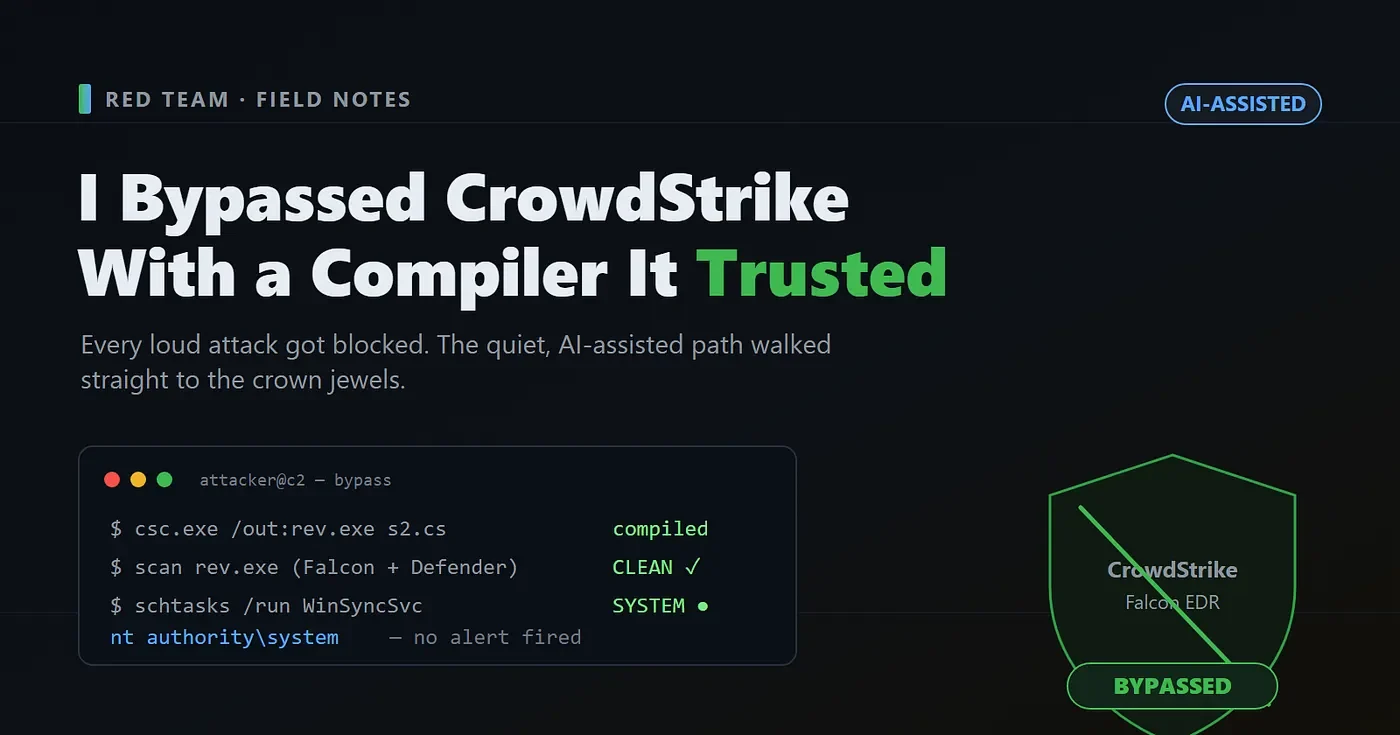
The image at the top sets the scene: a week inside a hardened, dual-EDR enterprise, where native tooling that the EDR trusts carried the author all the way to the crown jewels.
The setup
The starting conditions, as the author describes them:
- A low-privilege foothold on a Windows computer inside an enterprise that runs two EDR products.
- CrowdStrike plus a second EDR agent. Defender is named later, in the context of scanning compiled output.
- An isolated network segment, canary data only, and full authorisation for the engagement.
A few of those need unpacking.
- Low-privilege foothold means the author could log in and do small things, but not administer the machine. Compare it to being given a visitor badge that opens the lobby but not the server room.
- Isolated segment means the network was separated from the real corporate network, so nothing done there could affect real systems.
- Canary data means fake records planted on purpose. If an attacker reaches them, you know the attacker got that far, and no real customer data is exposed.
- Lateral movement means moving from one computer to another inside the network, getting a little further each time, like walking from the lobby to a corridor to a locked office.
No product versions, host names, account names or tool versions are given anywhere in the report. Every technique relies only on parts that ship with Windows itself: csc.exe (the C# compiler that comes with Windows and is signed by Microsoft), Scheduled Tasks, WMI event subscriptions, and the WMI path for deleting shadow copies. We will explain each of those when they appear.
The diagram shows the assumed-breach attack chain and marks what the EDR blocked versus what walked through.
Round 1: the EDR wins, repeatedly
The first round was deliberately loud. The author did not try to be subtle; they tried the obvious things on purpose, to establish a baseline. The result was that the endpoint stack is effective against conventional tradecraft. Here is what failed:
- Credential dumping from SAM, LSASS, DPAPI and browser stores: blocked.
- Local privilege escalation across a full checklist of vectors: every one failed.
- A stock command-and-control beacon from a known framework: blocked on sight.
- Attempts to kill the EDR: blocked, and the agent self-healed each time.
vssadminshadow-copy deletion: blocked.
Each of those terms deserves a plain explanation, because they are the vocabulary of the whole article.
- Credential dumping means trying to pull stored passwords and password hashes out of the machine so you can log in as someone else. SAM, LSASS and DPAPI are three places Windows keeps that material. Browser stores are the saved passwords inside a web browser. Think of it as looking for the spare keys people hide around the office.
- Privilege escalation means turning a limited account into an administrator account. A checklist of vectors is simply a list of known tricks for doing that, tried one after another.
- Command-and-control (C2) beacon is the regular check-in signal that malware sends back to the attacker's server, like a spy radioing home on a schedule. A stock beacon from a known framework is one that security products have seen thousands of times, so it is recognised instantly.
- Killing the EDR means trying to stop the security program itself. It was blocked, and the agent restarted itself each time, which is what "self-healed" means.
vssadminis a built-in Windows command for managing shadow copies. A shadow copy is a snapshot Windows keeps of your files so you can restore an earlier version. Ransomware likes to delete shadow copies first, because then the victim cannot simply restore from a snapshot. Blockingvssadminis a common defensive measure.
The image illustrates this first round: killing the EDR was blocked and it self-healed every time, and shadow-copy deletion was blocked. The author's conclusion is that signature-based detection is good now, and walking in with an off-the-shelf tool and a smile is mostly over. Mostly.
The pivot: one forgotten server becomes the whole network
A big engagement is won on the box nobody watches. The Windows lateral paths were locked down, so the author stopped pushing on those and mapped the rest of the internal network instead. That mapping surfaced a server in a deeper segment with no EDR agent on it and nobody watching it. That host, not the endpoint stack, became the way in.
- Mapping the network means finding out which machines exist and what they are, the way you might walk a building and note every door. It is reconnaissance, done before any attempt to get in.
- Deeper segment means a part of the network further from the entry point, usually behind more restrictions.
This is the structural observation of the whole week. It is not a single missed signature. It is that the guards were all standing in the rooms that had guards, and one room had none.
Step 1: profile the unmonitored server and gain authenticated access
The author profiled the server, built a targeted wordlist with AI assistance from the organisation's own naming and password patterns, and obtained authenticated access. From that host they pivoted deeper and reached a database of sensitive records. The write-up calls this the crown jewels and notes that the endpoint stack, two hops away, was completely blind to the box that gave everything up.
- Profiling means studying a machine before attacking it: what it runs, what it is called, what it is used for.
- A wordlist is a list of guesses, usually usernames or passwords, tried one after another. Building one from the organisation's own patterns means using names and habits specific to that company rather than a generic list, which makes the guesses far more likely to work. Compare it to guessing a colleague's PIN by knowing their birthday rather than trying random numbers.
- Authenticated access means logging in successfully with valid credentials, as opposed to exploiting a bug.
- Pivoting means using one compromised machine as a stepping stone to reach another.
No commands, URLs or credentials for this step are published.
Round 2: stop bringing malware, bring a compiler
The EDR answers one question well: have I seen this bad thing before? So the author stopped giving it known-bad things.
Instead of delivering a binary, they delivered plain C# source. C# is a programming language; source is the human-readable text of a program, before it is turned into something the computer runs. Source code is just text, and text has no signature, so there is nothing for the guard's book to match. The author then compiled that source into a reverse shell on the target itself, in memory, using the compiler already present on the machine:
csc.exe
Line by line, in plain words:
csc.exeis the C# compiler that ships with Windows. A compiler is a program that turns source code into a runnable program, the way a recipe turns ingredients into a meal. It is signed by Microsoft, which means Windows and the EDR both trust it as a legitimate system tool.- Because the compiler is trusted and already installed, running it raises no suspicion. The dangerous program is assembled on the box seconds before it runs, so there is no known-bad file to match. The author's framing is bringing lumber instead of a gun: the guard is looking for weapons, and you walk in with wood and a saw.
- A reverse shell is a connection that lets the attacker type commands on the victim machine from their own. It is called reverse because the victim machine reaches out to the attacker rather than the other way round, which often slips past network defences.
- In memory means the program never lands as a file on disk. It exists only while it runs, so there is no file for a scanner to pick up later.
The technique has a name in the MITRE ATT&CK catalogue, which is a public dictionary of attacker techniques: T1027.004, Compile After Delivery. The same file that spawned SYSTEM shells scanned clean on both CrowdStrike and Defender, because it was born on the box seconds before it ran. SYSTEM is the highest-privilege account on Windows, the equivalent of the building's master key.
On top of that, a three-stage obfuscation ladder was stacked: Base64, then XOR, then runtime compilation. The write-up states there was zero detection at any rung. The exact payloads are not reproduced in the report.
- Obfuscation means disguising something so it does not look like what it is. The image calls it a ladder because each rung adds another layer of disguise.
- Base64 is a way of writing any data using only ordinary letters and digits. It is not encryption; anyone can decode it. Its purpose here is to make the content look like harmless text.
- XOR is a simple mathematical operation used to scramble data with a key. It is reversible if you know the key, and it changes the bytes so a fingerprint no longer matches.
- Runtime compilation means compiling the code while the program is already running, rather than beforehand, so the final form never exists as a file anyone could inspect.
Round 3: the path the SOC never sees
Here is the deliberate choice most write-ups skip: the author picked the route with nothing for a SOC to alert on. A SOC, or security operations centre, is the team of people who watch security alerts and respond to them. No noisy beaconing, no malware on disk, no known-bad API calls. Just native Windows features doing native Windows things.
- Beaconing is the regular check-in traffic we described earlier. It is noisy because it repeats on a schedule and stands out in network logs.
- An API is a defined way for one program to ask another program to do something, like a service counter with a fixed list of requests. A known-bad API call is one that malware commonly uses, so security tools watch for it.
- Native means built into Windows itself, as opposed to something you installed.
Persistence with native Windows features
Persistence means making sure you still have access after a reboot, so the intrusion does not disappear when the machine restarts. It was established two ways:
- A Scheduled Task running as SYSTEM. A Scheduled Task is Windows' built-in scheduler: you tell it to run something at a certain time or event, and it does. It is the same mechanism that runs your antivirus scan at midnight.
- A WMI event subscription. WMI, or Windows Management Instrumentation, is a built-in system for managing and monitoring Windows machines. An event subscription tells WMI to run something whenever a particular event happens, such as a program starting. It is like setting a rule with the building's facilities team: whenever this door opens, do that.
Neither leaves a file on disk in the usual sense, both survive reboots, and the write-up states that normal AV enumeration does not see them. No alert fired on either host. AV enumeration means the routine sweep an antivirus does looking for suspicious files; if there is no file, there is nothing to sweep up.
Exfiltration over ordinary HTTPS
Exfiltration means getting stolen data out of the network. Data was exfiltrated as ordinary HTTPS traffic that the endpoint reads as its own telemetry, producing zero egress alerts. A DNS tunnel was configured as a backup channel. Defender did not react.
- HTTPS is the normal encrypted web traffic your browser uses. Because it is encrypted and extremely common, it is hard to tell apart from legitimate browsing.
- Telemetry is the routine status data that security agents send back to their own management servers. If stolen data is hidden inside traffic that looks like that, the network sees nothing unusual.
- Egress means traffic leaving the network. An egress alert fires when something leaves that should not.
- A DNS tunnel hides data inside DNS queries. DNS is the system that turns a website name into an address, and it is one of the few things almost every network must allow, which makes it a useful hiding place when other routes are closed.
Impact simulation and the recovery kill
Impact is the security term for the damage an attacker can actually do, as opposed to how far they got. It was demonstrated with a ransomware simulation using a signed crypto tool in a loop, with no malware binary involved. Neither EDR interrupted it.
- Ransomware is malware that encrypts files and demands payment to unlock them. A simulation means the author demonstrated the capability without causing real harm.
- A signed crypto tool is a legitimate encryption program with a valid digital signature, meaning the publisher is verified. The EDR trusts it because it is genuine software being used for the wrong purpose. A binary is a compiled program file; here there was none, because the tool was already installed.
For the recovery kill, vssadmin was blocked, so the author deleted the same shadow copies through the WMI path instead. The write-up describes this as the same destruction through a different door, and silent. Recovery kill means destroying the backups that would let a victim recover, which is what makes ransomware hurt.
The image makes the point visually: same objective, two doors. The EDR guards the door it recognises, not the goal itself.
The pattern across persistence, exfiltration and impact is the same: the EDR guards the path it recognises, not the goal. Change the path and the goal stays reachable.
Why it worked: the root cause
The design gap is that detection is anchored to artefacts and paths rather than to outcomes. An artefact is a concrete thing to look at: a file, a fingerprint, a command name. A path is the route taken to do something. An outcome is what actually happens as a result. The EDR is very good at the first two and does not model the third.
- A signed compiler that ships with the operating system is trusted, so compiling a reverse shell on the box produces nothing the agent has a signature for.
- Scheduled Tasks and WMI subscriptions are legitimate administrative mechanisms, so their use is not inherently malicious.
- HTTPS to an external endpoint looks like telemetry.
- A signed crypto tool is signed.
- Blocking
vssadmincloses one route to shadow copies while leaving the WMI route open to the same result.
The secondary cause is coverage. The highest-risk finding of the week was a server with no agent on it at all, which made the rest of the chain possible. Local logs on compromised hosts were wiped silently, which the write-up treats as a further failure of the detection story: if logs only exist on the box, an attacker who owns the box owns the evidence. Logs are the records of what happened on a machine; if they live only on that machine, whoever controls the machine can delete them.
What an attacker could do here
Under the conditions of this engagement, an attacker with a low-privilege foothold could:
- Move laterally to an unmonitored server, obtain authenticated access, and reach a database of sensitive records.
- Execute code as SYSTEM through on-box compilation without a detection.
- Persist across reboots through a Scheduled Task and a WMI event subscription without an alert.
- Exfiltrate data over HTTPS without an egress alert, with a DNS tunnel as fallback.
- Run a ransomware simulation with a signed tool that neither EDR interrupted.
- Destroy shadow copies through WMI after
vssadminwas blocked.
These outcomes depend on the preconditions in the report: an initial foothold, an unmonitored host reachable from it, and the native Windows components being available and unrestricted.
The debrief: what to fix
The recommendations in the debrief, as stated:
- EDR is a floor, not a ceiling. It stops commodity malware, but it cannot stop native tools and code compiled on the fly. A floor is the minimum you stand on, not the roof over your head.
- Watch the builders. Restrict
csc.exeandmsbuildto allow-lists, and alert on Scheduled Task creation (event IDs 4698, 4700 and 4701), new WMI subscriptions and Startup items. An allow-list is a list of programs permitted to run, with everything else refused.msbuild.exeis another Microsoft build tool that can compile code. Event IDs are the numbers Windows uses to label each kind of log entry, so 4698, 4700 and 4701 are the specific records of a scheduled task being created, updated or deleted. Startup items are programs Windows launches automatically at login. - Defend the goal, not the tool. Block
vssadminand the WMI path, because both reach the same outcome. - Ship logs off-box. Local logs were wiped silently, so an immutable SIEM is the requirement. SIEM stands for security information and event management: a central system that collects logs from many machines. Immutable means the records cannot be altered or deleted once written, so an attacker who owns one machine cannot erase the evidence held elsewhere.
- Prefer behaviour over signatures. Baseline normal activity and alert on deviation. A baseline is a record of what normal looks like, so that anything different stands out.
- Inventory what your agent is not installed on. The forgotten server was the highest-risk finding.
Variants to test
Each one names what a positive result looks like.
- Other signed build tools. Try
msbuild.exeand other Microsoft-signed compilers or script hosts already present on the target to assemble a payload on the box. A positive result is execution with no signature-based alert. - Alternative persistence mechanisms. Test WMI event subscriptions and Scheduled Tasks separately from file-based persistence, then reboot. A positive result is survival across reboot with no alert on creation.
- Shadow-copy deletion paths. Where
vssadminis blocked, attempt the WMI route to the same shadow copies. A positive result is deletion with no alert. - Egress blending. Send exfiltration over HTTPS that resembles the endpoint's own telemetry, with a DNS tunnel as fallback. A positive result is data leaving with zero egress alerts.
- Coverage gaps. Enumerate hosts in deeper segments that lack the agent. A positive result is any reachable host with no EDR and no monitoring, which is the precondition for the whole chain here.
- Log integrity. Attempt to clear local logs on a compromised host. A positive result is silent wiping with no off-box copy to contradict it.
The takeaway
Modern EDR made being loud hard, and quietly raised the value of being boring: native tools, signed binaries, code compiled on the fly, and a pivot to the one box nobody was watching. The gap is not in the product you bought. It is in the assumption that buying it was the finish line.
Glossary
- Allow-list: a list of programs permitted to run, with everything else refused.
- API: a defined way for one program to ask another program to do something.
- Artefact: a concrete thing a security tool can inspect, such as a file or a fingerprint.
- Assumed-breach: a test that starts from a small foothold already inside the network and asks how far an attacker can get.
- Authenticated access: logging in successfully with valid credentials.
- AV enumeration: the routine sweep an antivirus performs looking for suspicious files.
- Baseline: a record of what normal activity looks like, so deviations stand out.
- Beaconing: regular check-in traffic sent from an infected machine to an attacker's server.
- Binary: a compiled program file.
- Canary data: fake records planted on purpose so that reaching them proves an attacker got that far without exposing real data.
- C2 (command-and-control): the channel an attacker uses to send instructions to and receive results from an infected machine.
- C#: a programming language developed by Microsoft.
- Compiler: a program that turns source code into a runnable program.
- Credential dumping: extracting stored passwords or password hashes from a machine.
- Crown jewels: the most sensitive data an organisation holds.
csc.exe: the C# compiler that ships with Windows and is signed by Microsoft.- DNS: the system that turns a website name into a network address.
- DNS tunnel: hiding data inside DNS queries to move it out of a network.
- DPAPI: a Windows component that stores encrypted secrets such as saved passwords.
- EDR (endpoint detection and response): software installed on each computer that watches for and responds to malicious behaviour.
- Egress: traffic leaving a network.
- Event ID: the number Windows uses to label a kind of log entry, such as 4698 for scheduled task creation.
- Exfiltration: moving stolen data out of a network.
- Foothold: an initial, usually limited, way into a system.
- HTTPS: the normal encrypted traffic used by web browsers.
- Immutable: unable to be altered or deleted once written.
- Impact: the damage an attacker can actually cause.
- In memory: running without ever being written to disk as a file.
- Isolated segment: a part of a network separated from the rest so actions there cannot affect real systems.
- Lateral movement: moving from one compromised machine to another inside a network.
- Logs: records of what happened on a machine.
- Low-privilege foothold: access to a machine with only limited permissions, not administrator rights.
- LSASS: a Windows process that holds login credentials in memory.
- Malware: any program written to do something harmful.
- MITRE ATT&CK: a public catalogue of attacker techniques, each with an identifier such as T1027.004.
msbuild.exe: a Microsoft build tool that can compile code.- Native: built into Windows itself rather than installed separately.
- Obfuscation: disguising something so it does not look like what it is.
- Outcome: what actually happens as a result of an action, as opposed to the route taken.
- Path: the route taken to achieve something.
- Persistence: arrangements that keep an attacker's access alive after a reboot.
- Pivot: to use one compromised machine as a stepping stone to reach another.
- Privilege escalation: turning a limited account into an administrator account.
- Profiling: studying a machine before attacking it.
- Ransomware: malware that encrypts files and demands payment to unlock them.
- Recovery kill: destroying the backups that would let a victim recover.
- Reverse shell: a connection that lets an attacker type commands on a victim machine from their own.
- SAM: a Windows file that stores local account password hashes.
- Scheduled Task: Windows' built-in scheduler, which runs something at a set time or event.
- Shadow copy: a snapshot Windows keeps of files so an earlier version can be restored.
- SIEM: a central system that collects and analyses logs from many machines.
- Signature: a fingerprint used to recognise a known piece of malware.
- Signed: carrying a digital signature that verifies who published the software.
- SOC (security operations centre): the team that watches security alerts and responds to them.
- Source code: the human-readable text of a program before it is compiled.
- Startup items: programs Windows launches automatically at login.
- SYSTEM: the highest-privilege account on Windows.
- T1027.004 (Compile After Delivery): the MITRE identifier for compiling a payload on the target machine after delivering it as source.
- Telemetry: routine status data that security agents send back to their management servers.
vssadmin: a built-in Windows command for managing shadow copies.- WMI (Windows Management Instrumentation): a built-in system for managing and monitoring Windows machines.
- WMI event subscription: a WMI rule that runs something whenever a chosen event occurs.
- Wordlist: a list of guesses, usually usernames or passwords, tried one after another.
- XOR: a simple reversible mathematical operation used to scramble data with a key.
- Base64: a way of writing any data using only ordinary letters and digits, which is not encryption and can be decoded by anyone.



