I Changed One Parameter… and Broke a B2B Booking System
The booking platform trusted a client-supplied partner identifier, letting one partner read and book using another partner's negotiated prices. It also accepted inflated passenger counts without changing the vehicle or price, and exposed other users' bookings when the booking identifier was changed.
 Published on medium.com
Cybersecurity
The full write-up lives on its author's site
It belongs to its author, so we link to it rather than copy it. The other two tabs are our own rewrites, checked against it.
Context
This write-up comes from a security assessment of a B2B travel booking platform. Partners on such a platform each have their own negotiated pricing, their own customers and their own reservations, and the platform is expected to keep those tenants apart. The features examined here are the booking flow and the transfer reservation workflow, where a partner selects a vehicle and a price for a given number of passengers.
The researcher found three issues, presented in order of impact: a broken access control flaw that lets one partner use another partner's pricing, a business logic flaw that lets a request carry more passengers than the selected vehicle and price account for, and an IDOR that exposes other users' bookings. None of them required advanced exploitation techniques; the author describes the work as careful observation of how the application was supposed to behave.
Setup
The report does not describe the accounts, roles, tooling or versions used. What it does show is that the testing was done against live booking requests, with the ability to modify parameters such as the partner context, the passenger count and a booking identifier, and to observe the responses. No automated scanning or advanced tooling was involved, according to the conclusion.
Finding it
While analysing booking requests, the researcher noticed a parameter that defines the partner context:
partnerId=XXXX
In a correctly isolated multi-tenant system, this value should be tied to the authenticated session. Its presence as a client-supplied field, controlling which partner's data the backend uses, is what made it worth testing.
Separately, in the transfer reservation workflow, one parameter stood out:
adults=1
Passenger count is exactly the kind of input that should be reconciled against vehicle capacity and price, so it was the natural next thing to change.
Finally, during further testing of booking endpoints, the researcher identified a booking identifier that could be modified to address other users' reservations.
Exploitation
Step 1: Cross-partner pricing through partnerId
The researcher replaced the partnerId value with another value. The request still returned a valid response: no validation, no restriction. From there it became possible to access pricing from another partner, perform bookings using those prices, and effectively bypass the platform's pricing model.
The report does not include the full request or the response body, only the parameter itself:
partnerId=XXXX
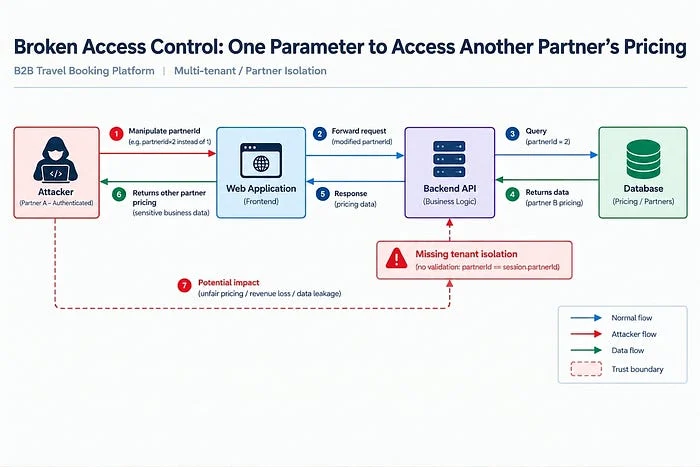
The diagram illustrates the tenant isolation breakdown: the boundary between partners that the platform is supposed to enforce.
A proof of concept video accompanies this finding:
Step 2: Capacity and pricing bypass through adults
Moving to the booking workflow and focusing on transfer reservations, the researcher increased the passenger count:
adults=8 adults=20
The system continued to accept the request without any adjustment. The selected vehicle remained the same and the price remained unchanged. The application does not enforce consistency between the number of passengers, the vehicle capacity and the pricing logic.
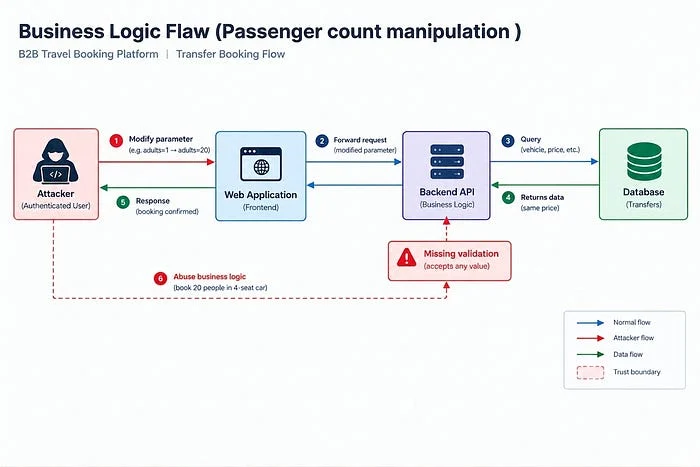
The diagram covers the pricing and capacity bypass.
The proof of concept for this issue:
Step 3: IDOR on bookings
By modifying a booking identifier, it was possible to access other users' reservations. The application returned the data without verifying ownership. The report does not show the identifier or the request.
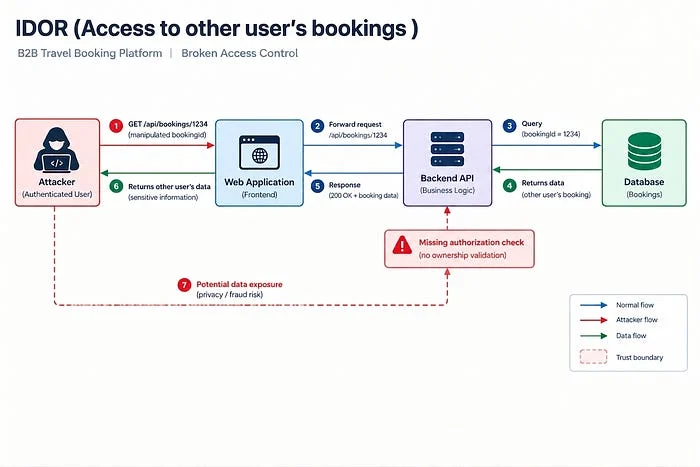
The diagram shows the unauthorised data access path.
The proof of concept for the IDOR:
Root cause
For the first issue, the backend relies on a client-controlled parameter (partnerId) without validating it against the authenticated session. The partner context is taken from the request rather than derived from who is logged in, so any value supplied by the client is honoured.
For the second, the application does not enforce consistency between passenger count, vehicle capacity and pricing. The booking is accepted as submitted, and neither the vehicle selection nor the price is recalculated or rejected when the numbers stop making sense.
For the third, the backend does not verify whether the requested resource belongs to the authenticated user. Ownership is assumed rather than checked.
In all three cases the common thread is trust in client input: access control and business rules that should be enforced server-side were left to assumptions that were never validated.
Impact
The first issue gives unauthorised access to sensitive pricing data, financial loss through pricing abuse, risk of large-scale exploitation, and loss of trust between partners. Pricing in a B2B system is negotiated and specific to each partner, so cross-partner access undermines the entire commercial model, not just a single record.
The second causes revenue loss due to incorrect pricing and operational issues such as vehicle mismatch, and it is easy to exploit with minimal effort.
The third exposes booking data, which often contains personal information, travel details and contextual data that can be reused in attacks. The author notes that although IDOR is well known, its impact here is not negligible.
Combined, the issues let an attacker access sensitive data, manipulate booking parameters and leverage pricing from other partners, turning the application from merely vulnerable into exploitable in a way that directly affects the business.
Fix
The lessons it draws point to what should be done: access control must be enforced consistently rather than assumed, business logic should never rely on client input, and multi-tenant systems require strict isolation by design. In practice that means deriving the partner context from the authenticated session instead of accepting partnerId from the request, validating passenger count against vehicle capacity and recalculating or rejecting the price when they conflict, and checking resource ownership on every booking lookup.
Variants to test
- Partner or tenant identifiers in other requests. Look for fields such as
partnerId,tenantId,accountIdororgIdin booking, pricing and search requests. A positive result is a valid response containing another tenant's pricing when the value is swapped. - Passenger and quantity fields in other booking flows. Try
adults,children,passengers,roomsorguestswith values far above the selected capacity. A positive result is an accepted booking where the vehicle or price does not change to match the new count. - Sequential or guessable booking identifiers. Change the identifier in a booking retrieval request to one belonging to another account. A positive result is another user's reservation returned without an ownership check.
- Combinations of the above. Use a foreign partner's pricing together with an inflated passenger count and a foreign booking identifier. A positive result is a single workflow that crosses tenant, capacity and ownership boundaries at once.
What happened, in plain words
A security researcher spent some time testing a travel booking website. This particular website is not the kind you use to book a holiday for yourself. It is a B2B platform, which stands for business to business. That means the customers of the website are travel agencies and other companies, not individual travellers. Each of those companies is called a partner. A partner logs in, sees the prices that were negotiated for it, and books travel for its own clients.
On a platform like this, the most important rule is that partners must be kept apart. Company A should never see Company B's prices, Company B's customers or Company B's reservations. Security people call this tenant isolation: each company is a tenant, and the walls between tenants must hold.
The researcher found that the walls did not hold. By changing a few values in the requests the website sends and receives, they could:
- read prices that belonged to a different partner;
- make a booking with more passengers than the chosen vehicle and price allowed for;
- and open reservations that belonged to other users.
None of this needed special tools or clever tricks. The author describes it as careful observation of how the application was supposed to work, followed by small changes to see what would happen. The article covers three issues, starting with the most serious one.
A few ideas you need first
Before walking through the findings, here are the basic concepts the rest of the article relies on. Each one is explained from scratch.
Websites, servers and requests
When you use a website, your browser (Chrome, Firefox, Safari) sends a message to a computer somewhere else, called a server, and the server sends a message back. The page you see is the result. Your browser asks, the server answers. That is the whole relationship.
What an API is
Many websites are built in two layers. One layer is what you see: buttons, forms, pages. The other layer is a set of addresses on the server that accept requests and return data, usually in a compact format rather than a pretty page. That second layer is called an API, short for Application Programming Interface. A useful comparison is a restaurant. The dining room is the website you see. The kitchen is the server where the real work happens. The API is the waiter: you tell the waiter what you want, the waiter carries the order to the kitchen, and the waiter brings back the plate. You never walk into the kitchen yourself, and the kitchen never talks to you directly.
When you click "book" on a travel site, your browser is really sending an API request to the server. The server checks it, does the work, and sends back an answer.
Parameters
An API request often carries small pieces of information called parameters. Think of a order form: the dish you want, how many people are eating, whether you want the sauce on the side. Each of those is a parameter, a named value. In a request, a parameter looks like a name, an equals sign and a value, for example adults=1. The name is adults, the value is 1.
Parameters matter enormously in security, because the browser sends them and the server has to decide whether to believe them. A parameter is just text on the wire. Anyone can edit it before it leaves their machine.
Sessions, cookies and tokens
When you log in to a website, the server needs a way to remember who you are on the next request. Otherwise you would have to type your password on every page. The usual solution is a session: after you log in, the server gives your browser a small piece of data, often stored in a cookie (a small file the browser keeps for that site) or sent as a token (a string your browser includes in each request). On every later request, your browser presents that cookie or token, and the server uses it to look up who you are.
The key idea: the server knows who you are because of the session, not because of anything else in the request. If a request also contains a field saying "I am partner number 42", the server should check that claim against the session. If it does not, the claim is just a stranger's word.
Access control
Access control is the set of rules that decide who is allowed to see or do what. In an office building, access control is the keycard system: your card opens your floor and not the floor of another department. In a web application, access control is the code that checks, on every request, whether the logged-in user is allowed to touch the thing they are asking for.
When that check is missing or wrong, security people call it broken access control. It is one of the most common and most damaging families of web vulnerabilities, because it lets people reach data and actions that were never meant for them.
IDOR
IDOR stands for Insecure Direct Object Reference. It sounds complicated but the idea is simple. Many web addresses contain an identifier, a number or code that points at one specific record, such as a booking. If the server hands back whatever record the identifier points at, without checking that the record belongs to the person asking, then anyone who changes the number can read someone else's record. It is like a hotel where room keys are numbered 101, 102, 103 and the reception gives you a key to any number you ask for, without checking that you are staying in that room.
Business logic flaws
Not every vulnerability is a technical bug like a missing password check. Some are about the rules of the business itself. A shop that lets you buy ten items for the price of one because it never checks the quantity is not broken in a technical sense; it is broken in its business logic. The code runs fine, it just does not enforce the rules the business depends on. These flaws are often the most valuable findings, because automated scanners rarely spot them: the scanner does not know what the correct behaviour is supposed to be.
Proof of concept
A proof of concept, or PoC, is a demonstration that a vulnerability is real. It is usually a short video or a set of steps showing the issue happening, so that the person receiving the report can see it with their own eyes rather than take it on trust.
The platform and the features involved
The report describes an assessment of a B2B travel booking platform. Partners on the platform each have their own negotiated pricing, their own customers and their own reservations. The features examined are the booking flow in general and the transfer reservation workflow in particular. A transfer is the ride between, say, an airport and a hotel. In that workflow, a partner picks a vehicle and a price for a given number of passengers.
The researcher found three issues and presents them in order of impact:
- A broken access control flaw that lets one partner use another partner's pricing.
- A business logic flaw that lets a request carry more passengers than the selected vehicle and price account for.
- An IDOR that exposes other users' bookings.
How the testing was done
The report does not describe the accounts, roles, tools or software versions used. What it does show is that the testing happened against live booking requests, with the ability to change parameters such as the partner context, the passenger count and a booking identifier, and to watch what came back. According to the conclusion, no automated scanning or advanced tooling was involved.
That is worth pausing on. The researcher did not run a scanner that fires thousands of attacks and prints a list. They read the requests, understood what each field was for, and asked a simple question: what happens if I change this? That is a technique anyone can learn.
Finding the first issue: the partner parameter
While analysing booking requests, the researcher noticed a parameter that defines which partner the request is about:
partnerId=XXXX
Line by line:
partnerIdis the name of the parameter. The word is short for partner identifier, meaning a value that says which partner this request concerns.=separates the name from the value.XXXXis a placeholder for whatever value the real request carried. The report does not show the actual value.
Why this mattered: in a correctly isolated multi-tenant system, this value should be tied to the logged-in session. The server should look at your cookie or token, work out which partner you are, and use that. If instead the server reads the partner from a field the browser sends, then the browser is effectively choosing whose data the server will use. That is the same as a restaurant letting the customer write their own table number on the order and the kitchen trusting it.
Finding the second issue: the passenger count
Separately, in the transfer reservation workflow, one parameter stood out:
adults=1
Line by line:
adultsis the parameter name: the number of adult passengers on the transfer.1is the value: one adult.
Why this mattered: the number of passengers is exactly the kind of input that should be checked against the vehicle's capacity and against the price. A car that seats four should not quietly accept eight passengers at the price of one. So this was the natural next thing to change.
Finding the third issue: the booking identifier
During further testing of booking endpoints, the researcher identified a booking identifier that could be changed to point at other users' reservations. The idea is the IDOR described above: the address of a booking contains something that says which booking it is, and the server returns whatever that something points at.
Step 1: using another partner's pricing
The researcher replaced the partnerId value with another value. The request still returned a valid response. No validation, no restriction. From there it became possible to access pricing from another partner, perform bookings using those prices, and effectively bypass the platform's pricing model.
The report does not include the full request or the response body, only the parameter itself:
partnerId=XXXX
Line by line:
partnerIdis the field that tells the server which partner's context to use.XXXXstands for the value the researcher put in.
The important part is what did not happen. The server did not reject the request. It did not compare the supplied value with the partner attached to the session. It simply used it. A valid response came back, containing the other partner's pricing.
Why this is serious: pricing in a B2B system is not public. It is negotiated, controlled and specific to each partner. Allowing one partner to read another's prices undermines the entire commercial model, not just a single record. The author puts it plainly: this is not just a technical issue, it is a breakdown of how the platform is supposed to operate.
The diagram illustrates the tenant isolation breakdown: the boundary between partners that the platform is supposed to enforce, and the path that crosses it.
A proof of concept video accompanies this finding:
Step 2: more passengers than the vehicle and price allow
Moving to the booking workflow and focusing on transfer reservations, the researcher increased the passenger count:
adults=8 adults=20
Line by line:
adults=8is the parameter set to eight adult passengers.adults=20is the same parameter set to twenty adult passengers.- The two are shown side by side as the values the researcher tried, not as two fields in one request.
The system continued to accept the request without any adjustment. The selected vehicle stayed the same. The price stayed the same. The application does not enforce consistency between the number of passengers, the vehicle capacity and the pricing logic.
Why this matters: a booking is a promise. The customer is promised a vehicle that fits the group, at a price that reflects the group. If the system accepts twenty passengers in a vehicle priced for one, the promise is broken in the platform's favour and the partner's cost is wrong. The author lists the consequences as revenue loss from incorrect pricing and operational problems such as a vehicle that does not match the group.
The diagram covers the pricing and capacity bypass.
The proof of concept for this issue:
Step 3: opening other users' bookings
By changing a booking identifier, it was possible to access other users' reservations. The application returned the data without verifying ownership.
Why this still matters, even though IDOR is a well-known issue: booking data often contains personal information, travel details and contextual data that can be reused in further attacks. A reservation often contains personal information and travel details. That is useful on its own, and it is also useful as raw material for convincing phishing or social engineering.
The diagram shows the unauthorised data access path.
The proof of concept for the IDOR:
Why each issue happened
For the first issue, the backend relies on a client-controlled parameter (partnerId) without validating it against the authenticated session. The partner context is taken from the request rather than derived from who is logged in, so any value the client supplies is honoured. In plain terms: the server asked the browser who it was, and believed the answer.
For the second, the application does not enforce consistency between passenger count, vehicle capacity and pricing. The booking is accepted as submitted, and neither the vehicle selection nor the price is recalculated or rejected when the numbers stop making sense.
For the third, the backend does not verify whether the requested resource belongs to the authenticated user. Ownership is assumed rather than checked.
In all three cases the common thread is trust in client input. Access control and business rules that should be enforced on the server were left to assumptions that were never validated. A useful comparison: a bouncer who checks your name against the guest list is enforcing access control. A bouncer who asks "are you on the list?" and lets you in when you say yes is not.
What the impact is
The first issue gives unauthorised access to sensitive pricing data, financial loss through pricing abuse, risk of large-scale exploitation, and loss of trust between partners. Because pricing is negotiated per partner, cross-partner access undermines the whole commercial model.
The second causes revenue loss due to incorrect pricing and operational issues such as vehicle mismatch, and it is easy to exploit with minimal effort.
The third exposes booking data, which often contains personal information, travel details and contextual data that can be reused in attacks. The author notes that although IDOR is well known, its impact here is not negligible.
Combined, the issues let an attacker access sensitive data, manipulate booking parameters and leverage pricing from other partners. At that point the application is no longer just vulnerable; it becomes exploitable in a way that directly affects the business.
What should be fixed
The lessons it draws point to what should be done:
- Access control must be enforced consistently, not assumed.
- Business logic should never rely on client input.
- Multi-tenant systems require strict isolation by design.
In practice that means deriving the partner context from the authenticated session instead of accepting partnerId from the request, validating passenger count against vehicle capacity and recalculating or rejecting the price when they conflict, and checking resource ownership on every booking lookup.
Other places to look for the same patterns
If you are testing a similar platform, the same three ideas can be tried in other places. These are variants of the findings above, not separate confirmed issues.
- Partner or tenant identifiers in other requests. Look for fields such as
partnerId,tenantId,accountIdororgIdin booking, pricing and search requests. A positive result is a valid response containing another tenant's pricing when the value is swapped. - Passenger and quantity fields in other booking flows. Try
adults,children,passengers,roomsorguestswith values far above the selected capacity. A positive result is an accepted booking where the vehicle or price does not change to match the new count. - Sequential or guessable booking identifiers. Change the identifier in a booking retrieval request to one belonging to another account. A positive result is another user's reservation returned without an ownership check.
- Combinations of the above. Use a foreign partner's pricing together with an inflated passenger count and a foreign booking identifier. A positive result is a single workflow that crosses tenant, capacity and ownership boundaries at once.
What this case teaches
The assessment reinforces a few important points. Most importantly, many high-impact issues are not the result of complex exploits, but of small assumptions that were never properly validated.
What the researcher found was not the result of automated scanning or advanced tooling. It came from understanding how the system works, questioning what should and should not be possible, and testing those assumptions step by step. If you are building or assessing B2B platforms, marketplaces or booking systems, it is worth looking beyond technical controls and focusing on how the business logic is enforced. That is where small gaps can turn into real-world impact.
Glossary
- API: the part of a website that accepts requests and returns data, as opposed to the pages you see; the waiter between your browser and the server's kitchen.
- B2B: business to business; a platform whose customers are companies rather than individual consumers.
- Broken access control: a vulnerability where the application fails to check whether the person making a request is allowed to do what they are asking.
- Business logic flaw: a vulnerability where the code runs correctly but the rules of the business are not enforced, such as accepting more passengers than the vehicle holds.
- Client: the program making the request, usually your browser. Anything the client sends can be changed by its user.
- Cookie: a small piece of data a website stores in your browser and which your browser sends back on later requests, often used to remember that you are logged in.
- IDOR: Insecure Direct Object Reference; a flaw where changing an identifier in a request gives access to a record belonging to someone else, because ownership is never checked.
- Multi-tenant: a system serving several separate organisations (tenants) from one installation, where each tenant's data must be kept apart.
- Parameter: a named value sent with a request, such as
adults=1; the name isadultsand the value is1. - Partner: in this platform, a business customer with its own negotiated pricing, customers and reservations.
- PoC (proof of concept): a demonstration, often a video, showing a vulnerability actually happening.
- Request: the message a browser sends to a server asking it to do something or return something.
- Response: the message the server sends back.
- Server: the computer that receives requests, applies the rules and returns responses.
- Session: the server's record of who you are after you log in, kept alive by a cookie or token your browser presents on each request.
- Tenant isolation: the rule that one tenant's data, pricing and customers must never be reachable by another tenant.
- Token: a string your browser sends with requests to prove who it is, similar in purpose to a cookie.
- Transfer reservation: a booking for a ride between two places, such as an airport and a hotel, where a vehicle and price are chosen for a number of passengers.
- Validation: checking that a value supplied by the client is acceptable before acting on it.

