Marking Your Own Homework (Check Point Remote Access VPN IKEv1 Authentication Bypass CVE-2026-50751)
A logic flaw in Check Point's IKEv1 VPN code allowed a client to set a flag in a Vendor ID payload that told the gateway to skip certificate and signature verification. An attacker could then authenticate as any provisioned user using a self-signed certificate and a random signature, gaining VPN access.
 Published on labs.watchtowr.com
This research is a glimpse into the capability powering the watchTowr Platform, a Preemptive Exposure Management solution. We enable organizations to autonomously validate and mitigate their exposure to emerging threats, ahead of in-the-wild exploitation.
The full write-up lives on its author's site
It belongs to its author, so we link to it rather than copy it. The other two tabs are our own rewrites, checked against it.
Context
Check Point sells Security Gateways, the firewall and VPN appliances that sit at the perimeter of a large number of corporate and government networks. The Remote Access VPN and Mobile Access blades are the components that let a remote workforce dial into the corporate network from anywhere, including a coffee shop.
On 8 June 2026, Check Point released hotfixes for a pair of vulnerabilities in Mobile Access/SSL VPN, Remote Access VPN and Spark Firewall products, specifically in the "deprecated" IKEv1 VPN code. The headline issue is CVE-2026-50751, an authentication bypass with a CVSS score of 9.3. The advisory describes the root cause as a "logic flaw in how certificates are validated during the IKEv1 key exchange".
Various sources indicate the vulnerability has been exploited in the wild since 7 May 2026, roughly a month before anyone received a patch, and that, per Check Point, there were "a few dozen targeted organizations". At least one incident has been linked to a Qilin ransomware affiliate.

The affected Gaia versions are:
R80.20.XR80.40R81R81.10R81.10.XR81.20R82R82.00.XR82.10
End-of-support versions receive no hotfix at all.
Setup
The analysis compared two builds using the usual "what has changed" process:
- R82.10 Jumbo Hotfix Take 19 (vulnerable)
- R82.10 Jumbo Hotfix Take 19 plus the sk185033 hotfix (patched)
There are three prerequisites for exploitation:
- The target accepts legacy Remote Access clients.
- IKEv1 is permitted (not IKEv2-only).
- Machine certificate authentication is not mandatory.
These sound unlikely, but "support our older clients" is a sentence uttered in every enterprise, so the victim pool is large.
Finding it
The first assumption was that the fix would sit in vpnd, the legacy VPN daemon, described as the home of "all IKE in legacy mode". That was wrong: vpnd does not even bind UDP 500 or 4500.

On R81.10 and later, Check Point redirects IKE negotiation to a newer daemon, iked, which listens internally on UDP 30500. The "deprecated IKEv1" code lives in the new daemon, not the old one.
Diffing the correct binary (ike) made the changed files and functions stand out immediately:
ikeMainMode.ccikeAggressive.ccmachine_cert_utils.cc, the loudest of all
A single signature change told most of the story before a single instruction was read:
process_cert_payloads(char *msg, _phase1NegState *state, ushort *err, int process_machine_certs)

process_cert_payloads(char *msg, _phase1NegState *state, ushort *err)
The vulnerable function takes a trailing int. The patch deleted it. When a security patch removes an argument from a function whose sole purpose is validating certificates, it suggests the function was letting someone make a decision the code should never have allowed them to make.
Exploitation
Step 1: Understand the certificate-processing flag
The vulnerable process_cert_payloads, lightly cleaned up, looks like this:
if (process_machine_certs != 0) {
    while (seekPayload(0xf6, ...) >= 0) {
        processCertPayload(...);
    }
}
return 1;
Whether the gateway processes the machine-certificate material at all is decided entirely by process_machine_certs, a flag handed in by the caller.
The patched version discards the flag and consults the appliance's own configuration instead:
cert_mode     = *(int *)(state + 0x4bd4);
cert_required = is_machine_cert_supported(cert_mode);
if (cert_required != '\\0') {
    while (seekPayload(0xf6, ...) >= 0) {
        processCertPayload(...);
    }
}
return 1;
The patched code reads a new field, state + 0x4bd4, populated from the gateway's own machine-cert policy (off / optional / required), and a new function is_machine_cert_supported() decides whether to enforce based on that policy. The fix in one sentence: stop letting the client decide whether the client needs to authenticate.
Step 2: Find the signature check that can be skipped
One level up, in the caller process_auth_pl, the private-key proof is validated, or not:
peer_flags = *(uint *)(state + 0x4bc4);
check_sig  = peer_flags & 2;

process_cert_payloads(msg, state, err, check_sig);

if ((check_sig != 0) &&
    (seekPayload(0xf9, ...) >= 0)) {
    processSigPayload(...);
}
The code reads from offset 0x4bc4 in the phase-1 state and tests bit 0x2. The signature verification is guarded by a logical AND. If bit 0x2 is clear, the && short-circuits, seekPayload(0xF9) is never called, processSigPayload is never called, and the function returns success. The signature that proves the client owns the private key behind its certificate is verified only if a flag says so.
Step 3: Find the second door in verify_peer_auth
A second, independent door sits in verify_peer_auth:
peer_flags = state[0x4bc4];
if ((((byte)peer_flags & 4) != 0) ||
    (verifyMessagePhase1(...) >= 0)) {
    return 0;
}
verifyMessagePhase1 is the phase-1 signature check. If bit 0x4 of the same 0x4bc4 flags word is set, the || short-circuits and the function returns "authenticated" without ever calling it. The whole question of "is this client who it says it is" rests on two bits in a single dword at state + 0x4bc4. Set bit 0x4, and authentication steps aside.
Step 4: Find who writes the flags word
Grepping the iked binary for every instruction that writes to 0x4bc4 found exactly two. The first is the initializer in FwIkeNewPhase1State, which zeroes the field when a new negotiation starts. The second is in processVendorIDPayload: the flag that decides whether the certificate signature gets checked is written from the Vendor ID payload, supplied by the client.
The Vendor ID carrying the 16-byte magic is 3c f1 87 b2 47 40 29 ea 46 ac 7f d0 ea f2 89 f5, which the gateway logs as VPNExtFeatures. The four bytes immediately after the magic are dropped, byte-swapped, straight into the gate:
int trailing = vid_len - 16;
if (trailing <= 3)
    return ...;

uint cap = *(uint *)(vid + 16);
*(uint *)(state + 0x4bc4) = bswap32(cap);
The handler insists on at least four bytes after the magic, reads those four attacker-supplied bytes out of the Vendor ID body, byte-swaps them and stores the result verbatim into state + 0x4bc4, the flags word that verify_peer_auth and process_auth_pl consult. The client sends the server a bitmask saying "here is how thoroughly you should check me", and the server agrees.
A peer that sends only the VPNExtFeatures VID gets logged by the gateway as vendorid = 0 ... not a Check Point peer. The gateway writes in its own logs that it does not recognise the client as legitimate, then honours the client's "don't check my signature" flag anyway.
Step 5: Prove it with a garbage signature
A minimal IKEv1 Main Mode client was written using AES-256 / SHA1 / DH group 2 and Check Point's 0xFADD hybrid auth method. It sends the VPNExtFeatures VID with the four trailing bytes set to 0x00000004 (bit 0x4), completes the Diffie-Hellman exchange, and in the encrypted message 5 sends a completely random HASH_I. Identical packets were pointed at a vulnerable and a patched appliance:
| Gateway | What iked logged |
Outcome |
|---|---|---|
| Vulnerable (R82.10 T19) | verify_peer_auth: vendorid=0 .. not a Check Point peer -> MMCreate6 -> IkeSAFromState: User watchtowr saved |
ACCEPTED |
| Patched (T19 + sk185033) | verifyMessagePhase1: Authentication failure with hybrid -> NOTIFY authentication failed |
REJECTED |
The vulnerable box created a phase-1 SA off a signature generated with os.urandom. The negative controls confirm the mechanism:
msg1 Vendor ID |
verifyMessagePhase1 runs? |
Result |
|---|---|---|
VPNExtFeatures cap = 0x00000004 |
skipped | BYPASS |
VPNExtFeatures cap = 0x00000000 |
runs | rejected |
| no Vendor ID at all | runs | rejected |
Step 6: Turn the bypass into a login as any user
Completing phase 1 with a nonsense hash is not yet "I am on your internal network as Dave from Accounts". The client was switched from the hybrid method to RSA signature auth (IKE auth method 3), specifically the certificate path. The entire credential presented is:
- An ID payload containing a distinguished name:
CN=<username>,OU=users,O=<ICA-O>. - A certificate payload containing a self-signed X.509 minted moments earlier, for a private key that was then thrown away.
- A signature payload containing 256 bytes of
os.urandom. - The
VPNExtFeaturesVID, bit0x4.
Because the vulnerability skips verifyMessagePhase1, the gateway checks neither the signature (so no private key is needed) nor the certificate's trust chain (so it need not be issued by anyone; self-signed is fine). The only thing actually checked is that the subject DN resolves to a provisioned Remote Access user.
An attacker therefore needs two things:
- A valid username. A wrong guess fails at user lookup while a right one succeeds, so the same probe doubles as a username oracle.
- The ICA organization (
O=) string for the DN.
The ICA organization is not a secret: it sits in the gateway's own public TLS certificate, so it can simply be read.
Running the exploit:
$ python3 watchTowr-vs-Check-Point-CVE-2026-50751.py -u watchtowr
[#] CVE-2026-50751 Check Point IKEv1 Remote-Access certificate-auth bypass
[+] Self-signed cert (untrusted); signature will be invalid (no private key)
[#] Connecting via udp ...
[#] Authenticating as 'watchtowr' with the forged certificate + invalid signature...
[#] Decrypting...
[+] Gateway Internal IP: [redacted]
[+] [BYPASSED] Gateway authenticated us as 'watchtowr'. CVE-2026-50751 certificate-authentication bypass confirmed.
The Gateway Internal IP line is not cosmetic. The gateway's final phase-1 message was decrypted with the negotiated session key, revealing its own identity internal IP [redacted] and its VPN certificate. That message can only be decrypted by someone who genuinely holds the session key, which can only be held if the gateway genuinely authenticated the client. The gateway confirms it on its side:
IkeSAFromState: User CN=watchtowr,OU=users,O=watchtowr saved
Step 7: Exploit over 443/TCP
The vulnerability is not limited to 500/UDP. When UDP 500/4500 are filtered, as they often are at a paranoid perimeter, Check Point clients fall back to "Visitor Mode", which tunnels the same IKE exchange over a raw TCP stream on port 443 using a framing protocol called TCPT. After reverse-engineering the protocol, the bypass was demonstrated to work identically over TCP.
The vulnerability also appears exploitable across all certificate modes. Check Point gives administrators four "User authentication method" settings for the SSL Network Extender:
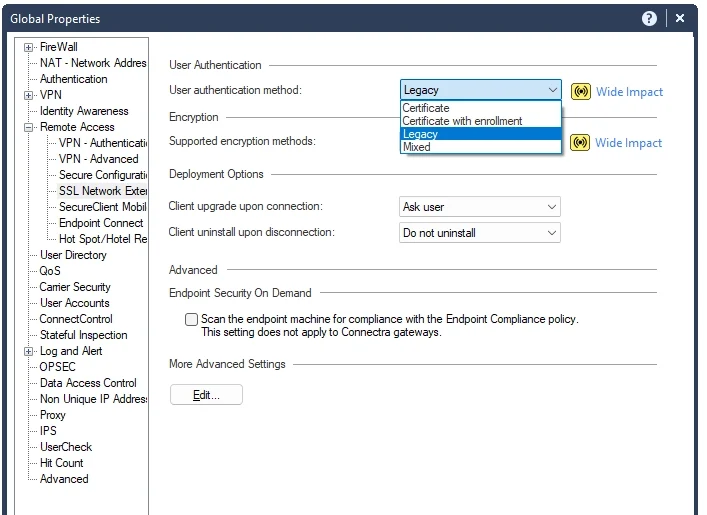
| Mode | 500/UDP | 443/TCP | Verdict |
|---|---|---|---|
| Certificate | yes | yes | BYPASSED |
| Certificate with enrollment | yes | yes | BYPASSED |
| Mixed | yes | yes | BYPASSED |
| Legacy (username/password) | - | - | not bypassable (XAUTH password still gates) |
Three out of four modes hand out a session with zero resistance. Only the plain password mode holds the line, because it still demands an actual password via XAUTH afterwards.
Root cause
The gateway lets the client choose how carefully to check its credentials. The client chooses "don't bother", and the gateway doesn't bother. Concretely, the VPNExtFeatures Vendor ID payload is attacker-controlled, and four bytes after its magic are written verbatim into the phase-1 state flags word at state + 0x4bc4. Bits of that word then control whether the certificate payloads are processed and whether the phase-1 signature check runs. The patch removes the caller-supplied flag and derives the decision from the gateway's own machine-cert policy instead.
The trust decision was made from data supplied by the very peer being authenticated, and the gateway logged the peer as "not a Check Point peer" while still honouring the flag.
Impact
An unauthenticated attacker who can reach the gateway can complete IKEv1 phase 1 with a forged, self-signed certificate and an invalid signature, and be authenticated as a provisioned Remote Access user whose username and ICA organization they know. The attacker can decrypt the gateway's final phase-1 message, learning its internal identity IP and VPN certificate. This works over UDP 500/4500 and over TCP 443 in Visitor Mode, and across the Certificate, Certificate with enrollment and Mixed authentication modes. The Legacy username/password mode is not bypassable because XAUTH still requires a password. Exploitation requires that the target accepts legacy Remote Access clients, that IKEv1 is permitted, and that machine certificate authentication is not mandatory.
Fix
Check Point released hotfixes on 8 June 2026 (sk185033). The patch changes process_cert_payloads to drop the caller-supplied process_machine_certs argument and instead read the gateway's own machine-cert policy from state + 0x4bd4 via is_machine_cert_supported(). End-of-support versions receive no hotfix. A Detection Artefact Generator is available at watchtowrlabs/watchTowr-vs-Check-Point-CVE-2026-50751.
Variants to test
- Send a
VPNExtFeaturesVID with the four trailing bytes set to0x00000004and a randomHASH_Iin message 5. A positive result is the gateway loggingIkeSAFromState: User ... savedand accepting the SA. - Send the same VID with cap
0x00000000, and separately send no Vendor ID at all. Both should be rejected, confirming the flag is what drives the bypass. - Present a self-signed certificate with DN
CN=<username>,OU=users,O=<ICA-O>and 256 bytes of random signature data. A positive result is a session as that user, with the gateway's internal IP and VPN certificate revealed in the decrypted final phase-1 message. - Repeat the exchange over TCP 443 using TCPT framing when UDP 500/4500 are filtered. A positive result is the same bypass over the TCP path.
- Try each of the four "User authentication method" settings. Certificate, Certificate with enrollment and Mixed should be bypassed; Legacy should still require the XAUTH password.
What happened, in plain words
Imagine a company office building with a security guard at the door. To get in, you show a badge. The guard is supposed to look at the badge, check it is real, and check it belongs to you. Now imagine the guard instead asks you, the visitor, "how carefully should I check your badge?" and then does whatever you say. If you answer "don't bother", the guard waves you through. That is, in essence, what happened here.
Check Point makes Security Gateways: firewall and VPN appliances that sit at the edge of a huge number of corporate and government networks. A VPN (Virtual Private Network) is a way for someone working from a coffee shop to reach the company's internal network as if they were sitting in the office. The Remote Access VPN and Mobile Access features are the parts that let a remote workforce dial in.
On 8 June 2026, Check Point released hotfixes (small emergency patches) for a pair of vulnerabilities in Mobile Access/SSL VPN, Remote Access VPN and Spark Firewall products, specifically in the "deprecated" IKEv1 VPN code. "Deprecated" means the vendor considers it old and would prefer you stopped using it, but it still works. The headline issue is CVE-2026-50751, an authentication bypass with a CVSS score of 9.3. An authentication bypass means getting past the login check without actually proving who you are. CVSS is a standard 0 to 10 score for how serious a vulnerability is, where 10 is the worst. The advisory describes the root cause as a "logic flaw in how certificates are validated during the IKEv1 key exchange".
A certificate, in this context, is a digital document that proves an identity, a bit like a passport. A logic flaw means the code does not crash or misbehave in an obvious way; it simply makes a wrong decision.
Various sources indicate the vulnerability has been exploited in the wild since 7 May 2026, roughly a month before anyone received a patch, and that, per Check Point, there were "a few dozen targeted organizations". At least one incident has been linked to a Qilin ransomware affiliate. Ransomware is malicious software that locks up a victim's files and demands payment to unlock them; an affiliate is a criminal partner who carries out attacks using someone else's ransomware.
The affected Gaia versions are:
R80.20.XR80.40R81R81.10R81.10.XR81.20R82R82.00.XR82.10
Gaia is the name of the operating system Check Point appliances run. Each of those codes is a version of it. End-of-support versions receive no hotfix at all, meaning the vendor has stopped maintaining them and will not fix this.
Setup
The analysis compared two builds using the usual "what has changed" process. Comparing an old and a new version of the same software is called diffing, and it is one of the most effective ways to find what a security patch actually changed, because the fix points straight at the bug.
- R82.10 Jumbo Hotfix Take 19 (vulnerable)
- R82.10 Jumbo Hotfix Take 19 plus the sk185033 hotfix (patched)
"Jumbo Hotfix Take 19" is a bundle of accumulated fixes; sk185033 is the specific patch for this issue.
There are three prerequisites for exploitation:
- The target accepts legacy Remote Access clients. A client is the program on the user's machine that connects to the VPN.
- IKEv1 is permitted (not IKEv2-only). IKE, Internet Key Exchange, is the protocol two machines use to agree on encryption keys before a VPN session starts. Version 1 is the old one, version 2 the newer one.
- Machine certificate authentication is not mandatory. That is, the gateway does not insist that the connecting machine prove itself with a certificate.
These sound unlikely, but "support our older clients" is a sentence uttered in every enterprise, so the victim pool is large.
Finding it
The first assumption was that the fix would sit in vpnd, the legacy VPN daemon, described as the home of "all IKE in legacy mode". A daemon is a program that runs in the background, quietly handling a service. That assumption was wrong: vpnd does not even bind UDP 500 or 4500. "Bind" means to listen on a network port. UDP is one of the two main ways data travels over the internet (the other is TCP); port 500 and port 4500 are the standard ports for IKE traffic.
On R81.10 and later, Check Point redirects IKE negotiation to a newer daemon, iked, which listens internally on UDP 30500. The "deprecated IKEv1" code lives in the new daemon, not the old one. This is why the first look in the wrong place found nothing.
Diffing the correct binary (ike) made the changed files and functions stand out immediately. A binary is the compiled program file; a function is a named block of code that does one job.
ikeMainMode.ccikeAggressive.ccmachine_cert_utils.cc, the loudest of all
A single signature change told most of the story before a single instruction was read. A function signature is the line that lists a function's name and the inputs it accepts.
process_cert_payloads(char *msg, _phase1NegState *state, ushort *err, int process_machine_certs)

process_cert_payloads(char *msg, _phase1NegState *state, ushort *err)
Line by line: the first line is the old, vulnerable version of a function called process_cert_payloads. It takes four inputs: msg (the incoming message), state (the current state of the negotiation), err (somewhere to record an error), and process_machine_certs, an integer flag. The second line is the patched version, which takes only three inputs: the trailing int process_machine_certs is gone.
The vulnerable function takes a trailing int. The patch deleted it. When a security patch removes an argument from a function whose sole purpose is validating certificates, it suggests the function was letting someone make a decision the code should never have allowed them to make. In other words, the old code was asking a caller "should I check this certificate?", and the caller could say no.
Exploitation
Step 1: Understand the certificate-processing flag
The vulnerable process_cert_payloads, lightly cleaned up, looks like this:
if (process_machine_certs != 0) {
    while (seekPayload(0xf6, ...) >= 0) {
        processCertPayload(...);
    }
}
return 1;
Line by line: if (process_machine_certs != 0) means "only do the following if the flag is not zero". Inside, while (seekPayload(0xf6, ...) >= 0) keeps looking through the message for a piece of data of type 0xf6 (a certificate payload) as long as one is found. For each one, processCertPayload(...) handles it. Finally return 1 reports success regardless.
Whether the gateway processes the machine-certificate material at all is decided entirely by process_machine_certs, a flag handed in by the caller. If the caller passes zero, the certificate is never looked at, and the function still says "fine".
The patched version discards the flag and consults the appliance's own configuration instead:
cert_mode     = *(int *)(state + 0x4bd4);
cert_required = is_machine_cert_supported(cert_mode);
if (cert_required != '\\0') {
    while (seekPayload(0xf6, ...) >= 0) {
        processCertPayload(...);
    }
}
return 1;
Line by line: the first line reads a value from the gateway's own state at a fixed offset, 0x4bd4, and stores it in cert_mode. The second line passes that mode to a new function, is_machine_cert_supported, which returns whether a certificate is required. The if then only processes certificates when that answer is not the null character. The rest is the same as before.
The patched code reads a new field, state + 0x4bd4, populated from the gateway's own machine-cert policy (off / optional / required), and a new function is_machine_cert_supported() decides whether to enforce based on that policy. The fix in one sentence: stop letting the client decide whether the client needs to authenticate.
Step 2: Find the signature check that can be skipped
One level up, in the caller process_auth_pl, the private-key proof is validated, or not. A private key is the secret half of a cryptographic key pair; proving you hold it is how you show a certificate really belongs to you.
peer_flags = *(uint *)(state + 0x4bc4);
check_sig  = peer_flags & 2;

process_cert_payloads(msg, state, err, check_sig);

if ((check_sig != 0) &&
    (seekPayload(0xf9, ...) >= 0)) {
    processSigPayload(...);
}
Line by line: the first line reads a 32-bit number (a "dword") from the state at offset 0x4bc4 and calls it peer_flags. The second line uses a bitwise AND with 2 to test whether a particular bit is set, storing the answer in check_sig. The third line passes that answer into process_cert_payloads as the flag from Step 1. The if then only looks for a signature payload (type 0xf9) and processes it when check_sig is non-zero and such a payload exists. The && means "and": if the left side is false, the right side is never evaluated.
The code reads from offset 0x4bc4 in the phase-1 state and tests bit 0x2. The signature verification is guarded by a logical AND. If bit 0x2 is clear, the && short-circuits, seekPayload(0xF9) is never called, processSigPayload is never called, and the function returns success. The signature that proves the client owns the private key behind its certificate is verified only if a flag says so.
Step 3: Find the second door in verify_peer_auth
A second, independent door sits in verify_peer_auth:
peer_flags = state[0x4bc4];
if ((((byte)peer_flags & 4) != 0) ||
    (verifyMessagePhase1(...) >= 0)) {
    return 0;
}
Line by line: the first line again reads the flags word at 0x4bc4. The if checks two things joined by ||, which means "or": either bit 0x4 of the lowest byte is set, or verifyMessagePhase1 returns a value of zero or more. If either is true, the function returns 0 (which in this code means "authenticated"). Because of the ||, if the bit is set, verifyMessagePhase1 is never called at all.
verifyMessagePhase1 is the phase-1 signature check. If bit 0x4 of the same 0x4bc4 flags word is set, the || short-circuits and the function returns "authenticated" without ever calling it. The whole question of "is this client who it says it is" rests on two bits in a single dword at state + 0x4bc4. Set bit 0x4, and authentication steps aside.
Step 4: Find who writes the flags word
Grepping the iked binary for every instruction that writes to 0x4bc4 found exactly two. Grepping means searching a file for a pattern. The first is the initializer in FwIkeNewPhase1State, which zeroes the field when a new negotiation starts. The second is in processVendorIDPayload: the flag that decides whether the certificate signature gets checked is written from the Vendor ID payload, supplied by the client.
A Vendor ID payload is a small optional block a client can include in an IKE message to announce which vendor's features it supports. Because it comes from the client, its contents are under the client's control.
The Vendor ID carrying the 16-byte magic is 3c f1 87 b2 47 40 29 ea 46 ac 7f d0 ea f2 89 f5, which the gateway logs as VPNExtFeatures. A magic value is a fixed sequence of bytes used to recognise a particular kind of data. The four bytes immediately after the magic are dropped, byte-swapped, straight into the gate:
int trailing = vid_len - 16;
if (trailing <= 3)
    return ...;

uint cap = *(uint *)(vid + 16);
*(uint *)(state + 0x4bc4) = bswap32(cap);
Line by line: the first line works out how many bytes follow the 16-byte magic. The if refuses to continue unless there are at least four of them. The next line reads those four bytes as a 32-bit number and calls it cap. The last line byte-swaps that number (reverses the order of its bytes, because different systems store numbers in different orders) and writes it into the flags word at state + 0x4bc4.
The handler insists on at least four bytes after the magic, reads those four attacker-supplied bytes out of the Vendor ID body, byte-swaps them and stores the result verbatim into state + 0x4bc4, the flags word that verify_peer_auth and process_auth_pl consult. The client sends the server a bitmask saying "here is how thoroughly you should check me", and the server agrees. A bitmask is simply a number whose individual bits each act as an on/off switch.
A peer that sends only the VPNExtFeatures VID gets logged by the gateway as vendorid = 0 ... not a Check Point peer. The gateway writes in its own logs that it does not recognise the client as legitimate, then honours the client's "don't check my signature" flag anyway.
Step 5: Prove it with a garbage signature
A minimal IKEv1 Main Mode client was written using AES-256 / SHA1 / DH group 2 and Check Point's 0xFADD hybrid auth method. These are the ingredients of the encrypted conversation: AES-256 and SHA1 are encryption and hashing algorithms, DH group 2 is a Diffie-Hellman key-agreement group (a standard way for two parties to agree on a shared secret over an open network), and 0xFADD is the numeric code Check Point uses for its hybrid authentication method. It sends the VPNExtFeatures VID with the four trailing bytes set to 0x00000004 (bit 0x4), completes the Diffie-Hellman exchange, and in the encrypted message 5 sends a completely random HASH_I. HASH_I is the value that is supposed to prove the client's identity; sending random bytes means sending a signature that proves nothing. Identical packets were pointed at a vulnerable and a patched appliance:
| Gateway | What iked logged |
Outcome |
|---|---|---|
| Vulnerable (R82.10 T19) | verify_peer_auth: vendorid=0 .. not a Check Point peer -> MMCreate6 -> IkeSAFromState: User watchtowr saved |
ACCEPTED |
| Patched (T19 + sk185033) | verifyMessagePhase1: Authentication failure with hybrid -> NOTIFY authentication failed |
REJECTED |
The vulnerable box created a phase-1 SA off a signature generated with os.urandom. An SA, Security Association, is the established encrypted session between two machines; os.urandom is a Python function that returns random bytes. The negative controls confirm the mechanism:
msg1 Vendor ID |
verifyMessagePhase1 runs? |
Result |
|---|---|---|
VPNExtFeatures cap = 0x00000004 |
skipped | BYPASS |
VPNExtFeatures cap = 0x00000000 |
runs | rejected |
| no Vendor ID at all | runs | rejected |
A negative control is a test where you expect the attack to fail, to prove that the thing you changed is really what causes the success. Here, only the value 0x00000004 gets through, which pins the cause on that bit.
Step 6: Turn the bypass into a login as any user
Completing phase 1 with a nonsense hash is not yet "I am on your internal network as Dave from Accounts". The client was switched from the hybrid method to RSA signature auth (IKE auth method 3), specifically the certificate path. RSA is a widely used public-key algorithm. The entire credential presented is:
- An ID payload containing a distinguished name:
CN=<username>,OU=users,O=<ICA-O>. - A certificate payload containing a self-signed X.509 minted moments earlier, for a private key that was then thrown away.
- A signature payload containing 256 bytes of
os.urandom. - The
VPNExtFeaturesVID, bit0x4.
A distinguished name is the structured name inside a certificate, made of fields like CN (common name), OU (organisational unit) and O (organisation). A self-signed X.509 is a certificate that vouches for itself rather than being issued by a trusted authority; X.509 is the standard format for such certificates.
Because the vulnerability skips verifyMessagePhase1, the gateway checks neither the signature (so no private key is needed) nor the certificate's trust chain (so it need not be issued by anyone; self-signed is fine). The only thing actually checked is that the subject DN resolves to a provisioned Remote Access user. A trust chain is the sequence of signatures linking a certificate back to a trusted authority.
An attacker therefore needs two things:
- A valid username. A wrong guess fails at user lookup while a right one succeeds, so the same probe doubles as a username oracle. An oracle is any behaviour that leaks a yes/no answer you were not meant to have.
- The ICA organization (
O=) string for the DN.
The ICA organization is not a secret: it sits in the gateway's own public TLS certificate, so it can simply be read. TLS is the encryption behind HTTPS, and a public TLS certificate is handed to anyone who connects, so its contents are visible to all.
Running the exploit:
$ python3 watchTowr-vs-Check-Point-CVE-2026-50751.py -u watchtowr
[#] CVE-2026-50751 Check Point IKEv1 Remote-Access certificate-auth bypass
[+] Self-signed cert (untrusted); signature will be invalid (no private key)
[#] Connecting via udp ...
[#] Authenticating as 'watchtowr' with the forged certificate + invalid signature...
[#] Decrypting...
[+] Gateway Internal IP: [redacted]
[+] [BYPASSED] Gateway authenticated us as 'watchtowr'. CVE-2026-50751 certificate-authentication bypass confirmed.
Line by line: the first line runs a Python script and passes -u watchtowr, the username to impersonate. The next lines are the script's own progress messages: it says which vulnerability it targets, notes that it is using a self-signed certificate and that the signature will therefore be invalid because no private key is held, reports that it is connecting over UDP, says it is authenticating as watchtowr with the forged certificate and invalid signature, and then reports that it is decrypting. The final two lines are the results: the gateway's internal IP address, and a confirmation that the gateway authenticated the client as watchtowr, proving the bypass.
The Gateway Internal IP line is not cosmetic. The gateway's final phase-1 message was decrypted with the negotiated session key, revealing its own identity internal IP [redacted] and its VPN certificate. That message can only be decrypted by someone who genuinely holds the session key, which can only be held if the gateway genuinely authenticated the client. The gateway confirms it on its side:
IkeSAFromState: User CN=watchtowr,OU=users,O=watchtowr saved
This is the gateway's own log line, recording that it saved a session for the user whose distinguished name is CN=watchtowr,OU=users,O=watchtowr.
Step 7: Exploit over 443/TCP
The vulnerability is not limited to 500/UDP. When UDP 500/4500 are filtered, as they often are at a paranoid perimeter, Check Point clients fall back to "Visitor Mode", which tunnels the same IKE exchange over a raw TCP stream on port 443 using a framing protocol called TCPT. TCP is the other main transport protocol, and port 443 is the port normally used for HTTPS, so traffic there is often allowed through firewalls. A framing protocol is a set of rules for marking where one message ends and the next begins inside a continuous stream. After reverse-engineering the protocol, the bypass was demonstrated to work identically over TCP.
The vulnerability also appears exploitable across all certificate modes. Check Point gives administrators four "User authentication method" settings for the SSL Network Extender:
| Mode | 500/UDP | 443/TCP | Verdict |
|---|---|---|---|
| Certificate | yes | yes | BYPASSED |
| Certificate with enrollment | yes | yes | BYPASSED |
| Mixed | yes | yes | BYPASSED |
| Legacy (username/password) | - | - | not bypassable (XAUTH password still gates) |
Three out of four modes hand out a session with zero resistance. Only the plain password mode holds the line, because it still demands an actual password via XAUTH afterwards. XAUTH is an extra username-and-password step some VPNs ask for after the certificate stage.
Root cause
The gateway lets the client choose how carefully to check its credentials. The client chooses "don't bother", and the gateway doesn't bother. Concretely, the VPNExtFeatures Vendor ID payload is attacker-controlled, and four bytes after its magic are written verbatim into the phase-1 state flags word at state + 0x4bc4. Bits of that word then control whether the certificate payloads are processed and whether the phase-1 signature check runs. The patch removes the caller-supplied flag and derives the decision from the gateway's own machine-cert policy instead.
The trust decision was made from data supplied by the very peer being authenticated, and the gateway logged the peer as "not a Check Point peer" while still honouring the flag.
Impact
An unauthenticated attacker who can reach the gateway can complete IKEv1 phase 1 with a forged, self-signed certificate and an invalid signature, and be authenticated as a provisioned Remote Access user whose username and ICA organization they know. The attacker can decrypt the gateway's final phase-1 message, learning its internal identity IP and VPN certificate. This works over UDP 500/4500 and over TCP 443 in Visitor Mode, and across the Certificate, Certificate with enrollment and Mixed authentication modes. The Legacy username/password mode is not bypassable because XAUTH still requires a password. Exploitation requires that the target accepts legacy Remote Access clients, that IKEv1 is permitted, and that machine certificate authentication is not mandatory.
Fix
Check Point released hotfixes on 8 June 2026 (sk185033). The patch changes process_cert_payloads to drop the caller-supplied process_machine_certs argument and instead read the gateway's own machine-cert policy from state + 0x4bd4 via is_machine_cert_supported(). End-of-support versions receive no hotfix. A Detection Artefact Generator is available at watchtowrlabs/watchTowr-vs-Check-Point-CVE-2026-50751. A Detection Artefact Generator is a tool that produces the log patterns and checks you can use to spot attempts at this attack.
Variants to test
- Send a
VPNExtFeaturesVID with the four trailing bytes set to0x00000004and a randomHASH_Iin message 5. A positive result is the gateway loggingIkeSAFromState: User ... savedand accepting the SA. - Send the same VID with cap
0x00000000, and separately send no Vendor ID at all. Both should be rejected, confirming the flag is what drives the bypass. - Present a self-signed certificate with DN
CN=<username>,OU=users,O=<ICA-O>and 256 bytes of random signature data. A positive result is a session as that user, with the gateway's internal IP and VPN certificate revealed in the decrypted final phase-1 message. - Repeat the exchange over TCP 443 using TCPT framing when UDP 500/4500 are filtered. A positive result is the same bypass over the TCP path.
- Try each of the four "User authentication method" settings. Certificate, Certificate with enrollment and Mixed should be bypassed; Legacy should still require the XAUTH password.
Glossary
- Authentication bypass: getting past a login or identity check without proving who you are.
- Bitmask: a number whose individual bits each act as an on/off switch.
- Binary: the compiled program file that a computer actually runs.
- Certificate: a digital document that proves an identity, like a passport for a machine.
- Client: the program on a user's machine that connects to a server or VPN.
- CVSS: a standard 0 to 10 score for how serious a vulnerability is.
- Daemon: a program that runs in the background handling a service.
- Deprecated: old software the vendor would prefer you stopped using, but which still works.
- Detection Artefact Generator: a tool that produces log patterns and checks for spotting an attack.
- Diffing: comparing two versions of software to see what changed.
- Distinguished name (DN): the structured name inside a certificate, made of fields like CN, OU and O.
- Dword: a 32-bit number.
- End-of-support: a version the vendor no longer maintains or patches.
- Function: a named block of code that does one job.
- Function signature: the line listing a function's name and the inputs it accepts.
- Gaia: the operating system Check Point appliances run.
- Hotfix: a small emergency patch for a specific problem.
- IKE (Internet Key Exchange): the protocol two machines use to agree on encryption keys before a VPN session.
- Jumbo Hotfix Take: a bundle of accumulated fixes for a product.
- Logic flaw: a bug where the code makes a wrong decision rather than crashing.
- Magic value: a fixed sequence of bytes used to recognise a particular kind of data.
- Negative control: a test where you expect failure, to prove what really causes a success.
- Oracle: any behaviour that leaks a yes/no answer you were not meant to have.
- Private key: the secret half of a cryptographic key pair, used to prove a certificate belongs to you.
- Ransomware: malicious software that locks up files and demands payment to unlock them.
- RSA: a widely used public-key encryption and signature algorithm.
- SA (Security Association): the established encrypted session between two machines.
- Self-signed certificate: a certificate that vouches for itself rather than being issued by a trusted authority.
- TCP: one of the two main internet transport protocols, used for reliable streams of data.
- TLS: the encryption behind HTTPS.
- Trust chain: the sequence of signatures linking a certificate back to a trusted authority.
- UDP: one of the two main internet transport protocols, used for fast, connectionless data.
- Vendor ID payload: an optional block a client includes in an IKE message to announce which vendor features it supports.
- VPN (Virtual Private Network): a way to reach a private network securely over the internet.
- XAUTH: an extra username-and-password step some VPNs ask for after the certificate stage.
- X.509: the standard format for digital certificates.

