Private Bug Bounty Experience— Tata Play Bug Bounty Program
An unauthenticated Spring Boot Actuator management index on a Tata Play subdomain returned HTTP 200 and listed management links including shutdown and refresh, while a health endpoint disclosed infrastructure details. The author notes that listing an operation does not prove it is callable, and that other sensitive endpoints returned 403, so the exposure was partial.

medium.com
Published on medium.com
Tata
The full write-up lives on its author's site
It belongs to its author, so we link to it rather than copy it. The other two tabs are our own rewrites, checked against it.
Context
Tata Play runs a bug bounty program, and this write-up is about a private submission to it. The subject is a Spring Boot Actuator management interface exposed on a Tata Play subdomain. Actuator is the part of Spring Boot that exposes operational endpoints for an application: an index that lists the available management links, a health endpoint that reports on the application and its dependencies, and, depending on configuration, operations such as shutdown and refresh. Spring Boot's own documentation describes shutdown as an operation that gracefully shuts down an application, and recommends securing Actuator endpoints that are exposed to the public.
The author withholds the hostname and the reproduction details, because the behaviour he observed may still be present. Everything below is what he was willing to publish.
Setup
No accounts, roles or special tooling are described. The testing was unauthenticated: the requests were made from outside, without credentials, against the Actuator index of the subdomain. The only precondition that matters is that the management interface was reachable from the internet.
One constraint shaped the testing: Tata Play's published program rules prohibit denial of service testing. The author therefore left the shutdown action itself untested in the original submission.
Finding it
At 15:00:45 IST on 13 October 2026, an unauthenticated request to the Actuator index returned HTTP 200. The response listed management links, including shutdown and refresh. A separate health response disclosed details about the application's infrastructure.
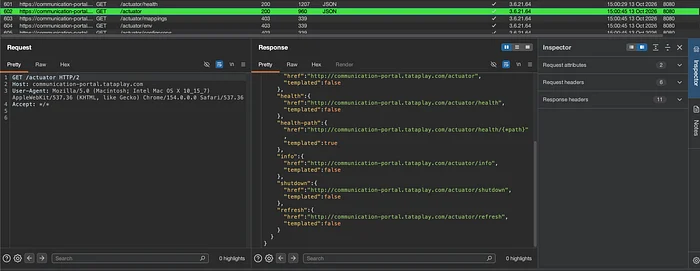
The screenshot shows the initial discovery of the vulnerability.
Other sensitive Actuator endpoints returned 403, so this was a partial exposure rather than unrestricted access to every management function. The author is careful about what that does and does not prove: an Actuator index alone does not show that every listed operation is callable without authentication. But listing a shutdown operation on a public management interface, next to a detailed health response, was enough to merit a close review.
Exploitation
Step 1: request the Actuator index unauthenticated
At 15:00:45 IST on 13 October, a request to the Actuator index without credentials returned HTTP 200. The body listed the management links, among them shutdown and refresh. The report does not reproduce the raw request or response.
Step 2: request the health endpoint
A separate health response returned details about the application's infrastructure. The report does not reproduce this response either.
Step 3: probe the other sensitive endpoints
Other sensitive Actuator endpoints returned 403. This is what makes the exposure partial: the index and health data were readable, but not every management function was reachable.
Step 4: observe the change in access
Later on 13 October, shortly after the report was submitted, a browser-style request to the same Actuator index returned HTTP 403 at 18:12:12 IST. The response identified an AWS load balancer.
Step 5: re-check with a minimal request
On 24 October at 01:05:15 IST, a minimal request again returned HTTP 200 and listed the same management links.
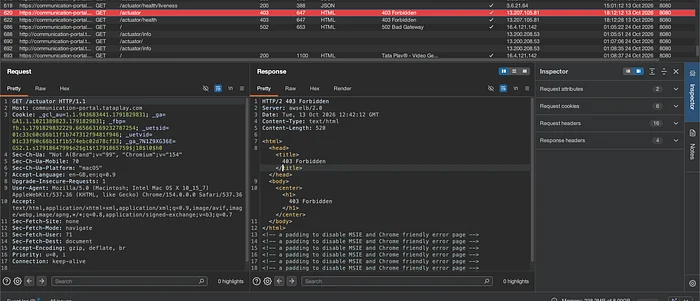
The screenshot is captioned as the vulnerability seeming to be patched soon after with a hotfix, though the author says this is not proven.
The author is explicit that this sequence does not prove that Tata Play fixed the issue and then reversed the fix. The 403 request differed from the 200 requests in protocol and headers, and he cannot see the edge rules or the deployment history. It could have been a temporary restriction, a rule matching that particular request, or a different routing decision. He reports only what the responses showed.
Root cause
A Spring Boot Actuator management interface was reachable from the internet without authentication, at least for the index and health endpoints, and the index advertised operations including shutdown and refresh. Spring Boot's documentation recommends securing Actuator endpoints exposed to the public, so the likely cause is that the management endpoints were exposed without that protection, or with protection that did not cover the index and health paths. The report does not describe the application's configuration, so the exact mistake is not established.
Why the other endpoints returned 403 while the index and health did not is also not explained in the report. The author notes only that the exposure was partial.
Impact
An unauthenticated party could read the Actuator index, learning which management operations the application advertises, and could read a health response that disclosed details about the application's infrastructure. Whether the advertised operations, including shutdown, were actually callable without authentication was not tested, because the program rules prohibit denial of service testing. The author treats the listing of a shutdown operation on a public interface, alongside the detailed health response, as sufficient reason for a close review rather than as proof of exploitability.
The report does not assign a severity or a CVSS score, and it does not state that any bounty was paid.
The duplicate decision
The author reported several findings on 13 October 2026. Three were marked duplicate. He says he can accept that outcome if someone reported them first. Tata Play's bug bounty FAQ states that later reports of the same issue are duplicates and ineligible for a bounty. He does not know whether another researcher reported this first or whether Tata Play already knew about it internally, and he does not ask readers to treat the duplicate decision as proof of bad faith.
His argument is narrower: a duplicate status explains who may receive credit or a reward, but it does not tell a researcher whether the underlying risk has been removed. He asks Tata Play to review the new shutdown response, verify the management interface from an external network, and clarify the status of remediation through the reporting channel. He also asks for a way to add material evidence to a closed or duplicate case without the security concern disappearing behind a workflow label.
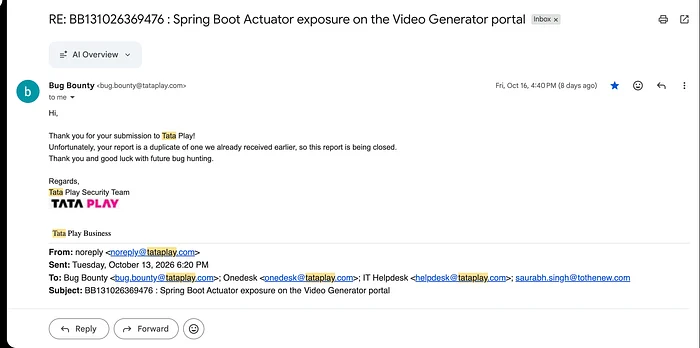
The screenshot is captioned as there being no way for the author to verify whether this was really reported.
He closes by saying he will not hunt on this program again, on the view that even a finding nobody reported earlier could be labelled a duplicate and left without a response to follow-up e-mails. He ends with a broader question about whether it is more valuable to find a vulnerability and publish a blog or write-up for credibility than to write a curated report.
Fix
What the author asks for is a review of the new shutdown response, verification of the management interface from an external network, and clarification of the remediation status through the reporting channel. The general remedy implied by the finding is the one Spring Boot's documentation recommends: secure Actuator endpoints that are exposed to the public, so that the index, health data and management operations are not reachable unauthenticated.
Variants to test
- Actuator index on other Spring Boot hosts. Request the Actuator index without credentials. A positive result is HTTP 200 with a body listing management links.
- Health endpoint disclosure. Request the health endpoint separately. A positive result is a response that reveals infrastructure details rather than a bare status.
- Advertised operations versus callable operations. Compare what the index lists with what the other endpoints return. A positive result is an operation listed in the index whose endpoint does not return 403.
- Consistency of access over time. Repeat the same request with the same protocol and headers at intervals. A positive result is a change in status code that cannot be explained by a difference in the request itself, which is the check the author could not complete here.
- Edge behaviour. Compare a browser-style request with a minimal one against the same path. A difference in status between them points to a rule at the edge rather than to a change in the application, which is exactly the ambiguity the author flags in his own timeline.
What happened, in plain words
A security researcher spent some time testing a company called Tata Play, which runs a bug bounty program. A bug bounty program is a scheme where a company invites outside people to look for security weaknesses in its systems and report them privately, usually in exchange for money or recognition. The researcher found a weakness on one of Tata Play's subdomains. A subdomain is a smaller address that sits under a company's main web address, for example something like something.tataplay.com rather than tataplay.com itself.
The weakness was that a part of the application meant for internal management was reachable from the open internet without anyone logging in. He reported it. Tata Play marked the report as a duplicate, which under its FAQ makes it ineligible for a bounty. The researcher does not know whether someone else reported it first. The researcher's complaint is not really about the money. It is that a duplicate label tells you nothing about whether the problem was actually fixed, and in his case a later minimal request to the same index again returned HTTP 200.
This article walks through what he found, what he did, and why the duplicate decision left an important question unanswered. It is written for someone who has never done security testing before, so every technical idea is explained as it comes up.
The background you need first
What a bug bounty program is
Companies that run software often have a page describing how to report security problems to them. Some go further and offer a reward, called a bounty, for useful reports. The rules on that page matter: they say what you are allowed to test and what you are not. Tata Play has such a page, and the researcher refers to it more than once.
What Spring Boot and Actuator are
Spring Boot is a popular toolkit for building web applications, mostly in the Java programming language. It saves developers a lot of work by providing ready-made pieces. One of those pieces is called Actuator.
Actuator is best imagined as a service hatch on a building. Normally customers walk in through the front door, but the building also has a small panel of switches and gauges for the staff: one switch shows whether the power is on, another lists what equipment is installed, and one, in some setups, shuts the whole building down. Actuator is that staff panel for a web application. It exposes small web addresses, called endpoints, that report on the application and let an operator manage it.
An endpoint is simply a specific address on a website that returns a specific piece of information or performs a specific action. When you type an address into your browser and press Enter, you are requesting an endpoint. The server, the computer that hosts the website, decides what to send back.
The report mentions three kinds of Actuator endpoint:
- The index, which is a list of the management links that are available. Think of it as the contents page of the staff panel.
- The health endpoint, which reports on the state of the application and the things it depends on. Think of it as the gauges on the panel.
- Operations such as shutdown and refresh. Shutdown, as Spring Boot's own documentation describes it, gracefully shuts down an application. Operations such as shutdown and refresh. These are the actual switches, not just the gauges.
Spring Boot's documentation recommends securing Actuator endpoints that are exposed to the public. In plain terms: if the staff panel can be reached from the street, put a lock on it.
What HTTP status codes mean
Every time your browser asks a web server for something, the server replies with a three-digit number, called a status code, that summarises what happened. Two of them appear throughout this story:
- 200 means OK. The server understood the request and is sending back the content you asked for.
- 403 means Forbidden. The server understood the request but is refusing to serve it, usually because you are not allowed.
There is also 401, which means Unauthorized, but it does not appear in this report. The distinction between 200 and 403 is the backbone of the whole timeline: 200 means the door opened, 403 means it stayed shut.
What "unauthenticated" means
Authentication is proving who you are, normally by logging in with a username and password. A request is unauthenticated when it carries no proof of identity at all. If you open a website in a private browsing window, without logging in, and it still shows you something, that something was served to an unauthenticated visitor. That is what the researcher was checking: could a complete stranger, with no account and no password, see the staff panel?
What a load balancer is
A load balancer is a piece of equipment, or a cloud service, that sits in front of a group of servers and shares incoming traffic between them. It is like a receptionist who directs visitors to whichever desk is free. The report mentions an AWS load balancer, meaning one provided by Amazon Web Services, a large cloud hosting company. This detail matters later because a load balancer can apply its own rules about who gets in, separately from the application behind it.
The setup
The researcher describes no accounts, no special roles and no unusual tools. He made requests from outside, without credentials, against the Actuator index of the subdomain. The only precondition that matters is that the management interface was reachable from the internet at all.
One rule shaped what he was willing to do. Tata Play's published program rules prohibit denial of service testing. A denial of service test is one that deliberately tries to knock a service over, for example by flooding it with traffic or by triggering a shutdown, to see whether it falls. Because the rules forbid it, he left the shutdown action itself untested in his original submission. He noted that the switch was advertised, but he did not press it.
Finding it
At 15:00:45 IST on 13 October 2026, an unauthenticated request to the Actuator index returned HTTP 200. IST here means Indian Standard Time, the time zone used in the timestamps. The response listed management links, including shutdown and refresh. A separate health response disclosed details about the application's infrastructure.
The screenshot shows the initial discovery of the vulnerability.
Other sensitive Actuator endpoints returned 403, so this was a partial exposure rather than unrestricted access to every management function. Partial exposure is an important idea: the contents page and the gauges were readable, but not every switch behind them could be reached.
The researcher is careful about what this does and does not prove. An Actuator index alone does not show that every listed operation can actually be called without authentication. A contents page can list a chapter that is missing from the book. But listing a shutdown operation on a public management interface, next to a detailed health response, was enough to merit a close review.
Exploitation
Step 1: request the Actuator index unauthenticated
At 15:00:45 IST on 13 October, a request to the Actuator index without credentials returned HTTP 200. The body listed the management links, among them shutdown and refresh. The report does not reproduce the raw request or response.
Why this step: the index is the cheapest possible check. If a stranger can see the list of management links, the panel is exposed. If the server had answered 403 or 401, there would have been nothing to report.
Step 2: request the health endpoint
A separate health response returned details about the application's infrastructure. The report does not reproduce this response either.
Why this step: the index tells you what exists. The health endpoint tells you how much it is willing to say. A health response that reveals infrastructure details is more informative to an outsider than a bare "everything is fine", so it is worth checking separately.
Step 3: probe the other sensitive endpoints
Other sensitive Actuator endpoints returned 403. This is what makes the exposure partial: the index and health data were readable, but not every management function was reachable.
Why this step: knowing that some endpoints are locked and others are not tells you the shape of the mistake. It is the difference between a building with no locks at all and one where the front desk is open but the server room is shut.
Step 4: observe the change in access
Later on 13 October, shortly after the report was submitted, a browser-style request to the same Actuator index returned HTTP 403 at 18:12:12 IST. The response identified an AWS load balancer.
Why this step: he went back to the same address to see whether anything had changed after reporting. It had. A browser-style request means one that looks like it came from an ordinary web browser, with the extra information browsers normally send along.
Step 5: re-check with a minimal request
On 24 October at 01:05:15 IST, a minimal request again returned HTTP 200 and listed the same management links.
Why this step: a minimal request is one that sends as little extra information as possible, just the bare request. If the answer differs from the browser-style request, the difference may lie in the request itself rather than in the application.
The screenshot is captioned as the vulnerability appearing to be patched soon after with a hotfix.
The researcher is explicit that this sequence does not prove that Tata Play fixed the issue and then reversed the fix. The 403 request differed from the 200 requests in protocol and headers, and he cannot see the edge rules or the deployment history. It could have been a temporary restriction, a rule matching that particular request, or a different routing decision. He reports only what the responses showed.
Two terms in that paragraph need unpacking. Headers are the extra lines of information that travel with every web request and response, alongside the actual content. They say things like which browser is asking, what format it would like back, and so on. Protocol here refers to the rules used to carry the request, for example HTTP versus HTTPS, the encrypted version. If two requests differ in these details, a server or a load balancer may treat them differently even when the address is identical. Edge rules are the filtering rules applied at the outer boundary of a company's network, typically by a load balancer or a content delivery service, before a request ever reaches the application. Deployment history is the record of what software versions were running and when, which an outsider cannot see.
Root cause
A Spring Boot Actuator management interface was reachable from the internet without authentication, at least for the index and health endpoints, and the index advertised operations including shutdown and refresh. Spring Boot's documentation recommends securing Actuator endpoints exposed to the public, so the likely cause is that the management endpoints were exposed without that protection, or with protection that did not cover the index and health paths. The report does not describe the application's configuration, so the exact mistake is not established.
Why the other endpoints returned 403 while the index and health did not is also not explained in the report. The researcher notes only that the exposure was partial.
Impact
An unauthenticated party could read the Actuator index, learning which management operations the application advertises, and could read a health response that disclosed details about the application's infrastructure. Whether the advertised operations, including shutdown, were actually callable without authentication was not tested, because the program rules prohibit denial of service testing. The researcher treats the listing of a shutdown operation on a public interface, alongside the detailed health response, as sufficient reason for a close review rather than as proof of exploitability.
The report does not assign a severity or a CVSS score, and it does not state that any bounty was paid. A CVSS score is a standard number from 0 to 10 used to express how serious a vulnerability is; the report simply does not give one.
The duplicate decision
The researcher reported several findings on 13 October 2026. Three were marked duplicate. He says he can accept that outcome if someone reported them first. Tata Play's bug bounty FAQ states that later reports of the same issue are duplicates and ineligible for a bounty. He does not know whether another researcher reported this first or whether Tata Play already knew about it internally, and he does not ask readers to treat the duplicate decision as proof of bad faith.
His argument is narrower: a duplicate status explains who may receive credit or a reward, but it does not tell a researcher whether the underlying risk has been removed. He asks Tata Play to review the new shutdown response, verify the management interface from an external network, and clarify the status of remediation through the reporting channel. Remediation means the actual fixing of the problem. He also asks for a way to add material evidence to a closed or duplicate case without the security concern disappearing behind a workflow label.
The screenshot is captioned as there being no way for the author to verify whether the issue was really reported.
He closes by saying he will not hunt on this program again, on the view that even a finding nobody reported earlier could be labelled a duplicate and left without a response to follow-up e-mails. He ends with a broader question about whether it is more valuable to find a vulnerability and publish a blog or write-up for credibility than to write a curated report.
Fix
What the researcher asks for is a review of the new shutdown response, verification of the management interface from an external network, and clarification of the remediation status through the reporting channel. The general remedy implied by the finding is the one Spring Boot's documentation recommends: secure Actuator endpoints that are exposed to the public, so that the index, health data and management operations are not reachable unauthenticated.
Variants to test
These are the checks the researcher suggests for anyone looking at similar systems. Each one is described in plain terms.
- Actuator index on other Spring Boot hosts. Request the Actuator index without credentials. A positive result is HTTP 200 with a body listing management links. In other words, ask the staff panel for its contents page without logging in, and see whether it hands it over.
- Health endpoint disclosure. Request the health endpoint separately. A positive result is a response that reveals infrastructure details rather than a bare status. The gauges should say "fine"; if they instead describe the machinery, that is worth noting.
- Advertised operations versus callable operations. Compare what the index lists with what the other endpoints return. A positive result is an operation listed in the index whose endpoint does not return 403. A contents page that lists a chapter is not the same as a chapter you can actually open.
- Consistency of access over time. Repeat the same request with the same protocol and headers at intervals. A positive result is a change in status code that cannot be explained by a difference in the request itself, which is the check the researcher could not complete here. This is the discipline of changing one thing at a time, so that you know what caused the difference.
- Edge behaviour. Compare a browser-style request with a minimal one against the same path. A difference in status between them points to a rule at the edge rather than to a change in the application, which is exactly the ambiguity the researcher flags in his own timeline.
Glossary
- 403: an HTTP status code meaning Forbidden; the server understood the request but refused to serve it.
- 200: an HTTP status code meaning OK; the server understood the request and returned the content.
- Actuator: the part of Spring Boot that exposes operational endpoints for an application, such as an index, a health report and management operations.
- Authentication: the act of proving who you are, normally by logging in.
- AWS: Amazon Web Services, a large cloud hosting company.
- Bounty: a reward, often money, paid for a useful security report.
- Bug bounty program: a scheme in which a company invites outside people to find and privately report security weaknesses, usually under published rules.
- Browser-style request: a request that looks like it came from an ordinary web browser, including the extra information browsers normally send.
- CVSS score: a standard number from 0 to 10 expressing how serious a vulnerability is.
- Denial of service testing: testing that deliberately tries to knock a service over, for example by flooding it or triggering a shutdown; Tata Play's rules prohibit it.
- Deployment history: the record of what software versions were running and when.
- Duplicate: a report of an issue that someone else already reported, which under Tata Play's FAQ is ineligible for a bounty.
- Edge rules: filtering rules applied at the outer boundary of a network, typically by a load balancer, before a request reaches the application.
- Endpoint: a specific web address that returns a specific piece of information or performs a specific action.
- Headers: extra lines of information sent with every web request and response, alongside the actual content.
- Health endpoint: an Actuator endpoint that reports on the state of the application and its dependencies.
- HTTP: the set of rules used to carry requests and responses between a browser and a web server.
- Index (Actuator): the Actuator endpoint that lists the available management links.
- IST: Indian Standard Time, the time zone used in the report's timestamps.
- Load balancer: equipment or a cloud service that sits in front of several servers and shares incoming traffic between them.
- Minimal request: a request that sends as little extra information as possible.
- Partial exposure: a situation where some parts of an interface are reachable without authentication and others are not.
- Protocol: the version of the rules used to carry a request, for example HTTP versus HTTPS.
- Refresh: an Actuator operation that reloads the application's settings.
- Remediation: the actual fixing of a security problem.
- Shutdown: an Actuator operation that, as Spring Boot's documentation describes it, gracefully shuts down an application.
- Spring Boot: a popular toolkit for building web applications, mostly in Java.
- Status code: a three-digit number a web server returns to summarise what happened to a request.
- Subdomain: a smaller address that sits under a company's main web address.
- Unauthenticated: carrying no proof of identity at all, such as a request made without logging in.
- Vulnerability: a weakness in a system that could be used to cause harm or gain access it should not allow.



