Spoofing 802.11 Wireless Beacon Management Frames with Manipulated Power Values Resulting in Denial of Service for Wireless Clients
Wireless clients trust the maximum transmit power and power constraint values inside 802.11 beacon management frames, and the Linux kernel uses them to set the card's transmit power. An attacker who spoofs a beacon with a manipulated value can force a victim's wireless card to drop its transmit power to zero, disrupting connectivity.
 Published on trustwave.com
Change theme to light
The full write-up lives on its author's site
It belongs to its author, so we link to it rather than copy it. The other two tabs are our own rewrites, checked against it.
Context
This is a research journey through the Linux wireless stack, specifically the mac80211 subsystem in Ubuntu, and how it handles power values advertised by an access point. The feature under scrutiny is the 802.11h power constraint mechanism: an access point can include a Country information element (IE) carrying a maximum transmit power, and a Power Constraint element telling clients how far below that regulatory maximum they should operate. The kernel combines the two and limits the wireless card's transmit power accordingly, printing the result to dmesg.
The researcher, Tom Neaves, came across the paper "Protecting Wi-Fi Beacons from Outside Forgeries" by Mathy Vanhoef, Prasant Adhikari and Christina Popper (WiSec 2020) after he had worked it all out. "Protecting Wi-Fi Beacons from Outside Forgeries" by Mathy Vanhoef, Prasant Adhikari and Christina Popper (WiSec 2020). The write-up is therefore about the journey and the mechanics rather than a novel disclosure.

Setup
The work was done on Ubuntu, with the kernel source downloaded for inspection (nearly 4 GB, 74,099 files). The tooling on the wireless side was Scapy for frame construction, plus vi and xxd for byte-level editing of captured frames. A test access point provided a baseline beacon, and a separate "victim" computer was watched through dmesg while frames were sent. No specific kernel version, wireless card model or Scapy version is given.
Finding it
The starting point was accidental. While doing unrelated Bluetooth research and installing packages, Ubuntu crashed. Looking through dmesg for the cause produced no answer, but one line concerning the wireless interface stood out: the card's transmit power appeared to have been limited based on information provided by the access point. The values in question were:
40 (40 - 0)
That raised three questions: can the value be set to 0, can it be set to a negative value, and where exactly is it set, in which management frame type and at which offset. Since wireless management frames can be spoofed, any value taken from an access point frame and acted on by the client is a candidate for abuse.
Exploitation
Step 1: trace the dmesg string back to the code
The researcher searched the Ubuntu source tree for the string "as advertised by", which appears in the dmesg output. The hit is in /net/mac80211/mlme.c.
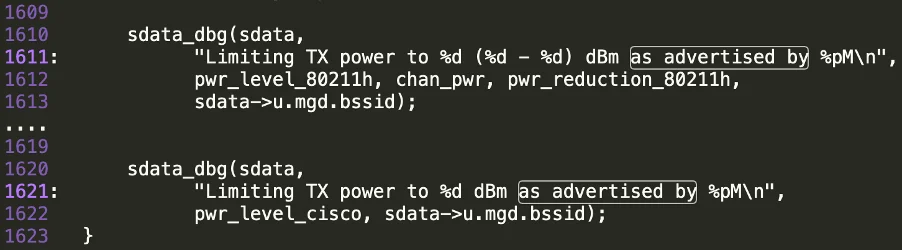
The responsible function is ieee80211_handle_pwr_constr(), which produces the dmesg line.

The calculation involves three variables: pwr_level_80211h, chan_pwr and pwr_reduction_80211h. To manipulate the outcome, each needs a known source.
Step 2: find where the values come from
Scrolling up in the function shows a reference to country_ie, the Country information element in a wireless frame, which carries the country string, channel number and similar details. The function calls [redacted](), passing the country IE details in.
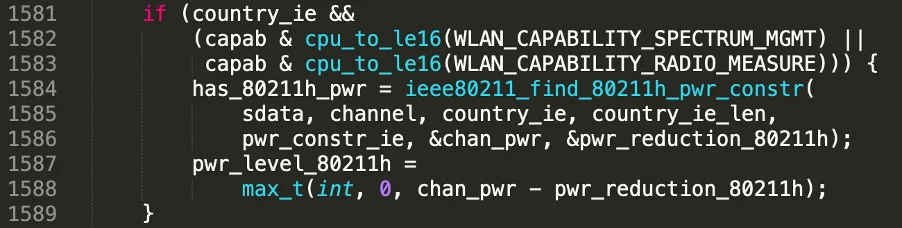
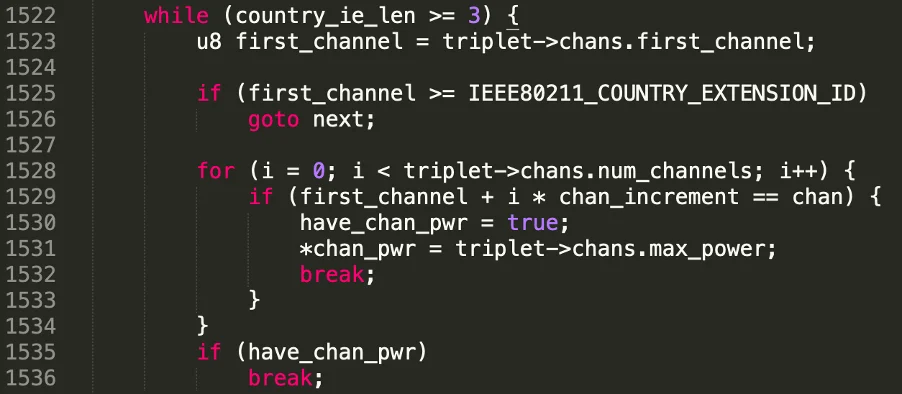
Inside [redacted](), line 1531 assigns chan_pwr from chans.max_power, taken from the country IE.
To confirm, the researcher inspected the wireless side and found "Maximum Transmit Power Level: 40dBm" under the country IE.

The hex dump of that field is 28 hexadecimal, which is 40 decimal, matching the dmesg output. The left-hand side of the calculation is therefore the maximum transmit power from the country IE.
Step 3: identify the right-hand side
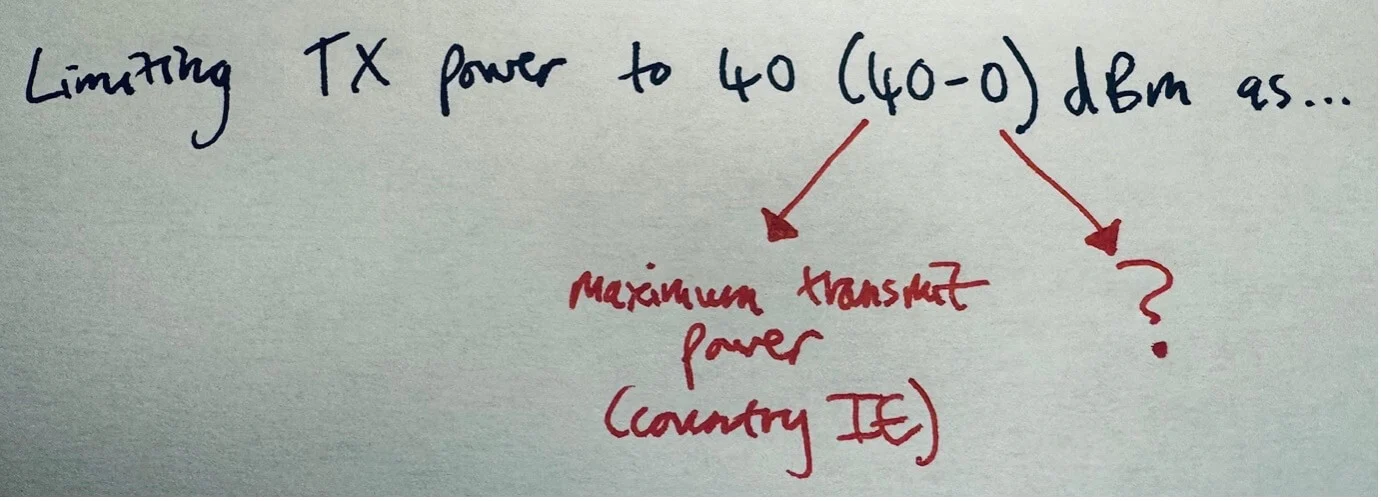
The calculation shows that pwr_reduction_80211h is the right-hand operand.

Back in [redacted](), after extracting chans.max_power into chan_pwr, a second conditional checks whether the frame carries both a maximum transmit power (in the country IE) and a power constraint element. If so, pwr_reduction takes the value of pwr_constr_elem.
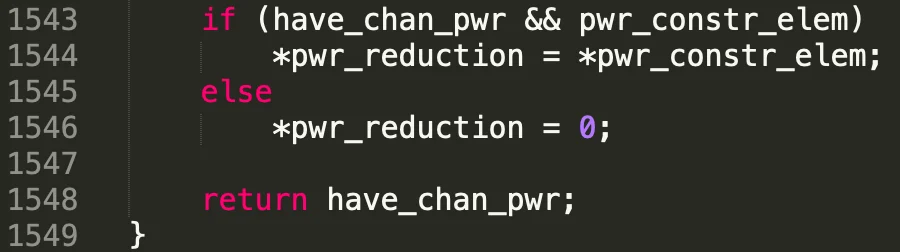
Reading the 802.11h standard explains the element: the Power Constraint IE is set by the access point and tells clients by how much to reduce their power below the regulatory limit for the configured country, the latter being the maximum transmit power in the country IE. That matches the original dmesg output of 40 (40 - 0).

Step 4: build a spoofed beacon
The researcher first tried reconstructing whole beacon, probe response, association and re-association frames from scratch with Scapy. This was painful: Scapy lacked support for building some elements with presets such as Dot11EltRSN and Dot11EltCountry, so raw bytes had to be worked out by hand and inserted with Dot11Elt, then checked by trial and error. The aim was to make the frames believable all the way down to RSN details so a client would act on the power values.
Following the call chain backwards would have led to the caller ieee80211_rx_mgmt_beacon(), which reveals that beacon frames are the relevant type. The researcher found this only after the manual construction effort.
Plan B was simpler: capture a real beacon from the test access point and modify only the bytes that matter. In the baseline beacon, the maximum transmit power byte is 28 hexadecimal (40 decimal). Changing it to 00 sets the advertised maximum to 0.
With the modified beacon transmitted, dmesg on the victim showed:
Limiting TX power to 0 (0 - 0)
The client had been told by a forged beacon to reduce its wireless card's transmit power to 0, reflected as Tx-Power=0 dBm.
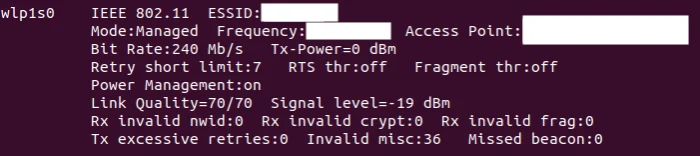
Step 5: deal with the real access point
The effect was not stable: the genuine access point keeps sending beacons with the true value (40 dBm), and the client's card resets its transmit power each time.

A sustained attack therefore requires the forged beacons to keep being sent, likely at a higher volume, as with any denial of service. To measure the impact of the rapid transmit power flipping, the researcher pinged the gateway from the victim and then sent many forged beacons carrying the 0 maximum transmit power.
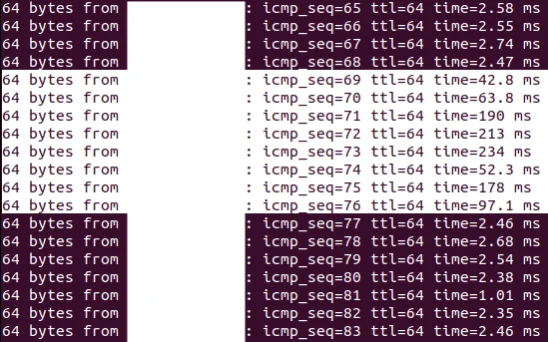
Baseline responses were around 2 ms. While the forged beacons were in the air, making the transmit power flip to 0 and back with the real beacons, response times rose significantly, up to 234 ms. Stopping the forged beacons returned responses to the ~2 ms baseline.
Step 6: manipulate the power constraint element
The second element is the power constraint. In the baseline beacon it has a value of 00 (0), because it reduces nothing from the maximum transmit power on the left, and the right-hand side was always 0 in the original output.

Using vi and xxd, the researcher replaced 00 with 32 hexadecimal, which is 50 decimal. The reasoning: if the baseline is 40 - 0, then 40 - 50 should answer the earlier question about negative values, aiming for -10. The maximum transmit power was left at 40 so only one variable changed at a time.
The result was:
0 (40 - 50)
The calculation was accepted, but no negative number was reported in the transmit power. The researcher notes this may be how a minus input is handled in reality, maybe a crash in other circumstances. The real access point's beacons still override the effect, so keeping the client affected requires the same continuous spoofing approach as with the maximum transmit power.

Root cause
The client takes power values from unauthenticated management frames and acts on them directly. The kernel code path from ieee80211_rx_mgmt_beacon() through ieee80211_handle_pwr_constr() and [redacted]() reads chans.max_power from the country IE and pwr_constr_elem from the power constraint element, then applies the result to the wireless card's transmit power. Nothing verifies that the frame came from the legitimate access point, so a forged beacon with modified bytes is treated the same as a real one. As the researcher puts it, inputs are trusted and acted on without any kind of signature verification.
Impact
An attacker who can transmit forged beacon frames can drive a client's transmit power to 0 dBm, and can also set a power constraint value larger than the maximum transmit power, as shown with 50 against 40. The practical effect measured here is a denial of service: ping response times from the victim to the gateway rose from a ~2 ms baseline to as much as 234 ms while forged beacons were being sent. The effect is only maintained while the forged frames keep arriving, because the real access point's beacons restore the correct values. The researcher also raises the possibility of a crash or other behaviour from negative inputs, without demonstrating one.
Fix
The write-up does not describe a patch or a change made by the vendor. The lesson stated is to never trust inputs and act on them with settings, especially when those inputs are not verified with any kind of signature. The cited prior work, "Protecting Wi-Fi Beacons from Outside Forgeries", covers the broader problem of beacon forgery.
Variants to test
- Other management frame types. The researcher initially built probe response, association and re-association frames before finding that beacons are the relevant type. Sending forged frames of each type with a modified country IE and watching dmesg on a client shows which types the client acts on; a positive result is a changed
Limiting TX powerline. - Other information elements consumed by the kernel. Any IE whose values feed a setting, such as channel or country details, is worth tracing from its dmesg output back to the parsing function; a positive result is a client-side setting that changes on a forged frame.
- Boundary values in the power constraint element. The researcher tried
32hexadecimal (50 decimal) against a maximum of 40. Trying values that produce larger negative results, or values at the element's limits, shows whether the client clamps, wraps or misbehaves; a positive result is an unexpected transmit power, a kernel warning or a crash. - Sustained spoofing against the real access point. Because genuine beacons reset the value, testing at higher frame rates shows how much of the effect can be maintained; a positive result is a client whose response times stay elevated while forged frames continue.
- Other operating systems and drivers. The code path examined is Ubuntu's mac80211; testing clients on other platforms with the same forged beacon shows whether they apply the same values; a positive result is a comparable transmit power change or connectivity degradation.
What happened, in plain words
A security researcher named Tom Neaves was working on something unrelated (Bluetooth research) on his Ubuntu computer when the machine crashed. While looking through the computer's diagnostic log to find out why, he spotted a line about his Wi-Fi card. The line said his wireless card's transmit power had been limited, and the numbers in brackets suggested the limit had been calculated from information sent by the Wi-Fi access point he was connected to.
That was the interesting part. An access point is the box that broadcasts a Wi-Fi network (often called a router). It regularly sends out small announcement messages called beacon frames, which tell nearby devices the network's name and various settings. Those messages are not protected by any password or signature, so anyone with the right tools can create their own copies of them. If the computer blindly trusts a number inside such a message and uses it to change a hardware setting, then anyone who can send a fake message can control that setting.
Tom spent the rest of the article following that number backwards through the Ubuntu source code (the human-readable instructions that make up the operating system), working out exactly which message and which bytes carry it, then building a fake beacon that told a test laptop to reduce its transmit power to zero. The result was a measurable slowdown of the laptop's network connection: a denial of service. He later discovered that another researcher, Mathy Vanhoef, had published a paper on the same general problem in 2020, so this was not the first time it had been found. The value of the article is the walkthrough of how the mechanism works.
Background you need first
A few ideas come up again and again, so here they are from scratch.
Wi-Fi and access points. Your laptop's Wi-Fi card talks to an access point over radio. The access point and the card exchange small structured messages called frames. Some frames carry your data (web pages, video); others are housekeeping, called management frames. Beacon frames are management frames that an access point broadcasts many times per second so devices can find and stay on the network.
Transmit power. A Wi-Fi card can shout loudly or quietly. Higher transmit power means the signal travels further; lower power means it fades sooner. The card's transmit power is a real hardware setting, measured in dBm (decibels relative to one milliwatt, a standard unit for radio signal strength).
Information elements. Management frames are not free-form text. They are built from small labelled chunks called information elements, or IEs. Each IE has an identifier (what kind of information it is) and a value. Two IEs matter here: the Country IE, which carries details about the regulatory rules for a country including a maximum allowed transmit power, and the Power Constraint IE, which tells the device how far below that maximum it should stay.
Regulatory limits. Governments limit how strongly Wi-Fi equipment may transmit, to avoid interfering with other radio users. The Country IE is how an access point tells devices which country's rules apply and what the ceiling is.
dmesg. This is the Linux command that prints the kernel log: messages the operating system's core (the kernel) writes about hardware and drivers. When something happens to your Wi-Fi card, a line often appears there. It is the first place to look when hardware behaves unexpectedly.
Source code and the kernel. Ubuntu is built on Linux. The part of Linux that handles Wi-Fi is called mac80211. Its source code is a large collection of text files that programmers can download and read. Reading it tells you exactly how the system reacts to any given input.
Spoofing. Sending a message that pretends to come from someone else. Because beacon frames carry no signature, a laptop cannot tell a real beacon from a forged one.
Denial of service (DoS). Any attack whose goal is to make something work badly or stop working, rather than to steal data. Slowing a connection to a crawl counts.
Scapy. A Python library (a reusable set of programming tools) for building and sending network packets, including Wi-Fi frames.
vi and xxd. vi is a text editor available on Linux. xxd is a tool that shows a file as hexadecimal bytes (base-16 numbers, where each byte is two characters such as 28 or 00) and can convert edits back. Together they let you change individual bytes of a captured frame.
Ping. A simple command that sends a tiny message to another machine and measures how long the reply takes, in milliseconds (ms). It is the easiest way to measure whether a connection is healthy.
Setting up
The work was done on Ubuntu. Tom downloaded the Ubuntu kernel source code for inspection: nearly 4 GB of files, 74,099 of them. On the wireless side he used Scapy to build frames, and vi plus xxd to edit captured frames byte by byte. A test access point provided a genuine beacon to use as a starting point, and a separate "victim" computer was watched through dmesg while frames were sent. The article does not give a specific kernel version, wireless card model or Scapy version.
Finding it
The discovery was accidental. While doing unrelated Bluetooth research and installing packages, Ubuntu crashed. Searching dmesg for the cause turned up nothing useful, but one line about the wireless interface stood out: the card's transmit power seemed to have been limited based on information from the access point. The values were:
40 (40 - 0)
Read that as: the new transmit power is 40, calculated as 40 minus 0. The first 40 is a ceiling taken from somewhere, and the 0 is an amount to subtract. Three questions followed: can the value be set to 0, can it be set to a negative number, and where exactly is it set, in which type of management frame and at which position in that frame. Since management frames can be spoofed, any value taken from an access point frame and acted on by the client is a candidate for abuse.
Exploitation
Step 1: trace the dmesg string back to the code
The plan was to work backwards from the log line to the code that printed it. Tom searched the Ubuntu source tree for the string "as advertised by", a phrase that appears in the dmesg output. The hit is in /net/mac80211/mlme.c.
The image shows the hit in that file.
The responsible function is ieee80211_handle_pwr_constr(), which produces the dmesg line.
The image shows that function in the source.
The calculation involves three variables: pwr_level_80211h, chan_pwr and pwr_reduction_80211h. To manipulate the outcome, each needs a known source. A variable is just a named box holding a value; the question is who puts the value in the box.
Step 2: find where the values come from
Scrolling up in the function shows a reference to country_ie, the Country information element in a wireless frame, which carries the country string, channel number and similar details. The function calls [redacted](), passing the country IE details in.
The image shows the code around that call.
Inside [redacted](), line 1531 assigns chan_pwr from chans.max_power, taken from the country IE.
The image shows that assignment.
To confirm, Tom inspected the wireless side and found "Maximum Transmit Power Level: 40dBm" under the country IE.
The image shows the maximum transmit power value under the country IE.
The hex dump of that field is 28 hexadecimal, which is 40 decimal, matching the dmesg output. Hexadecimal is base 16: the digits go 0 to 9 then A to F, so 28 means 2 times 16 plus 8, which is 40. The left-hand side of the calculation is therefore the maximum transmit power from the country IE.
The image shows the hex bytes of the frame.
Step 3: identify the right-hand side
The calculation shows that pwr_reduction_80211h is the right-hand operand, the amount being subtracted.
The image shows the calculation in the code.
Back in [redacted](), after extracting chans.max_power into chan_pwr, a second conditional checks whether the frame carries both a maximum transmit power (in the country IE) and a power constraint element. If so, pwr_reduction takes the value of pwr_constr_elem. A conditional is an if-statement: the code only does the next thing when a condition is true.
The image shows that conditional statement.
Reading the 802.11h standard explains the element. 802.11h is a Wi-Fi standard for operating in the 5 GHz band, where radar and satellite systems share the airwaves; it includes rules for reducing power to avoid interference. The Power Constraint IE is set by the access point and tells clients by how much to reduce their power below the regulatory limit for the configured country, the latter being the maximum transmit power in the country IE. That matches the original dmesg output of 40 (40 - 0): a ceiling of 40 with nothing subtracted.
The image relates to the power constraint element.
Step 4: build a spoofed beacon
The first attempt was to reconstruct whole beacon, probe response, association and re-association frames from scratch with Scapy. Probe responses are replies to a device asking what networks are nearby; association and re-association frames are part of joining a network. This was painful: Scapy lacked support for building some elements with presets such as Dot11EltRSN and Dot11EltCountry, so raw bytes had to be worked out by hand and inserted with Dot11Elt, then checked by trial and error. RSN stands for Robust Security Network and covers the security settings of a Wi-Fi network; the aim was to make the frames believable all the way down to those details so a client would act on the power values.
Following the call chain backwards would have led to the caller ieee80211_rx_mgmt_beacon(), which reveals that beacon frames are the relevant type. Tom found this only after the manual construction effort. A caller is the function that invokes another one; reading it tells you what kind of input triggers the code you are looking at.
Plan B was simpler: capture a real beacon from the test access point and modify only the bytes that matter. In the baseline beacon, the maximum transmit power byte is 28 hexadecimal (40 decimal). Changing it to 00 sets the advertised maximum to 0.
With the modified beacon transmitted, dmesg on the victim showed:
Limiting TX power to 0 (0 - 0)
Line by line: the kernel announces it is limiting transmit power; the new value is 0; the calculation is 0 minus 0, because the ceiling itself was changed to 0 and nothing was subtracted. The client had been told by a forged beacon to reduce its wireless card's transmit power to 0, reflected as Tx-Power=0 dBm.
The image shows the victim's dmesg with the limiting line.
Step 5: deal with the real access point
The effect was not stable: the genuine access point keeps sending beacons with the true value (40 dBm), and the client's card resets its transmit power each time.
The image relates to the real access point's beacons resetting the value.
A sustained attack therefore requires the forged beacons to keep being sent, likely at a higher volume, as with any denial of service. To measure the impact of the rapid transmit power flipping, Tom pinged the gateway from the victim and then sent many forged beacons carrying the 0 maximum transmit power. The gateway is the access point itself, the device the laptop sends traffic through to reach the internet.
The image shows the ping results.
Baseline responses were around 2 ms. While the forged beacons were in the air, making the transmit power flip to 0 and back with the real beacons, response times rose significantly, up to 234 ms. Stopping the forged beacons returned responses to the ~2 ms baseline. That is the proof: the attack measurably degrades the connection.
Step 6: manipulate the power constraint element
The second element is the power constraint. In the baseline beacon it has a value of 00 (0), because it reduces nothing from the maximum transmit power on the left, and the right-hand side was always 0 in the original output.
The image shows the power constraint element in the baseline beacon.
Using vi and xxd, Tom replaced 00 with 32 hexadecimal, which is 50 decimal. The reasoning: if the baseline is 40 - 0, then 40 - 50 should answer the earlier question about negative values, aiming for -10. The maximum transmit power was left at 40 so only one variable changed at a time, which is good experimental practice: change one thing, observe, then change the next.
The result was:
0 (40 - 50)
Line by line: the resulting transmit power is 0; the calculation is 40 minus 50, which is -10 in ordinary arithmetic. The calculation was accepted, but no negative number was reported in the transmit power; the card ended up at 0 instead. That answers how a minus input is handled in practice, possibly a crash in other circumstances. The real access point's beacons still override the effect, so keeping the client affected requires the same continuous spoofing approach as with the maximum transmit power.
The image relates to the result of the modified power constraint.
Root cause
The client takes power values from unauthenticated management frames and acts on them directly. The kernel code path from ieee80211_rx_mgmt_beacon() through ieee80211_handle_pwr_constr() and [redacted]() reads chans.max_power from the country IE and pwr_constr_elem from the power constraint element, then applies the result to the wireless card's transmit power. Nothing verifies that the frame came from the legitimate access point, so a forged beacon with modified bytes is treated the same as a real one. As Tom puts it, inputs are trusted and acted on without any kind of signature verification. A signature here would be a cryptographic proof attached to the frame showing who sent it; without one, the receiver has no way to tell real from fake.
Impact
An attacker who can transmit forged beacon frames can drive a client's transmit power to 0 dBm, and can also set a power constraint value larger than the maximum transmit power, as shown with 50 against 40. The practical effect measured here is a denial of service: ping response times from the victim to the gateway rose from a ~2 ms baseline to as much as 234 ms while forged beacons were being sent. The effect is only maintained while the forged frames keep arriving, because the real access point's beacons restore the correct values. Tom also raises the possibility of a crash or other behaviour from negative inputs, without demonstrating one.
Fix
The article does not describe a patch or a change made by the vendor. The lesson stated is to never trust inputs and act on them with settings, especially when those inputs are not verified with any kind of signature. The cited prior work, "Protecting Wi-Fi Beacons from Outside Forgeries", covers the broader problem of beacon forgery.
Variants to test
- Other management frame types. Tom initially built probe response, association and re-association frames before finding that beacons are the relevant type. Sending forged frames of each type with a modified country IE and watching dmesg on a client shows which types the client acts on; a positive result is a changed
Limiting TX powerline. - Other information elements consumed by the kernel. Any IE whose values feed a setting, such as channel or country details, is worth tracing from its dmesg output back to the parsing function; a positive result is a client-side setting that changes on a forged frame.
- Boundary values in the power constraint element. Tom tried
32hexadecimal (50 decimal) against a maximum of 40. Trying values that produce larger negative results, or values at the element's limits, shows whether the client clamps, wraps or misbehaves; a positive result is an unexpected transmit power, a kernel warning or a crash. - Sustained spoofing against the real access point. Because genuine beacons reset the value, testing at higher frame rates shows how much of the effect can be maintained; a positive result is a client whose response times stay elevated while forged frames continue.
- Other operating systems and drivers. The code path examined is Ubuntu's mac80211; testing clients on other platforms with the same forged beacon shows whether they apply the same values; a positive result is a comparable transmit power change or connectivity degradation.
Glossary
- Access point: the device that broadcasts a Wi-Fi network and connects wireless devices to it.
- Beacon frame: a management frame an access point broadcasts regularly to announce the network and its settings.
- Management frame: a Wi-Fi frame used for housekeeping (finding networks, joining, announcing settings) rather than carrying user data.
- Information element (IE): a labelled chunk inside a management frame carrying one piece of information.
- Country IE: the information element carrying country and regulatory details, including a maximum transmit power.
- Power Constraint IE: the information element telling a device how far below the regulatory maximum to keep its transmit power.
- 802.11h: a Wi-Fi standard for the 5 GHz band that includes power reduction rules to avoid interference.
- Transmit power: how strongly a wireless card sends its radio signal, measured in dBm.
- dBm: a unit for radio signal strength, relative to one milliwatt.
- dmesg: the Linux command that shows the kernel's log of hardware and driver messages.
- Kernel: the core part of an operating system that talks to hardware.
- mac80211: the part of the Linux kernel that handles Wi-Fi.
- Source code: the human-readable instructions that make up a program.
- Function: a named block of code that does a specific job and can be called by other code.
- Caller: the function that invokes another function.
- Variable: a named box in a program that holds a value.
- Conditional: an if-statement; code that only runs when a condition is true.
- Hexadecimal: base-16 number notation, where each byte is written as two characters such as
28or00. - Hex dump: a display of raw bytes as hexadecimal numbers.
- Signature: a cryptographic proof attached to a message showing who sent it; without one, a receiver cannot tell real from fake.
- Denial of service (DoS): an attack that makes something work badly or stop working, rather than stealing data.
- Ping: a command that measures how long a small message takes to reach another machine and come back, in milliseconds.
- Millisecond (ms): one thousandth of a second.
- Gateway: the device (here, the access point) that traffic passes through to reach other networks.
- Scapy: a Python library for building and sending network packets and frames.
- Python: a popular programming language.
- Library: a reusable collection of code that saves you writing common tasks yourself.
- vi: a text editor available on Linux.
- xxd: a Linux tool that shows files as hexadecimal bytes and converts edits back.
- RSN (Robust Security Network): the security settings of a Wi-Fi network, carried in a management frame.
- Probe response: a management frame an access point sends in reply to a device asking what networks are nearby.
- Association / re-association frame: management frames exchanged when a device joins or rejoins a network.
- Variable assignment: putting a value into a named box in a program.
- Proof of concept: a working demonstration that an attack or bug is real.


