The gate that gates nothing
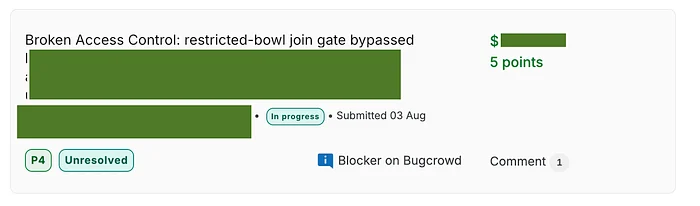
A restricted community area was protected only by a short screening question whose full answer set was disclosed to non-members through a metadata endpoint, with no human review and no rate limiting on submissions. An attacker with any registered account could submit the disclosed options in rapid succession and be auto-approved, gaining access to content and member data that had been redacted beforehand.

medium.com
Published on medium.com
Cybersecurity
The full write-up lives on its author's site
It belongs to its author, so we link to it rather than copy it. The other two tabs are our own rewrites, checked against it.
Context
The target here is a class of feature rather than a single named product: access-controlled community platforms that put a restricted area behind a short screening question. The flow is familiar. A visitor registers, is shown a join dialog with a question and a handful of options, answers it, and is then reviewed and admitted. Until admission, the content and the member data behind the gate are supposed to stay hidden.
On paper this is real access control. The write-up argues that on the platform tested it was not, because the screening question was cosmetic in three compounding ways. The report does not name the platform, the endpoint paths, the parameters or the exact question, so what follows stays at the level of behaviour and method.
Setup
The researcher describes a recent test against an access-controlled community platform with a join gate of this kind. The report does not give the account roles used, the tooling, or any version numbers. The preconditions that matter are the ones the flow itself implies: a registered account that has not yet passed the gate, and the ability to observe the join dialog's metadata request and the protected endpoints before and after passing.
Finding it
The starting observation is a pattern the researcher keeps meeting on community platforms: a restricted area gated behind a short screening question, with content hidden until the answer is accepted and reviewed. The gate looks solid, and the question is whether it actually filters anyone.
Three properties of the implementation made the answer no. Each is unremarkable on its own; together they remove the control entirely.
- The full answer set was disclosed to non-members before they attempted to join. It came back through a metadata endpoint whose only purpose was to render the join dialog, so the secret was shown to anyone who asked.
- There was no human in the loop. A matching answer triggered instant auto-approval, with no leader review, no identity verification and nothing else checked by the server.
- There was no rate limiting on the check. Submitting every disclosed option in under a second was processed without a lockout.
Exploitation
Step 1: Read the answer set from the join dialog metadata
Before answering anything, request the metadata that renders the join dialog. The report does not reproduce the request or the response, but it states the result plainly: the full answer set, a handful of options, was returned to a non-member. The candidate answers are exactly the material a screening question is supposed to withhold, and here they arrived through an endpoint meant only to draw the dialog.
Step 2: Submit the disclosed options in rapid succession
The check itself accepted repeated submissions with no attempt budget and no lockout. Sending every disclosed option in under a second was processed normally. With the answer set already known and no throttling, a correct match was guaranteed within two or three requests in the worst case.
Step 3: Collect the auto-approval
A matching answer triggered instant auto-approval. Nothing else was verified: no leader review, no identity check, no additional server-side condition. The account moved from non-member to member on the strength of the guess alone.
Step 4: Diff the protected endpoints
With membership granted, the same endpoints that had been fully redacted a moment earlier returned content and member data.
Root cause
The design treats the screening question as a control while implementing it as a formality. The answer set is returned by a metadata endpoint meant only to render the dialog, which turns the question into a lookup rather than a test. Approval is granted automatically when an answer matches, with no review step behind it. And the check has no rate limiting, so even without the disclosure the answer space could be walked quickly.
Each of these is a separate weakness, and the report is explicit that none is dramatic alone. The failure is that they compound: disclosure narrows the search space to a handful of known values, the missing lockout makes trying all of them cheap, and auto-approval converts a correct guess directly into access. The path that mattered had no withholding of the options, no attempt budget, and no human decision between a match and admission.
Impact
Any registered account could pass the gate in under three requests and immediately read content and member data that had been fully redacted a moment earlier. The exposure is to whatever sits behind the gate: the restricted content and the member data the platform keeps hidden from non-members. The condition is simply that the platform runs this join flow with the three properties described. The report does not attach a severity, a CVSS score or a bounty to the finding.
Fix
- The report gives no fix. A reasonable change would be to stop returning the answer set through the join dialog metadata and check answers server-side.
- Put an attempt budget and a lockout on the check, so repeated submissions cannot be used to walk the answer space.
- Put a human in the loop, or at minimum additional server-side verification, between a matching answer and admission, so a match is not the same thing as approval.
The researcher's closing point is worth keeping: a barrier existing is not the same as a barrier working, and screening only has value if it screens.
Variants to test
- Pre-join metadata disclosure. Inspect every request the join, quiz or challenge dialog makes before you answer. A positive result is the correct answer, the question text, or anything that narrows the search space coming back to a non-member.
- Rapid repeated submissions. Send the same check many times in quick succession. A positive result is every submission being processed with no attempt budget and no lockout.
- Auto-approval without review. Pass the gate with a matching answer and watch what happens next. A positive result is immediate admission with nothing else verified: no leader review, no identity check, no further server-side condition.
- Before and after diff of protected endpoints. Capture the protected endpoints as a non-member, pass the gate, and capture them again. A clean flip from redacted to full content is your proof that the gate is meant to matter, and therefore that the bypass does.
- Report despite an "intended" response. If you are told the auto-approve behaviour is intended, report it anyway. Intent does not change whether the screening is actually delivered: if the answer space is guessable and there is no lockout, the control fails regardless of what it was designed to do.
What happened, in plain words
Imagine a members-only club with a door. To get in, you have to answer a short question at the door, and then a person inside is supposed to check your answer and decide whether to let you in. Until you are let in, everything inside stays hidden.
That is the idea behind an access-controlled community platform: a website where some content and some information about members is kept behind a join gate. A visitor creates an account, sees a join dialog (a small pop-up window) with a question and a few possible answers, picks one, and is then reviewed and admitted.
On paper, that is real access control. Access control just means deciding who is allowed to see or do what. The gate is the thing that makes that decision.
On a recent test, the researcher found that the gate did not actually decide anything. The screening question was cosmetic, meaning it looked like a check but did not really check. Three things combined to make it useless:
- The full list of possible answers was handed to people who had not even tried to join yet. It came back through a metadata request, which is a request the page makes to the server to get the information it needs to draw the join dialog. The secret was shown to anyone who asked.
- No human was involved. A matching answer triggered instant auto-approval. There was no leader review, no identity verification, and nothing else the server checked.
- There was no rate limiting on the check. Rate limiting means putting a limit on how often someone can do something, like a bouncer who stops you after three tries. Here, submitting every disclosed option in under a second was processed without a lockout, so nothing stopped a person from trying them all.
None of these three is dramatic on its own. Together, they mean the gate filters nobody. Any registered account could pass it in under three requests and immediately read content and member data that had been fully redacted a moment earlier. Redacted means hidden or blanked out.
The lesson: a barrier existing is not the same as a barrier working.
The setup
The target here is not one named product. It is a type of feature: access-controlled community platforms that put a restricted area behind a short screening question. The flow is familiar. A visitor registers, is shown a join dialog with a question and a handful of options, answers it, and is then reviewed and admitted. Until admission, the content and the member data behind the gate are supposed to stay hidden.
The report does not name the platform, the endpoint paths, the parameters or the exact question. An endpoint is simply a specific address on a server that a page talks to, like a particular counter in a shop. A parameter is a piece of information sent along with a request, like writing a note on a form. Because the report leaves those out, what follows stays at the level of behaviour and method.
The researcher describes a recent test against an access-controlled community platform with a join gate of this kind. The report does not give the account roles used, the tooling, or any version numbers. The preconditions that matter are the ones the flow itself implies: a registered account that has not yet passed the gate, and the ability to observe the join dialog's metadata request and the protected endpoints before and after passing.
In plain terms: you need an account that is not yet a member, and you need to be able to watch the traffic between your browser and the server. Watching traffic is what browser developer tools do: they show every request the page makes and every response it gets back. A request is your browser asking the server for something; a response is the server's answer.
Finding it
The starting observation is a pattern the researcher keeps meeting on community platforms: a restricted area gated behind a short screening question, with content hidden until the answer is accepted and reviewed. The gate looks solid, and the question is whether it actually filters anyone.
Three properties of the implementation made the answer no. Each is unremarkable on its own; together they remove the control entirely.
- The full answer set was disclosed to non-members before they attempted to join. It came back through a metadata endpoint whose only purpose was to render the join dialog, so the secret was shown to anyone who asked. Metadata here means data about the dialog, such as the question and the options, rather than the content behind the gate.
- There was no human in the loop. A matching answer triggered instant auto-approval, with no leader review, no identity verification and nothing else checked by the server.
- There was no rate limiting on the check. Submitting every disclosed option in under a second was processed without a lockout.
A useful comparison is a locked door where the key is taped to the handle, the lock opens by itself when the right key goes in, and nobody is watching how many times you try. Each detail is small. Together, the door is open.
Exploitation
Exploitation means actually using the weakness to get in, rather than just suspecting it exists. The report describes four steps.
Step 1: Read the answer set from the join dialog metadata
Before answering anything, request the metadata that renders the join dialog. The report does not reproduce the request or the response, but it states the result plainly: the full answer set, a handful of options, was returned to a non-member. The candidate answers are exactly the material a screening question is supposed to withhold, and here they arrived through an endpoint meant only to draw the dialog.
Why this step was taken: to see whether the page already knows the correct answer before you answer. If the browser has to receive the options in order to draw the dialog, then anyone can read them, and the question stops being a test and becomes a lookup. A lookup means you just find the answer in a list instead of working it out.
Step 2: Submit the disclosed options in rapid succession
The check itself accepted repeated submissions with no attempt budget and no lockout. An attempt budget is a cap on how many tries you get. Sending every disclosed option in under a second was processed normally. With the answer set already known and no throttling, a correct match was guaranteed within two or three requests in the worst case.
Why this step was taken: to see whether the server slows you down or stops you after a few tries. If it does not, then even a short list of options can be tried in full almost instantly, and the question cannot protect anything.
Step 3: Collect the auto-approval
Nothing else was verified: no leader review, no identity check, no additional server-side condition. The account moved from non-member to member on the strength of the guess alone.
Why this step was taken: to see what happens after a correct answer. If a match is the same thing as admission, then the only thing standing between a stranger and the members' area is knowing one of a few options, which step 1 already gave away.
Step 4: Diff the protected endpoints
With membership granted, the same endpoints that had been fully redacted a moment earlier returned content and member data.
A diff means comparing two things to see what changed. Here it means capturing the protected endpoints as a non-member, passing the gate, and capturing them again. If the same request goes from hidden to full content, that shows the gate really was doing something, and therefore that getting around it really is a problem.
Root cause
Root cause means the underlying reason the weakness exists, not just where it showed up.
The design treats the screening question as a control while implementing it as a formality. The answer set is returned by a metadata endpoint meant only to render the dialog, which turns the question into a lookup rather than a test. The client is your browser, the program on your computer that talks to the server. Approval is granted automatically when an answer matches, with no review step behind it. A string match means comparing text exactly, character for character. And the check has no rate limiting, so even without the disclosure the answer space could be walked quickly. The answer space is the set of all possible answers.
Each of these is a separate weakness, and the report is explicit that none is dramatic alone. The failure is that they compound: disclosure narrows the search space to a handful of known values, the missing lockout makes trying all of them cheap, and auto-approval converts a correct guess directly into access. The path that mattered had no withholding of the options, no attempt budget, and no human decision between a match and admission.
Server-side means the work happens on the server, where the user cannot see or change it, as opposed to in the browser, where the user can. Withholding the options server-side would mean the browser never receives the correct answer at all.
Impact
Impact means what an attacker could actually do with the weakness.
Any registered account could pass the gate in under three requests and immediately read content and member data that had been fully redacted a moment earlier. The exposure is to whatever sits behind the gate: the restricted content and the member data the platform keeps hidden from non-members. The condition is simply that the platform runs this join flow with the three properties described. The report does not attach a severity, a CVSS score or a bounty to the finding. Severity is a rating of how serious a weakness is, CVSS is a standard scoring system for it, and a bounty is a payment some programmes make for reporting a valid weakness.
Fix
- The report gives no fix. A reasonable change would be to stop returning the answer set through the join dialog metadata and check answers server-side.
- Put an attempt budget and a lockout on the check, so repeated submissions cannot be used to walk the answer space.
- Put a human in the loop, or at minimum additional server-side verification, between a matching answer and admission, so a match is not the same thing as approval.
The researcher's closing point is worth keeping: a barrier existing is not the same as a barrier working, and screening only has value if it screens.
Variants to test
Variants here means other versions of the same idea that you can look for on other sites. The researcher lists five things to check on every join, quiz or challenge gate you come across.
- Pre-join metadata disclosure. Inspect every request the join, quiz or challenge dialog makes before you answer. A positive result is the correct answer, the question text, or anything that narrows the search space coming back to a non-member.
- Rapid repeated submissions. Send the same check many times in quick succession. A positive result is every submission being processed with no attempt budget and no lockout.
- Auto-approval without review. Pass the gate with a matching answer and watch what happens next. A positive result is immediate admission with nothing else verified: no leader review, no identity check, no further server-side condition.
- Before and after diff of protected endpoints. Capture the protected endpoints as a non-member, pass the gate, and capture them again. A clean flip from redacted to full content is your proof that the gate is meant to matter, and therefore that the bypass does.
- Report despite an "intended" response. If you are told the auto-approve behaviour is intended, report it anyway. Intent does not change whether the screening is actually delivered: if the answer space is guessable and there is no lockout, the control fails regardless of what it was designed to do.
Glossary
- Access control: the part of a system that decides who is allowed to see or do what.
- Access-controlled community platform: a website where some content and member information is kept behind a gate that only admitted members can pass.
- Answer set: the full list of possible answers to a screening question.
- Answer space: all the possible answers someone could try; the smaller it is, the easier it is to guess through.
- Attempt budget: a cap on how many tries a person gets at a check.
- Auto-approval: admission granted automatically the moment a condition is met, with no person deciding.
- Bounty: a payment some programmes make to someone who reports a valid weakness.
- Bypass: getting past a control without satisfying it properly.
- Client: the program on your side, usually your browser, that sends requests and receives responses.
- Compound: when several small weaknesses combine so that the total effect is much larger than any one alone.
- Control: a safeguard meant to prevent something, such as a gate meant to keep non-members out.
- Cosmetic: present in appearance only; it looks like a check but does not really check.
- CVSS: a standard scoring system for rating how serious a weakness is.
- Diff: a comparison of two captures of the same thing to see what changed.
- Disclosure: revealing information that was supposed to stay hidden.
- Endpoint: a specific address on a server that a page talks to for a particular purpose.
- Exploitation: actually using a weakness to gain something, rather than only suspecting it exists.
- Impact: what an attacker could actually do with a weakness.
- Join dialog: the small pop-up window shown when someone tries to join, containing the screening question and its options.
- Lockout: a block that stops further attempts after too many tries.
- Lookup: finding an answer in a list rather than working it out.
- Metadata: data about something, such as the question and options needed to draw a dialog, rather than the content itself.
- Metadata endpoint: the endpoint whose only job is to supply that data so the dialog can be drawn.
- Non-member: a registered account that has not yet passed the gate.
- Parameter: a piece of information sent along with a request.
- Precondition: something that must already be true before a test can be carried out.
- Protected endpoint: an endpoint whose response is supposed to be hidden from non-members.
- Rate limiting: limiting how often someone can do something in a given time.
- Redacted: hidden or blanked out.
- Request: your browser asking the server for something.
- Response: the server's answer to a request.
- Root cause: the underlying reason a weakness exists.
- Screening question: a short question used to decide whether someone should be admitted.
- Server: the computer that holds the content and decides what to send back.
- Server-side: happening on the server, where the user cannot see or change it.
- Severity: a rating of how serious a weakness is.
- String match: comparing text exactly, character for character.
- Throttling: deliberately slowing down or limiting repeated actions.
- Variant: another version of the same idea, looked for on other sites.

