The Illusion of Instant Block
The site allowed deactivating a user, but existing sessions remained valid and retained pre-deactivation privileges, so a blocked user could still change their name and block or delete other admins. Additionally, the status field was mass-assignable in the profile-update request, letting a blocked user lift their own block.

medium.com
Published on medium.com
Bug Bounty
The full write-up lives on its author's site
It belongs to its author, so we link to it rather than copy it. The other two tabs are our own rewrites, checked against it.
Context
The target is a SaaS platform with user and admin accounts. The feature under test lets a user deactivate (block) any other user, including an Admin. The write-up does not name the product or the program, and gives no versions or endpoint paths. The author's question is simple: when you deactivate someone, is that really the end of it?
The answer, in this case, was no. The platform marked the account as blocked but left the account's existing sessions alive, so a deactivated user kept talking to the server with the privileges they had before deactivation. A second, related flaw let a blocked user lift their own block by injecting a status field into the profile-update request.
Setup
The report describes two scenarios, both reproduced from an ordinary user account on the same platform:
- A user is deactivated by someone else (the report notes the feature allows deactivating even an Admin). The researcher then checks whether the deactivated account can still act.
- While reproducing the first issue, the researcher inspects the profile-update request and tries to add fields to it.
The report does not list specific tools, browser versions, or the number of accounts used.
Finding it
The researcher started by understanding how the deactivation feature works, then tried to break it. Looking at the second user's account, the block was indeed in place. But the site never invalidated the old sessions: they stayed alive and kept communicating with the server as if nothing had changed.
The existing session remained valid and retained the account's pre-deactivation privileges. That is the first finding: deactivation changes the account's state but not the authority of sessions already issued.
Exploitation
Step 1: act from a deactivated account
With the account blocked, the researcher used the still-valid session to change the account's name as a simple proof of concept. From the same "deactivated" account they also blocked other users and deleted other admins.
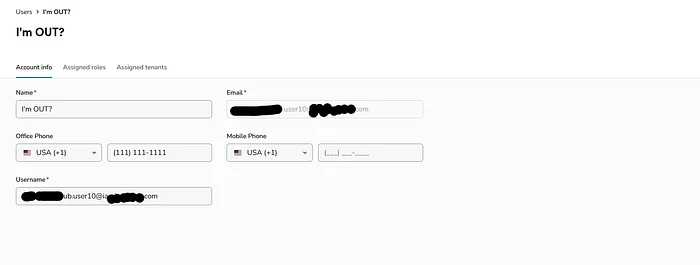
The screenshot shows the name change used as proof. The report does not include the raw request or response for this step, only the description of what was done from the blocked session.
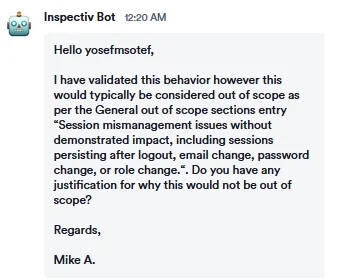
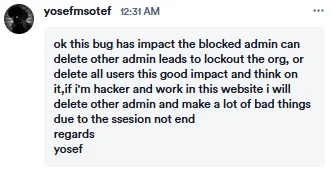
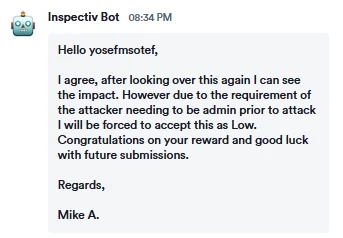
The triager was about to close the report as Out of Scope, and the researcher walked him through the actual impact. The report was then accepted.
Step 2: spot the status field in a response
While reproducing the first issue (user gets blocked, then we check whether they can still interact with the system and change anything while blocked), the researcher noticed that when the name was changed, the response came back with "status": "BLOCKED".
Step 3: replay status in the profile-update request
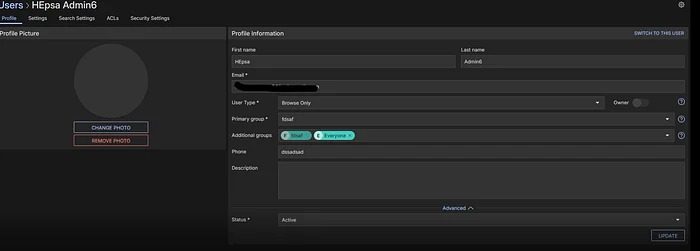
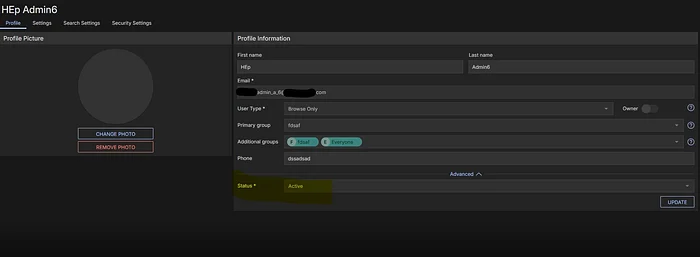
The next idea was to take that parameter and throw it back into the request that edits any profile field. By manually injecting the parameter into the request body, the researcher was able to modify the status. The report calls this a textbook mass assignment vulnerability.
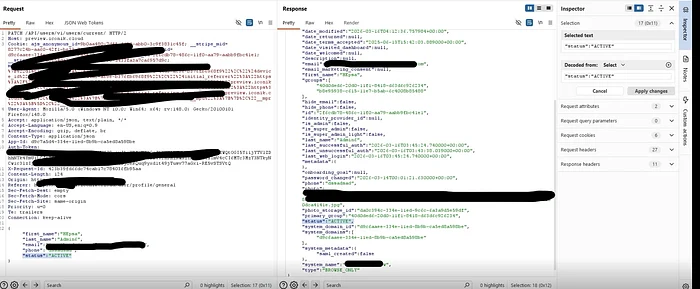
The report does not reproduce the request body or the exact value sent. What it does show is the result from the admin's side: the user had lifted the block off themselves.
Step 4: try the same with permissions
The obvious follow-up: if status was injectable, what about permissions? The researcher grabbed the permissions field from a legitimate response and replayed it in the profile-update request using the exact same approach. This one was properly validated server-side and was rejected. The mass assignment issue was therefore scoped to the status field and was not a full privilege-escalation path.
Root cause
The report's own reading of the first issue is that the application validated the account status during authentication but failed to revoke existing sessions or enforce the blocked state on subsequent requests. Authentication happened once; after that, the session carried the old privileges and nothing re-checked whether the account was still allowed to act.
For the second issue, injecting a status field into the profile-update request body changed the account's status. The permissions field was validated server-side and rejected, so the mass assignment was scoped to status. The report does not show the server-side code, so the exact implementation is not visible; .
Impact
A blocked account kept its pre-deactivation privileges through its existing session. In the researcher's demonstration that meant renaming the account, blocking other users, and deleting other admins, all from the "deactivated" account. The report frames this as an organisational problem on a SaaS platform: a user who is supposed to be locked out can still remove or delete assets, remove members, or block them outright, while the operator believes the block holds.
Separately, a blocked user could clear their own block by injecting status into the profile-update request. Because permissions was rejected, this did not escalate to a higher role; the impact of the mass assignment is limited to the block state itself.
Fix
Based on the root cause it identifies, two changes are needed:
- Revoke or invalidate existing sessions when an account is deactivated, and enforce the blocked state on every subsequent request rather than only at authentication.
- Stop accepting
statusfrom the profile-update body, or validate it server-side the waypermissionsalready is, so a user cannot change their own block state.
Variants to test
- Session survival after deactivation. Block an account while it holds a live session, then replay a privileged request from that session. A positive result is any successful state change after the block.
- Session survival after role change or removal. Demote or remove a user and replay requests from their old session. A positive result is the old role still being honoured.
- Field injection on profile update. Take fields seen in responses (
status,role,permissions, verification flags) and add them to the update body one at a time. A positive result is the field being applied; a rejected field, as withpermissionshere, shows server-side validation is present for that one. - Self-unblock via mass assignment. As a blocked user, try to set the block state back through any endpoint that edits the account. A positive result is the admin view showing the block removed.
- Other state fields on the same handler. If
statusis writable, check adjacent fields such as activation or suspension flags in the same request. A positive result is any state change the user should not control.

What happened, in plain words
A security researcher found two related problems on a website that lets people manage other users. The site had a feature to deactivate (block) any user, even an admin. The researcher asked a simple question: when you block someone, does that really stop them? The answer was no. The blocked user's existing login session stayed alive, so they could still do things like change their name, block other users, and even delete other admins. Then the researcher found a second issue: by adding a hidden field called status to a request that updates a profile, a blocked user could remove their own block. The report was initially going to be closed as out of scope, but the researcher explained the real impact and it was accepted.
This article explains both issues from scratch, assuming you only know how to use a browser. We will go step by step and explain every term. The report does not name the product or the program, and gives no versions or endpoint paths.
Background: what is a SaaS platform and what is a session?
A SaaS platform (Software as a Service) is a website you use online without installing anything, like an online shop or a project management tool. It usually has user accounts and admin accounts. Admins can manage other users: create them, block them, delete them.
When you log in to a website, the server gives your browser a small piece of data called a session cookie (or just session). Your browser sends it with every request so the server knows who you are. Think of it like a wristband at an event: you show it once at the entrance, and after that you can move around freely. The server checks the wristband on each request, but it does not re-check your ID every time.
A request is a message your browser sends to the server, asking for something or telling it to do something. A response is the server's reply. An API (Application Programming Interface) is the set of URLs and rules the website uses to talk to its server. When you click a button, your browser sends an API request in the background.
The feature under test
The platform had a feature that lets a user deactivate (block) any other user, including an Admin. The report does not name the product or the program. The researcher's question was: when you deactivate someone, is that really the end of it?
The answer, in this case, was no. The platform marked the account as blocked but left the account's existing sessions alive. So a deactivated user kept talking to the server with the privileges they had before deactivation. A second, related flaw let a blocked user lift their own block by injecting a status field into the profile-update request.
Setup
The report describes two scenarios, both reproduced from an ordinary user account on the same platform:
- A user is deactivated by someone else (the report notes the feature allows deactivating even an Admin). The researcher then checks whether the deactivated account can still act.
- While reproducing the first issue, the researcher inspects the profile-update request and tries to add fields to it.
The report does not list specific tools, browser versions, or the number of accounts used.
Finding it
The researcher started by understanding how the deactivation feature works, then tried to break it. Looking at the second user's account, the block was indeed in place. But the site never invalidated the old sessions: they stayed alive and kept communicating with the server as if nothing had changed.
The existing session remained valid and retained the account's pre-deactivation privileges. That is the first finding: deactivation changes the account's state but not the authority of sessions already issued.
Exploitation
Step 1: act from a deactivated account
With the account blocked, the researcher used the still-valid session to change the account's name as a simple proof of concept. From the same "deactivated" account they also blocked other users and deleted other admins.
The screenshot shows the name change used as proof. The report does not include the raw request or response for this step, only the description of what was done from the blocked session.
The triager was about to close the report as Out of Scope, and the researcher walked him through the actual impact. The report was then accepted.
Step 2: spot the status field in a response
While reproducing the first issue (user gets blocked, then we check whether they can still interact with the system and change anything while blocked), the researcher noticed that when the name was changed, the response came back with "status": "BLOCKED".
Step 3: replay status in the profile-update request
The next idea was to take that parameter and throw it back into the request that edits any profile field. By manually injecting the parameter into the request body, the researcher was able to modify the status. The report calls this a textbook mass assignment vulnerability.
The report does not reproduce the request body or the exact value sent. What it does show is the result from the admin's side: the user had lifted the block off themselves.
Step 4: try the same with permissions
The obvious follow-up: if status was injectable, what about permissions? The researcher grabbed the permissions field from a legitimate response and replayed it in the profile-update request using the exact same approach. This one was properly validated server-side and was rejected. The mass assignment issue was therefore scoped to the status field and was not a full privilege-escalation path.
Root cause
The report's own reading of the first issue is that the application validated the account status during authentication but failed to revoke existing sessions or enforce the blocked state on subsequent requests. Authentication happened once; after that, the session carried the old privileges and nothing re-checked whether the account was still allowed to act.
For the second issue, injecting a status field into the profile-update request body changed the account's status. The permissions field was validated server-side and rejected, so the mass assignment was scoped to status.
Impact
A blocked account kept its pre-deactivation privileges through its existing session. In the researcher's demonstration that meant renaming the account, blocking other users, and deleting other admins, all from the "deactivated" account. The report frames this as an organisational problem on a SaaS platform: a user who is supposed to be locked out can still remove or delete assets, remove members, or block them outright, while the operator believes the block holds.
Separately, a blocked user could clear their own block by injecting status into the profile-update request. Because permissions was rejected, this did not escalate to a higher role; the impact of the mass assignment is limited to the block state itself.
Fix
Based on the root cause it identifies, two changes are needed:
- Revoke or invalidate existing sessions when an account is deactivated, and enforce the blocked state on every subsequent request rather than only at authentication.
- Stop accepting
statusfrom the profile-update body, or validate it server-side the waypermissionsalready is, so a user cannot change their own block state.
Variants to test
- Session survival after deactivation. Block an account while it holds a live session, then replay a privileged request from that session. A positive result is any successful state change after the block.
- Session survival after role change or removal. Demote or remove a user and replay requests from their old session. A positive result is the old role still being honoured.
- Field injection on profile update. Take fields seen in responses (
status,role,permissions, verification flags) and add them to the update body one at a time. A positive result is the field being applied; a rejected field, as withpermissionshere, shows server-side validation is present for that one. - Self-unblock via mass assignment. As a blocked user, try to set the block state back through any endpoint that edits the account. A positive result is the admin view showing the block removed.
- Other state fields on the same handler. If
statusis writable, check adjacent fields such as activation or suspension flags in the same request. A positive result is any state change the user should not control.
Glossary
- API: the set of URLs and rules a website uses to talk to its server; when you click a button, your browser sends an API request in the background.
- Authentication: the process of proving who you are, usually by logging in with a username and password.
- Cookie: a small piece of data a website stores in your browser; a session cookie identifies your logged-in session.
- Deactivate (block): to mark an account as disabled so the user cannot use it.
- Endpoint: a specific URL that an API exposes for a particular action, such as updating a profile.
- Field: a named piece of data in a request or response, like
statusorpermissions. - Handler: the part of the server code that processes a particular request.
- Mass assignment: a vulnerability where a program automatically copies fields from a user's request into an internal object without checking which fields the user is allowed to set.
- Out of scope: a report that the bug bounty program decides is not eligible for a reward, often because it is not considered a security issue.
- Parameter: another word for a field in a request.
- Privilege: the level of access an account has, such as a normal user or an admin.
- Privilege escalation: gaining a higher level of access than you are supposed to have.
- Request: a message your browser sends to a server asking it to do something.
- Response: the server's reply to a request.
- SaaS: Software as a Service; a website you use online without installing anything.
- Session: a period of interaction between your browser and a server, identified by a session cookie; it lets the server remember you are logged in.
- Session cookie: a cookie that holds the identifier for your session.
- Triager: the person who first reviews a bug bounty report and decides whether it is valid.
- Vulnerability: a weakness in a system that can be exploited to cause harm.

