The Owner Removed Me… But I Could Still Cancel Reservations
A removed restaurant waiter's old session token still worked, letting them read new reservations and customer personal data. The reservation response also exposed a guest token that allowed cancelling bookings without logging in.

I discovered that even after being removed, the waiter’s old session could still access new reservations and expose customers’ personal information.
The full write-up lives on its author's site
It belongs to its author, so we link to it rather than copy it. The other two tabs are our own rewrites, checked against it.
Context
This is a write-up about a restaurant reservation platform. The product has two sides. On the staff side, a restaurant administrator can invite employees, such as waiters, and those employees use an authenticated API to read reservation information. On the guest side, customers manage their own bookings through a widget page that is reached with a link containing a restaurant identifier and a guest token.
The feature at the centre of the report is the unread reservations endpoint, which staff clients call to retrieve reservation information for a restaurant. The report does not name the platform.
Setup
The researcher used two accounts:
- Account 1: Restaurant Administrator, registered as
[redacted]. - Account 2: Waiter invited to the restaurant, registered as
[redacted].
The only tool mentioned is Burp Suite, specifically Repeater, where the captured request was kept for later testing.
Finding it
The researcher logged in as the waiter and captured the request that retrieves reservation information:
GET /api/v1/restaurants/{restaurant_uuid}/reservations/unread
Authorization: Bearer {Waiter_Toekn}
The request is scoped to a restaurant by restaurant_uuid and authenticated with the waiter's bearer token. It was saved in Repeater.
Then the administrator removed the waiter from the restaurant, so the waiter was no longer a member.
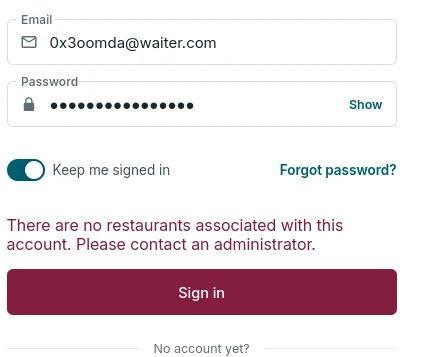
The expectation was that the old session would lose access immediately. Instead, replaying the captured request with the same session still worked. The backend was accepting a session belonging to a user who had already been removed. That is the first thing that looked wrong: removal from the restaurant did not invalidate the session or the authorisation attached to it.
Exploitation
Step 1: Confirm the removed waiter still reads reservations
The captured request was resent unchanged after removal:
GET /api/v1/restaurants/{restaurant_uuid}/reservations/unread
Authorization: Bearer {Waiter_Toekn}
It still returned data. The session of a user who is no longer a member of the restaurant continued to be accepted by the backend.
Step 2: Check whether new reservations are affected
The next question was whether this only affected reservations that existed before the removal, or newly created ones too. The researcher created a new test reservation after removing the waiter, then sent the request again with the old waiter token:
GET /api/v1/restaurants/{restaurant_uuid}/reservations/unread
Authorization: Bearer {old_waiter_token}
The response included the new reservation.
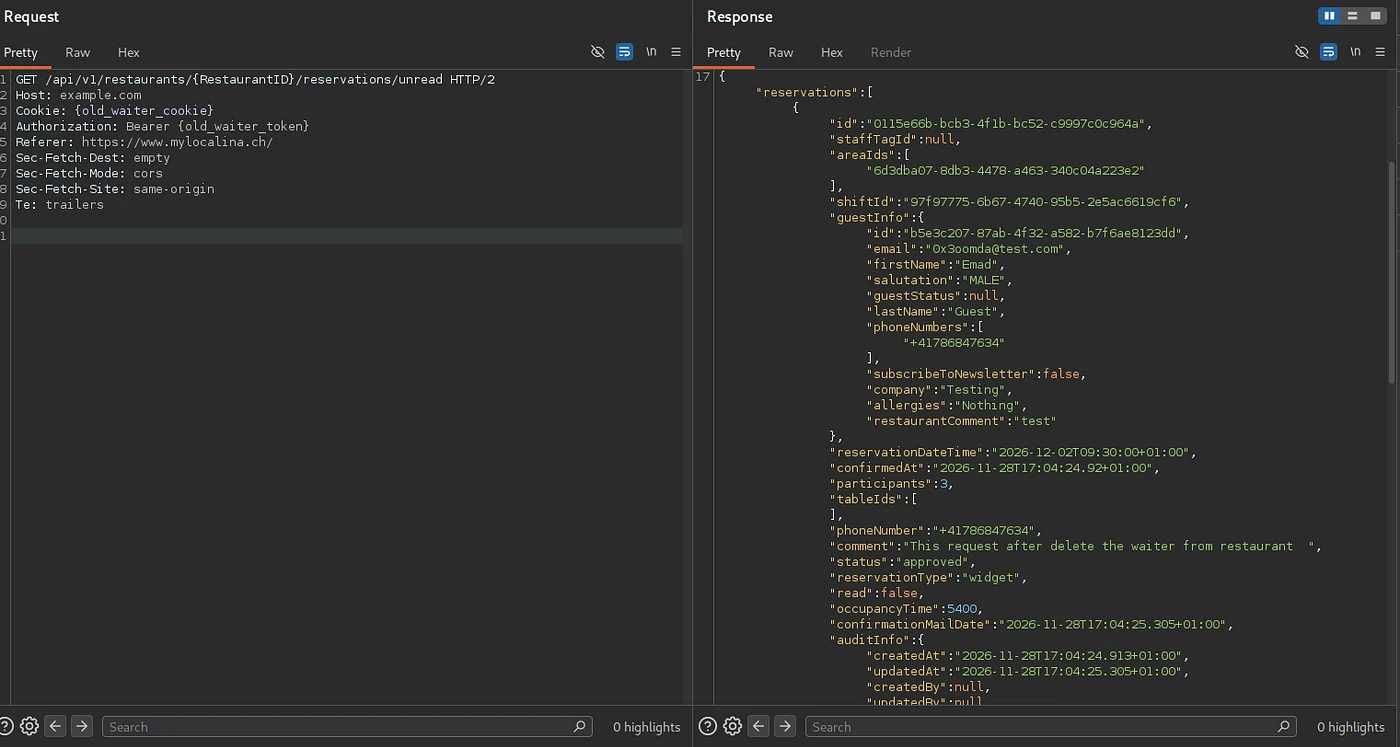
So the stale session was not limited to historical data: it kept receiving current reservation information. The researcher also noticed that the response contained reservation identifiers, which opened the next line of enquiry.
Step 3: Read reservation details without authentication
Using the reservation IDs from the previous response, the researcher looked for other endpoints and found one that returned reservation details without authentication:
GET /api/v1/public/restaurants/{restaurant_uuid}/reservations/{reservation_uuid}
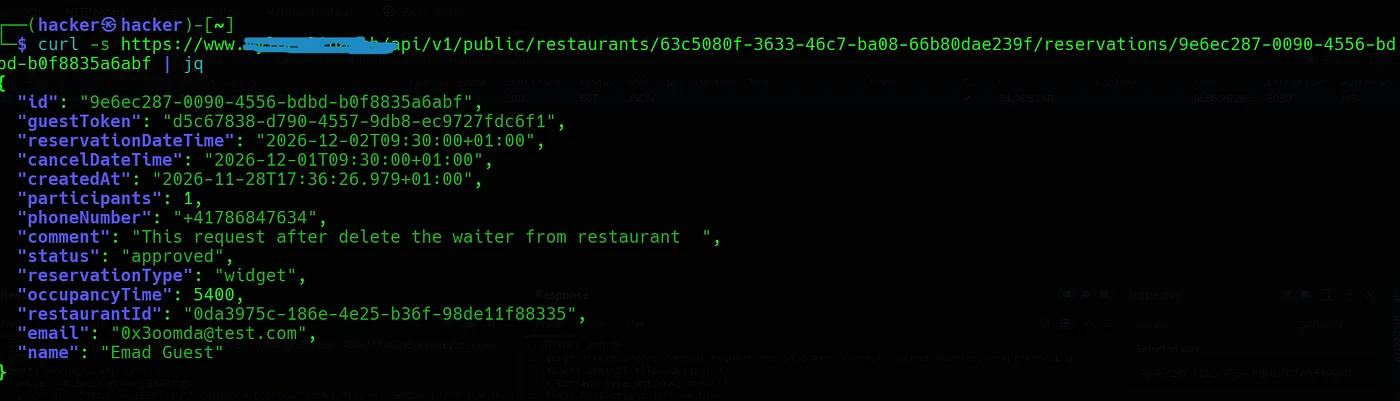
The response exposed sensitive customer information, including:
- Customer name
- Email address
- Phone number
- Reservation date and time
- Reservation status
guestToken
One field stood out: guestToken. The researcher set out to understand what that token actually allowed.
Step 4: Use the guest token to reach the guest interface
The platform's guest side uses the token in a widget URL. The researcher opened the following URL in a browser:
https://www.example.com/widget?id={restaurant_id}&[redacted]
The guest reservation page loaded without requiring authentication. Using the exposed token, the researcher could access the reservation management interface and cancel the associated booking.
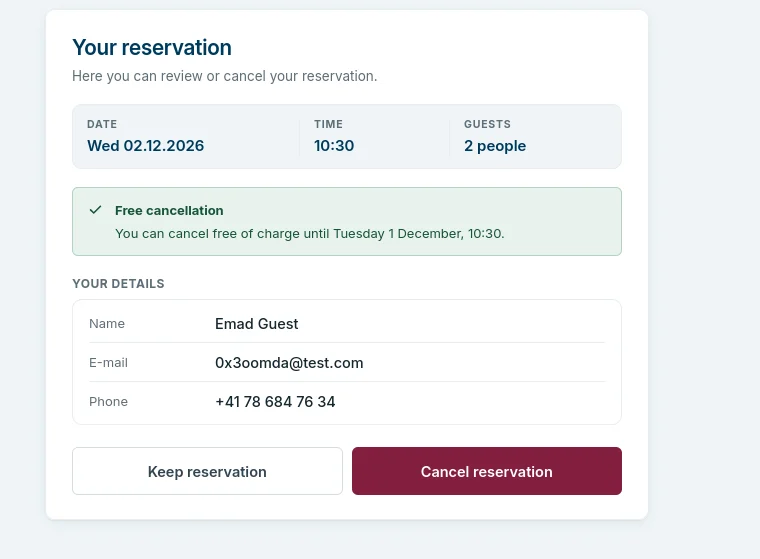
With that, the removed waiter could cancel both new and old reservations without being a member of the restaurant.
Root cause
The report describes the behaviour but does not show the code, so the following is inferred from what was observed.
Two weaknesses combine. First, the staff API authorises requests against a session that survives removal from the restaurant: the backend kept accepting the removed waiter's bearer token for the unread reservations endpoint, including for reservations created after the removal. Likely the session or token is not invalidated when membership is revoked, and the authorisation check does not re-verify current membership on each request.
Second, the public reservation details endpoint returns full reservation data, including the guestToken, without authentication. The guest token is then sufficient on its own to open the guest management interface and cancel the booking, so possession of the token is treated as authorisation for that action.
Impact
The report describes two impacts.
- Customer PII disclosure. A removed waiter could continue accessing new reservations and retrieve customers' personal information, including names, email addresses and phone numbers.
- Unauthorised reservation cancellation. The exposed
guestTokenallowed access to the guest reservation interface and enabled cancellation of the associated reservation without authentication.
Together, these issues could allow someone retaining access to reservation data to expose customer information and interfere with restaurant bookings. The impact depends on the attacker still holding a valid session from before removal, and on the public endpoint continuing to return the guestToken alongside the reservation details.
Fix
The report does not state what was changed. Based on the two weaknesses, the fixes would be to invalidate or re-check staff sessions and membership on every request so that removal from a restaurant takes effect immediately, and to stop returning the guestToken from an unauthenticated endpoint, or to require authentication and authorisation before reservation details are returned.
Variants to test
- Removed staff member replays a read request. Invite a low-privilege user, capture a request, remove the user, then replay it. A positive result is a successful response containing data created after the removal.
- Role change instead of removal. Downgrade a staff member's role and replay requests that the old role allowed. A positive result is that the old privileges still work.
- Other staff endpoints after removal. Replay requests for reservation lists, customer records and similar resources. A positive result is any endpoint that still returns data to the removed account.
- Unauthenticated detail endpoints. Take identifiers from an authenticated response and request the corresponding detail endpoint without a token. A positive result is a response containing customer data or a token.
- Token fields in responses. Look for fields such as
guestTokenin reservation or booking responses, then try them against the guest-facing widget or management URL. A positive result is a management interface that loads and permits actions such as cancellation without login.
Hunting notes
This kind of bug tends to hide where membership and roles are managed separately from sessions: invitation and removal flows, role changes, and any endpoint that authorises on a token without re-checking current membership. The signal during testing is simple: capture a request as a low-privilege member, have an administrator remove or downgrade that member, and replay the request. If it still succeeds, the session outlives the membership.
The second half is about what responses carry. Reservation and booking objects often include identifiers and tokens meant for the guest side. Grepping authenticated responses for token-like fields and then trying them against public or guest URLs is a quick way to find a path from an authenticated read to an unauthenticated action.
To show impact, the researcher demonstrated both that the removed waiter could read a reservation created after removal and that the leaked guestToken allowed cancelling a booking through the guest interface without authentication. That chain, from stale session to PII to an unauthenticated state-changing action, is what makes the finding concrete.
What happened, in plain words
A restaurant uses a booking website. Staff members, such as waiters, log in to see the restaurant's reservations. Customers book tables through a separate guest page.
The researcher set up two accounts: a restaurant administrator and a waiter. The administrator then removed the waiter from the restaurant, which should mean the waiter loses all access. It did not. The waiter's old login still worked, and it could still read reservations, including brand new ones made after the removal.
Worse, each reservation record contained a special code called a guestToken. The researcher found that this code, on its own, was enough to open the guest booking page and cancel the reservation, with no login at all. So a removed employee could keep seeing customer details and could cancel bookings.
Below, every step is explained from scratch, including the tools and the words used.
Background: what the product is and what the words mean
This is a restaurant reservation platform. It has two sides:
- The staff side. A restaurant administrator can invite employees, such as waiters. Those employees log in and use the platform's API to read reservation information.
- The guest side. Customers manage their own bookings through a widget page. A widget here is a small embedded page, reached by a link that contains a restaurant identifier and a guest token.
A few terms first, because they come up constantly:
- API (Application Programming Interface): the way one piece of software asks another for data. Think of it as a waiter in a restaurant: you (the app) tell the waiter (the API) what you want, and the waiter brings it from the kitchen (the server). You never walk into the kitchen yourself.
- Endpoint: one specific address on that API, for example the address that returns unread reservations. Each endpoint does one job.
- Request: the message an app sends to the server, for example "give me the unread reservations for this restaurant".
- Response: the server's reply, usually containing the data that was asked for.
- Token (or bearer token): a long string of characters that acts like a temporary ID card. Instead of sending a username and password with every request, the app sends the token, and the server checks it. "Bearer" means "whoever carries this token is treated as the logged-in user".
- Session: the period during which the server remembers that you are logged in. The token is what represents that session.
- Authentication: proving who you are, usually by logging in.
- Authorisation: what you are allowed to do once you are logged in. A waiter may read reservations but not change restaurant settings.
- UUID: a long random-looking identifier, such as a restaurant ID or a reservation ID. It is used to point at one specific thing.
- PII (Personally Identifiable Information): data that identifies a real person, such as a name, email address or phone number.
- Access control: the rules that decide who can see or do what. When those rules fail, it is called an access control issue or broken access control.
- Burp Suite and Repeater: Burp Suite is a tool that sits between your browser and a website so you can see and edit the requests. Repeater is one part of it where you can keep a request, change it, and send it again and again to see what happens.
The feature at the centre of the report is the unread reservations endpoint. Staff apps call it to fetch reservation information for a restaurant. The report does not name the platform.
1. Setting up the test
The researcher used two accounts:
- Account 1: Restaurant Administrator, registered as
[redacted]. - Account 2: Waiter invited to the restaurant, registered as
[redacted].
Why two accounts? Because the whole test is about what happens to one person's access when another person removes them. You need an administrator to do the removing, and a waiter to be removed.
The only tool mentioned is Burp Suite, specifically Repeater, where the captured request was kept for later testing.
First, the researcher logged in as the waiter and captured the request that retrieves reservation information:
GET /api/v1/restaurants/{restaurant_uuid}/reservations/unread
Authorization: Bearer {Waiter_Toekn}
Line by line:
GETis the type of request. GET means "read something, do not change anything"./api/v1/restaurants/{restaurant_uuid}/reservations/unreadis the endpoint address.{restaurant_uuid}is a placeholder for the restaurant's unique identifier.reservations/unreadmeans "the reservations that staff have not read yet".Authorization: Bearer {Waiter_Toekn}is a header, an extra piece of information attached to the request. It carries the waiter's token, which tells the server who is asking.{Waiter_Toekn}is a placeholder for the real token (the spelling in the report is kept as written).
The request is scoped to one restaurant by restaurant_uuid and authenticated with the waiter's bearer token. It was saved in Repeater so it could be sent again later without retyping anything.
2. The owner removes the waiter
Next, the researcher switched to the administrator account and removed the waiter from the restaurant. The waiter was no longer a member.
The expectation was simple: once you are removed, your old login should stop working immediately. That is how most people assume access works. To test it, the researcher returned to Burp Repeater and sent the previously captured request again, using the same session.
It still worked.
The backend, meaning the server behind the API, was accepting a session belonging to a user who had already been removed. This is the first thing that looked wrong: removal from the restaurant did not invalidate the session or the authorisation attached to it. In everyday terms, the restaurant took back the waiter's staff badge, but the old badge still opened the staff door.
3. Accessing new reservations
The next question was whether this only affected reservations that existed before the removal, or newly created ones too. This matters: if only old data is visible, the damage is limited to what the waiter already saw. If new data is visible, the removed waiter keeps learning about customers who book after they left.
So the researcher created a new test reservation after removing the waiter. Then the request was sent again with the old waiter token:
GET /api/v1/restaurants/{restaurant_uuid}/reservations/unread
Authorization: Bearer {old_waiter_token}
Line by line:
GETagain means "read, do not change".- The endpoint is the same unread reservations address, for the same restaurant.
- The
Authorizationheader now carries{old_waiter_token}, the token captured before the waiter was removed. Nothing else changed: same request, same token, but the user behind it is no longer a member.
The response included the new reservation.
So the stale session was not limited to historical data: it kept receiving current reservation information. A stale session means a login that should have expired or been revoked but still works. The researcher also noticed that the response contained reservation identifiers, which opened the next line of enquiry. An identifier is just a label that points at one specific reservation, and if you have it, you can ask other parts of the system about that reservation.
4. From PII disclosure to guest token abuse
Using the reservation IDs from the previous response, the researcher looked for other endpoints and found one that returned reservation details without authentication:
GET /api/v1/public/restaurants/{restaurant_uuid}/reservations/{reservation_uuid}
Line by line:
GETmeans read.- The address starts with
/api/v1/public/. The wordpublicsuggests this endpoint is meant to be reachable without logging in, for example by the guest side of the product. {restaurant_uuid}points at the restaurant, and{reservation_uuid}points at one specific reservation.- There is no
Authorizationheader at all. That is the point: the request carries no token, so the server has no idea who is asking.
The response exposed sensitive customer information, including:
- Customer name
- Email address
- Phone number
- Reservation date and time
- Reservation status
guestToken
One field stood out: guestToken. A field here means one named piece of data inside the response. The researcher set out to understand what that token actually allowed. The reasoning is straightforward: if the guest side of the product uses a token to let a customer manage their booking, then anyone holding that token might be treated as that customer.
5. The unexpected discovery: cancelling reservations
The platform's guest side uses the token in a widget URL. The researcher opened the following URL in a browser:
https://www.example.com/widget?id={restaurant_id}&[redacted]
Line by line:
https://www.example.com/widgetis the address of the guest widget page.?starts the query string, the part of a URL that carries extra values.id={restaurant_id}passes the restaurant identifier.&separates the values, and `[redacted] passes the token that was found in the reservation response.
In plain terms, this URL is a link that says "open the guest page for this restaurant, and here is the guest token". The guest reservation page loaded without requiring authentication. Using the exposed token, the researcher could access the reservation management interface and cancel the associated booking.
With that, the removed waiter could cancel both new and old reservations without being a member of the restaurant. The chain is now complete: an old staff login reads reservations, the reservation response leaks a guest token, and the guest token alone is enough to cancel the booking.
Why it worked
The report describes the behaviour but does not show the code, so the following is inferred from what was observed.
Two weaknesses combine.
- The staff API trusts a session that outlives membership. The backend kept accepting the removed waiter's bearer token for the unread reservations endpoint, including for reservations created after the removal. Likely the session or token is not invalidated when membership is revoked, and the authorisation check does not re-verify current membership on each request. In everyday terms, the door checks that you have a badge, but never checks whether the badge has been cancelled.
- The public reservation details endpoint returns too much. It returns full reservation data, including the
guestToken, without authentication. The guest token is then sufficient on its own to open the guest management interface and cancel the booking, so possession of the token is treated as authorisation for that action.
Impact
The report describes two impacts.
- Customer PII disclosure. A removed waiter could continue accessing new reservations and retrieve customers' personal information, including names, email addresses and phone numbers.
- Unauthorised reservation cancellation. The exposed
guestTokenallowed access to the guest reservation interface and enabled cancellation of the associated reservation without authentication.
Together, these issues could allow someone retaining access to reservation data to expose customer information and interfere with restaurant bookings.
The impact depends on the attacker still holding a valid session from before removal, and on the public endpoint continuing to return the guestToken alongside the reservation details.
Fix
The report does not state what was changed. Based on the two weaknesses, the fixes would be:
- Invalidate or re-check staff sessions and membership on every request, so that removal from a restaurant takes effect immediately.
- Stop returning the
guestTokenfrom an unauthenticated endpoint, or require authentication and authorisation before reservation details are returned.
Variants to test
These are the same ideas applied in slightly different situations. Each one follows the same pattern: do something as a low-privilege user, change that user's status, then repeat the request and see whether it still works.
- Removed staff member replays a read request. Invite a low-privilege user, capture a request, remove the user, then replay it. A positive result is a successful response containing data created after the removal.
- Role change instead of removal. Downgrade a staff member's role and replay requests that the old role allowed. A positive result is that the old privileges still work.
- Other staff endpoints after removal. Replay requests for reservation lists, customer records and similar resources. A positive result is any endpoint that still returns data to the removed account.
- Unauthenticated detail endpoints. Take identifiers from an authenticated response and request the corresponding detail endpoint without a token. A positive result is a response containing customer data or a token.
- Token fields in responses. Look for fields such as
guestTokenin reservation or booking responses, then try them against the guest-facing widget or management URL. A positive result is a management interface that loads and permits actions such as cancellation without login.
Hunting notes
This kind of bug tends to hide where membership and roles are managed separately from sessions: invitation and removal flows, role changes, and any endpoint that authorises on a token without re-checking current membership. The signal during testing is simple: capture a request as a low-privilege member, have an administrator remove or downgrade that member, and replay the request. If it still succeeds, the session outlives the membership.
The second half is about what responses carry. Reservation and booking objects often include identifiers and tokens meant for the guest side. Searching authenticated responses for token-like fields, then trying them against public or guest URLs, is a quick way to find a path from an authenticated read to an unauthenticated action.
To show impact, the researcher demonstrated both that the removed waiter could read a reservation created after removal and that the leaked guestToken allowed cancelling a booking through the guest interface without authentication. That chain, from stale session to PII to an unauthenticated state-changing action, is what makes the finding concrete.
Glossary
- API: the way one piece of software asks another for data, without needing to know how the other side works internally.
- Endpoint: one specific address on an API that performs one job, such as returning unread reservations.
- Request: the message an app sends to a server asking for something or asking it to do something.
- Response: the server's reply to a request, usually containing data.
- Header: an extra labelled piece of information attached to a request or response, such as an authorisation token.
- Token: a string of characters that acts like a temporary ID card, proving to the server who is making the request.
- Bearer token: a token where whoever carries it is treated as the logged-in user, with no further proof required.
- Stale session: a login that should have expired or been revoked but still works.
- Broken access control: a failure in those rules, letting someone do more than they should.
- UUID: a long random-looking identifier used to point at one specific thing, such as a restaurant or reservation.
- Widget: a small embedded page, here the guest page used to manage a booking.
- Query string: the part of a URL after the
?that carries extra values, such as an ID and a token. - Burp Suite: a tool that sits between your browser and a website so you can see and edit requests.
- Repeater: the part of Burp Suite where you keep a request, change it, and send it again and again.
- Backend: the server-side system that receives requests and returns data.
- GET: the type of request that means "read something, do not change anything".
- Field: one named piece of data inside a response, such as
guestToken. - Replay: sending a previously captured request again, unchanged or with small edits.

