The Trust Boundaries Hidden Inside Everyday Features: Four Vulnerabilities Discovered Through…
Four separate issues were found: an authentication bypass via a client-controlled header that also enabled SSRF and tenant isolation failure, a shared rate limit causing platform-wide denial of service, a prompt-injection-driven denial of service with information disclosure, and a support assistant that could be steered outside its intended scope. An attacker could gain unauthorised access to internal resources, disrupt all users, crash the assistant, or abuse the assistant for unrelated purposes.
 Published on medium.com
Cybersecurity
The full write-up lives on its author's site
It belongs to its author, so we link to it rather than copy it. The other two tabs are our own rewrites, checked against it.
Context
This write-up collects four vulnerability reports filed over a single research season. Three were against HackerSavanna's own platform, and one was against a private program triaged through HackerSavanna's disclosure ecosystem, redacted in the report as "wantam". The targets are different: an authentication layer, a rate limiter on an AI assistant, a URL summarisation feature in the same assistant, and a support chatbot. The bug classes and severities differ too. What they share is a trust boundary that existed in design but was not enforced where it mattered.
The author's framing is worth keeping in mind while reading: none of the four needed exotic payloads, race conditions or zero-days. Each began with a feature behaving as designed until a single modified request showed that an assumption underneath it was wrong.
Setup
The report does not describe a lab, custom tooling or specific versions. The tooling implied by the narrative is a browser, a proxy, and the ability to send the same request twice with one thing changed. For the second finding, a second account in a separate session was needed. For the third, the researcher used a URL hosted on their own infrastructure plus an out-of-band listener. For the first, an unauthenticated request and then the same request with one added header were enough.
Finding it
The four findings are presented in the order they were discovered.
1. One header, zero credentials, total access
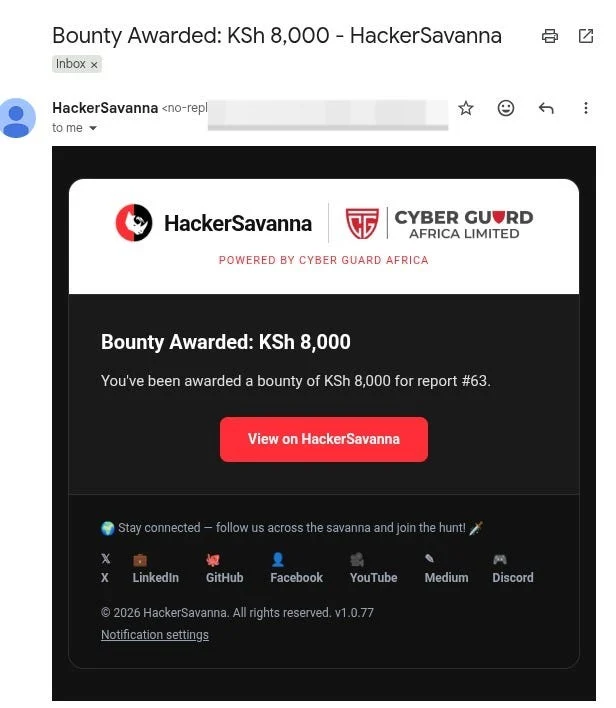
Target: private program, redacted as "wantam". Reward: KSh 8,000 (Report #63).
The starting point was an ordinary authentication test. An unauthenticated request correctly returned 401 Unauthorized. Adding a single custom header changed the result completely:
X-Wantam-Platform: wantam
No token, no cookie, no session. With that header present, the response contained a fully authenticated user context. Further testing showed the effect was not limited to informational endpoints: state-changing functionality that should have required authentication accepted requests solely because the header was present.
The bypass alone was serious. What made the finding more impactful was what the access exposed next. One accessible endpoint triggered internal scanning operations. Because the scanner executed requests from inside the platform's own environment, it effectively became an SSRF primitive.
Initial testing showed obvious inputs such as [redacted] were correctly blocked, but alternative representations were never normalised before validation. The hex-encoded equivalent bypassed the filter entirely:
0x7f000001
The resulting scan output resolved to localhost and returned backend-specific headers that were never observable through the public edge infrastructure, confirming the request had genuinely reached the internal network. Further testing showed cloud metadata endpoints and additional internal addresses were reachable through the same mechanism.
A separate, unrelated issue surfaced during the same assessment: newly registered users were automatically placed into the organisation's live operational tenant rather than an isolated one, exposing internal source code within minutes of account creation.
Root cause
- Authentication based on a client-controlled header.
- SSRF filtering performed on raw strings rather than resolved addresses.
- Improper tenant isolation during onboarding.
Impact
- Authentication bypass.
- Internal SSRF.
- Cloud metadata exposure.
- Tenant isolation failure.
- Unauthorised access to internal resources.
Fix
The header-based bypass was removed, validation logic was moved to occur after resolution rather than on the raw string, and tenant assignment was corrected. The full chain was retested and confirmed fixed.
2. Shared rate limit on the AI assistant
Target: HackerSavanna AI Assistant. Reference: publicly disclosed via SavannaHub, https://www.hackersavanna.com/savannahub/66.
The assistant implemented rate limiting, but the limit was not scoped to the user. After sending several normal messages in quick succession, the assistant began returning a generic error instead of a response. Alongside the error was an internal throttling identifier, an implementation detail that raised the question of how the limiter was actually being tracked.
The critical observation came from testing a second account. A completely unrelated account, authenticated in a separate session with no prior interaction history, received the exact same error on its very first request. The limiter was not tracking individual users; it was tracking the feature itself.
In practice, any researcher could exhaust the shared quota and temporarily deny access to every other researcher on the platform. To affected users the behaviour was indistinguishable from a backend outage, which made it harder to recognise, let alone report.
Root cause
- The rate-limit counter was effectively global rather than user-scoped.
Impact
- Platform-wide denial of service.
- Availability impact affecting all researchers, not just the triggering account.
- Misleading error handling that obscured the actual cause.
Fix
HackerSavanna rescoped the limiter to key requests against the authenticated user rather than a shared counter. The fix was verified and the report publicly disclosed.
3. Prompt injection leading to application-level denial of service
Target: HackerSavanna AI Assistant. Reference: publicly disclosed via SavannaHub, https://www.hackersavanna.com/savannahub/52.
The assistant offered URL summarisation, which means the application accepted untrusted user input and performed outbound requests on the user's behalf. Testing began with a URL hosted under the researcher's own infrastructure. When the assistant was instructed to summarise the page, an out-of-band listener immediately recorded an inbound request originating from HackerSavanna's environment, confirming server-side fetching was taking place.
The next step was to replace the external URL with an internal address. Instead of a summary, the application returned an unhandled server exception complete with stack traces, filesystem paths and internal identifiers. Additional malformed payloads produced the same category of failure.
At first glance this looked like SSRF. During triage, HackerSavanna's team conducted a deeper review and determined that the infrastructure assumptions behind the original SSRF theory did not hold for their deployment. What remained consistently reproducible, and formed the final classification, was a prompt-driven denial-of-service condition capable of crashing the assistant's rendering pipeline while exposing internal implementation details.
Root cause
- Insufficient validation and error handling around AI-driven URL processing.
Impact
- Application-level denial of service.
- Internal information disclosure.
- Exposure of implementation details useful for further attacks.
Fix
The issue was patched and publicly disclosed as a prompt-injection-driven DoS rather than the originally reported SSRF. The report notes that accurate classification matters as much as finding the bug.
4. AI support assistant failed to enforce its own scope restrictions
Target: HackerSavanna Support Assistant. Reference: SavannaHub disclosure #74, https://www.hackersavanna.com/savannahub/74.
The support assistant advertised itself as limited to bug bounty hunting, report writing, platform guidance and research onboarding. That restriction existed entirely inside the model's instructions, with no server-side enforcement layer behind it.
After a short conversational detour and one deliberately vague follow-up, the assistant stopped applying the restriction entirely. Requests with no relation to bug bounty research were answered normally, with no acknowledgement that they fell outside its stated purpose.
Unlike the previous three findings, this was not a confidentiality or integrity issue. The impact was operational: an assistant budgeted, tuned and deployed for a specific function could be redirected into general-purpose use simply by steering the conversation off-topic.
Root cause
- Reliance on prompt-based policy enforcement with no server-side validation.
Impact
- Resource abuse.
- Increased inference costs.
- Loss of the assistant's intended operational scope.
Fix
Scope validation was moved into application logic rather than relying solely on model instructions. The behaviour was no longer reproducible after remediation.
Root cause
The common failure across all four findings is the same. A security control existed, the application trusted that the control was being enforced, and the enforcement lived in the wrong place.
The rate limiter trusted a global counter. The AI assistant trusted input it had not validated. The authentication layer trusted a user-controlled header. The support assistant trusted a system prompt to behave like an access-control mechanism. In each case the feature worked exactly as intended until the assumption behind it was questioned.
Impact
The first finding combined an authentication bypass that reached state-changing functionality with an SSRF primitive that reached localhost, cloud metadata endpoints and other internal addresses, plus a tenant isolation failure that exposed internal source code to newly registered users. The second is a platform-wide availability issue affecting every researcher, disguised as a backend outage. The third is an application-level DoS with internal information disclosure. The fourth is operational: resource abuse, increased inference costs and loss of the assistant's intended scope.
Fix
All four reports were triaged, remediated and verified. Three were publicly disclosed through HackerSavanna's SavannaHub. The specific changes were: removal of the header-based bypass, SSRF validation moved to occur after resolution, corrected tenant assignment, user-scoped rate limiting, patched URL processing with better error handling, and server-side scope validation for the support assistant.
Variants to test
- Client-controlled authentication headers. Send the same request with and without any custom header the application mentions, and compare the response. A positive result is a change from
401 Unauthorizedto an authenticated context, especially on state-changing endpoints. - Alternative IP representations in SSRF filters. Where
[redacted]is blocked, try hex, octal, decimal and IPv6 forms, and check whether the filter runs before or after DNS resolution. A positive result is a response that resolves to localhost or returns backend-specific headers not visible at the edge. - Cloud metadata reachability. From any server-side fetch primitive, test whether metadata endpoints and additional internal addresses are reachable. A positive result is a response from a metadata endpoint or internal address that should not be reachable from outside.
- Tenant assignment on registration. Create a fresh account and inspect what it can see immediately. A positive result is a fresh account landing in the live operational tenant and seeing internal source code.
- Rate-limit scoping. Exhaust a quota from one account, then make a first request from a second, unrelated account in a separate session. A positive result is the same throttling error on the second account's first request.
- URL summarisation features. Point the feature at a URL you control with an out-of-band listener, then at internal addresses and malformed payloads. A positive result is an inbound request from the target's environment, or an unhandled exception with stack traces and filesystem paths.
- Prompt-based scope restrictions. Ask an assistant something clearly outside its advertised purpose after a short detour and a vague follow-up. A positive result is a normal answer with no acknowledgement that the request is out of scope.
What happened, in plain words
Over one research season I filed four bug reports. Three were against HackerSavanna's own platform, and one was against a private program that was handled through HackerSavanna's disclosure ecosystem and is redacted in the report as "wantam". The four targets were different: a login and authentication layer, a rate limiter on an AI assistant, a URL summarisation feature inside that same assistant, and a support chatbot. The bug classes and severities were different too.
What they all share is a trust boundary that existed on paper but was not actually enforced where it mattered. A trust boundary is an imaginary line in a system: on one side are things the system trusts (its own internal servers, its own logged-in users), and on the other side are things it should not trust (anyone on the internet, any text typed into a chat box). When a system assumes a boundary is being guarded but nobody is actually standing at the gate, that is where bugs live.
None of the four needed exotic payloads, race conditions or zero-days. A payload is the piece of input you send to try to make a system misbehave. A race condition is a bug that appears only when two things happen at almost the same instant. A zero-day is a flaw nobody has found or fixed yet. Each of these four started with a feature working exactly as designed, until one modified request showed that an assumption underneath it was wrong.
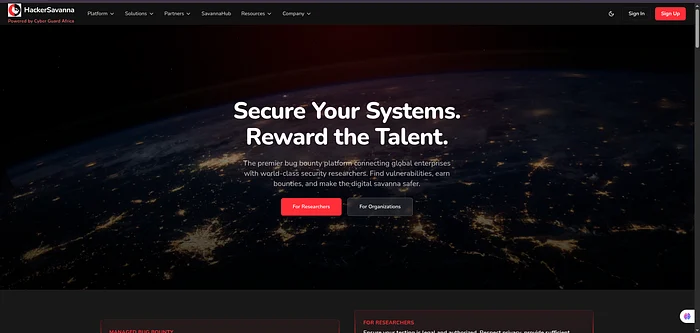
The image above is the HackerSavanna site, the platform where these reports were filed and disclosed.
Setup
The report does not describe a lab, custom tooling or specific versions. The tooling implied by the narrative is a browser, a proxy, and the ability to send the same request twice with one thing changed. A proxy is a program that sits between your browser and the website and lets you read and edit every request before it goes out; security testers use it because a browser normally hides this traffic from you.
For the second finding, a second account in a separate session was needed. A session is the period during which a site remembers who you are, usually by storing a small piece of data in your browser. For the third, the researcher used a URL hosted on their own infrastructure plus an out-of-band listener. An out-of-band listener is a small server you run that does nothing except record any connection that arrives at it, so you can prove that some other machine really did reach out to you. For the first finding, an unauthenticated request and then the same request with one added header were enough. A header is a small labelled line of extra information that travels with every web request, such as what browser you use or what kind of data you accept.
Finding it
The four findings are presented in the order they were discovered.
1. One header, zero credentials, total access
Target: private program, redacted as "wantam". Reward: KSh 8,000 (Report #63).
The image above is the heading of this first finding, showing the target and the reward.
The starting point was an ordinary authentication test. Authentication is how a system checks that you are who you claim to be, like a bouncer checking your name against a guest list. An unauthenticated request, meaning one sent with no login details at all, correctly returned 401 Unauthorized. 401 is the standard web status code for "you are not logged in, go away". So far the system behaved properly.
Adding a single custom header changed the result completely:
X-Wantam-Platform: wantam
Line by line: X-Wantam-Platform is the name of the header. Headers starting with X- are custom ones invented by the application rather than part of the web standard. wantam is the value being sent. The colon separates the name from the value. That is the whole request addition: one line of text saying "I am on the wantam platform".
No token, no cookie, no session. A token is a string of characters a site gives you after you log in, which you show on later requests to prove you logged in. A cookie is a small piece of data the browser stores and sends back automatically, often used to hold that token. With that header present, the response contained a fully authenticated user context, meaning the server replied as if a real logged-in user had made the request. Further testing showed the effect was not limited to informational endpoints. An endpoint is one specific address on a server that does one specific job, like a counter for "show my profile" or "change my password". State-changing functionality means actions that alter data, such as editing a record or creating something. Those actions, which should have required authentication, accepted requests solely because the header was present.
Why this step mattered: the tester sent the same request twice, once normally and once with one line added, and read the difference. The server was trusting a value the client controls. Anyone can type any header, so a header can never prove identity.
The bypass alone was serious. What made the finding more impactful was what the access exposed next. One accessible endpoint triggered internal scanning operations. Because the scanner executed requests from inside the platform's own environment, it effectively became an SSRF primitive. SSRF stands for Server-Side Request Forgery: a feature that makes the server fetch a URL for you, which an attacker can abuse to make the server fetch things it can reach but you cannot, such as other machines on its private network. A useful comparison is a hotel concierge who will fetch anything you ask for: harmless for a nearby shop, dangerous if you ask him to open the staff room.
Initial testing showed obvious inputs such as [redacted] were correctly blocked. [redacted] is the standard address that means "this very machine", so blocking it is the obvious first defence. But alternative representations were never normalised before validation. Normalising means converting different spellings of the same thing into one standard form before checking it. The hex-encoded equivalent bypassed the filter entirely:
0x7f000001
Line by line: this is the same address as [redacted], written in hexadecimal, a base-16 number system. 0x marks it as hex. The filter compared the raw text against the string [redacted], saw something different, and let it through, even though the machine resolves both to the same place. It is like a bouncer with a list of banned names who lets in the same person using a nickname.
The resulting scan output resolved to localhost and returned backend-specific headers that were never observable through the public edge infrastructure, confirming the request had genuinely reached the internal network. Localhost is the machine itself. Backend means the internal servers behind the public front door. Edge infrastructure is the public-facing layer that normally handles outside traffic. Seeing headers that only exist on the inside proved the request had crossed from outside to inside.
Further testing showed cloud metadata endpoints and additional internal addresses were reachable through the same mechanism. Cloud metadata endpoints are special internal addresses that cloud providers expose to their own machines, often containing configuration and credentials. They are meant to be reachable only from inside, which is exactly why an SSRF that reaches them is dangerous.
A separate, unrelated issue surfaced during the same assessment: newly registered users were automatically placed into the organisation's live operational tenant rather than an isolated one, exposing internal source code within minutes of account creation. A tenant is a separate space inside one shared system, one per customer or team, so that each sees only its own data. Tenant isolation is the rule that keeps those spaces apart. New users landing in the live tenant meant a stranger could see the organisation's real data and code straight after signing up.
Root cause
- Authentication based on a client-controlled header.
- SSRF filtering performed on raw strings rather than resolved addresses.
- Improper tenant isolation during onboarding.
Impact
- Authentication bypass.
- Internal SSRF.
- Cloud metadata exposure.
- Tenant isolation failure.
- Unauthorised access to internal resources.
Fix
The header-based bypass was removed, validation logic was moved to occur after resolution rather than on the raw string, and tenant assignment was corrected. In plain words: the server stopped trusting the header, started checking the address after it had been converted to its real form, and put new users in their own space. The full chain was retested and confirmed fixed.
2. Shared rate limit on the AI assistant
Target: HackerSavanna AI Assistant. Reference: publicly disclosed via SavannaHub, https://www.hackersavanna.com/savannahub/66.
Rate limiting is a control that caps how many requests you can make in a period, like a shop limiting each customer to five items so nobody clears the shelves. Done correctly, it stops abuse while keeping the service available to everyone else. The assistant implemented rate limiting, but the limit was not scoped to the user. Scoped to the user means counted separately per person; here it was not.
After sending several normal messages in quick succession, the assistant began returning a generic error instead of a response. Alongside the error was an internal throttling identifier, an implementation detail that raised the question of how the limiter was actually being tracked. Throttling is the act of slowing or blocking requests once a limit is hit. An identifier is a label the system uses internally to refer to something, and seeing one leak into an error message tells you something about how the system is built.
The critical observation came from testing a second account. A completely unrelated account, authenticated in a separate session with no prior interaction history, received the exact same error on its very first request. The limiter was not tracking individual users; it was tracking the feature itself. The comparison is a single shared ticket machine for a whole building: one person can empty it and everyone else is locked out.
In practice, any researcher could exhaust the shared quota and temporarily deny access to every other researcher on the platform. Denial of service means making a service unusable for its real users, not by breaking it but by using up its capacity. To affected users the behaviour was indistinguishable from a backend outage, which made it harder to recognise, let alone report.
Root cause
- The rate-limit counter was effectively global rather than user-scoped.
Impact
- Platform-wide denial of service.
- Availability impact affecting all researchers, not just the triggering account.
- Misleading error handling that obscured the actual cause.
Fix
HackerSavanna rescoped the limiter to key requests against the authenticated user rather than a shared counter. In plain words, each person now gets their own counter. The fix was verified and the report publicly disclosed.
3. Prompt injection leading to application-level denial of service
Target: HackerSavanna AI Assistant. Reference: publicly disclosed via SavannaHub, https://www.hackersavanna.com/savannahub/52.
The assistant offered URL summarisation, which means the application accepted untrusted user input and performed outbound requests on the user's behalf. Outbound means the server reaching out to another machine. This is the same concierge situation as before: a feature that fetches a page for you can be pointed at pages you were never meant to reach.
Testing began with a URL hosted under the researcher's own infrastructure. When the assistant was instructed to summarise the page, an out-of-band listener immediately recorded an inbound request originating from HackerSavanna's environment, confirming server-side fetching was taking place. Server-side fetching means the server, not your browser, downloads the page. Proving it with your own listener matters because it shows the request came from their machine, not yours.
The next step was to replace the external URL with an internal address. Instead of a summary, the application returned an unhandled server exception complete with stack traces, filesystem paths and internal identifiers. An exception is an error the program did not expect and did not handle. A stack trace is the list of internal steps the program was taking when it crashed, which reveals how the code is structured. Filesystem paths are folder locations on the server, such as where the code lives. Additional malformed payloads produced the same category of failure.
At first glance this looked like SSRF. During triage, HackerSavanna's team conducted a deeper review and determined that the infrastructure assumptions behind the original SSRF theory did not hold for their deployment. Triage is the first review a security team does on a report to decide whether it is real and how serious it is. What remained consistently reproducible, and formed the final classification, was a prompt-driven denial-of-service condition capable of crashing the assistant's rendering pipeline while exposing internal implementation details. Prompt-driven means the trigger was text typed into the assistant. The rendering pipeline is the part of the application that turns the assistant's answer into something displayed on screen; crashing it takes the feature down.
Root cause
- Insufficient validation and error handling around AI-driven URL processing.
Impact
- Application-level denial of service.
- Internal information disclosure.
- Exposure of implementation details useful for further attacks.
Fix
The issue was patched and publicly disclosed as a prompt-injection-driven DoS rather than the originally reported SSRF. Prompt injection is when text you feed an AI assistant is treated as instructions rather than as content, steering it to do something the designer did not intend. The report notes that accurate classification matters as much as finding the bug.
4. AI support assistant failed to enforce its own scope restrictions
Target: HackerSavanna Support Assistant. Reference: SavannaHub disclosure #74, https://www.hackersavanna.com/savannahub/74.
The support assistant advertised itself as limited to bug bounty hunting, report writing, platform guidance and research onboarding. That restriction existed entirely inside the model's instructions, with no server-side enforcement layer behind it. A model here means the AI system answering questions. Server-side enforcement means the application itself checks and blocks requests, rather than relying on the AI to police itself. The comparison is a sign on a door saying "staff only" with no lock on it.
After a short conversational detour and one deliberately vague follow-up, the assistant stopped applying the restriction entirely. Requests with no relation to bug bounty research were answered normally, with no acknowledgement that they fell outside its stated purpose.
Unlike the previous three findings, this was not a confidentiality or integrity issue. Confidentiality means keeping data secret; integrity means keeping data correct and unaltered. The impact here was operational: an assistant budgeted, tuned and deployed for a specific function could be redirected into general-purpose use simply by steering the conversation off-topic.
Root cause
- Reliance on prompt-based policy enforcement with no server-side validation.
Impact
- Resource abuse.
- Increased inference costs.
- Loss of the assistant's intended operational scope.
Fix
Scope validation was moved into application logic rather than relying solely on model instructions. In plain words, the application now checks the request itself instead of trusting the AI to refuse. The behaviour was no longer reproducible after remediation.
Root cause
The common failure across all four findings is the same. A security control existed, the application trusted that the control was being enforced, and the enforcement lived in the wrong place.
The rate limiter trusted a global counter. The AI assistant trusted input it had not validated. The authentication layer trusted a user-controlled header. The support assistant trusted a system prompt to behave like an access-control mechanism. In each case the feature worked exactly as intended until the assumption behind it was questioned.
Impact
The first finding combined an authentication bypass that reached state-changing functionality with an SSRF primitive that reached localhost, cloud metadata endpoints and other internal addresses, plus a tenant isolation failure that exposed internal source code to newly registered users. The second is a platform-wide availability issue affecting every researcher, disguised as a backend outage. The third is an application-level DoS with internal information disclosure. The fourth is operational: resource abuse, increased inference costs and loss of the assistant's intended scope.
Fix
All four reports were triaged, remediated and verified. Remediation means the fix was actually applied. Three were publicly disclosed through HackerSavanna's SavannaHub. The specific changes were: removal of the header-based bypass, SSRF validation moved to occur after resolution, corrected tenant assignment, user-scoped rate limiting, patched URL processing with better error handling, and server-side scope validation for the support assistant.
Variants to test
These are the same ideas generalised, so a beginner can try them on other systems.
- Client-controlled authentication headers. Send the same request with and without any custom header the application mentions, and compare the response. A positive result is a change from
401 Unauthorizedto an authenticated context, especially on state-changing endpoints. - Alternative IP representations in SSRF filters. Where
[redacted]is blocked, try hex, octal, decimal and IPv6 forms, and check whether the filter runs before or after DNS resolution. DNS resolution is the step that turns a name or alternative address into the real numeric address. A positive result is a response that resolves to localhost or returns backend-specific headers not visible at the edge. - Cloud metadata reachability. From any server-side fetch primitive, test whether metadata endpoints and additional internal addresses are reachable. A positive result is a response from a metadata endpoint or internal address that should not be reachable from outside.
- Tenant assignment on registration. Create a fresh account and inspect what it can see immediately. A positive result is a fresh account landing in the live operational tenant and seeing internal source code.
- Rate-limit scoping. Exhaust a quota from one account, then make a first request from a second, unrelated account in a separate session. A positive result is the same throttling error on the second account's first request.
- URL summarisation features. Point the feature at a URL you control with an out-of-band listener, then at internal addresses and malformed payloads. A positive result is an inbound request from the target's environment, or an unhandled exception with stack traces and filesystem paths.
- Prompt-based scope restrictions. Ask an assistant something clearly outside its advertised purpose after a short detour and a vague follow-up. A positive result is a normal answer with no acknowledgement that the request is out of scope.
Glossary
- Authentication: the process of proving who you are to a system, like showing ID at a door.
- Backend: the internal servers and code behind the public-facing part of a site.
- Cloud metadata endpoint: a special internal address a cloud provider exposes to its own machines, often holding configuration and credentials.
- Confidentiality: keeping data secret from those not allowed to see it.
- Cookie: a small piece of data a browser stores for a site and sends back automatically, often holding a login token.
- Denial of service (DoS): making a service unusable for its real users, usually by exhausting its capacity.
- DNS resolution: the step that turns a name or alternative address into the real numeric address of a machine.
- Edge infrastructure: the public-facing layer that normally handles traffic coming from outside.
- Endpoint: one specific address on a server that performs one specific job.
- Exception: an error a program did not expect and did not handle.
- Filesystem path: a folder location on a server, such as where its code is stored.
- Header: a small labelled line of extra information sent with every web request or response.
- Hex / hexadecimal: a base-16 way of writing numbers, often used to write addresses in a different form.
- Identifier: a label a system uses internally to refer to something.
- Integrity: keeping data correct and unaltered.
- Localhost: the machine itself;
[redacted]is its standard address. - Model: the AI system that generates answers in an assistant.
- Normalisation: converting different spellings of the same thing into one standard form before checking it.
- Out-of-band listener: a small server you run that records any connection arriving at it, used to prove another machine reached out.
- Outbound: traffic a server sends out to another machine.
- Payload: the piece of input you send to a system, often to test how it reacts.
- Prompt injection: when text fed to an AI assistant is treated as instructions rather than content, steering it off its intended behaviour.
- Proxy: a program between your browser and a site that lets you read and edit requests.
- Rate limiting: capping how many requests someone can make in a period.
- Remediation: the act of fixing a vulnerability.
- Rendering pipeline: the part of an application that turns data into what is displayed on screen.
- Scoped to the user: counted or applied separately for each person.
- Server-side fetching: the server, rather than your browser, downloading a page or resource.
- Server-side enforcement: the application itself checking and blocking requests, rather than trusting another component to do it.
- Session: the period during which a site remembers who you are.
- SSRF (Server-Side Request Forgery): abusing a feature that fetches URLs so the server fetches things you cannot reach yourself.
- Stack trace: the list of internal steps a program was taking when it crashed, revealing its structure.
- State-changing functionality: actions that alter data, such as creating or editing records.
- Tenant: a separate space inside a shared system, one per customer or team.
- Tenant isolation: the rule that keeps tenants from seeing each other's data.
- Throttling: slowing or blocking requests once a limit is reached.
- Token: a string a site gives you after login, shown on later requests to prove you logged in.
- Triage: the first review a security team does on a report to judge whether it is real and how serious.
- Trust boundary: an imaginary line between things a system trusts and things it should not.
- Zero-day: a flaw nobody has found or fixed yet.

