This is how can I spoof ANY Sentry.Io log infinitely and create fake error-logs
The author claims that Sentry's error-ingestion endpoint accepts arbitrary event data, including a caller-supplied event identifier, without validation or rate limiting. They say this lets anyone flood a project with unlimited fabricated error logs containing spoofed titles, tags, users and IPs, which could be used to mislead or phish the administrators who read them.
Carlos Daniel Giovanella Follow
 Published on medium.com
Ok. First of all: I reported this on HackerOne, 45 days ago.
The full write-up lives on its author's site
It belongs to its author, so we link to it rather than copy it. The other two tabs are our own rewrites, checked against it.
Context
Sentry.io is a service for tracking application errors: applications send error events to it, and the people who operate those applications read the resulting logs to find and fix problems. The researcher's argument in this write-up is that the ingestion side of that service accepts error events whose contents are entirely attacker-controlled, and that it does so without a meaningful limit on how many events can be created.
The report was first filed on HackerOne 45 days before the write-up. Ten days after filing, someone submitted a duplicate, and the researcher was told that if they believed this was a security issue they should report it to Sentry.io directly, which they did. The write-up was published after HackerOne said the researcher could share it, and the researcher states they are disclosing because Sentry.io said this is not a security issue.
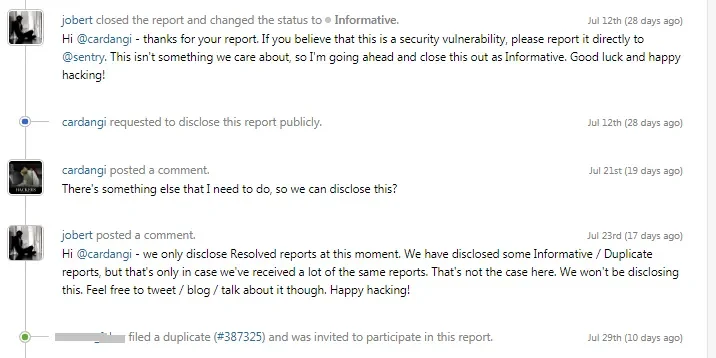
The screenshot shows the report details on HackerOne.
Setup
The write-up does not describe a test account, a specific project, a role, a tool or a version. The report does not describe a test account, a specific project, a role, a tool or a version. The researcher notes that if you have access to the API key, you cannot prevent this. No request, header, endpoint or payload is reproduced in the report, so none can be shown here.
Finding it
The researcher's first point is that the event_id parameter is not required. If the sender does not fill it in, the system generates it automatically, and the researcher says the service specified the 128-bit identifier (uuid4) and replied that this was not a security issue because that is the way the service should work.
From there the researcher's concern is not the identifier itself but the combination of two properties: any data in the event can be spoofed (title, description, tags, bug information, user, anything), and events can be created infinitely, without a request limit. In the researcher's words, this allows creating any fake error log, with fake ids and titles and a faked IP, and every other field.
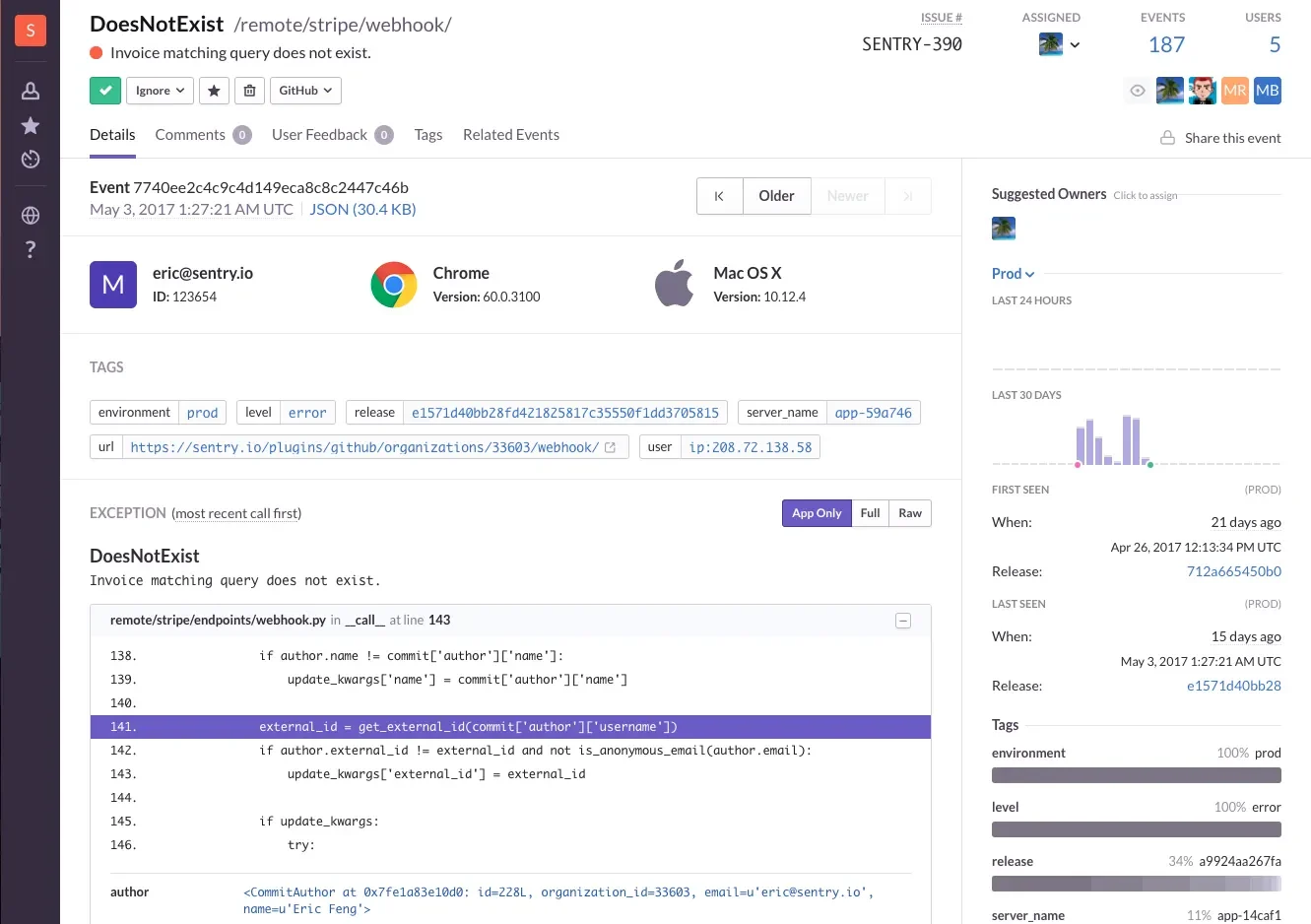
The screenshot shows the Sentry screen that users see, illustrating that the displayed data can be spoofed and changed.
Exploitation
The report describes the abuse at the level of volume and content rather than with reproducible requests. The steps below follow the researcher's own sequence of arguments to Sentry.io, and then the demonstration they carried out.
Step 1: omit the event identifier
The researcher raised that event_id is not required and that the service generates a uuid4 for the sender when it is missing. Sentry.io's position, as reported, was that this is intended behaviour and not a security issue.
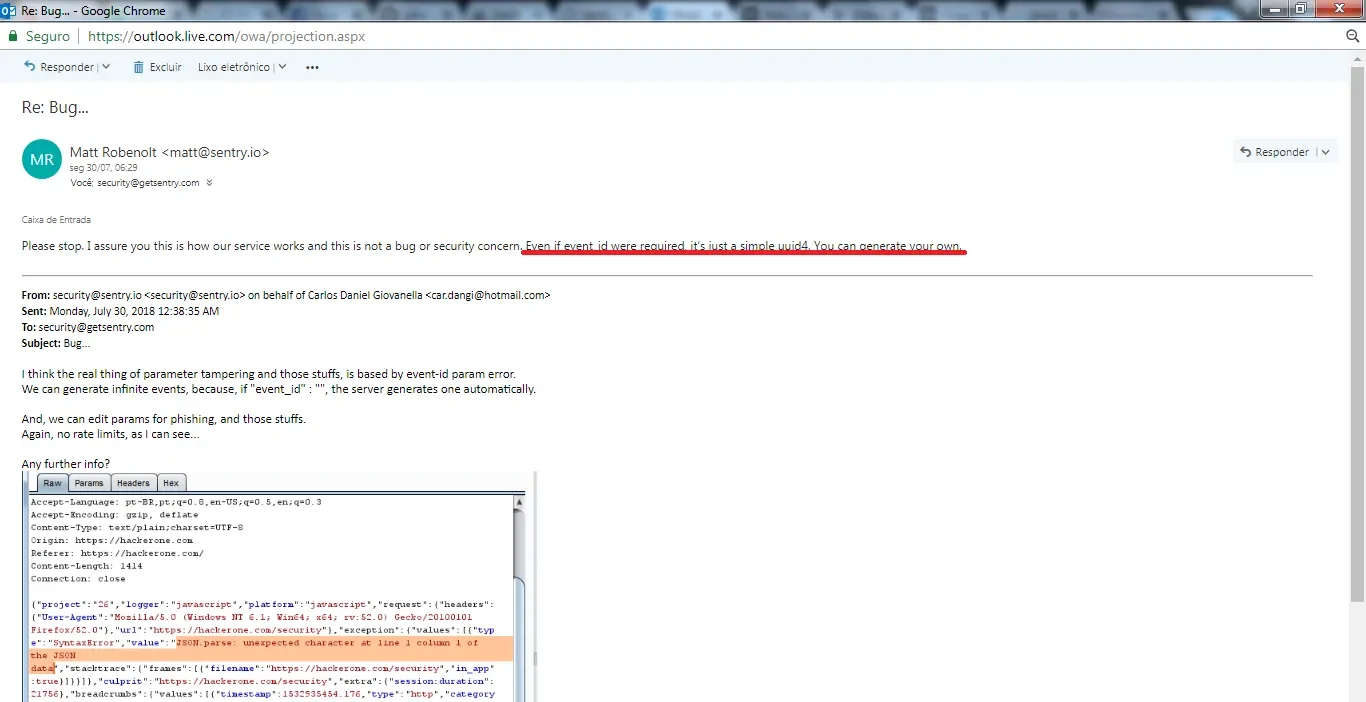
Step 2: argue that noisy logs harm customers
The researcher then argued that the noise affects Sentry.io's customers. The response, as quoted in the write-up, was that this is not a security concern and that the researcher was "causing an annoyance for a customer and generating some noisy logs".
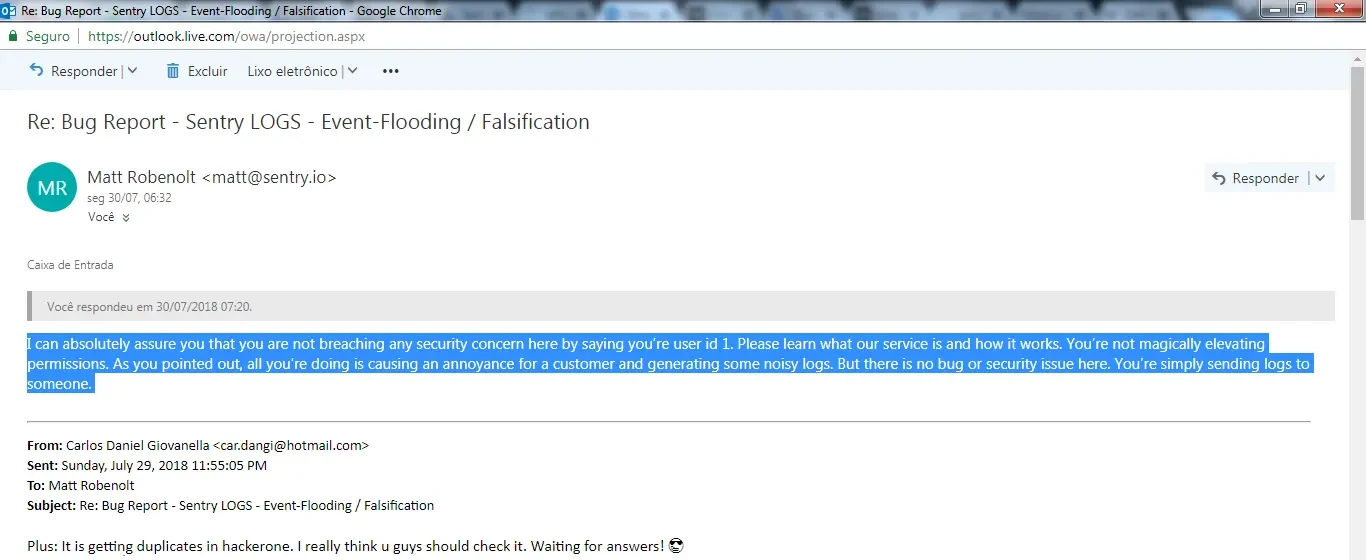
Step 3: raise useless data and phishing potential
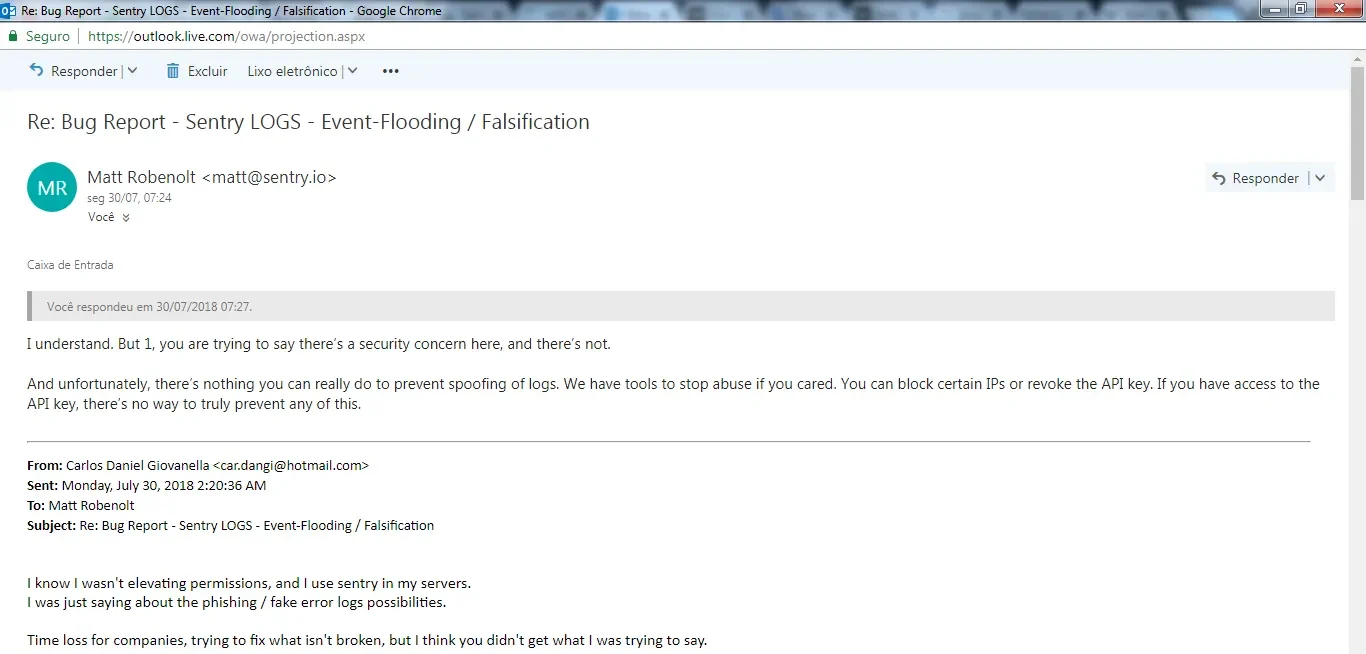
After the researcher showed that the point was useless data and phishing potential, Sentry.io said they "understand" but that it is not a security concern and that they cannot stop it. They pointed to tools for stopping abuse; the researcher notes having sent 20,000 fake error logs to HackerOne in 10 minutes and calls those "great tools". The researcher also notes that holding the API key does not let you prevent this.
Step 4: raise request size
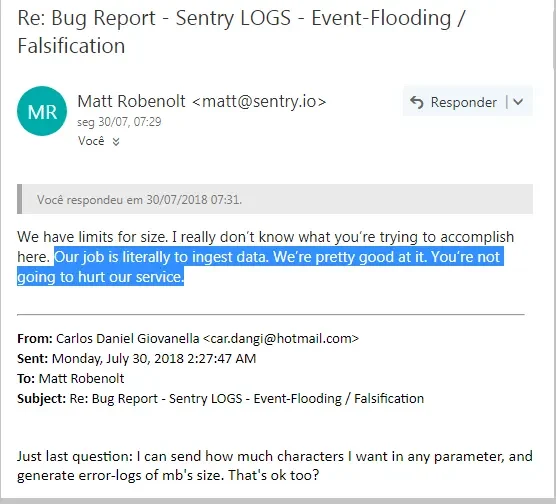
The last attempt was to point out that requests can be megabytes in size. Sentry.io's answer, as reported, was that their job is "Ingest data" and that the researcher "can't hurt their service", even with the phishing potential.
Step 5: the demonstration
The researcher spoofed 100,000 error logs to HackerOne with 1 IP address within 10 minutes, using fake errors. Earlier in the write-up the same idea is described at a smaller scale: generating 10,000 fake reports with 50 different IPs in about 5 minutes, so that administrators of the system believe an error exists where it does not, and look for it. The researcher describes this as fishing for the fish: the fake logs are the bait for the people who read them.
Root cause
The event_id parameter is not required: when it is absent the system generates a uuid4 automatically instead of rejecting the event. Because any data in the event can be spoofed and events can be created infinitely without a request limit, an attacker can produce unlimited, fully fabricated logs.
Impact
The impact described is on the people who read the logs, not on Sentry.io's own infrastructure. An attacker can create fake error logs with spoofed titles, descriptions, tags, bug information, users and IP addresses, in unlimited quantity. Administrators may then investigate errors that do not exist, and the logs can be used for phishing against system administrators or anyone else who reads them. The researcher also notes that requests can be megabytes in size. These effects depend on the reader trusting the log content.
Fix
Sentry.io's stated position was that the behaviour is intended, that it is not a security concern, and that abuse can be handled with their tools. The researcher closes by hoping someone reads the write-up and fixes it, but no specific remediation is proposed in the text.
Variants to test
- Omit the event identifier on another error-ingestion service and see whether the server generates one for you instead of rejecting the event. A positive result is an accepted event with a server-generated identifier.
- Submit an event with spoofed user, IP and tag fields and check whether the receiving dashboard displays them as if they were genuine. A positive result is fabricated metadata rendered to the reader without any indication of its origin.
- Submit a large number of events from a single address in a short window and observe whether any limit stops you. A positive result is a high accepted volume from one source, as the researcher reports for 100,000 events from 1 IP in 10 minutes.
- Submit oversized requests and check whether they are accepted. A positive result is acceptance of requests in the megabyte range.
- Check whether holding the API key gives any way to prevent submissions, as the researcher says it does not. A positive result is that no key-level control stops the flood.
What happened, in plain words
Sentry.io is a service that helps software teams keep track of errors. When a program crashes or misbehaves, it can send a message to Sentry.io describing what went wrong, and Sentry.io stores that message as a log entry. The people who run the program then open Sentry.io and read those logs to find and fix problems. Think of it like a suggestion box in an office: anyone can drop a note in, and the manager reads the notes later to decide what to fix.
The researcher in this write-up is arguing that the part of Sentry.io that receives these notes (the "ingestion" side) accepts notes whose contents are completely controlled by whoever sends them, and that it does so without any meaningful limit on how many notes can be sent. In the suggestion box comparison, that would mean anyone can drop in thousands of notes claiming anything they like, and the manager has no way to tell which notes are real.
The report was first filed on HackerOne 45 days before the write-up. HackerOne is a platform where security researchers report bugs to companies and the companies respond. Ten days after the report was filed, someone else submitted a duplicate, meaning another researcher reported the same thing. The researcher was told that if they believed this was a security issue they should report it to Sentry.io directly, which they did. The write-up was published after HackerOne said the researcher could share it, and the researcher states they are disclosing because Sentry.io said this is not a security issue.
The screenshot shows the report details on HackerOne.
Setup
The write-up does not describe a test account, a specific project, a role, a tool or a version. An API key is like a password that a program uses to prove to a service that it is allowed to send data; it is not a human login, it is a secret string that the software includes with each request. The researcher notes that if you have access to the API key, you cannot prevent this. No request, header, endpoint or payload is reproduced in the report, so none can be shown here.
Finding it
The researcher's first point is that the event_id parameter is not required. A parameter is a named piece of information that you send along with a request, like a field on a form. event_id is the name Sentry.io uses for the identifier of a single error event. If the sender does not fill it in, the system generates it automatically. The researcher says the service specified the 128-bit identifier (uuid4) and replied that this was not a security issue because that is the way the service should work. A uuid4 is a long random-looking string of characters used as a unique name for something; 128-bit refers to how much randomness goes into it, which makes collisions extremely unlikely.
From there the researcher's concern is not the identifier itself but the combination of two properties. First, any data in the event can be spoofed: title, description, tags, bug information, user, anything. Spoofing means making something look like it came from somewhere or someone it did not. Second, events can be created infinitely, without a request limit. A request limit (often called rate limiting) is a cap on how many requests a service will accept from one source in a period of time, like a bouncer who only lets a certain number of people into a club per minute. In the researcher's words, this allows creating any fake error log, with fake ids and titles and a faked IP, and every other field. An IP address is the numeric address a device uses on a network, roughly like a postal address for a computer.
The screenshot shows the Sentry screen that users see, illustrating that the displayed data can be spoofed and changed.
Exploitation
The report describes the abuse at the level of volume and content rather than with reproducible requests. The steps below follow the researcher's own sequence of arguments to Sentry.io, and then the demonstration they carried out.
Step 1: omit the event identifier
The researcher raised that event_id is not required and that the service generates a uuid4 for the sender when it is missing. Sentry.io's position, as reported, was that this is intended behaviour and not a security issue.
Step 2: argue that noisy logs harm customers
The researcher then argued that the noise affects Sentry.io's customers. Noise here means a large amount of irrelevant or fake entries mixed in with the real ones, the way a mailbox full of junk mail makes it harder to find the letter you actually need. The response, as quoted in the write-up, was that this is not a security concern and that the researcher was "causing an annoyance for a customer and generating some noisy logs".
Step 3: raise useless data and phishing potential
After the researcher showed that the point was useless data and phishing potential, Sentry.io said they "understand" but that it is not a security concern and that they cannot stop it. Phishing is a trick where an attacker makes a message look trustworthy so the reader clicks something or hands over information; here the fake error logs would be the bait, and the system administrators reading them would be the target. They pointed to tools for stopping abuse; the researcher notes having sent 20,000 fake error logs to HackerOne in 10 minutes and calls those "great tools", a sarcastic way of saying the tools did not stop the flood. The researcher also notes that holding the API key does not let you prevent this.
Step 4: raise request size
The last attempt was to point out that requests can be megabytes in size. A megabyte is a unit of data size, roughly a million characters of text; a normal short message is a few hundred bytes, so a megabyte-sized request is thousands of times larger. Sentry.io's answer, as reported, was that their job is "Ingest data" and that the researcher "can't hurt their service", even with the phishing potential. Ingesting data simply means receiving and storing it.
Step 5: the demonstration
The researcher spoofed 100,000 error logs to HackerOne with 1 IP address within 10 minutes, using fake errors. Earlier in the write-up the same idea is described at a smaller scale: generating 10,000 fake reports with 50 different IPs in about 5 minutes, so that administrators of the system believe an error exists where it does not, and look for it. The researcher describes this as fishing for the fish: the fake logs are the bait for the people who read them.
Root cause
The event_id parameter is not required: when it is absent the system generates a uuid4 automatically instead of rejecting the event. In plain terms, the service trusts whatever the sender puts in the form, and when a required-looking field is left blank it quietly fills it in instead of refusing the submission. Because any data in the event can be spoofed and events can be created infinitely without a request limit, an attacker can produce unlimited, fully fabricated logs. The report does not describe any server-side validation, signing or rate limiting that would have prevented it. Validation means checking that the data makes sense before accepting it; signing means attaching a cryptographic proof that the data came from a trusted source; rate limiting is the cap on volume described earlier. The only defence mentioned is Sentry.io's reference to abuse-stopping tools.
Impact
The impact described is on the people who read the logs, not on Sentry.io's own infrastructure. An attacker can create fake error logs with spoofed titles, descriptions, tags, bug information, users and IP addresses, in unlimited quantity. Administrators may then investigate errors that do not exist, and the logs can be used for phishing against system administrators or anyone else who reads them. The researcher also notes that requests can be megabytes in size. These effects depend on the reader trusting the log content.
Fix
Sentry.io's stated position was that the behaviour is intended, that it is not a security concern, and that abuse can be handled with their tools. The researcher closes by hoping someone reads the write-up and fixes it, but no specific remediation is proposed in the text.
Variants to test
These are ideas for checking whether other services have the same weakness. Each one describes what to try and what a positive result would look like.
- Omit the event identifier on another error-ingestion service and see whether the server generates one for you instead of rejecting the event. A positive result is an accepted event with a server-generated identifier.
- Submit an event with spoofed user, IP and tag fields and check whether the receiving dashboard displays them as if they were genuine. A positive result is fabricated metadata rendered to the reader without any indication of its origin.
- Submit a large number of events from a single address in a short window and observe whether any limit stops you. A positive result is a high accepted volume from one source, as the researcher reports for 100,000 events from 1 IP in 10 minutes.
- Submit oversized requests and check whether they are accepted. A positive result is acceptance of requests in the megabyte range.
- Check whether holding the API key gives any way to prevent submissions, as the researcher says it does not. A positive result is that no key-level control stops the flood.
Glossary
- API: a way for one program to talk to another, like a service counter where you hand over a request and get a response back.
- API key: a secret string a program uses to prove to a service that it is allowed to send data, similar to a password but for software.
- Event: a single recorded occurrence, in this case one error report sent to Sentry.io.
- event_id: the name of the field that holds the unique identifier for one event.
- Header: extra information sent alongside a request, like the label on a parcel that says what is inside and where it is going.
- HackerOne: a platform where security researchers report bugs to companies and the companies respond.
- Ingestion: the act of receiving and storing incoming data.
- IP address: the numeric address a device uses on a network, roughly like a postal address for a computer.
- Megabyte: a unit of data size, roughly a million characters of text.
- Metadata: data that describes other data, such as who sent an event or when it happened.
- Parameter: a named piece of information sent along with a request, like a field on a form.
- Payload: the actual body of data carried by a request, as opposed to the headers around it.
- Phishing: a trick where an attacker makes a message look trustworthy so the reader clicks something or hands over information.
- Rate limiting: a cap on how many requests a service will accept from one source in a period of time.
- Request: a message a program sends to a service asking it to do something, like posting a letter.
- Root cause: the underlying design or coding reason a weakness exists.
- Spoofing: making something look like it came from somewhere or someone it did not.
- Tag: a label attached to an event so it can be grouped or searched later.
- uuid4: a long random-looking string used as a unique name for something, with 128 bits of randomness.
- Validation: checking that data makes sense before accepting it.
- Vulnerability: a weakness in a system that someone could abuse to cause harm.



