Unauthenticated DaData Relay: Leaking FNS Registry Records and Burning a Paid API Quota
A backend proxy service that relays requests to the paid DaData registry API accepted anonymous POST requests without any authentication, returning full FNS registry records for any search term. An attacker could spend the company's paid API quota and obtain registry data without an account.
 Published on medium.com
API
The full write-up lives on its author's site
It belongs to its author, so we link to it rather than copy it. The other two tabs are our own rewrites, checked against it.
Context
DaData is a commercial service that returns structured data about Russian legal entities and individual entrepreneurs: names, tax IDs, addresses, directors and more. Companies typically pay per request or per plan, and they put a small proxy service in front of it so the API key stays on the server.
The target here is dadata-client-**.**.ru, a backend service that relays requests to DaData. Its /suggestions/party endpoint is meant to answer party lookups, but it accepted anonymous POST requests with no token, cookie or API key, and returned full FNS (Federal Tax Service) registry records for any search term. The host matched the program's published wildcard scope, so it was in scope.
A proxy like this is only safe if it checks who is calling it. If it does not, anyone on the internet can spend the owner's paid quota. The key stays hidden, but the service is effectively public.
Setup
No account, session or credential was needed. The only tooling shown is curl, with a request body kept in a local file (body.json) and a custom X-Bug-Bounty: alkaser header used to identify the researcher's traffic. The report does not describe any other tooling or version information.
Finding it
The endpoint answered a single request with no credentials at all. That alone is suspicious for a service that fronts a paid API, but on its own it could be read as a deliberately public API. The decisive evidence came from comparing it with a sibling service on the company's own backend, which correctly returns 401 Unauthorized for the equivalent lookup. That makes the open relay a one-instance misconfiguration rather than an intentional public API.
Exploitation
Step 1: An endpoint that answers anyone
One request, no credentials:
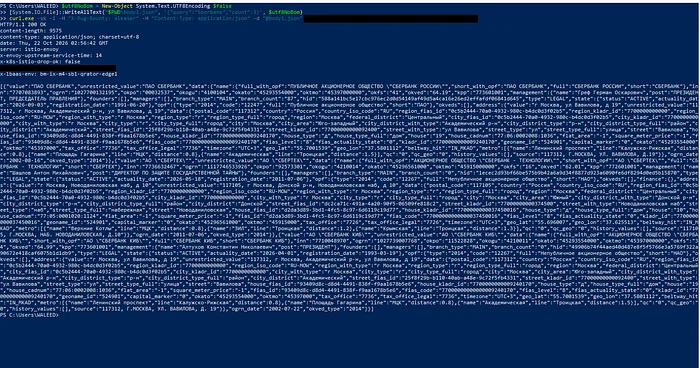
curl -sk -i -H "X-Bug-Bounty: alkaser" -H "Content-Type: application/json" \ -d "@body.json" "https://dadata-client-**.**.ru/suggestions/party"
The body sent was:
{"query":"Sberbank","count":3}
-s silences progress output, -k skips certificate verification, and -i includes the response headers. The Content-Type: application/json header tells the relay the body is JSON, and -d "@body.json" reads the payload from the local file. The query field is the search term and count is the number of records requested.
The response was 200 OK, returning full registry records for every match: legal name, INN, OGRN, KPP, OKPO, director name and title, registration and actuality dates, full registered address with FIAS id, GPS coordinates, and nearest metro stations.
Step 2: Finding the real limit
To see whether there was any cap on how much data one request can pull, the count parameter was tested.
count: 50returned400 Bad Request: “'Count' должно быть в диапазоне от 1 до 20” (must be between 1 and 20).count: 20returned200 OKwith exactly 20 distinct records.
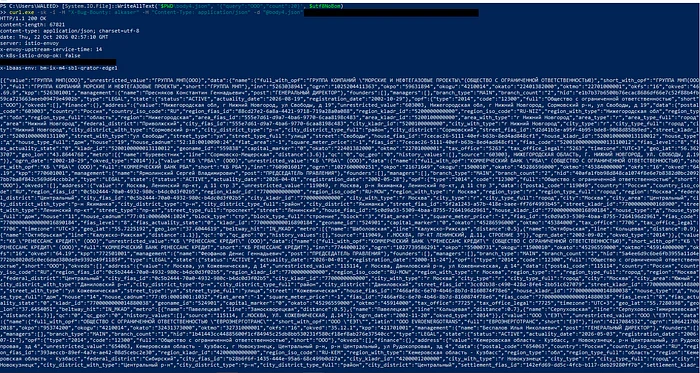
So input validation works, and the only limit observed is 20 rows per request. There was no sign of a per-client limit. Volume tests were not run, to stay within safe testing practice.
Step 3: The control that proves it is a bug
To check whether the endpoint was meant to be public, the company's own backend was queried:
curl -sk -i -H "X-Bug-Bounty: alkaser" \ "https://**-sellplus-backend.**.ru/api/Suggestion/fio/?query=test"
The response was 401 Unauthorized with WWW-Authenticate: Bearer. The same company protects the same kind of lookup everywhere else, and only this instance is open. That is the difference between “public API by design” and “broken access control”.
Root cause
The relay performs no authentication on /suggestions/party: it accepts anonymous POST requests and returns registry records from the paid DaData API. The input validation on count shows that some defensive logic exists, but nothing checks the identity of the caller. The sibling backend demonstrates that the company already has a Bearer authentication scheme for the equivalent lookup, .
Impact
- Quota abuse. Anyone can spend the company's paid DaData subscription, 20 records per request, billed to them. The quota was not exhausted because that would be harmful testing, so this is the theoretical impact.
- Free data relay. The service hands registry data to anyone with no access control, which can conflict with the provider's licensing terms on redistribution.
- Counterparty enumeration. Anyone can look up named companies without an account or session.
What it is not: no customer data was exposed, and the findById-style routes returned 404. This is broken access control plus third-party quota abuse, not a breach of the company's own application data.
The issue was reported as Standoff365 report #37253 (CWE-306, rated Medium by the researcher). It was triaged and closed within minutes on Oct 29 as a duplicate of #37076 (“Unauthenticated proxy to the paid DaData API”), with read access granted to the original. The submission itself was made on Oct 22.
Fix
The report recommends three changes:
- Require authentication on the relay, using the same Bearer scheme already used on the main backend.
- Restrict it at the network or mesh level so only internal services can reach it.
- Add per-client rate limiting.
The report does not say whether any of these were applied.
Variants to test
- Look for the protected twin. When an endpoint answers anonymously, find the same functionality on another host or service owned by the same company. A positive result is a
401 UnauthorizedwithWWW-Authenticate: Bearer(or an equivalent challenge) on the sibling, which turns “maybe public by design” into “clearly a misconfiguration”. - Probe the input validation boundary. Send an out-of-range value for a paging or count parameter and then the maximum accepted value. A positive result is a
400with a range message for the first and a200with exactly the maximum number of distinct records for the second, which quantifies the leak per request without volume testing. - Check identifier-style routes. Try
findById-style paths on the same relay. A404there, as seen here, narrows the impact to search-based enumeration rather than direct record retrieval. - Test other relay endpoints. The report only covers
/suggestions/party; other suggestion paths on the same host are worth checking for the same missing authentication, with a200and registry data in the response as the positive signal.
What happened, in plain words
A company built a small helper service on the internet. The helper's job is to pass questions to a paid data provider called DaData and hand the answers back. DaData sells information about Russian companies: their official names, tax numbers, addresses, directors and so on. Companies that use DaData usually pay per request and put a small proxy in front of it so the API key stays on the server.
The problem: the helper never asked who was calling. Anyone with a browser or a command-line tool could send it a company name and get back a full official record, free, with no account, no login and no key. The company's paid quota could be spent by anyone, because the helper used the company's subscription behind the scenes.
The researcher who found this proved it in three careful steps: first he showed the helper answers strangers, then he measured how much data one request can pull, and finally he found a second service from the same company that does the same kind of lookup but correctly refuses strangers. That last comparison is what turned a suspicion into a confirmed bug. He reported it, and it was closed as a duplicate of an earlier report about the same thing.
Below, every step is explained from zero, including the tools and the words used.
Background: what DaData is and why a helper sits in front of it
DaData is a commercial service. You ask it about a company or a sole trader, and it answers with structured facts: the legal name, the tax identification number, the address, who runs it, and more. "Structured" means the answer arrives in a fixed, machine-readable shape rather than as a paragraph of text, so a program can pick out individual fields.
Because DaData charges money, the company does not let its own websites and apps talk to DaData directly. If they did, the secret key that proves "we are a paying customer" would have to travel to every visitor's browser, where anyone could copy it. Instead the company puts a small in-between service on its own server. That service is called a proxy or relay: it receives a request from the outside, adds the secret key on the server side, forwards the request to DaData, and passes the answer back.
A relay like this is only safe if it checks who is calling. Think of a hotel concierge who will place calls for guests: fine if he asks for your room number first, a problem if anyone off the street can walk in and use the hotel's phone line all day. The key stays hidden either way, but the bill is the hotel's.
The target in this story is dadata-client-**.**.ru, one such relay. The asterisks hide parts of the hostname. Its /suggestions/party endpoint is the part that answers questions about companies ("party" here means a legal party, a company or entrepreneur). The host matched the bug bounty programme's published wildcard scope, meaning the programme had said in advance that hosts matching that pattern were fair game to test.
The words you need before the steps
- An API (application programming interface) is a way for one program to ask another program for something, over the internet, in a fixed format. A restaurant menu is a fair comparison: it lists exactly what you can order and how to ask for it. An endpoint is one specific item on that menu, one address you can send a request to.
- A request is the message your program sends: an address, a method (GET to fetch, POST to send data along), some headers, and sometimes a body with data.
- A response is the answer: a status code (a three-digit number saying what happened), headers, and usually a body with the data.
- A status code of
200means "OK, here is your answer".400means "your request was malformed or out of range".401means "you are not identified, log in first".404means "no such thing here". - A header is a small labelled line attached to a request or response, carrying extra information, like the label on a parcel.
- A cookie is a small piece of data a website stores in your browser so it can recognise you on the next request, like a cloakroom ticket.
- A token or API key is a secret string that proves who you are or that you have paid. It is like a membership card: whoever holds it gets the service.
- JSON is a simple text format for data, made of names and values in curly braces. It is how most modern APIs exchange information.
- Authentication means checking identity: who is calling? Broken access control is the vulnerability class here: the service has the ability to check identity but does not apply it, so people who should be refused are let in. The formal catalogue of such weaknesses is called CWE, and this one is CWE-306, "Missing Authentication for Critical Function".
- curl is a free command-line tool, present on most computers, that sends requests over the internet and prints the answers. It is the browser's engine without the window.
Setup: what was needed
Nothing much. No account, no session, no credential. The only tool shown is curl, with the request body kept in a local file called body.json, and a custom header X-Bug-Bounty: alkaser added to identify the researcher's traffic to the programme. The report does not describe any other tooling or version information.
Step 1: an endpoint that answers anyone
The first test was a single request with no credentials at all:
curl -sk -i -H "X-Bug-Bounty: alkaser" -H "Content-Type: application/json" \ -d "@body.json" "https://dadata-client-**.**.ru/suggestions/party"
Line by line, in plain words:
curlis the tool being run.-smeans silent: do not print the progress meter, just the answer.-kmeans skip certificate checking. Normally curl verifies that the server's encryption certificate is genuine;-ktells it not to bother, which is common when testing hosts whose certificates may not match.-imeans include the response headers in the output, so the status code and headers are visible alongside the body.-H "X-Bug-Bounty: alkaser"adds a header naming the researcher, so the programme can recognise the traffic as authorised testing.-H "Content-Type: application/json"tells the relay that the body being sent is JSON, so it knows how to read it.-d "@body.json"sends the contents of the local filebody.jsonas the request body. The@means "read from this file".- The final quoted string is the address being called: the relay host plus the
/suggestions/partyendpoint.
The body sent was:
{"query":"Sberbank","count":3}
This is JSON with two fields. query is the search term, here the name of a large Russian bank. count is how many matching records the caller wants back, here three.
The response was 200 OK, returning full registry records for every match: legal name, INN, OGRN, KPP, OKPO, director name and title, registration and actuality dates, full registered address with FIAS id, GPS coordinates, and nearest metro stations.
Why this step mattered: a service that sits in front of a paid API and answers a stranger with no token, no cookie and no key is suspicious. But on its own it could still be a deliberately public API, so the researcher did not stop here.
Step 2: finding the real limit
Next question: is there any cap on how much data one request can pull? If a single request could return thousands of records, the leak would be far worse. So the count parameter was tested at its edges.
count: 50returned400 Bad Request: “'Count' должно быть в диапазоне от 1 до 20” (must be between 1 and 20).count: 20returned200 OKwith exactly 20 distinct records.
What this shows: the relay does check its input. Asking for 50 is refused with a clear message saying the allowed range is 1 to 20. Asking for the maximum, 20, works and returns exactly 20 different records. So the only limit observed is 20 rows per request, and there was no sign of a per-client limit, meaning nothing appeared to stop the same caller from asking again and again. Volume tests were not run, to stay within safe testing practice: hammering the service would have been harmful testing, so the researcher stopped at the boundary.
Why this step mattered: it measured the leak precisely, one request equals at most 20 records, without actually abusing the service.
Step 3: the control that proves it is a bug
Is this endpoint meant to be public? To answer that, the researcher checked the company's own backend, a different service belonging to the same company:
curl -sk -i -H "X-Bug-Bounty: alkaser" \ "https://**-sellplus-backend.**.ru/api/Suggestion/fio/?query=test"
Line by line:
curlagain, with the same-s,-kand-iflags as before, for the same reasons.- The same
X-Bug-Bounty: alkaserheader identifies the traffic. - The address is a different host,
**-sellplus-backend.**.ru, and a different path,/api/Suggestion/fio/, with a query string?query=test. A query string is the part of an address after the question mark, carrying simple values; here the search term istest.
The response was 401 Unauthorized with WWW-Authenticate: Bearer. A 401 means the service wants to know who you are before it answers. WWW-Authenticate: Bearer is the header a server uses to say which login scheme it expects: "Bearer" means send a token in the Authorization header, in the form Bearer <token>.
So the same company protects the same kind of lookup everywhere else, and only this one instance is open. That is the difference between "public API by design" and "broken access control".
Why this step mattered: it is the control, the comparison that settles the question. Without it, the finding is a guess; with it, the finding is a confirmed misconfiguration.
Root cause
The relay performs no authentication on /suggestions/party. It accepts anonymous POST requests and returns registry records from the paid DaData API. The input validation on count shows that some defensive logic exists, but nothing checks the identity of the caller. The sibling backend shows the company already has a Bearer authentication scheme for the equivalent lookup, .
Impact: what could actually go wrong
- Quota abuse. Anyone can spend the company's paid DaData subscription, 20 records per request, billed to them. The quota was not exhausted because that would be harmful testing, so this is the theoretical impact.
- Free data relay. The service hands registry data to anyone with no access control, which can conflict with the provider's licensing terms on redistribution.
- Counterparty enumeration. Anyone can look up named companies without an account or session. Enumeration means working through a list of names and collecting the answers.
What it is not: no customer data was exposed, and the findById-style routes returned 404. Routes of that kind look up a single record by its identifier; a 404 there means they were not available, so the exposure was limited to searching by name. This is broken access control plus third-party quota abuse, not a breach of the company's own application data.
The issue was reported as Standoff365 report #37253 (CWE-306, rated Medium by the researcher). It was triaged and closed within minutes on Oct 29 as a duplicate of #37076 ("Unauthenticated proxy to the paid DaData API"), with read access granted to the original. The submission itself was made on Oct 22.
Fix
The report recommends three changes:
- Require authentication on the relay, using the same Bearer scheme already used on the main backend.
- Restrict it at the network or mesh level so only internal services can reach it. A mesh here means the private network layer between a company's own services.
- Add per-client rate limiting, meaning a cap on how many requests each caller may make in a period.
The report does not say whether any of these were applied.
Variants to test
- Look for the protected twin. When an endpoint answers anonymously, find the same functionality on another host or service owned by the same company. A positive result is a
401 UnauthorizedwithWWW-Authenticate: Bearer(or an equivalent challenge) on the sibling, which turns "maybe public by design" into "clearly a misconfiguration". - Probe the input validation boundary. Send an out-of-range value for a paging or count parameter and then the maximum accepted value. A positive result is a
400with a range message for the first and a200with exactly the maximum number of distinct records for the second, which quantifies the leak per request without volume testing. - Check identifier-style routes. Try
findById-style paths on the same relay. A404there, as seen here, narrows the impact to search-based enumeration rather than direct record retrieval. - Test other relay endpoints. The report only covers
/suggestions/party; other suggestion paths on the same host are worth checking for the same missing authentication, with a200and registry data in the response as the positive signal.
Glossary
- API: a fixed way for one program to ask another for data or actions over the internet.
- Endpoint: one specific address on an API that accepts requests, like one item on a menu.
- Proxy / relay: an in-between service that receives a request and forwards it to another service, often adding a secret key on the way.
- DaData: a commercial service that returns structured data about Russian companies and entrepreneurs.
- FNS: the Federal Tax Service, the Russian authority whose registry records the data comes from.
- INN, OGRN, KPP, OKPO: official Russian registration and tax identification numbers for a company.
- FIAS id: an identifier used in the Russian address registry.
- Request: the message sent to a service: address, method, headers and sometimes a body.
- Response: the answer: a status code, headers and usually a body.
- Status code: a three-digit number saying what happened, such as
200OK,400bad request,401not identified,404not found. - Header: a labelled line of extra information attached to a request or response.
- Cookie: a small piece of data a site stores in your browser to recognise you later.
- Token / API key: a secret string that proves identity or payment.
- Bearer: a login scheme where the caller sends a token in the
Authorizationheader asBearer <token>. - JSON: a simple text format for data, made of names and values in curly braces.
- curl: a command-line tool that sends requests over the internet and prints the answers.
- Query string: the part of an address after
?, carrying simple values. - Authentication: checking who is calling.
- Broken access control: a weakness where a service fails to enforce who is allowed to do what.
- CWE-306: the catalogue entry for "Missing Authentication for Critical Function".
- Quota: the amount of paid usage a subscription allows.
- Enumeration: working through a list of names or identifiers and collecting the answers.
- Rate limiting: a cap on how many requests a caller may make in a period.
- Mesh: the private network layer connecting a company's own services.
- Duplicate report: a submission describing a bug that was already reported.
- Wildcard scope: a programme rule saying that hosts matching a pattern are allowed to be tested.

