Vikunja CVE-2026–55064: The Vulnerability Hidden in the Previous Security Fix
A project update endpoint could not tell an omitted parent field from an explicit zero value, so a user with only Write permission could detach another user's project from its parent without Admin rights. This let them perform an Admin-only hierarchy change that could sever inherited permissions for collaborators.
Antariksha Akhilesh Sharma Follow
 Published on medium.com
Cybersecurity
The full write-up lives on its author's site
It belongs to its author, so we link to it rather than copy it. The other two tabs are our own rewrites, checked against it.
Context
Vikunja is a task and project management application written in Go. Its permission model is hierarchical: a project can sit beneath a parent project, and permissions are calculated through that hierarchy with a recursive permission CTE. A user's effective rights on a project can therefore be inherited from an ancestor rather than granted directly.
The feature at the centre of this write-up is the project update endpoint, which accepts a parent_project_id field to move a project beneath another project. Moving a project changes who can reach it, so the operation is security-sensitive.
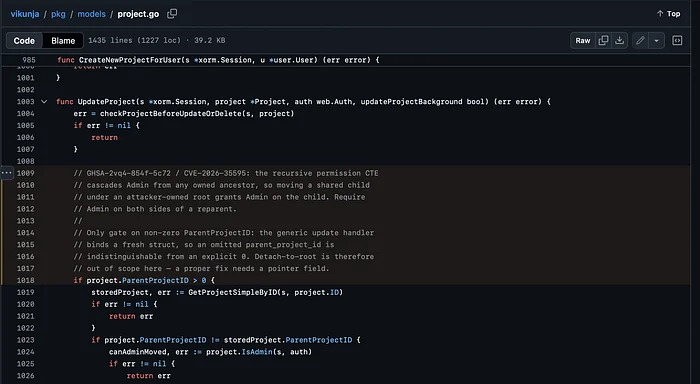
On 9 April, Vikunja shipped a fix for a privilege-escalation vulnerability, CVE-2026-35595 (GHSA-2vq4-854f-5c72). That patch closed the higher-impact path, but it also carried a comment describing one case it deliberately did not handle. About three months later, that exact case became CVE-2026-55064.
The lesson the author draws from the sequence: when a security patch says something is out of scope, treat it as a description of live behaviour. Sometimes the next vulnerability is already documented in the previous fix.
Setup
The example requests target http://localhost:3456/api/v1. Requests were authenticated with a bearer token held in a shell variable:
Authorization: Bearer $TOKEN
The relevant versions are those given for CVE-2026-55064: affected >= 2.3.0, fixed in 2.4.0. The runs used the same account and the same session, an account with only Write permission on the project. The examples use project 4, and its parent_project_id moved from 3 to null.
Finding it
The starting point was the earlier privilege escalation. In CVE-2026-35595, an attacker with Write access to somebody else's project could re-parent that project beneath a project they personally owned. Because permissions are computed recursively through the hierarchy, the attacker's Admin permission on their own project cascaded down to the victim project. In short: Write access plus re-parenting gave Admin access.
The initial fix required Admin permission on both sides of a re-parent operation, which is a sensible fix for the known vulnerability. But the patch also contained a comment stating that detach-to-root was out of scope.
That comment pointed at ParentProjectID. The field was represented as a plain int64, and in Go the zero value of an int64 is 0. The update handler also bound incoming requests into a fresh struct. As a result, the application could not distinguish between these two requests:
and:
{ "parent_project_id": 0}
From the perspective of the resulting struct, both could produce:
ParentProjectID == 0
Semantically, though, they mean very different things. The first means do not change the project's parent. The second means explicitly detach this project from its current parent and move it to the root. That distinction matters in any system where authorization flows from hierarchy.
Exploitation
The authorization check introduced by the first fix only ran when the supplied parent ID was greater than zero. Conceptually, the logic treated this as the security-sensitive case:
Project A | +--> move beneath Project B
but did not treat this as equivalent:
Project A | Xdetach to root
So a request containing:
{ "parent_project_id": 0}
did not pass through the new Admin-permission check. On its own that would not necessarily be a vulnerability. The important second half was that parent_project_id remained in the update column set unconditionally. The authorization guard did not consider the operation to be a parent change, but the database update still did. The write happened.
A user with only Write permission could therefore detach another user's project from its parent without having Admin rights.
Step 1: confirm the account lacks Admin
Using the same account and session, the first step is an operation that clearly requires Admin privileges, such as deleting the project:
curl -s -o /dev/null -w '%{http_code}' -X DELETE \ http://localhost:3456/api/v1/projects/4 \ -H "Authorization: Bearer $TOKEN"
This sends a DELETE to the project and prints only the HTTP status code. The server returns 403 Forbidden, which establishes that the account does not possess Admin rights.
Step 2: perform the detach
With the same account and session, the vulnerable update is sent:
curl -s -X POST http://localhost:3456/api/v1/projects/4 \ -H "Authorization: Bearer $TOKEN" \ -H 'Content-Type: application/json' \ -d '{"title":"Sensitive Child Project","parent_project_id":0}'
The body sets parent_project_id to 0, which the application interprets as an explicit request to move the project to the root. Across the runs, parent_project_id moved from 3 to null.
Across three independent runs, the DELETE returned 403 every time while parent_project_id moved from 3 to null, with the same account, the same session and in the same minute.
The negative control is what makes the proof meaningful. A successful request alone proves surprisingly little: if the attacker changes parent_project_id and the API accepts it, you still need to establish that the account was not legitimately authorised to perform an equivalent administrative operation. The 403 supplies that context. It demonstrates that the account does not have Admin rights, yet is still able to cross an authorization boundary through the vulnerable path.
Root cause
The missing pointer is only the mechanism. The real story is the mental model behind the authorization checks. Two separate guards were written around the idea of detecting a re-parent operation. They were looking for something conceptually like:
old parent -> new parent
but did not recognise:
old parent -> no parent
as the same class of security-sensitive state transition.
Authorization bugs frequently survive because security logic is written around a specific representation of an operation rather than its underlying effect. Move to another parent and detach from the current parent look different at the API level, but from an authorization perspective they are both mutations of the same trust boundary.
The binding layer collapsed omitted and explicitly zero into the same int64 value, so downstream authorization code could not tell whether a sensitive mutation had been requested. The guard keyed on the value being greater than zero, and the update column set did not, so the two disagreed about what the request meant.
Impact
In a hierarchical permission model, moving something to the root is not merely cosmetic. The project may be receiving permissions through its parent, and detaching it can sever that inheritance chain. Collaborators who previously reached the project through inherited permissions may suddenly lose access.
The vulnerability was therefore not simply that a Write user can change a numeric parent field. It was that a Write user can perform an Admin-only hierarchy mutation that changes the project's effective authorization relationships.
The impact is lower than the original privilege escalation, but the underlying mistake is arguably more interesting. CVE-2026-55064 is rated CVSS 4.3 (CVSS:3.1/AV:N/AC:L/PR:L/UI:N/S:U/C:N/I:L/A:N), classified as CWE-862, Missing Authorization, and affects versions >= 2.3.0, fixed in 2.4.0.
Fix
Vikunja fixed the root cause in version 2.4.0, along the lines the original patch comment had already suggested. The model changed from something like:
ParentProjectID int64
to the conceptual equivalent of:
ParentProjectID *int64
Now there are two representable states. nil means the client did not provide this field, while ptr(0) means the client explicitly asked to set the parent to zero. Once the application can distinguish those states, the authorization layer can reason about them correctly.
This is a common API security problem. For update endpoints there is often a critical difference between omitted, explicitly empty, explicitly zero, explicitly null and unchanged. If the binding layer collapses those states into the same representation, downstream authorization code may be unable to tell whether a sensitive mutation was requested.
Variants to test
The general method is variant analysis on security patches. Do not only ask whether a patch stops the published exploit. Also ask what definition of the dangerous operation the patch assumes, then look for equivalent state transitions outside that definition. If a guard protects A -> B, test:
A -> 0A -> nullA -> rootA -> deleted parentA -> archived parentA -> selfA -> previous value
The interesting variants live at representation boundaries: zero values, omitted fields, nulls, empty arrays, defaults and sentinel values.
When reviewing CVE-related commits, some of the cheapest greps available are TODO, for now, out of scope, a proper fix would, follow-up, not handled, currently assumes, temporary and edge case. These mark places where maintainers consciously accepted incomplete behaviour. Most will not be exploitable, but some describe the next vulnerability almost verbatim. Pay particular attention when the patch author has already left you a map: rather than hiding in some unrelated subsystem, the next vulnerability was sitting inside the previous security fix.
- Send an update that omits the parent field entirely and confirm nothing changes. A positive result is that the response or the stored state shows the parent unchanged.
- Send the same update with the parent field explicitly set to
0,null, an empty string or an empty array, using an account with only Write permission. A positive result is that the hierarchy changes while an Admin-only operation on the same resource still returns403. - Repeat the negative control first: attempt an operation that clearly requires Admin, such as deleting the resource, and confirm the
403. Without it, a successful mutation proves little. - Try other sentinel values and self-references, such as pointing a project at itself or at a previously deleted or archived parent, and compare the authorization decision with the resulting database write.
- Look for the same split between guard and write: a check that only fires for one representation of the operation, and an update column set that applies unconditionally.
What happened, in plain words
Vikunja is a task and project management application, the kind of tool a team uses to keep lists of work: projects, tasks inside those projects, and people who share them. It is written in Go, a programming language. You do not need to know Go to follow this; you only need to know that some of its rules about empty values matter later.
Vikunja lets you put one project underneath another, like folders inside folders. That nesting is not just for tidiness: it also decides who is allowed to do what. If you have permission on a parent project, you can inherit permission on the projects beneath it. The application works out those inherited rights with a recursive permission CTE through the project hierarchy.
On 9 April, the Vikunja developers released a fix for a serious security problem, tracked as CVE-2026-35595. A CVE is a public catalogue number given to a known vulnerability so people can refer to it unambiguously. That fix closed the dangerous path, but it also contained a comment saying that one particular case was deliberately not handled. About three months later, that exact case turned out to be a new vulnerability, CVE-2026-55064.
The lesson the author draws from this sequence is simple: when a security patch says something is out of scope, treat that sentence as a description of how the software still behaves. Sometimes the next vulnerability is already written down in the previous fix.
The original privilege escalation
The first vulnerability, CVE-2026-35595 (also published as advisory GHSA-2vq4-854f-5c72), was about project hierarchy and inherited permissions.
Imagine an attacker who has Write access to somebody else's project. Write access means they can change things in it, but they are not an administrator of it. The attacker also owns a project of their own, where they are Admin, meaning they can do anything.
The attacker could take the victim's project and move it underneath their own project. Vikunja calculates permissions through the project tree, so once the victim project sat beneath the attacker's project, the attacker's Admin rights on their own project flowed down to the victim project. In short: Write access plus moving a project gave Admin access.
The first fix required Admin permission on both sides of a re-parent operation. That is a sensible fix for the known problem. But the patch also carried a comment saying that detaching a project to the root, meaning moving it out from under any parent, was out of scope.
The problem with ParentProjectID
The comment pointed at a field called ParentProjectID, which records which project is the parent. In the code it was stored as a plain int64, a whole number. In Go, a number that has not been set has the value 0. The code that handles updates also copied each incoming request into a brand new, empty structure before reading it.
Because of that, the application could not tell these two requests apart:
and:
{ "parent_project_id": 0}
From the point of view of the resulting structure, both could produce:
ParentProjectID == 0
In plain words, the first request says nothing about the parent, so the parent should stay as it is. The second request explicitly asks to detach the project from its current parent and move it to the root. Those are very different intentions, but the code saw the same number in both cases. That distinction matters enormously in any system where permissions flow from the hierarchy.
The guard only understood re-parenting
The permission check added by the first fix only ran when the supplied parent ID was greater than zero. In other words, the code treated this as the security-sensitive case:
Project A | +--> move beneath Project B
but it did not treat this as equivalent:
Project A | Xdetach to root
So a request containing:
{ "parent_project_id": 0}
did not go through the new Admin-permission check. On its own, that would not necessarily be a vulnerability. The important second half was that parent_project_id stayed in the list of columns the database would update, no matter what. The permission guard did not think a parent change was happening, but the database update did it anyway. The write went through.
A user with only Write permission could therefore detach another user's project from its parent without having Admin rights.
Why detaching a project matters
In a system where permissions are inherited through a tree, moving something to the root is not just cosmetic. The project may have been receiving permissions through its parent. Detaching it can cut that inheritance chain.
That means collaborators who used to reach the project through inherited permissions may suddenly lose access.
The vulnerability was therefore not simply that a Write user can change a number in a parent field. It was that a Write user can perform an Admin-only change to the hierarchy that alters who can effectively access the project.
The impact was lower than the original privilege escalation, but the underlying mistake is arguably more interesting. CVE-2026-55064 has a CVSS score of 4.3 (CVSS:3.1/AV:N/AC:L/PR:L/UI:N/S:U/C:N/I:L/A:N). CVSS is a standard scoring system for the severity of vulnerabilities; 4.3 is in the medium range. It is classified as CWE-862, Missing Authorization, a category for cases where the software fails to check that a user is allowed to do something. Affected versions are >= 2.3.0, and it is fixed in 2.4.0.
The negative control makes the PoC meaningful
There is also an important lesson in how this kind of authorization bug should be demonstrated. A PoC, or proof of concept, is the set of steps that shows a vulnerability is real. A successful request alone proves surprisingly little.
If the attacker changes parent_project_id and the API accepts it, you still need to show that the account was not legitimately allowed to perform an equivalent administrative operation. That is where a negative control matters. A negative control is a test you expect to fail, used to prove that the thing you are testing really is restricted. Think of it like checking that a locked door really is locked before you show that a window opens.
Using the same account, in the same session:
- Attempt an operation that clearly requires Admin privileges, such as deleting the project.
- Observe the server returning
403 Forbidden. - Perform the vulnerable
parent_project_id: 0update. - Observe that the Admin-equivalent hierarchy change succeeds.
The 403 is what gives the exploit context. It shows that the account does not have Admin rights, yet can still cross an authorization boundary through the vulnerable path.
In practice that looks like this. First, confirm the account lacks Admin:
curl -s -o /dev/null -w '%{http_code}' -X DELETE \ http://localhost:3456/api/v1/projects/4 \ -H "Authorization: Bearer $TOKEN"
Line by line:
curlis a command-line tool for sending web requests, the same kind your browser sends when you click a link.-smeans silent: do not print progress or error chatter.-o /dev/nullthrows away the response body, the actual content the server sends back, so only the status code is shown.-w '%{http_code}'tells curl to print the HTTP status code, the three-digit number the server uses to say what happened, such as 200 for success or 403 for forbidden.-X DELETEsets the HTTP method to DELETE, which asks the server to remove something. Here it asks to delete project4.http://localhost:3456/api/v1/projects/4is the address.localhostmeans this computer,3456is the port the local Vikunja instance listens on, and/api/v1/projects/4is the path to project number 4. An API is the set of addresses a program exposes so other programs can talk to it; here it is the web interface of Vikunja.-H "Authorization: Bearer $TOKEN"adds a header, a small piece of extra information sent with the request. This one carries a token, a long secret string that proves who you are, like a wristband at an event.$TOKENis a shell variable holding that secret.
This sends a DELETE to the project and prints only the status code. The server returns 403 Forbidden, which establishes that the account does not have Admin rights.
Then perform the detach:
curl -s -X POST http://localhost:3456/api/v1/projects/4 \ -H "Authorization: Bearer $TOKEN" \ -H 'Content-Type: application/json' \ -d '{"title":"Sensitive Child Project","parent_project_id":0}'
Line by line:
-X POSTsets the method to POST, commonly used to send data that creates or updates something.- The address is the same project endpoint as before.
-H "Authorization: Bearer $TOKEN"sends the same identity token, so the server knows it is the same account.-H 'Content-Type: application/json'tells the server that the body is JSON, a common text format for structured data.-d '{"title":"Sensitive Child Project","parent_project_id":0}'is the body of the request. It sets the project title and setsparent_project_idto0, which the application interprets as an explicit request to move the project to the root.
Across the runs, parent_project_id moved from 3 to null.
Across three independent runs, the DELETE returned 403 every time while parent_project_id moved from 3 to null, with the same account, the same session and in the same minute.
Two guards, one shared assumption
Forget the missing pointer for a moment. The real story is the mental model behind the authorization checks. Two separate guards were written around the idea of detecting a re-parent operation, meaning a move from one parent to another. They were looking for something conceptually like:
old parent -> new parent
but they did not recognise:
old parent -> no parent
as the same class of security-sensitive state transition.
That is the real variant-analysis lesson. Variant analysis means taking a known bug and hunting for close relatives of it. Authorization bugs often survive because security logic is written around one particular way of expressing an operation rather than its actual effect. Moving to another parent and detaching from the current parent look different at the API level, but from an authorization point of view they are both changes to the same trust boundary.
nil and 0 are not the same thing
Vikunja fixed the root cause in version 2.4.0, along the lines the original patch comment had already suggested. The model changed from something like:
ParentProjectID int64
to the conceptual equivalent of:
ParentProjectID *int64
The star means the field is now a pointer, a value that can also be empty. Now there are two representable states. nil means the client did not provide this field, while ptr(0) means the client explicitly asked to set the parent to zero. Once the application can tell those states apart, the authorization layer can reason about them correctly.
This is a common API security problem. For update endpoints, there is often a critical difference between omitted, explicitly empty, explicitly zero, explicitly null and unchanged. If the layer that reads the request collapses those states into the same representation, the authorization code downstream may be unable to tell whether a sensitive change was requested.
Patch comments are attack-surface documentation
The original Vikunja developers understood the limitation and said so in the patch itself. The scope decision was reasonable: security patches are often deliberately narrow, and redesigning an entire update model while responding to a vulnerability introduces its own risk.
But that means security patches deserve to be reviewed differently from ordinary bug fixes. Do not only ask:
Does this patch stop the published exploit?
Also ask:
What definition of the dangerous operation does this patch assume?
Then look for equivalent state transitions outside that definition. If a guard protects A -> B, test:
A -> 0A -> nullA -> rootA -> deleted parentA -> archived parentA -> selfA -> previous value
The interesting variants live at representation boundaries: zero values, omitted fields, nulls, empty arrays, defaults, sentinel values. A sentinel value is a special value used to signal something, such as 0 meaning no parent.
And when you are doing variant analysis on CVE-related commits, some of the cheapest greps available are: TODO, for now, out of scope, a proper fix would, follow-up, not handled, currently assumes, temporary, edge case. A grep is a search through text, and a commit is a saved change to the code. These words mark places where maintainers consciously accepted incomplete behaviour. Most will not be exploitable. Some describe the next vulnerability almost verbatim.
Pay particular attention when the patch author has already left you a map. Rather than hiding in some unrelated subsystem, the next vulnerability was sitting inside the previous security fix.
"Detach-to-root is therefore out of scope here."
Glossary
- API: the set of addresses and rules a program exposes so other programs can talk to it, like a service counter with specific forms to fill in.
- Admin: the highest permission level on a project, allowing any action including deletion.
- Authorization: the process of deciding whether a user is allowed to perform an action.
- Bearer token: a secret string sent with a request that proves who you are, like a wristband at an event.
- Body: the part of a web request that carries data, such as a JSON document.
- Commit: a saved change to a codebase.
- CVE: a public catalogue number for a known vulnerability.
- CVSS: a standard scoring system for the severity of vulnerabilities.
- CWE-862: a category for vulnerabilities where the software fails to check that a user is authorised.
- curl: a command-line tool for sending web requests.
- DELETE: an HTTP method that asks the server to remove something.
- Endpoint: a specific address in an API that performs a particular operation.
- Go: a programming language; in Go an unset number is
0. - grep: a search through text for a pattern.
- Header: extra information sent alongside a web request, such as an identity token or the format of the body.
- HTTP status code: a three-digit number the server returns to say what happened, such as 200 for success or 403 for forbidden.
- int64: a whole number stored in 64 bits; its default value in Go is
0. - JSON: a common text format for structured data.
- Negative control: a test you expect to fail, used to prove that the thing you are testing really is restricted.
- nil: the empty value of a pointer, meaning no value was provided.
- Parent project: the project a project sits underneath in the hierarchy.
- Pointer: a value that can either point at something or be empty (
nil). - PoC (proof of concept): the steps that demonstrate a vulnerability is real.
- POST: an HTTP method commonly used to send data that creates or updates something.
- Privilege escalation: gaining more permissions than you were granted.
- Recursive permission CTE: a database query that walks up and down a tree to calculate inherited permissions.
- Root: the top level of the hierarchy, with no parent.
- Sentinel value: a special value used to signal something, such as
0meaning no parent. - Session: a period during which the server remembers who you are, usually via a token or cookie.
- Token: a secret string that proves your identity to the server.
- Variant analysis: taking a known bug and hunting for close relatives of it.
- Vulnerability: a weakness in software that someone can abuse to do something they should not be able to do.
- Write access: permission to change things in a project, but not to administer it.

