ads.twitter.com xss
A cross-site scripting flaw existed in the card name field when creating or cloning a card on Twitter's ads platform. An attacker could inject script that persisted and executed when the card was viewed, potentially stealing cookies.
 Originally disclosed on HackerOne
- Triaged in under an hour
- Fixed in 2 hours
- Paid in 4 days
- Disclosed after 2 months
Cross-Site Scripting vulnerability exists in card[name] parameter when creating/cloning a card via script https://ads.twitter.com/accounts/18ce53wrkma/cards/new?card_type=7. Here is the simple test vector: </title><script>alert(document.cookie)</script><title> After the card is created XSS becomes persistent and can be triggered via https://ads.twitter.com/accounts/18ce53wrkma/cards/show?url_id=42qj.
Attachments
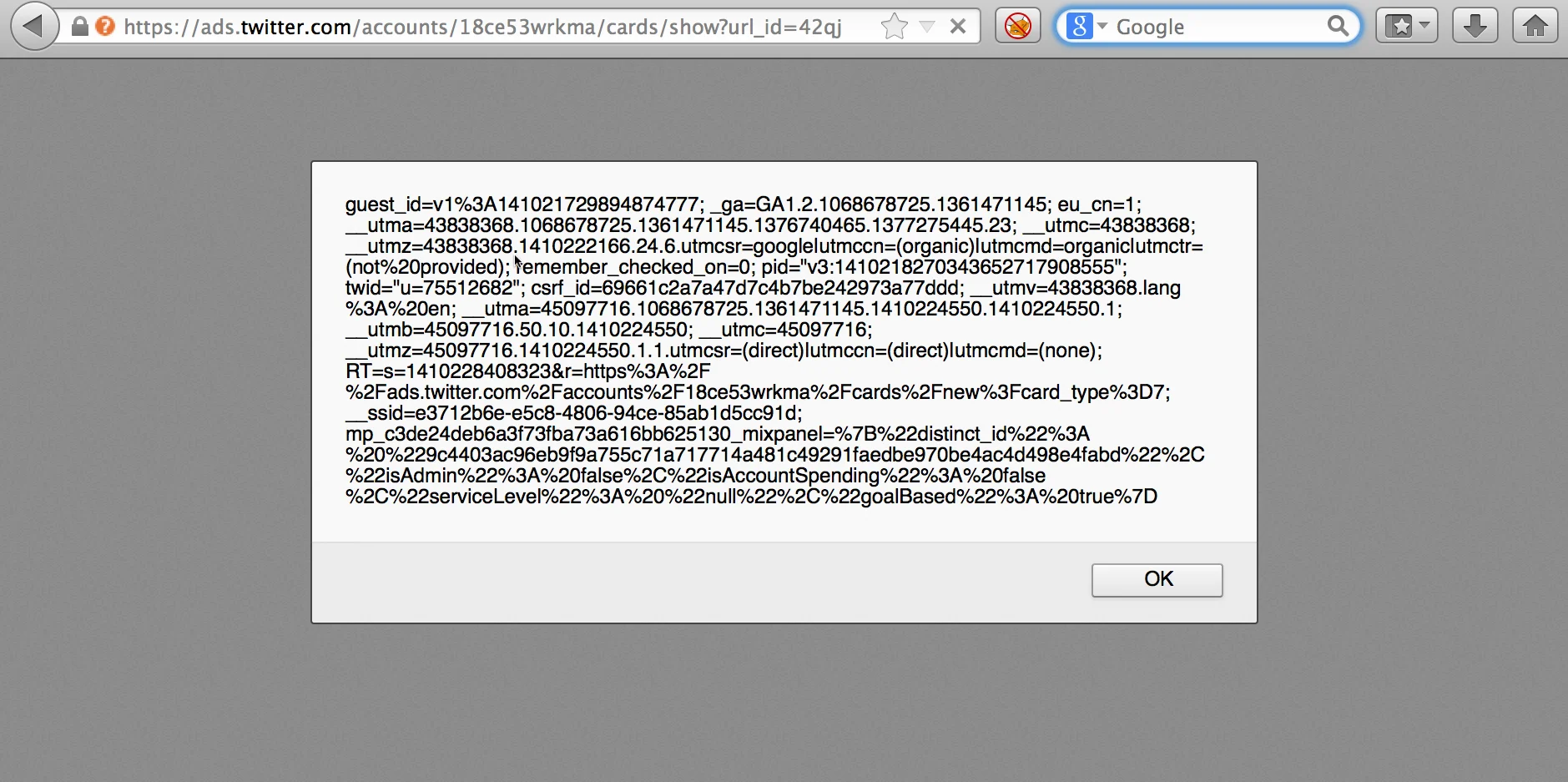
Not written yet. The AI write-up for this report has not been written yet. The Original tab links to the source.
How it worked
Root cause
Likely the card name input was stored and later rendered without proper HTML encoding or sanitisation.
Impact
An attacker could execute arbitrary script in the context of the ads.twitter.com site, potentially stealing session cookies.
What the attacker needed
Access to ads.twitter.com; ability to create a card
How it was found
- Go to the new card page with card_type=7.
- Enter a script payload in the card name field.
- Create the card.
- Visit the card's show page to trigger the stored script.
Explained by bugbounty.wiki with AI from the original and checked against quotes from it; it can still be wrong. Read the original before relying on a detail.
Not written yet. The AI write-up for this report has not been written yet. The Original tab links to the source.
Cross-site scripting (XSS) is when a website displays user input without cleaning it, so an attacker can sneak in code that runs in other people's browsers. Here, the card name field accepted a script tag, and the script ran whenever the card was viewed, which could let an attacker read a victim's login cookie.
What is XSS?
Script an attacker supplies runs in another user's browser, on the target's origin, with that user's session.



