Stored xss
An Android app on Google Play had a name containing an HTML image tag with an event handler. When its package id was entered in the 'Add New App' form on ads.twitter.com, the app name was rendered without encoding and the script ran in the page.
 Originally disclosed on HackerOne
- Triaged in 3 hours
- Fixed in 5 hours
- Paid in 23 hours
- Disclosed after 15 days
Hi!
There's a stored xss on ads.twitter.com under "Add New App" section at https://ads.twitter.com/accounts/18ce53wsl3g/campaigns/new_objective/app_installs.
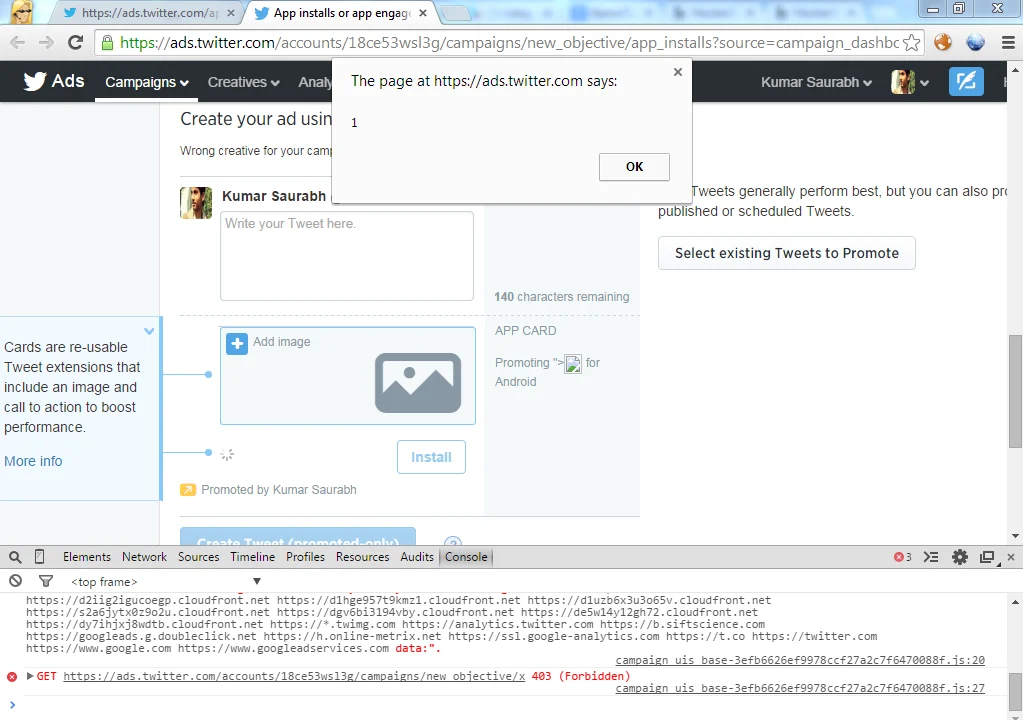
There's a option to add android application by Google play app id, so i searched for a app on play store with name " "><img src=x onerror=alert(1)>" " and then i got this app https://play.google.com/store/apps/details?id=com.rssappmaker.athe319.
So to reproduce this copy paste the app id "com.rssappmaker.athe319" in that box and then click on "add app" button. After that this xss will be triggered. See the attached image poc.png
Tested in latest version of chrome.
Thanks
Attachments
Not written yet. The AI write-up for this report has not been written yet. The Original tab links to the source.
How it worked
Impact
An attacker could run script in the browser of a user who adds the malicious app on ads.twitter.com.
What the attacker needed
A Google Play app with a crafted name; victim adds that app id in the form
How it was found
- Find or publish an Android app on Google Play whose name contains an HTML image tag with an event handler.
- Open the 'Add New App' section on ads.twitter.com.
- Enter the app's package id in the Google Play app id field.
- Click the 'add app' button to trigger the script.
Explained by bugbounty.wiki with AI from the original and checked against quotes from it; it can still be wrong. Read the original before relying on a detail.
Not written yet. The AI write-up for this report has not been written yet. The Original tab links to the source.
A website showed the name of an Android app after its id was entered. The attacker found an app whose name contained HTML code, so when the site displayed that name the browser ran a small script. This is called stored cross-site scripting.
What is XSS?
Script an attacker supplies runs in another user's browser, on the target's origin, with that user's session.





