Host Header Injection Attack - www.xnxx.com
The report claims that the web server accepts an arbitrary Host header and redirects to it, which could enable web cache poisoning. The attacker could potentially manipulate caching systems to serve malicious content, but the report provides no evidence of actual cache poisoning.
 Originally disclosed on HackerOne
- Disclosed after 4 months
Summary by the program
This is a recurrent report that is systematically rejected because it need to get access to the user computer / phone.
This is not a security issue at all.
The report
Host Header Injection Attack - www.xnxx.com
An attacker can manipulate the Host header as seen by the web application and cause the application to behave in unexpected ways.
Very often multiple websites are hosted on the same IP address. This is where the Host Header comes in. This header specifies which website should process the HTTP request. The web server uses the value of this header to dispatch the request to the specified website. Each website hosted on the same IP address is called a virtual host.
But what happens if we specify an invalid Host Header? If Apache receives an unrecognized Host Header, it passes it to the first virtual host defined in httpd.conf. Therefore, it's possible to send requests with arbitrary Host Headers to the first virtual host.
Another way to pass arbitrary Host headers is to use the X-Forwarded-Host Header. In some configurations this header will rewrite the value of the Host header. Therefore it's possible to make a request like:
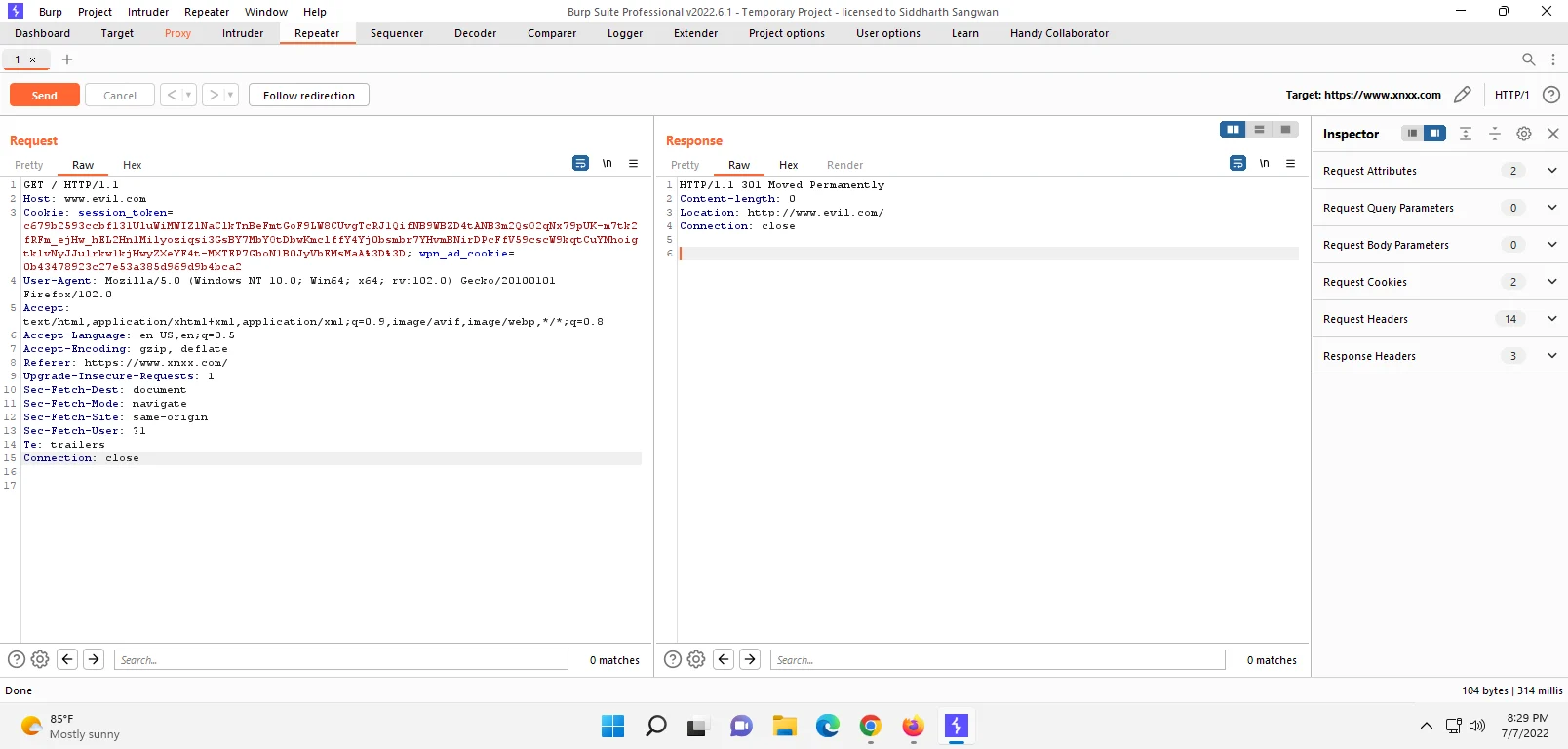
#PoC Request - GET / HTTP/1.1 Host: www.evil.com Cookie: session_token=c679b2593ccbf131UluWiMWIZlNaClkTnBeFmtGoF9LW8CUvgTcRJ1QifNB9WBZD4tANB3m2QsO2qNx79pUK-m7tk2fRFm_ejHw_hEL2Hn1Milyoziqsi3GsBY7MbYOtDbwKmclffY4Yj0bsmbr7YHvmBNirDPcFfV59cscW9kqtCuYNhoigtklvNyJJulrkw1kjHwyZXeYF4t-MXTEP7GboN1B0JyVbEMsMaA%3D%3D; wpn_ad_cookie=0b43478923c27e53a385d969d9b4bca2 User-Agent: Mozilla/5.0 (Windows NT 10.0; Win64; x64; rv:102.0) Gecko/20100101 Firefox/102.0 Accept: text/html,application/xhtml+xml,application/xml;q=0.9,image/avif,image/webp,/;q=0.8 Accept-Language: en-US,en;q=0.5 Accept-Encoding: gzip, deflate Referer: https://www.xnxx.com/ Upgrade-Insecure-Requests: 1 Sec-Fetch-Dest: document Sec-Fetch-Mode: navigate Sec-Fetch-Site: same-origin Sec-Fetch-User: ?1 Te: trailers Connection: close
#PoC Response - HTTP/1.1 301 Moved Permanently Content-length: 0 Location: http://www.evil.com/ Connection: close
#PoC Payload - Host: evil.com
Please verify and fix the same.
Impact
Tampering of Host header can lead to the following attacks: Web Cache Poisoning-Manipulating caching systems into storing a page generated with a malicious Host and serving it to others and more.
Attachments
Not written yet. The AI write-up for this report has not been written yet. The Original tab links to the source.
How it worked
Root cause
Likely the server uses the client-supplied Host header to build a redirect without validating it against an allowlist.
Impact
The report claims this could lead to web cache poisoning, but no cache poisoning was demonstrated and the program rejected the report as not a security issue.
What the attacker needed
Ability to send HTTP requests with custom Host header
How it was found
- Send an HTTP request with a manipulated Host header.
- Observe that the server responds with a redirect to the attacker-controlled host.
Explained by bugbounty.wiki with AI from the original and checked against quotes from it; it can still be wrong. Read the original before relying on a detail.
Not written yet. The AI write-up for this report has not been written yet. The Original tab links to the source.
A Host header tells a web server which website the browser wants to reach. This report says the server blindly trusts whatever host name is sent and redirects to it, which could let an attacker trick a cache into storing a malicious redirect. However, the report only shows a redirect and does not prove any real harm.
What is Misconfiguration?
Settings left unsafe: exposed panels, open storage buckets, debug modes, default credentials.



