How we breached ZDFheute live on television
A Google Document used by ZDFheute editorial staff to communicate with the live TV host was publicly accessible without authentication, granting full read and write access. An attacker could read viewer personal data and editorial comments, and could inject or alter content that might be read out live on air.
 Published on medium.com
In summer this year, we came across some security misconfiguration in Germany’s biggest — and one of Europe’s largest — Television networks named ZDF (Zweites Deutsches Fernsehen). This misconfiguration allowed us to access the internal communication while live on air, which was used to define the content of the show.
The full write-up lives on its author's site
It belongs to its author, so we link to it rather than copy it. The other two tabs are our own rewrites, checked against it.
Context
ZDF (Zweites Deutsches Fernsehen) is described in the report as Germany's biggest television network and one of Europe's largest. The product involved is the live TV programme ZDFheute, a format in which a current topic is discussed live on air together with invited experts. Viewers can raise questions directly to the experts on live television through the YouTube chat, email and other channels.
Because viewers interact directly, the format needs moderation: inappropriate comments have to be filtered out before they are passed to the host, who reads them out loud on air and asks the question on the viewer's behalf. The editorial staff and the host coordinate this live, and the coordination happens in a shared Google Document.

Setup
The researcher needed very little to reach the document:
- A browser.
- A Google account, used later to sign in and read the document's version history.
- No credentials, invitation or other authorisation for the document itself.
The document was reachable publicly over the internet and required no authentication.
Finding it
On 9th of July, 2022, the researcher was watching a recording of ZDFheute on YouTube. During the episode, the camera showed the moderator's laptop screen for a split second. Examining that frame further, the researcher saw an open browser displaying an open Google Docs editor.
The researcher navigated the browser to that link and was presented with the very same Google Document. No authentication was needed. The document was used to communicate between the editorial staff and the TV show host live on air and to deliver comments from the audience.
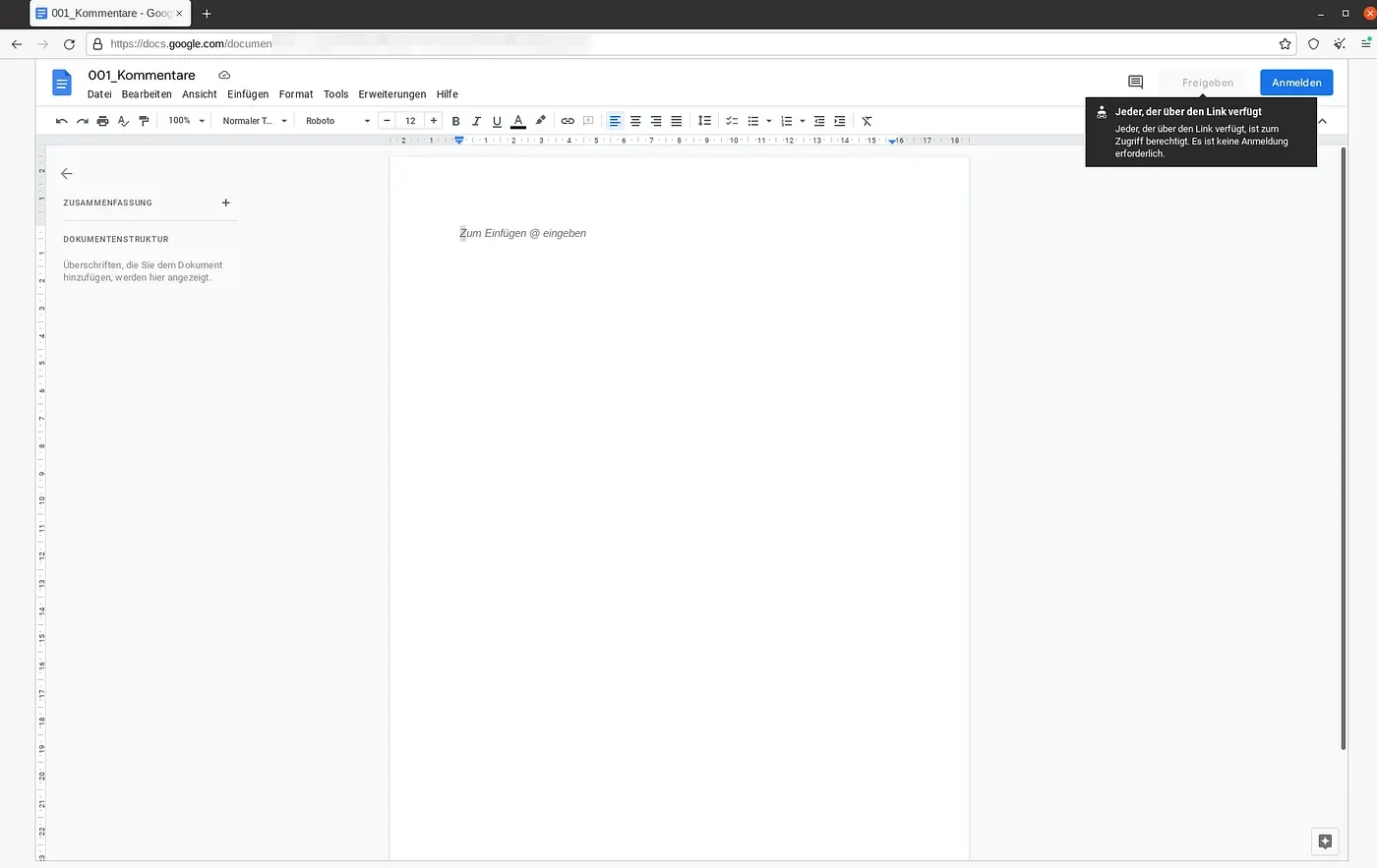
What made it clearly wrong was not only that the document was readable, but that the researcher's permissions were full read and write. From that point on, the researcher could take part as an editorial staff member, making news.
Exploitation
Step 1: Recover the document URL from the broadcast
The URL was not guessed or brute-forced. It was visible on screen in a single frame of the YouTube recording, where the moderator's laptop showed the Google Docs editor open in a browser. The researcher read the link from that frame and opened it directly.
Step 2: Open the document without authentication
Navigating to the link returned the live document itself. No login, no access request and no sharing invitation were involved. The document was the working channel between editorial staff and the on-air host, carrying audience comments.
Step 3: Check the granted permissions
The researcher checked the permissions attached to the document and found full read and write access. This is the difference between a leak and an injection point: write access meant the researcher could act as editorial staff and contribute content to the document that fed the live show.
Step 4: Read the version history
After signing in with a Google account, the researcher could also see the entire version history of the document, dating back roughly two years. Because nobody had removed the old content, the history exposed everything typed into the document across those two years, which covers each ZDFheute show since then.
The exposed material contained personal information of viewers, such as full names and email addresses, as well as personal commentary by the editorial staff.
Step 5: Report to ZDF
On 10th of July, 2022, after gathering all evidence and information needed to properly evaluate the risk and impact, the researcher emailed ZDF directly with a detailed description. No response was received.
Step 6: Observe the live workflow
A few weeks passed during which the researcher joined the editorial staff live on air, almost every evening that the ZDFheute live show took place. Several people, with full names, could be observed actively working in the document, adding names and comments of viewers who were posting questions via social media or via email.
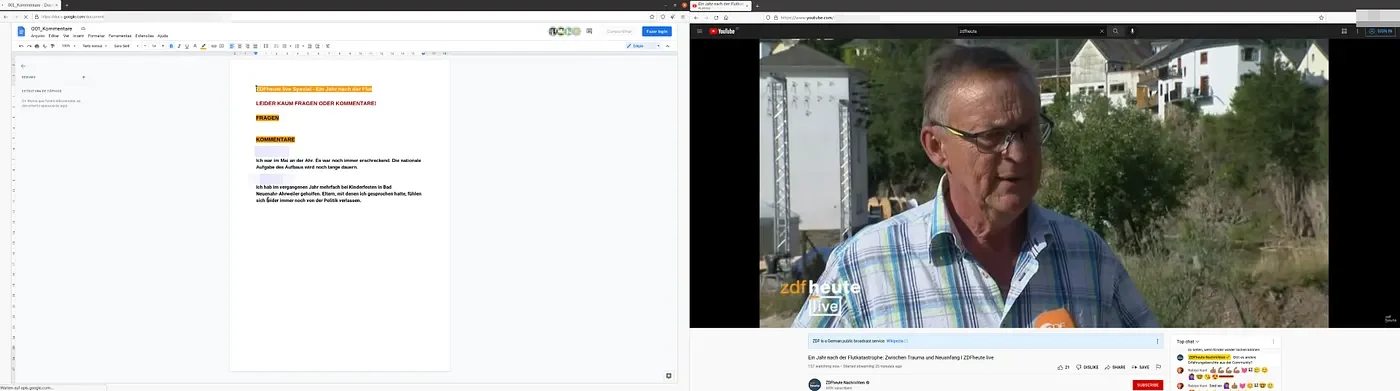
Two shows stood out. One covered a flooding that caused many deaths and destruction in central Germany:
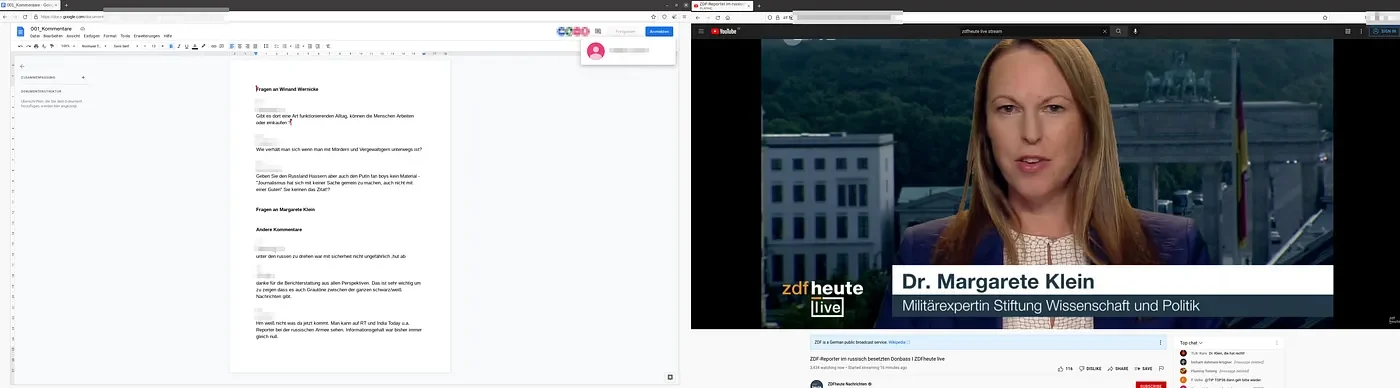
Another covered the Russian war in Ukraine, a show in which the researcher could have manipulated the communication and comments, and therefore possibly news being released live on air:
Step 7: Escalate to the Data Protection Officer
After waiting a couple of weeks without any response or action taken overall, on 27th of July, 2022, the researcher decided to reach out to more people at ZDF and eventually contacted their Data Protection Officer. He took swift action and made sure the document was no longer reachable publicly over the internet, and briefly thanked the researcher for the report.
Root cause
The report frames the issue as a security misconfiguration: a publicly reachable Google Document with no authentication. A document that was meant to be private to editorial staff and the host was reachable by anyone who had the link, and the link holder was granted read and write rather than read-only or no access. The report frames this as a security misconfiguration, and places it in the wider problem of publicly open Google Documents and files of all sorts, for which specific search engines exist.
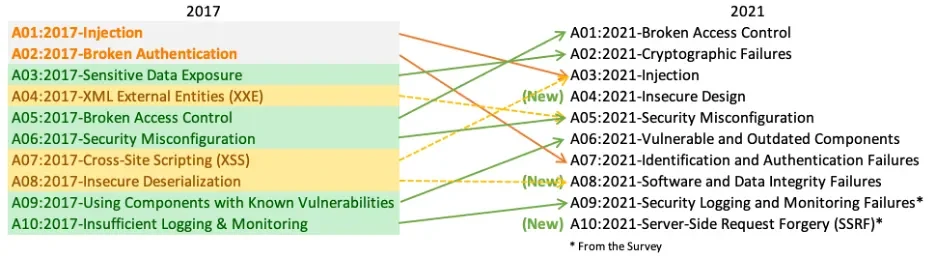
The report notes that the latest OWASP Top 10 from 2021 ranks "Identification and Authentication Failures" as the number seven issue in web applications and "Security Misconfiguration" as the fifth among the most common security issue categories.
The document required no further authentication; the report warns against treating an unknown URL as a private place. The report's own conclusion is that a URL which supposedly no one else knows about, and which does not require further authentication, must not be treated as a private place. Anything publicly available on the internet can and will be found, sooner or later. Old content was never removed, so after signing in the researcher could see roughly two years of names, email addresses and staff commentary.
Impact
Under the conditions observed, an attacker with the link could:
- Read the live editorial communication between staff and the on-air host.
- Read audience comments and questions before they were filtered and passed to the host.
- Write into the document as editorial staff, and therefore potentially manipulate the communication and comments, and possibly news released live on air.
- Read roughly two years of version history, including viewers' full names and email addresses and personal commentary by editorial staff.
The report is explicit about the hedge on the most serious outcome: the researcher could have manipulated the communication and comments and therefore possibly news being released live on air. It raises the question of what a false announcement on the Russian war on Germany's biggest TV channel could have led to during such tense times. This is why "Media and Culture" is classified as Critical Infrastructure (KRITIS) in Germany, with especially high requirements on security.
Fix
What was actually changed: after the Data Protection Officer was contacted on 27th of July, 2022, the document was made no longer reachable publicly over the internet. The report does not describe any further remediation.
What the report's reasoning implies should be done:
- Do not rely on an unguessable URL as the only access control. Require authentication and restrict sharing to the specific staff who need the document.
- Grant the minimum permission needed rather than read and write to anyone with the link.
- Remove old content from live working documents, and review version history exposure, so that past shows do not accumulate personal data.
Variants to test
- Link-shared cloud documents in broadcast and screenshot material. Review recorded streams, press photos and screen shares for document URLs visible in a frame. A positive result is a URL that opens the document without a login prompt.
- Permission level on any reachable document. Once a document opens, check whether the interface offers editing. A positive result is an edit control or a writable body rather than a read-only view.
- Version history retention. Sign in and open the file history on any document you are authorised to test. A positive result is historical content containing personal data or internal commentary that should have been removed.
- Public document search engines. Use the search engines the report mentions for publicly open Google Documents to look for an organisation's working files. A positive result is an internal-looking document reachable without authentication.
- Editorial and moderation workflows generally. Any shared document used to relay audience questions to an on-air host is worth checking for open sharing, since write access could allow manipulation of the communication.
What happened, in plain words
In summer 2022, a security researcher found that a working document used by Germany's biggest television network, ZDF (Zweites Deutsches Fernsehen), could be opened by anyone on the internet. The document was the shared notepad the editorial team and the on-air host used to coordinate a live programme called ZDFheute, where a current topic is discussed live with invited experts and viewers send in questions. Because the document was open to anyone with its link, and because anyone who opened it could also type into it, a stranger could read the live editorial conversation and could have written into it too. The researcher reported it, and after some weeks the document was closed off from the public internet.
This article walks through the whole story from zero. You only need to know how to use a browser. Every technical idea is explained the first time it appears.
The background: what ZDFheute is and why a document sits behind it
ZDF is described in the report as Germany's biggest television network and one of Europe's largest. ZDFheute is a live TV format: a current topic is discussed on air together with invited experts. Viewers can put questions directly to those experts on live television through the YouTube chat, by email and through other channels.
Because viewers write in directly, someone has to moderate. Moderation here means reading the incoming questions and comments and filtering out the inappropriate ones before anything reaches the host. The host then reads the chosen questions out loud on air and asks them on the viewer's behalf.
All of this happens live, so the editorial staff and the host need a shared place to coordinate in real time. That place was a Google Document: a word-processor file that lives online, in Google's cloud, and that several people can open and edit at the same time. Think of it as a shared whiteboard that everyone can see and write on at once, rather than a piece of paper passed around.
What the researcher needed to start
The setup was minimal:
- A browser.
- A Google account, used later to sign in and read the document's version history (explained below).
- No password, no invitation and no other permission for the document itself.
The document was reachable publicly over the internet and required no authentication.
Finding it
On 9th of July, 2022, the researcher was watching a recording of ZDFheute on YouTube. During the episode, the camera showed the moderator's laptop screen for a split second. Looking closely at that single frame, the researcher saw an open browser with an open Google Docs editor on screen.
A Google Docs editor is simply the web page where you type into a Google Document. When you open a document in Google Docs, the address bar of your browser shows a long link (a URL, short for Uniform Resource Locator, which is just the address of a page on the internet). That link is what the researcher read off the screen.
The researcher then typed that link into their own browser and was shown the very same Google Document. No authentication was needed. Authentication is the process of proving who you are, usually by logging in with a username and password. Here there was none: the page opened straight away, like a web page anyone can visit.
The document was used to communicate between the editorial staff and the TV show host live on air, and to deliver comments from the audience.
What made this clearly wrong was not only that the document could be read. It was that the researcher's permissions were full read and write. Permissions are the rules attached to a file that say what each person is allowed to do with it: look at it, change it, or nothing at all. Read and write means both looking and changing. From that moment the researcher could take part as an editorial staff member, making news.
How the problem was used, step by step
Step 1: Recover the document URL from the broadcast
The link was not guessed and not cracked by trying millions of combinations. It was simply visible on screen in one frame of the YouTube recording, where the moderator's laptop showed the Google Docs editor open in a browser. The researcher read the link from that frame and opened it directly.
Why this matters: many people assume that a long, messy-looking web address is effectively secret. This step shows that a link shown on television, even for a fraction of a second, is not secret at all. Anyone can pause a video and look.
Step 2: Open the document without authentication
Going to the link returned the live document itself. There was no login screen, no request for access and no sharing invitation. The document was the working channel between editorial staff and the on-air host, carrying audience comments.
Why this matters: normally, a private online document asks you to sign in and checks whether the owner has given you access. Here neither happened, which means the only thing standing between the public and the document was knowing the address.
Step 3: Check the granted permissions
The researcher checked what the document allowed them to do and found full read and write access. This is the difference between a leak and an injection point. A leak means information comes out that should have stayed in. An injection point means an outsider can put something in. Write access meant the researcher could act as editorial staff and contribute content to the document that fed the live show.
An everyday comparison: finding a diary left open on a park bench is a leak. Finding the diary open and a pen lying next to it, with room to write, is closer to an injection point.
Step 4: Read the version history
After signing in with a Google account, the researcher could also see the entire version history of the document, dating back roughly two years. Version history is a feature of online documents that keeps a record of every change ever made, so you can scroll back and see what the file looked like at any earlier moment. It is like the undo button, except it remembers everything forever instead of one step at a time.
Because nobody had removed the old content, the history exposed everything typed into the document across those two years, which covers each ZDFheute show since then.
The exposed material contained personal information of viewers, such as full names and email addresses, as well as personal commentary by the editorial staff.
Why this matters: even if the current page of a document looks harmless, the history behind it can hold months or years of information that was never meant to be public. Personal data such as names and email addresses is exactly the kind of thing that data protection rules exist to guard.
Step 5: Report to ZDF
On 10th of July, 2022, after gathering all the evidence and information needed to properly judge the risk and impact, the researcher emailed ZDF directly with a detailed description. No response was received.
Why this step was taken: the responsible thing to do on finding a problem like this is to tell the owner privately first, so they can fix it before anyone else finds it. This is often called responsible disclosure. The researcher did that and waited.
Step 6: Observe the live workflow
A few weeks passed. During that time the researcher joined the editorial staff live on air, almost every evening that the ZDFheute live show took place. Several people, with full names, could be observed actively working in the document, adding names and comments of viewers who were posting questions via social media or via email.
Why this step was taken: watching the document in normal use showed how it actually worked and how serious the exposure was. It confirmed that real staff were using it live, and that real viewers' details were flowing through it.
Two shows stood out. One covered a flooding that caused many deaths and destruction in central Germany:
Another covered the Russian war in Ukraine, a show in which the researcher could have manipulated the communication and comments, and therefore possibly news being released live on air:
Note the careful wording: the researcher could have manipulated the communication and comments, and therefore possibly news being released live on air. The report does not claim that any manipulation actually happened. It points out the possibility, which is what made the exposure serious.
Step 7: Escalate to the Data Protection Officer
After waiting a couple of weeks without any response or action taken overall, on 27th of July, 2022, the researcher decided to reach out to more people at ZDF and eventually contacted their Data Protection Officer. A Data Protection Officer is the person inside an organisation responsible for making sure personal data is handled lawfully and safely. Because the document held viewers' names and email addresses, this was the right person to tell.
He took swift action and made sure the document was no longer reachable publicly over the internet, and briefly thanked the researcher for the report.
Why this step was taken: when the first contact goes unanswered, going to a second, more specific contact inside the organisation is a common and sensible escalation. It worked.
Why it happened
The report frames the issue as a security misconfiguration: a publicly reachable Google Document with no authentication. Authorisation is the part of a system that decides what a person is allowed to do once they are identified; it is different from authentication, which is about who you are. Here, a document meant to be private to editorial staff and the host was reachable by anyone who had the link, and the person holding the link was given read and write rather than read-only or no access.
The report frames this as a security misconfiguration. That term means a system set up in an unsafe way, not broken by a clever attack: the settings were simply left in a state that allowed too much. Think of a shop that locks its safe but leaves the back door propped open.
The report also places this in the wider problem of publicly open Google Documents and files of all sorts, for which specific search engines exist. In other words, there are tools whose whole purpose is to find documents that people have accidentally left open to the public.
The report notes that the latest OWASP Top 10 from 2021 ranks "Identification and Authentication Failures" as the number seven issue in web applications and "Security Misconfiguration" as the fifth among the most common security issue categories. The OWASP Top 10 is a widely used list, published by a community of security professionals, of the most common categories of web security problems. It is not a ranking of specific products; it is a ranking of kinds of mistake.
The document required no further authentication; the report warns against treating an unknown URL as a private place. Obscurity here means relying on the address being hard to guess. The report's own conclusion is that a URL which supposedly no one else knows about, and which does not require further authentication, must not be treated as a private place. Anything publicly available on the internet can and will be found, sooner or later.
Old content was never removed, so after signing in the researcher could see roughly two years of names, email addresses and staff commentary.
What could have gone wrong
Under the conditions observed, an attacker with the link could:
- Read the live editorial communication between staff and the on-air host.
- Read audience comments and questions before they were filtered and passed to the host.
- Write into the document as editorial staff, and therefore potentially manipulate the communication and comments, and possibly news released live on air.
- Read roughly two years of version history, including viewers' full names and email addresses and personal commentary by editorial staff.
The report is explicit about the hedge on the most serious outcome: the researcher could have manipulated the communication and comments and therefore possibly news being released live on air. It raises the question of what a false announcement on the Russian war on Germany's biggest TV channel could have led to during such tense times. This is why "Media and Culture" is classified as Critical Infrastructure (KRITIS) in Germany, with especially high requirements on security. Critical infrastructure means organisations whose failure or disruption would seriously harm society, such as power, water, health and, in this case, media.
What was fixed
What was actually changed: after the Data Protection Officer was contacted on 27th of July, 2022, the document was made no longer reachable publicly over the internet. The report does not describe any further remediation.
What the report's reasoning implies should be done:
- Do not rely on an unguessable URL as the only access control. Require authentication and restrict sharing to the specific staff who need the document.
- Grant the minimum permission needed rather than read and write to anyone with the link.
- Remove old content from live working documents, and review version history exposure, so that past shows do not accumulate personal data.
Things worth checking elsewhere
These are patterns to look for, not instructions to attack anything you do not own or have permission to test.
- Link-shared cloud documents in broadcast and screenshot material. Review recorded streams, press photos and screen shares for document URLs visible in a frame. A positive result is a URL that opens the document without a login prompt.
- Permission level on any reachable document. Once a document opens, check whether the interface offers editing. A positive result is an edit control or a writable body rather than a read-only view.
- Version history retention. Sign in and open the file history on any document you are authorised to test. A positive result is historical content containing personal data or internal commentary that should have been removed.
- Public document search engines. Use the search engines the report mentions for publicly open Google Documents to look for an organisation's working files. A positive result is an internal-looking document reachable without authentication.
- Editorial and moderation workflows generally. Any shared document used to relay audience questions to an on-air host is worth checking for open sharing, since write access could allow manipulation of the communication.
Glossary
- Authentication: proving who you are, usually by logging in with a username and password.
- Authorisation: deciding what an identified person is allowed to do, such as read or write a file.
- Browser: the program you use to visit web pages, such as Chrome, Firefox or Safari.
- Cloud document: a file that lives on a company's servers on the internet rather than on your own computer, and that several people can open at once.
- Critical Infrastructure (KRITIS): organisations whose failure or disruption would seriously harm society, such as power, water, health and media; in Germany this status comes with especially high security requirements.
- Data Protection Officer: the person inside an organisation responsible for making sure personal data is handled lawfully and safely.
- Google Docs editor: the web page where you view and type into a Google Document.
- Injection point: a place where an outsider can put content in, as opposed to only taking content out.
- Leak: information coming out that should have stayed in.
- Moderation: reading incoming comments and questions and filtering out inappropriate ones before they reach the audience or host.
- Obscurity: relying on something being hard to guess, such as a long web address, as if it were a security measure.
- OWASP Top 10: a widely used community-published list of the most common categories of web security problems.
- Permissions: the rules attached to a file that say what each person may do with it, such as read, write or nothing.
- Read and write access: permission both to look at a document and to change it.
- Responsible disclosure: telling the owner of a system privately about a security problem first, so they can fix it before others find it.
- Security misconfiguration: a system set up in an unsafe way, where the settings allow too much, rather than being broken by a clever attack.
- URL (Uniform Resource Locator): the address of a page or file on the internet, shown in your browser's address bar.
- Version history: a feature of online documents that records every change ever made, so you can scroll back and see earlier versions.
- ZDF (Zweites Deutsches Fernsehen): described in the report as Germany's biggest television network and one of Europe's largest.
- ZDFheute: a live TV format in which a current topic is discussed on air with invited experts, with viewers sending in questions.



