macOS AUHelperService Full TCC Bypass
An XPC service with Full Disk Access entitlement accepted all clients and exposed routines that allowed reading and writing arbitrary files, including the user's TCC database. An attacker could bypass TCC protections and replace the TCC.db to grant themselves additional permissions.
 Published on jhftss.github.io
Last year, I discovered a full user TCC bypass issue in the macOS Sonoma beta version. There was a CVE number assigned at the beginning, but removed by Apple in the release of macOS 14.0.
The full write-up lives on its author's site
It belongs to its author, so we link to it rather than copy it. The other two tabs are our own rewrites, checked against it.
Context
This write-up covers a full user TCC bypass that the researcher, Mickey Jin (@patch1t), found in the macOS Sonoma beta. TCC (Transparency, Consent and Control) is the macOS subsystem that gates access to protected resources such as the user's files, and the kTCCServiceSystemPolicyAllFiles service is the one behind Full Disk Access (FDA). A process holding that entitlement can read and write files that TCC would otherwise protect.
The vulnerable component was an XPC service bundled inside Archive Utility:
/System/Library/CoreServices/Applications/Archive Utility.app/Contents/XPCServices/AUHelperService.xpc
Archive Utility is the built-in tool macOS uses to expand archives. Its helper XPC service exists so that archive handling can be done out of process. The report does not describe the normal, intended workflow of the service beyond the protocol it exposes, so the exact feature that calls each routine is not stated.
According to the report, a CVE number was assigned at the beginning but Apple removed it in the release of macOS 14.0. The researcher instead received credit in Apple's Additional Recognitions page. The report also states that, under the Apple Security Bounty programme, the report should have been rewarded with an additional 50%, but that the researcher was cut off 50%.
Setup
The report does not describe any accounts, roles or tooling beyond the researcher's own analysis of the XPC service and the public proof of concept. The precondition is simply a macOS Sonoma beta system with the vulnerable AUHelperService.xpc present. The researcher notes that the service gained the FDA entitlement since the release of the macOS Sonoma beta.
Finding it
The researcher noticed that the XPC service had been given the Full Disk Access entitlement. In the service's entitlement list this appears as:
	[Key] com.apple.private.tcc.allow
	[Value]
		[Array]
			[String] kTCCServiceSystemPolicyAllFiles
That entitlement is the kTCCServiceSystemPolicyAllFiles service, which is what Full Disk Access grants. A helper service for archive handling holding FDA is a powerful position: anything the service does on behalf of a client is done with that access.
The second observation was that the service did not restrict who could talk to it. It accepts all XPC clients by returning YES in the delegate method:
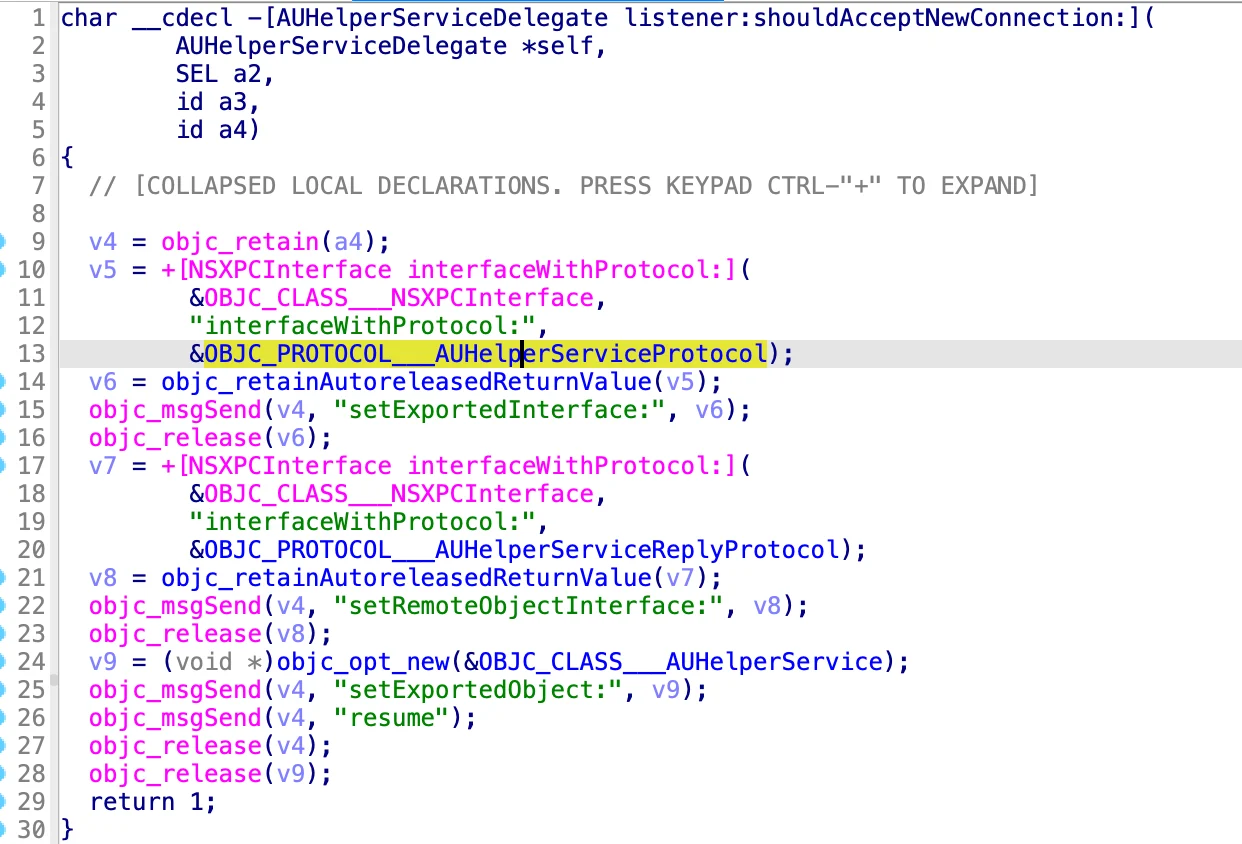
The image shows the delegate method that decides whether an incoming XPC connection is accepted, and the report states that it returns YES for all clients. In other words, there was no check on the connecting client's identity or entitlements at the point of connection.
The service exposes 9 service routines to XPC clients through the protocol AUHelperServiceProtocol:
@protocol AUHelperServiceProtocol
-(void) validateTargetDirectory:(NSURL *)target archiveWrapper:(NSSecurityScopedURLWrapper *)wrapper withReply:(void (^)(NSSecurityScopedURLWrapper *))reply;
-(void) moveWithUniquingFrom:(NSURL *)from into:(NSURL *)into baseName:(NSString *)baseName sourceWrapper:(NSSecurityScopedURLWrapper *)wrapper withReply:(void (^)(NSSecurityScopedURLWrapper *))reply;
...
@end
The protocol listing in the report shows two of the nine routines and elides the rest with .... Both shown routines take NSSecurityScopedURLWrapper objects, which is how sandbox extensions for file access are passed across XPC. Because the service holds FDA and accepts every client, the researcher reasoned that there were several different ways to exploit the issue by requesting different service routines.
Exploitation
Step 1: request validateTargetDirectory:archiveWrapper:withReply:
The first exploit called the method validateTargetDirectory:archiveWrapper:withReply:.
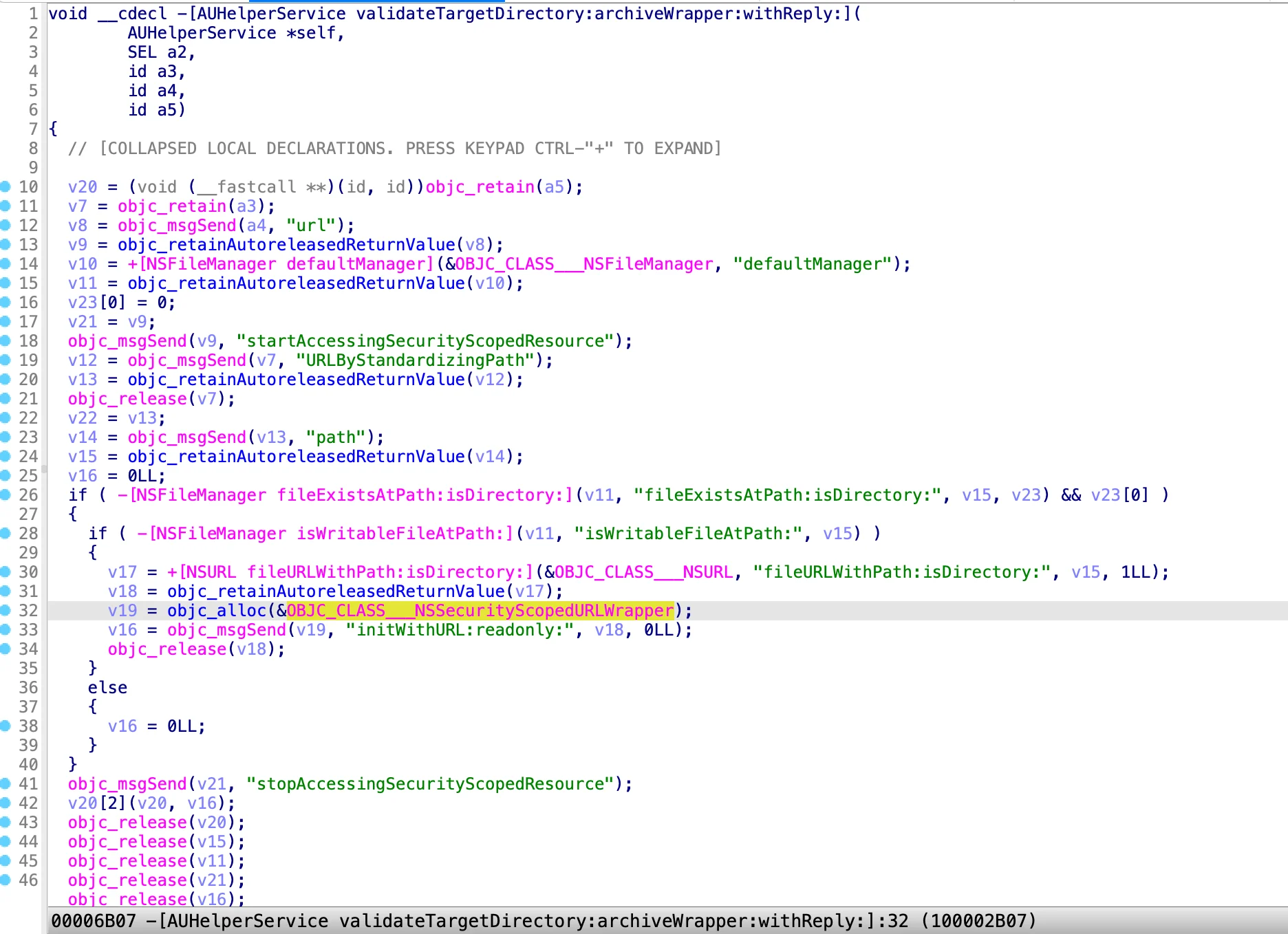
The image is placed at the start of the Exploit 1 section and shows the code for this first approach. The report does not reproduce that code as text, so the exact request is not available here beyond the method name and its signature in the protocol above.
According to the report, this method can be exploited to get read and write permission of an arbitrary path, even if that path is TCC-protected. The report states that this method can be exploited to get read and write permission of an arbitrary path, even a TCC-protected one, but does not describe the mechanism.
There is a limitation, and the researcher states it plainly: the sandbox extension cannot be issued to the user's TCC.db directly. So this first primitive gives read and write access to arbitrary TCC-protected paths, but not to the TCC database itself. To replace the user's TCC.db file, the researcher developed the second exploit.
Step 2: abuse moveWithUniquingFrom:into:baseName:sourceWrapper:withReply:
The second exploit abuses the routine moveWithUniquingFrom:into:baseName:sourceWrapper:withReply:.
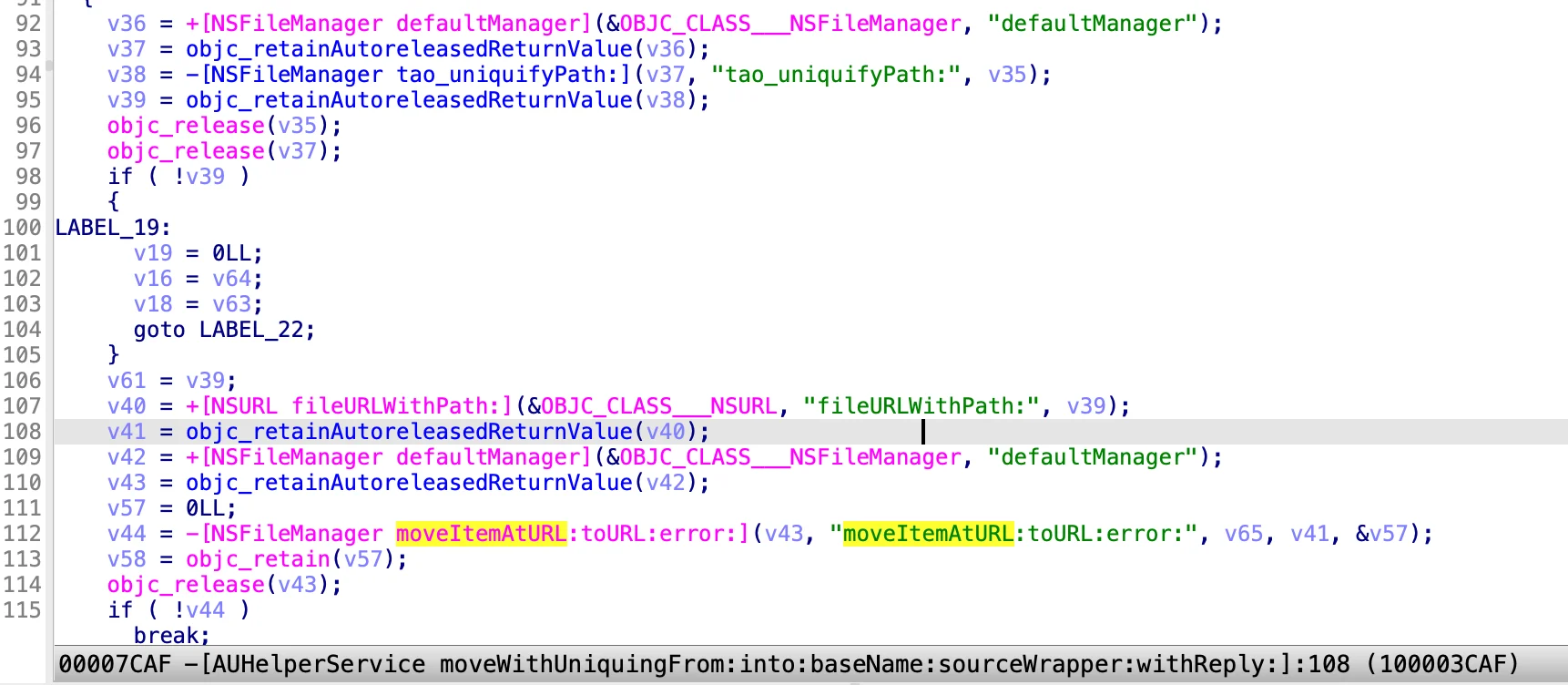
The image sits at the start of the Exploit 2 section and shows the code for the second approach. As with the first exploit, the report does not reproduce the code as text.
Because the service holds FDA, this move routine gives the researcher a primitive to move or replace the TCC.db file. That is the step the first exploit could not achieve: the first gave read and write access to arbitrary protected paths but could not obtain a sandbox extension for TCC.db, while the move routine operates with the service's own FDA permission and can therefore move or replace the database.
The researcher published the exploit for research purposes only at:
https://github.com/jhftss/POC/blob/main/exploit-AUHelperService/exploit.m
Root cause
The design mistake is the combination of two properties in one XPC service. First, the service was granted the FDA entitlement com.apple.private.tcc.allow with kTCCServiceSystemPolicyAllFiles, so every operation it performs runs with Full Disk Access. Second, the service accepted all XPC clients by returning YES in its delegate method, so any local process could connect and call the routines in AUHelperServiceProtocol.
The report states that the validate routine can be exploited to get read and write permission of an arbitrary path, including TCC-protected ones. The move routine went further and, with the service's FDA permission, allowed the TCC.db file to be moved or replaced.
Existing defences did not stop this because the privileged operations were performed by the helper service rather than by the calling process. The privileged operations were performed by the helper service, which accepted every XPC client.
Impact
An attacker who can run code locally on a vulnerable macOS Sonoma beta system can use the service to obtain read and write permission on arbitrary paths, even TCC-protected ones, and can move or replace the user's TCC.db file. The report's title describes it as a full TCC bypass, and the researcher notes that a full TCC bypass like this usually got 30.5k under the bounty programme. and the researcher notes that a full TCC bypass like this usually got 30.5k under the bounty programme.
The report does not enumerate which specific TCC-protected resources an attacker would then reach, nor does it describe persistence or other post-exploitation steps. The conditions are those of the report: the vulnerable service as shipped in the macOS Sonoma beta, with its FDA entitlement and its acceptance of all XPC clients.
Fix
Apple patched the issue immediately before releasing macOS Sonoma. After the patch, the XPC client must have the entitlement com.apple.private.AUHelperService.XPC:
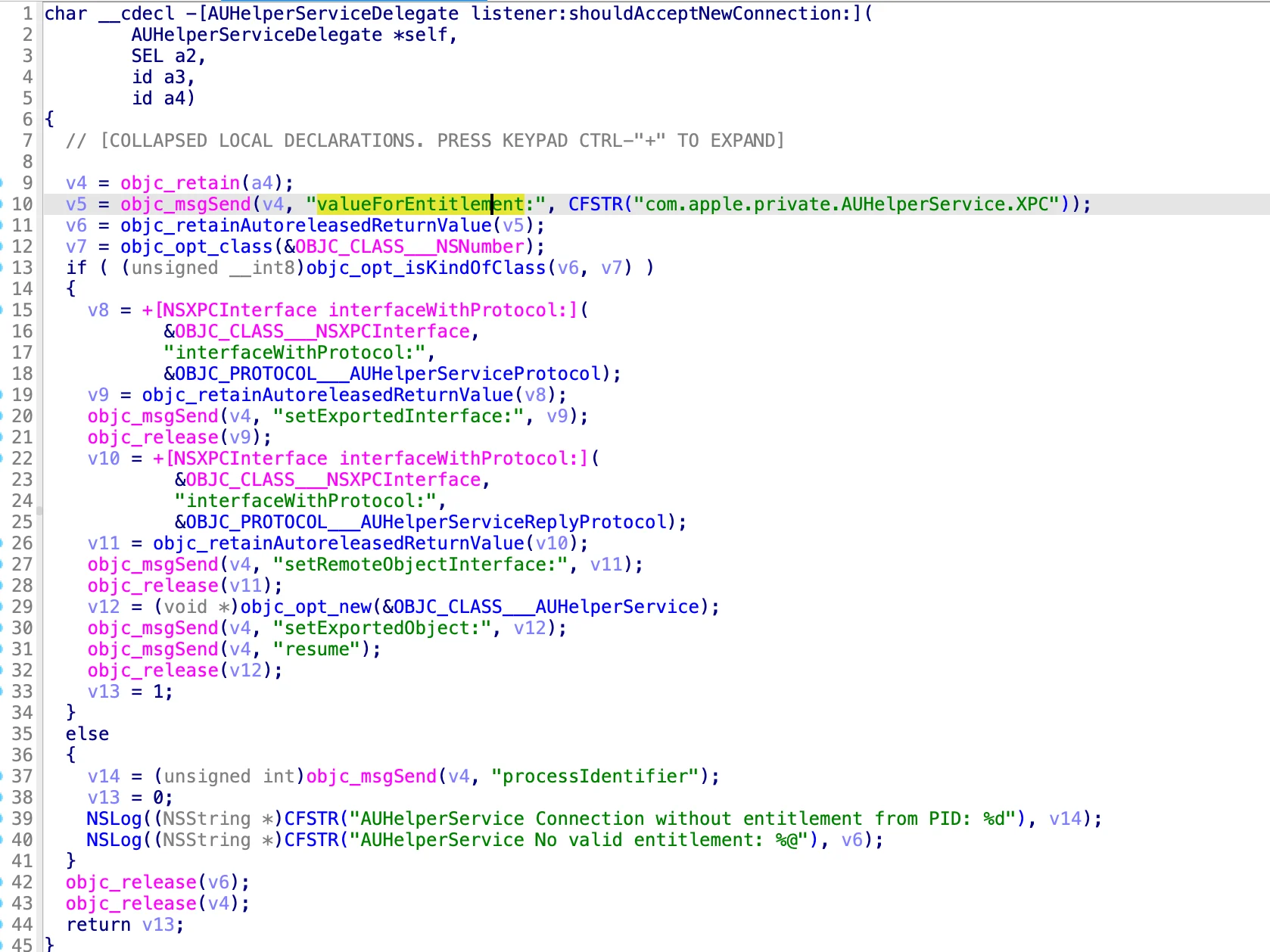
The image shows the entitlement check that now gates access to the service.
Timeline
The report includes the following timeline of the disclosure and bounty process.
| Date | Action |
|---|---|
| 2023-06-06 | Me: Initial report sent to Apple |
| 2023-09-27 | Me: Ask why the report was addressed without assigning a CVE |
| 2023-09-29 | Apple: CVEs are only assigned to software vulnerabilities previously released to production and not to vulnerabilities for beta-only software. |
| 2023-11-10 | Me: Ask for an update for the bounty review process |
| 2023-11-10 | Apple: Still reviewing the report for the Apple Security Bounty program. |
| 2023-12-01 | Me: Ask for an update |
| 2023-12-02 | Apple: Will have an update within a couple weeks. |
| 2024-01-12 | Me: Ask for an update |
| 2024-01-17 | Apple: Appreciate my patience on this report and will follow up… |
| 2024-01-26 | Apple: Award me with 23k for this report |
| 2024-01-26 | Me: Confused with the amount because a full tcc bypass like this usually got 30.5k. I asked for the reason |
| 2024-01-30 | Apple: The amount (23k) included the 50% beta bonus. Also, bounties for reports submitted in the past should not be considered precedent for future bounty awards. Apple technology is constantly changing, and so do the impacts of security bugs. |
Variants to test
These are general directions suggested by the report's findings, not claims about other targets.
- Look for XPC services that hold
com.apple.private.tcc.allowwithkTCCServiceSystemPolicyAllFilesand check whether their delegate accepts all clients. A positive result is a service that returns YES for a connection from an unprivileged process. - Enumerate the routines in such a service's protocol and look for ones that take or return
NSSecurityScopedURLWrapper. A positive result is a routine that returns a wrapper for a path the calling process could not otherwise access. - Look for move, copy or replace routines in FDA-privileged helpers. A positive result is a routine that can move or replace a TCC-protected file such as TCC.db using the service's own permission.
- Check whether the client identity is verified by entitlement, as in the patched
com.apple.private.AUHelperService.XPCcheck, or only by connection acceptance. A positive result is a service where the only gate is the delegate returning YES. - Test whether a sandbox extension can be issued for TCC.db directly through a validation routine. A negative result, as in Exploit 1 here, points to the move routine as the alternative path.
What happened, in plain words
Imagine your computer has a strict security guard. This guard, called TCC, decides which programs are allowed to look at your personal files, like your photos, messages, or the database that remembers all your privacy choices. Normally, the guard only lets a program see those files if you have said yes.
Now imagine a trusted helper program that the guard has given a special all-access pass. This helper is supposed to help with a simple job: unpacking compressed files (like .zip archives). But because it has the all-access pass, it can read and write almost anything on your disk. The problem was that this helper would talk to any other program that asked, without checking who it was. So a malicious program could ask the helper to do things on its behalf, and the helper would use its all-access pass to do them. That let the malicious program read and write files it should never have been able to touch, including the very database that stores your privacy choices. The second exploit gave a primitive to move or replace the TCC.db file.
The researcher, Mickey Jin (@patch1t), found this in a beta version of macOS Sonoma (the next version of Apple's computer operating system). He reported it to Apple, and Apple fixed it before the final release. The report also describes a disagreement about the bug bounty reward.
This article explains the story from scratch, assuming you know nothing about security, and shows the images from the original report.
Background: what is TCC and why does it matter?
TCC stands for Transparency, Consent and Control. It is a security feature in macOS that controls access to sensitive things: your files, your microphone, your camera, your location, and more. When an app wants to use your microphone, for example, TCC shows a pop-up asking for your permission. If you say yes, TCC remembers that choice in a database file called TCC.db. That database is like a ledger of all your privacy decisions.
TCC protects this database fiercely. Only a few system components are allowed to read or write it. The report describes the second exploit as giving a primitive to move or replace the TCC.db file.
One of the permissions TCC manages is called Full Disk Access (FDA). If a program has FDA, it can read and write almost any file on your disk, including files that TCC normally protects. FDA is meant for tools that genuinely need broad access, like backup software or antivirus. In the report, the permission is identified by the name kTCCServiceSystemPolicyAllFiles. That is the internal name for the FDA service.
The vulnerable component: Archive Utility and its helper
macOS comes with a built-in tool called Archive Utility. It is what opens when you double-click a .zip file or a .tar.gz archive. It unpacks the archive so you can use the files inside.
Archive Utility does not do all the work itself. It uses a helper program, a separate process, to handle archives. This helper is an XPC service. XPC is a way for programs on macOS to communicate with each other securely. Think of it like a private messaging system between apps. One program (the client) sends a message to another program (the service), and the service does something and maybe sends a reply.
The helper service in question is located at this path:
/System/Library/CoreServices/Applications/Archive Utility.app/Contents/XPCServices/AUHelperService.xpc
Let's break that down:
/System/Library/CoreServices/Applications/is a folder where Apple stores some built-in applications.Archive Utility.appis the application bundle for Archive Utility.Contents/XPCServices/is a folder inside the app bundle where XPC services are kept.AUHelperService.xpcis the XPC service bundle itself. The.xpcextension indicates it is an XPC service.
So this is a helper service that comes with Archive Utility. The report does not describe exactly which user actions cause Archive Utility to call this helper, but the helper exposes a set of routines (functions) that a client can call.
The two mistakes
The researcher found two problems that, combined, created a serious vulnerability.
Mistake 1: The helper had Full Disk Access
Since the macOS Sonoma beta, the helper service had been given the FDA entitlement. An entitlement is like a permission slip that macOS gives to a program, telling the system what the program is allowed to do. In the service's entitlement list, this appeared as:
	[Key] com.apple.private.tcc.allow
	[Value]
		[Array]
			[String] kTCCServiceSystemPolicyAllFiles
Let's explain this snippet line by line:
[Key] com.apple.private.tcc.allow: This is the name of the entitlement. It is a private Apple entitlement that allows the program to use TCC services. The key is like a label on the permission slip.[Value]: This indicates that the value for that key follows.[Array]: The value is an array, which is a list of items.[String] kTCCServiceSystemPolicyAllFiles: The array contains one string, which is the name of the TCC service being allowed.kTCCServiceSystemPolicyAllFilesis the internal identifier for Full Disk Access.
In plain words: this helper service was granted Full Disk Access. That means anything the helper does on behalf of a client is done with FDA privileges. The helper can read and write files that TCC would normally protect.
Mistake 2: The helper accepted all clients
XPC services can choose which clients they talk to. They do this by implementing a delegate method, which is a function that gets called when a new client tries to connect. The delegate method can return YES (allow) or NO (deny). In the vulnerable version, the helper returned YES for every client, as shown in the image:
The image shows the delegate method that decides whether to accept an incoming XPC connection. According to the report, it returns YES for all clients. That means there was no check on who was connecting. Any program running on the Mac could connect to this helper and call its routines.
The service routines
The helper exposes 9 service routines to clients through a protocol called AUHelperServiceProtocol. A protocol is like a contract that lists the functions a service provides. The report shows two of the nine routines and uses ... to indicate the rest:
@protocol AUHelperServiceProtocol
-(void) validateTargetDirectory:(NSURL *)target archiveWrapper:(NSSecurityScopedURLWrapper *)wrapper withReply:(void (^)(NSSecurityScopedURLWrapper *))reply;
-(void) moveWithUniquingFrom:(NSURL *)from into:(NSURL *)into baseName:(NSString *)baseName sourceWrapper:(NSSecurityScopedURLWrapper *)wrapper withReply:(void (^)(NSSecurityScopedURLWrapper *))reply;
...
@end
Let's explain this code block line by line:
@protocol AUHelperServiceProtocol: This begins the definition of a protocol named AUHelperServiceProtocol. The@symbol is used in Objective-C (the programming language) to denote a compiler directive.-(void) validateTargetDirectory:(NSURL *)target archiveWrapper:(NSSecurityScopedURLWrapper *)wrapper withReply:(void (^)(NSSecurityScopedURLWrapper *))reply;: This declares a method (function) namedvalidateTargetDirectory:archiveWrapper:withReply:. The-means it is an instance method.(void)means it returns nothing. It takes three parameters:targetof typeNSURL *(a pointer to an NSURL object, which represents a web address or file path),wrapperof typeNSSecurityScopedURLWrapper *(a pointer to a security-scoped URL wrapper, which we will explain), andreplywhich is a block (a piece of code) that takes anNSSecurityScopedURLWrapper *and returns nothing. The block is used to send a reply back to the caller.-(void) moveWithUniquingFrom:(NSURL *)from into:(NSURL *)into baseName:(NSString *)baseName sourceWrapper:(NSSecurityScopedURLWrapper *)wrapper withReply:(void (^)(NSSecurityScopedURLWrapper *))reply;: This declares another method namedmoveWithUniquingFrom:into:baseName:sourceWrapper:withReply:. It takes several parameters:from(an NSURL),into(an NSURL),baseName(an NSString, which is a text string),sourceWrapper(an NSSecurityScopedURLWrapper), and areplyblock that takes an NSSecurityScopedURLWrapper and returns nothing....: This indicates that there are more methods in the protocol that are not shown.@end: This ends the protocol definition.
Both shown routines take NSSecurityScopedURLWrapper objects. A security-scoped URL wrapper is a way to pass a file reference along with a permission token (called a sandbox extension) that allows the receiver to access that file. Normally, when an app wants to give another app access to a file, it wraps the file URL in a security-scoped URL and the system grants a temporary extension. In this case, because the helper has FDA, it can create wrappers for any file, even TCC-protected ones.
The researcher reasoned that because the service holds FDA and accepts every client, there are multiple ways to exploit it by calling different routines.
Exploit 1: Using validateTargetDirectory:archiveWrapper:withReply:
The first exploit calls the method validateTargetDirectory:archiveWrapper:withReply:. The image below shows the code for this approach:
The image is placed at the start of the Exploit 1 section and shows the code for the first exploit. The report does not reproduce that code as text, so we cannot show it here. However, the report describes what it does.
According to the report, this method can be exploited to get read and write permission for an arbitrary path, even if that path is TCC-protected. How?
However, there is a limitation: the sandbox extension cannot be issued to the user's TCC.db directly. In other words, this method cannot give access to the TCC database file itself. So the first exploit gives read and write access to arbitrary TCC-protected paths, but not to TCC.db. To replace TCC.db, the researcher needed a different approach.
Exploit 2: Abusing moveWithUniquingFrom:into:baseName:sourceWrapper:withReply:
The second exploit abuses the routine moveWithUniquingFrom:into:baseName:sourceWrapper:withReply:. The image below shows the code for this second approach:
The image sits at the start of the Exploit 2 section and shows the code for the second exploit. Again, the report does not reproduce the code as text.
Because the helper has FDA, this move routine gives the researcher a primitive to move or replace the TCC.db file. A primitive in security means a basic building block that can be used to achieve an effect. Here, the primitive is the ability to move or replace a file with the helper's FDA privileges. That is exactly what the first exploit could not do: the first gave read and write access to arbitrary protected paths but could not obtain a sandbox extension for TCC.db, while the move routine operates with the service's own FDA permission and can therefore move or replace the database.
The researcher published the exploit for research purposes only at:
https://github.com/jhftss/POC/blob/main/exploit-AUHelperService/exploit.m
This is a link to a GitHub repository containing the proof-of-concept code. The report does not include the code itself, only the link.
Root cause
The root cause is the combination of two properties in one XPC service. First, the service was granted the FDA entitlement com.apple.private.tcc.allow with kTCCServiceSystemPolicyAllFiles, so every operation it performs runs with Full Disk Access. Second, the service accepted all XPC clients by returning YES in its delegate method, so any local process could connect and call the routines in AUHelperServiceProtocol.
Because the routines take and return NSSecurityScopedURLWrapper objects, a client could ask the FDA-privileged service to validate a target directory and hand back a wrapper carrying read and write access to an arbitrary path, including TCC-protected ones. The move routine went further and, with the service's FDA permission, allowed the TCC.db file to be moved or replaced. The report does not state which specific check was missing inside each routine beyond the client acceptance behaviour; the connection-level acceptance of all clients is the behaviour the researcher documents.
Existing defences did not stop this because the privileged operations were performed by the helper service rather than by the calling process. The privileged operations were performed by the helper service, which accepted every XPC client.
Impact
An attacker who can run code locally on a vulnerable macOS Sonoma beta system can use the service to obtain read and write permission on arbitrary paths, even TCC-protected ones, and can move or replace the user's TCC.db file. The report's title describes it as a full TCC bypass, and the researcher notes that a full TCC bypass like this usually got 30.5k under the bounty programme. and the researcher notes that a full TCC bypass like this usually got 30.5k under the bounty programme.
The report does not enumerate which specific TCC-protected resources an attacker would then reach, nor does it describe persistence or other post-exploitation steps. The conditions are those of the report: the vulnerable service as shipped in the macOS Sonoma beta, with its FDA entitlement and its acceptance of all XPC clients.
Fix
Apple patched the issue immediately before releasing macOS Sonoma. After the patch, the XPC client must have the entitlement com.apple.private.AUHelperService.XPC:
The image shows the entitlement check that now gates access to the service.
Timeline
The report includes the following timeline of the disclosure and bounty process.
| Date | Action |
|---|---|
| 2023-06-06 | Me: Initial report sent to Apple |
| 2023-09-27 | Me: Ask why the report was addressed without assigning a CVE |
| 2023-09-29 | Apple: CVEs are only assigned to software vulnerabilities previously released to production and not to vulnerabilities for beta-only software. |
| 2023-11-10 | Me: Ask for an update for the bounty review process |
| 2023-11-10 | Apple: Still reviewing the report for the Apple Security Bounty program. |
| 2023-12-01 | Me: Ask for an update |
| 2023-12-02 | Apple: Will have an update within a couple weeks. |
| 2024-01-12 | Me: Ask for an update |
| 2024-01-17 | Apple: Appreciate my patience on this report and will follow up… |
| 2024-01-26 | Apple: Award me with 23k for this report |
| 2024-01-26 | Me: Confused with the amount because a full tcc bypass like this usually got 30.5k. I asked for the reason |
| 2024-01-30 | Apple: The amount (23k) included the 50% beta bonus. Also, bounties for reports submitted in the past should not be considered precedent for future bounty awards. Apple technology is constantly changing, and so do the impacts of security bugs. |
Variants to test
These are general directions suggested by the report's findings, not claims about other targets.
- Look for XPC services that hold
com.apple.private.tcc.allowwithkTCCServiceSystemPolicyAllFilesand check whether their delegate accepts all clients. A positive result is a service that returns YES for a connection from an unprivileged process. - Enumerate the routines in such a service's protocol and look for ones that take or return
NSSecurityScopedURLWrapper. A positive result is a routine that returns a wrapper for a path the calling process could not otherwise access. - Look for move, copy or replace routines in FDA-privileged helpers. A positive result is a routine that can move or replace a TCC-protected file such as TCC.db using the service's own permission.
- Check whether the client identity is verified by entitlement, as in the patched
com.apple.private.AUHelperService.XPCcheck, or only by connection acceptance. A positive result is a service where the only gate is the delegate returning YES. - Test whether a sandbox extension can be issued for TCC.db directly through a validation routine. A negative result, as in Exploit 1 here, points to the move routine as the alternative path.
Glossary
- TCC (Transparency, Consent and Control): A macOS security feature that controls access to sensitive resources like files, microphone, and camera, and records user consent in a database.
- Full Disk Access (FDA): A TCC permission that allows a program to read and write almost any file on the disk, including those normally protected by TCC.
- kTCCServiceSystemPolicyAllFiles: The internal identifier for the Full Disk Access service in TCC.
- XPC service: A way for programs on macOS to communicate with each other via a private messaging system; a service is a program that provides functionality to other programs (clients).
- Entitlement: A permission or capability granted to a program by the operating system, often stored in a signed certificate.
- Delegate method: A function that gets called to make a decision, such as whether to accept a connection.
- Protocol: In programming, a contract that defines a set of methods that a class can implement.
- NSSecurityScopedURLWrapper: An object that wraps a file URL along with a security token (sandbox extension) that grants access to that file.
- Sandbox extension: A token that allows a process to access a file or resource outside its normal sandbox.
- Primitive: A basic building block or capability that can be used to achieve a larger exploit.
- CVE: Common Vulnerabilities and Exposures, a unique identifier for a publicly known security vulnerability.
- Beta software: A pre-release version of software that is still being tested.
- Bug bounty programme: A programme where organisations reward researchers for finding and reporting security vulnerabilities.
- Proof of concept (POC): Code or a demonstration that proves a vulnerability exists and can be exploited.
- Objective-C: A programming language used in macOS and iOS development.
- NSURL: An Objective-C class that represents a URL or file path.
- NSString: An Objective-C class that represents a text string.
- Block: In Objective-C, a block is a piece of code that can be passed around and executed later, similar to a closure or lambda in other languages.
- Array: A data structure that holds a list of items.
- String: A sequence of characters, used to represent text.
- Key: In a dictionary or entitlement list, the name that identifies a value.
- Value: The data associated with a key.
- Local privilege escalation: Gaining higher privileges on a system from a lower-privileged starting point.
- TCC bypass: Circumventing the TCC security controls to access protected resources without user consent.

