Site-wide CSRF at Atavist
The account settings pages lacked CSRF tokens, so an attacker could make a logged-in user change their email address, delete a credit card, or cancel a subscription without the user's consent. The reporter notes the email change uses sequential user IDs, which may make the attack easier to target.

- Fixed in 3 months
- Paid in 3 months
- Disclosed after 3 months
Summary:
Hi team, I have a Atavist Magazine account. And there are no CSRF tokens on account settings.
For example ;
-
When changing email (there is a user ID but they are sequential) :
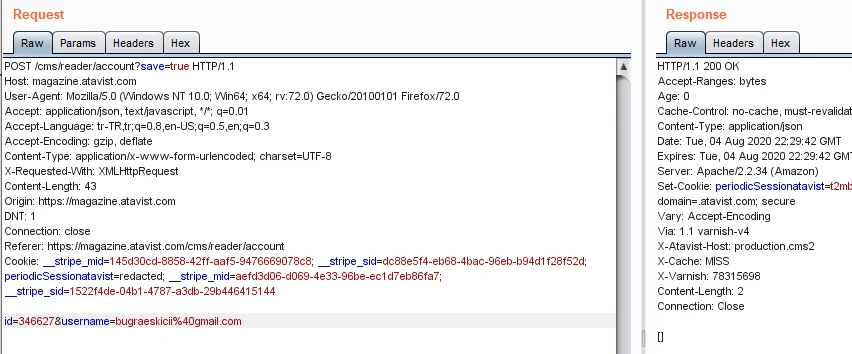
req.PNG From the original on HackerOne -
Deleting credit card :
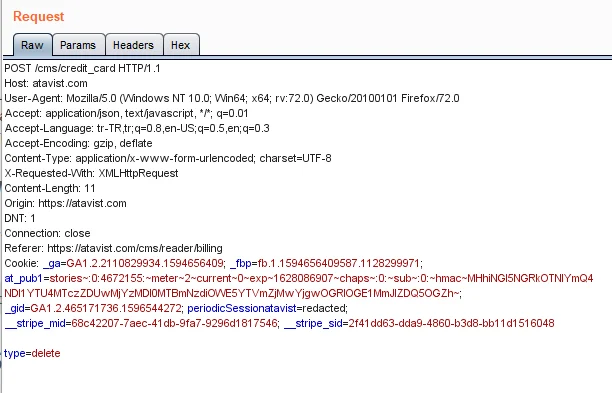
reqcard.PNG From the original on HackerOne -
Cancelling subscription : https://magazine.atavist.com/cms/ajax/cancel_subscription.php?product_id=com.theatavist.atavist.subscription.membership - this endpoint sends an email with
We'll Miss Youtitle, but it doesn't cancel the subscription. (this is not related to CSRF, there is a CSRF but the endpoint is weird :-D)
I didn't want to create report for each endpoint, because this is a site-wide issue. I think you can add a header for root fix.
Impact
Site-wide CSRF
Thanks, Bugra
Not written yet. The AI write-up for this report has not been written yet. The Original tab links to the source.
How it worked
Impact
An attacker could perform site-wide CSRF against logged-in users, potentially changing their email address, deleting a credit card, or cancelling a subscription, though the cancellation endpoint was noted as behaving oddly.
What the attacker needed
Victim is logged in; victim visits attacker-controlled page
The fix
The report suggests adding a header as a root fix, but does not state that a fix was applied.
Explained by bugbounty.wiki with AI from the original and checked against quotes from it; it can still be wrong. Read the original before relying on a detail.
Not written yet. The AI write-up for this report has not been written yet. The Original tab links to the source.
CSRF (cross-site request forgery) is when a malicious website makes your browser send a request to another site where you are already logged in, without you meaning to. Because the account settings pages did not check for a secret token that proves the request came from the real site, an attacker could trick a logged-in user into changing their email, deleting a card, or cancelling a subscription.
What is CSRF?
Another site makes a signed-in user's browser perform an action they did not intend.