How I Manipulated My Rank on the Bugcrowd Platform
 Published on blog.securitybreached.org
In recent years, Bug Bounties have gained significant popularity as a growing number of companies rely on crowdsourcing platforms to identify vulnerabilities within their systems. As such, the security of these platforms has become increasingly critical.
The full write-up lives on its author's site
It belongs to its author, so we link to it rather than copy it. The other two tabs are our own rewrites, checked against it.
Context
Bugcrowd is a crowdsourced security platform: companies run bounty and demo programs, researchers submit reports, and the platform awards points that feed into a public researcher ranking. The ranking is part of the platform's trust signal, both for researchers who want to look credible and for companies deciding who to work with.
The feature at the centre of this write-up is the Bugcrowd API used by company (tracker) accounts to create submissions inside a program. A company account can create a submission and address it to a researcher's email; the researcher then receives a claimable link and, once claimed, the submission is credited with points.
Setup
The researcher needed two accounts on Bugcrowd:
- A Researcher Account, the account whose rank is being manipulated.
- A Company Account (referred to in the article as the Tracker Account), used to create a Demo Program and obtain API credentials.
From the company account, the researcher created a Demo Program and took the API credentials for it. The API token is then used against the Bugcrowd API, following the platform's official documentation for creating a submission.
Finding it
While testing the Bugcrowd platform, the researcher found that reports could be imported through the API and points awarded to himself. These were demo points, and they did not appear on the main public profile page, but they were shown under the points total on the submissions page. That total was then included in the platform's ranking algorithm.
The result was visible directly in the ranking: the researcher reached 10th place on the platform with only 3205 points, while the person who had been ranked 11th had 13789 points. In other words, the ranking was not reflecting the points that the public profile showed, but a total that included demo points the researcher could generate at will.
Exploitation
Step 1: create the two accounts and a demo program
Register a Researcher Account and a Company Account. From the company account, create a Demo Program and retrieve its API credentials.
Step 2: craft the submission request
The researcher followed Bugcrowd's official API documentation for creating a claimable submission and sent the following script:
import requests

headers = {
    'accept': 'application/vnd.bugcrowd+json',
    'authorization': 'Token <ADD-YOUR-API-TOKEN>',
    'content-type': 'application/json',
}

data = '{"submission":{"source":"platform","title":"Security Breached","submitted_at":"2022-06-07T00:00:00.181Z","substate":"resolved","vrt_id":"server_side_injection.remote_code_execution_rce","priority":"1","researcher_email":"[redacted]"}}'

response = requests.post('https://api.bugcrowd.com/bounties/<YOUR-BOUNTY-UUID>/submissions', headers=headers, data=data)

print((response.text))
The important parts:
- The
authorizationheader carries the company account's API token, which is what authorises the creation of a submission in the program identified by<YOUR-BOUNTY-UUID>. - The
acceptheader selects the Bugcrowd JSON media type, andcontent-typedeclares the body as JSON. - In the body,
sourceis set toplatform,substatetoresolved, andpriorityto1, so the submission is created in a finished, high-priority state rather than as an open report. vrt_idselects a vulnerability rating taxonomy entry, hereserver_side_injection.remote_code_execution_rce.researcher_emailis the key field for the abuse: it addresses the submission to the researcher's own account, which is what makes it claimable by that account.
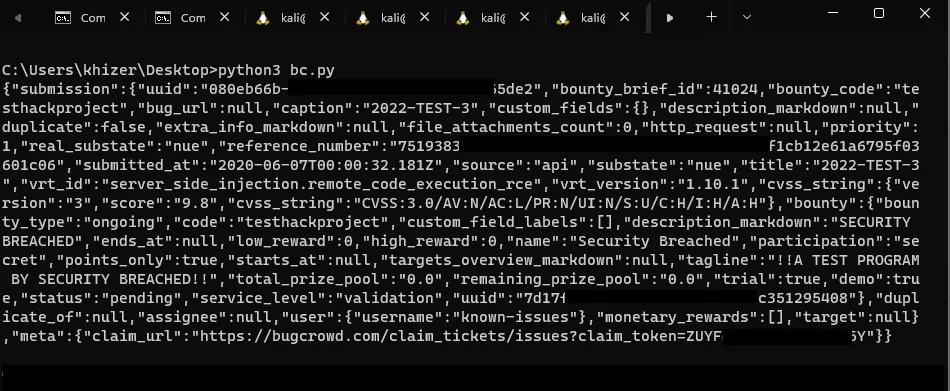
The screenshot accompanies the crafted API request.
Step 3: claim the submission and collect points
When the request succeeds, the researcher receives an email containing a claimable link for the submission. Claiming it credits the researcher account with demo points, which appear in the sidebar of the submissions page.
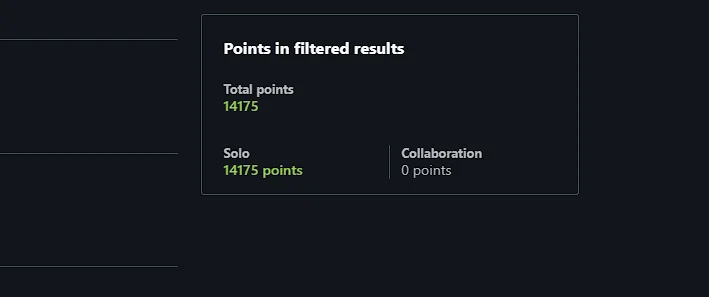
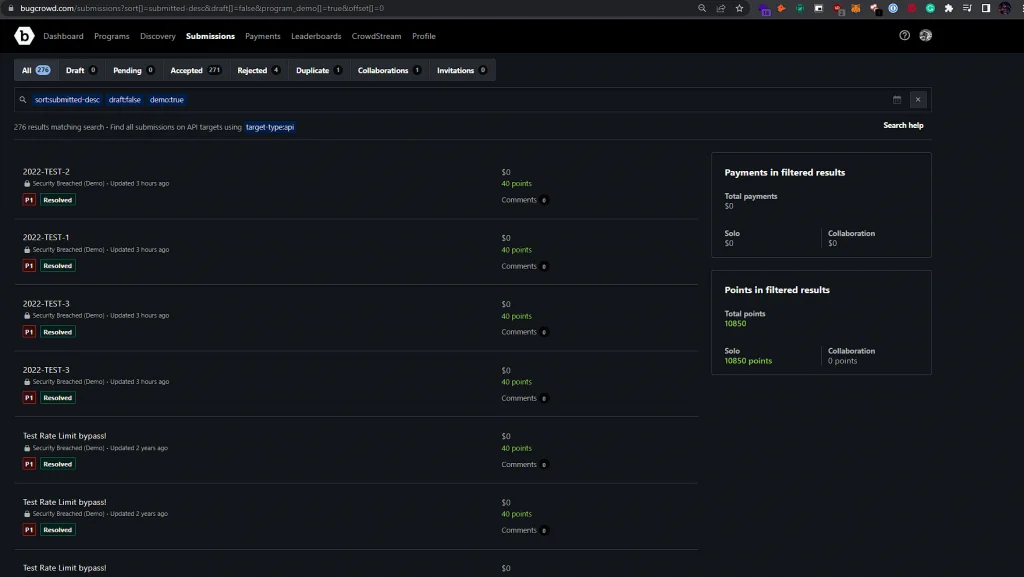
The two screenshots accompany the claim and points steps.
Step 4: repeat until the rank moves
Repeating the request builds up demo points. Once enough had accumulated, the change in rank became visible. For example, @MorningStar on Bugcrowd was ranked 10th, and as the researcher pushed his rank above that position, @MorningStar was pushed down to 11th.
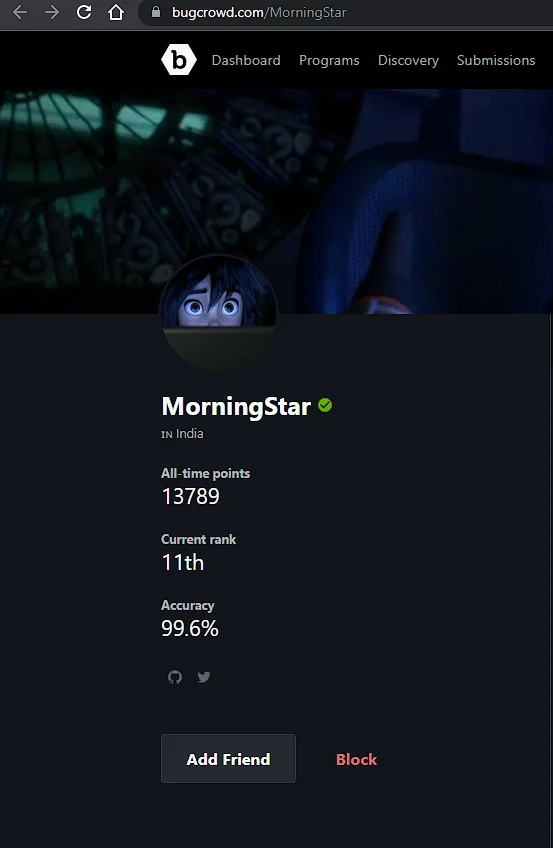
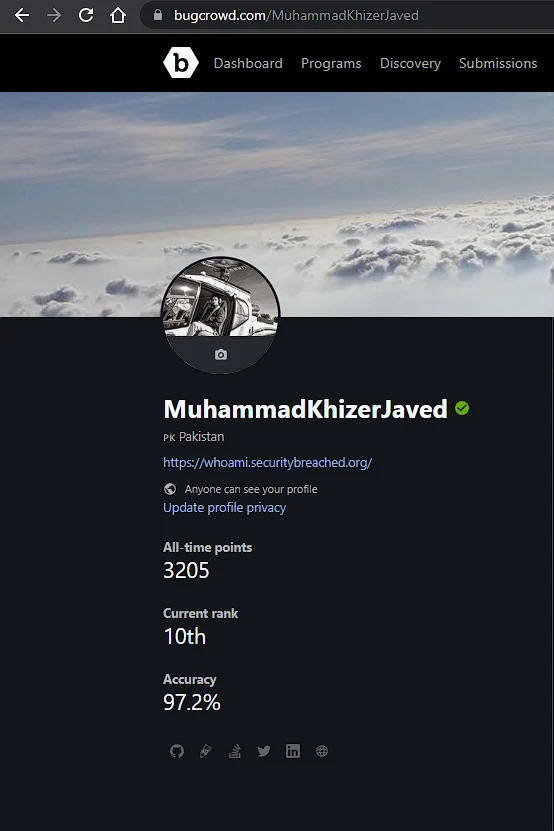
The screenshots relate to the rank change described above.
Root cause
Demo points generated through a demo program were included in the points total used by the ranking algorithm. The demo points were excluded from the public profile page but not from the points total on the submissions page, and that total is what the ranking consumed. The researcher could create submissions addressed to himself, claim them, and add demo points.
The request followed Bugcrowd's official documentation for creating a claimable submission. The article does not describe the server-side implementation or the fix. The article does not describe the server-side implementation, so the exact place where the filtering should have happened is not stated.
Impact
The impact was on the business side of Bugcrowd and others affiliated with it, because ranking is part of the platform's trust in other users and businesses. An attacker able to increase and modify data points could affect the platform ranking and potentially gain indirect financial benefits, for example by showing a fake rank on public platforms. That could lead to reputational damage for the business and a loss of trust among customers, and to financial losses.
The researcher notes that the demo points did not reflect on the main profile public page; the manipulation was visible in the points total on the submissions page and in the ranking derived from it.
Fix
The article does not describe the change that was made.
Variants to test
- Point sources that are not the public profile: on any platform with a ranking or reputation score, compare the total shown on internal pages with the total shown publicly, and check which one the ranking uses. A positive result is a score component that can be generated by the user and that moves the rank.
- Self-addressed submissions: where a company or program role can create a submission for a researcher email, try addressing it to an account you control. A positive result is a claimable submission that credits your own account.
- State fields in creation requests: try setting fields such as
substateto a resolved value andpriorityto a high value at creation time, as in the request above. A positive result is a submission accepted already resolved. - Demo or sandbox programs: check whether points from demo programs, test programs or sandbox environments are excluded from reputation, leaderboards or payout eligibility. A positive result is demo activity that changes a production ranking.
- Duplicate creation at scale: repeat a successful creation request and observe whether points accumulate without limits or review. A positive result is a rank change that outpaces accounts with far more points, as happened here with 3205 points against 13789.
What happened, in plain words
Bugcrowd is a website where security researchers and companies meet. Companies put their software on the platform and invite researchers to look for security problems in it. When a researcher finds something and reports it, the platform gives them points. Those points add up to a public ranking, a leaderboard of researchers. A high rank makes a researcher look credible, and companies use that rank when deciding who to trust with their systems.
He did it by using a feature meant for companies: the ability to create a report inside a program and address it to a researcher's email address. He then claimed those reports and collected the points.
With only 3205 points he reached 10th place on the platform. The person who had been ranked 11th had 13789 points.
This matters because a ranking is a trust signal. If someone can fake their position, they can present themselves as more experienced than they are, which can damage the platform's reputation and the trust of its customers, and can lead to financial losses.
Background: the pieces involved
Before the steps, here are the pieces you need to understand.
The platform and its ranking. Bugcrowd runs bounty programs and demo programs. Researchers submit reports, and the platform awards points. The points feed a ranking. The ranking is part of the platform's trust signal, both for researchers who want to look credible and for companies deciding who to work with.
The API. An API is a way for one program to ask another program to do something, without a human clicking buttons in a browser. Think of it as a waiter: you tell the waiter what you want, the waiter takes your order to the kitchen, and brings back the result. Here, the "order" is a request to create a submission, and the "kitchen" is Bugcrowd's servers.
The API token. To use the API you need to prove who you are. A token is a long secret string, like a password that a program sends with every request. If someone else gets your token, they can act as you. In the code below the token is replaced with a placeholder, <ADD-YOUR-API-TOKEN>, because it is a secret.
The company (tracker) account. Companies on Bugcrowd have their own account type. A company account can create programs and create submissions inside them. The researcher needed one of these because the feature he abused belongs to the company side.
The researcher account. This is the account whose rank is being manipulated. It is the account that receives the claimable submission and the points.
The demo program. A demo program is a practice program. Points earned through it are demo points, not real ones. The researcher's whole trick relies on the fact that demo points were counted by the ranking even though they should not have been.
The claimable submission. When a company creates a submission and addresses it to a researcher's email, the researcher gets an email with a link. Clicking the link claims the submission, and the submission is then credited with points. The researcher abused the claimable submission feature by addressing submissions to himself. The researcher abused it by addressing submissions to himself.
Setup: two accounts and a demo program
The researcher needed two accounts on Bugcrowd:
- A Researcher Account, the account whose rank is being manipulated.
- A Company Account (called the Tracker Account in the article), used to create a Demo Program and obtain API credentials.
From the company account, he created a Demo Program and took the API credentials for it. Those credentials are what let a program talk to Bugcrowd's API on behalf of the company account. He then followed Bugcrowd's official documentation for creating a submission.
Why two accounts? Because the feature that creates a submission belongs to the company side, while the points land on the researcher side. One person controlled both the company side and the researcher side.
Finding it
While testing the Bugcrowd platform, the researcher found that reports could be imported through the API and points awarded to himself. These were demo points. They did not appear on the main public profile page, but they were shown under the points total on the submissions page. That total was then included in the platform's ranking algorithm.
The result was visible directly in the ranking: the researcher reached 10th place with only 3205 points, while the person who had been ranked 11th had 13789 points. In other words, the ranking was not reflecting the points the public profile showed, but a total that included demo points the researcher could generate at will.
Exploitation
Step 1: create the two accounts and a demo program
Register a Researcher Account and a Company Account. From the company account, create a Demo Program and retrieve its API credentials.
This step is preparation. The company account is the key that opens the door to the submission-creation feature, and the demo program is the container the submissions will live in. The API credentials are the token that proves the requests come from that company account.
Step 2: craft the submission request
The researcher followed Bugcrowd's official API documentation for creating a claimable submission and sent the following script:
import requests

headers = {
    'accept': 'application/vnd.bugcrowd+json',
    'authorization': 'Token <ADD-YOUR-API-TOKEN>',
    'content-type': 'application/json',
}

data = '{"submission":{"source":"platform","title":"Security Breached","submitted_at":"2022-06-07T00:00:00.181Z","substate":"resolved","vrt_id":"server_side_injection.remote_code_execution_rce","priority":"1","researcher_email":"[redacted]"}}'

response = requests.post('https://api.bugcrowd.com/bounties/<YOUR-BOUNTY-UUID>/submissions', headers=headers, data=data)

print((response.text))
Line by line, in plain words:
import requestsloads a Python library calledrequests. Python is a programming language, and this library is a ready-made tool for sending web requests from a script instead of a browser.headers = { ... }builds a set of headers. Headers are extra pieces of information sent along with a request, like the label on a parcel that tells the post office what is inside and who sent it.'accept': 'application/vnd.bugcrowd+json'tells the server which format the script expects back. Here it asks for Bugcrowd's JSON format. JSON is a common text format for structured data, like a very strict shopping list.'authorization': 'Token <ADD-YOUR-API-TOKEN>'is the proof of identity. The wordTokenfollowed by the secret string tells Bugcrowd which company account is making the request. The placeholder is where the real token goes, and it is kept secret for the same reason you keep a password secret.'content-type': 'application/json'tells the server that the body of the request is written in JSON, so the server knows how to read it.data = '...'is the body of the request, the actual order being placed. It is one long JSON string. Inside it:"submission"is the object being created."source":"platform"says the submission came from the platform itself."title":"Security Breached"is the title of the report."submitted_at":"2022-06-07T00:00:00.181Z"is the date and time the submission is recorded as having been submitted."substate":"resolved"sets the state of the submission to resolved, meaning finished, rather than open."vrt_id":"server_side_injection.remote_code_execution_rce"picks an entry from the vulnerability rating taxonomy, a catalogue of vulnerability types. This one is remote code execution, a serious class of bug where an attacker can run their own code on a server."priority":"1"sets the priority to the highest value."researcher_email":"[redacted]"is the key field. It addresses the submission to the researcher's own account, which is what makes it claimable by that account.
response = requests.post('https://api.bugcrowd.com/bounties/<YOUR-BOUNTY-UUID>/submissions', headers=headers, data=data)sends the request.requests.postmeans "create something new". The URL points at the submissions collection of a specific bounty program, identified by<YOUR-BOUNTY-UUID>. A UUID is a long unique identifier, like a serial number for that program. The headers and the body are attached to the request.print((response.text))prints whatever the server sent back, so the researcher can see whether the request worked.
Why these values? The submission is created already in a finished, high-priority state rather than as an open report. That means it does not sit in a queue waiting for review. And because it is addressed to the researcher's own email, the researcher is the one who can claim it.
The screenshot accompanies the crafted API request.
Step 3: claim the submission and collect points
When the request succeeds, the researcher receives an email containing a claimable link for the submission. Claiming it credits the researcher account with demo points, which appear in the sidebar of the submissions page.
The two screenshots accompany the claim and points steps.
This is the moment the trick pays off. The company account created the submission, the researcher account claimed it, and the points landed on the researcher account. Nothing in this flow required the researcher to have actually found a bug.
Step 4: repeat until the rank moves
Repeating the request builds up demo points. Once enough had accumulated, the change in rank became visible. For example, @MorningStar on Bugcrowd was ranked 10th, and as the researcher pushed his rank above that position, @MorningStar was pushed down to 11th.
The screenshots relate to the rank change described above.
This shows a researcher being pushed down by someone who had generated points for himself.
Why it worked
Demo points generated through a demo program were included in the points total used by the ranking algorithm. The demo points were excluded from the public profile page but not from the points total on the submissions page, and that total is what the ranking consumed. The researcher could create submissions addressed to himself, claim them, and add demo points.
The request followed Bugcrowd's official documentation for creating a claimable submission. The article does not describe the server-side implementation or the fix. The article does not describe the server-side implementation, so the exact place where the filtering should have happened is not stated.
If a student can award themselves tidying points, they can win the prize without doing better in exams. The public report card looks normal, but the prize is wrong.
Impact
Fix
The article does not describe the change that was made.
Variants to test
If you want to look for similar problems on other platforms, here are starting points. Each one is a question you can ask about a platform you use.
- Point sources that are not the public profile: on any platform with a ranking or reputation score, compare the total shown on internal pages with the total shown publicly, and check which one the ranking uses. A positive result is a score component that can be generated by the user and that moves the rank.
- Self-addressed submissions: where a company or program role can create a submission for a researcher email, try addressing it to an account you control. A positive result is a claimable submission that credits your own account.
- State fields in creation requests: try setting fields such as
substateto a resolved value andpriorityto a high value at creation time, as in the request above. A positive result is a submission accepted already resolved. - Demo or sandbox programs: check whether points from demo programs, test programs or sandbox environments are excluded from reputation, leaderboards or payout eligibility. A positive result is demo activity that changes a production ranking.
- Duplicate creation at scale: repeat a successful creation request and observe whether points accumulate without limits or review. A positive result is a rank change that outpaces accounts with far more points, as happened here with 3205 points against 13789.
Glossary
- Demo points: points earned through a demo program, shown under the points total on the submissions page.
- Demo program: a program on Bugcrowd used in this report to generate demo points.
- Priority: a field on a submission indicating how urgent it is; the request above sets it to
1.